Pages

Powered by Blogger.
Showing posts with label Alfred Hitchcock. Show all posts

The Girl

Wednesday, January 2, 2013


Alfred Hitchcock has long been my favourite director, so it goes without saying that The Girl is a much anticipated BBC film. Aired recently on BBC, and available on DVD from 7th January, the film looks at the turbulent relationship between one of the most admired directors of cinema, Alfred Hitchcock, and his blonde muse, Tippi Hedren.

Starring Sienna Miller in the pivotal role and Toby Jones as Hitchcock, The Girl follows the relationship between the two characters during the production of The Birds and Marnie, and is an in-depth study into the psyche of Hitchcock. While Toby Jones is spot on in capturing the slow and deep vocal trademark of Hitchcock, it is Sienna Miller who shines as the tormented actress stuck in a dilemma of either giving herself to the director's sexual fantasies or leaving a career defining role in the most talked about films of the time.       

As much as The Girl is about the two films that Hitchcock made with Tippi Hedren, the film in reality presents a much more sinister side of Hitchcock, one that may or may not be known to the audience. It is the possessive and obsessive nature of the director towards the actress that transforms him into a psychotic, sadistic, sexual deviant that truly shocks. The film also explores the insecurities that Hitchcock had about his looks and weight and that how even though he was the most sort-after director, he still had issues that were eating him away from the inside.

More than anything else, The Girl is about the strength of a woman to defy an industry and its norms and to stand up for herself; as Tippi did by first completing the two movies she was in, even though Hitchcock continued to coax her into letting him have his way with her, and then by refusing to work with Hitchcock after Marnie. 

The Girl takes the audience behind the scenes of two of the greatest movies ever made by one of cinemas most eccentric director. In doing so, it presents the dark side of movie making and a relationship that tests the boundaries of not only the two people involved, but everyone who is connected to them.

Rating 3.5/5

DVD Information:
Release Date:       7 January 2013
Running Time:       87 Minutes
Language:             English
Certificate:          15 

HITCHCOCK

Saturday, November 24, 2012

HITCHCOCK
Written by John J. McLaughlin
Directed by Sasha Gervasi
Starring Anthony Hopkins, Helen Mirren and Scarlett Johansson

Alfred Hitchcock: You may call me Hitch; hold the cock.

If you’re going to make a movie about one of the greatest filmmakers of all time, your movie had better be good. To put it plainly, Alfred Hitchcock is simply one of the best and most famous film directors in history. And PSYCHO is arguably his most notorious film. It is an unfortunate shame, to say the least, that both the man himself, and this brilliant film, have been over simplified and stripped of all actual suspense and drama for the attempted biopic, HITCHCOCK. It is even more regrettable I’m afraid, to see two winning performances buried in such a middling movie.

HITCHCOCK adapts the modern style of biography filmmaking, choosing to focus on one particular period in the man’s life instead of a more strict adherence to portraying his life from birth to death. This approach worked quite well in films like CAPOTE and MY WEEK WITH MARILYN because, even though we only got a glimpse at their lives, we still got a grander sense of who they were and how they became these people. Screenwriter, John J. McLaughlin (BLACK SWAN), chooses to focus all of his attention on the period where Hitchcock made PSYCHO, but it seems to me it could have been any movie really. After all, all he did was take all these popular ideas of who Hitchcock was as a person, from his obsession with blondes to his overeating to his control issues, and plop them into the behind the scenes of PSYCHO. A setting should have a purpose; this slice of his life should have been so particularly telling that it would also inform on what came before and where the man would go after. Instead, we get in and out of Hitchcock’s life without getting to know very much about him at all.


HITCHCOCK is far from disastrous but it just feels so slight and unfocused, which may be the inexperience of the film's director, Sasha Gervasi. In fact, the only true anchors the film has are its two lead stars, Anthony Hopkins and Helen Mirren, as Mr. and Mrs. Alfred Hitchcock. Neither is given very much to work with but they make the most of it every moment they’re on screen. Hopkins takes the caricature he was given on the page and gives us an eye into the man’s soul. This is even more impressive given the size of the fat suit he’s got on. His Hitchcock is anxious, worried, unsure but also passionate and determined. His scenes with Mirren are what brings the film to life. They are a feisty pair and their chemistry truly feels like that of a dedicated, married couple, who have been together for ages. Together, Hopkins and Mirren make HITCHCOCK worth watching.

In conclusion and further to my first point, if you’re going to make a movie about Hitchcock, it should be a film that Hitchcock himself would be proud of. I’m not so sure he would have been able to sit through this one.


263. Marnie

Thursday, November 8, 2012

263. (04 Nov) Marnie (1964, Alfred Hitchcock) 71


Hitchcock makes his outlandish soap opera as technically proficient, entertaining and moving as is possible. However, Marnie seems quite haphazard when you consider the careful, near-perfect structure of The Birds. It's certainly self-aware, making playful use of the medium, but the sinister tone never quites rings completely true. Still, I'll never look at the color red the same way again.

Blu-ray Review: STRANGERS ON A TRAIN

Monday, November 5, 2012

STRANGERS ON A TRAIN
Written by Raymond Chandler and Czenzi Ormonde
Directed by Alfred Hitchcock
Starring Farley Granger, Ruth Roman and Robert Walker

Bruce Anthony: I admire people who do things.

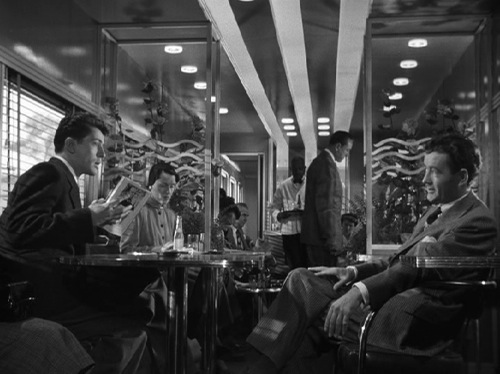
This is why people avoid making eye contact on the subway today. In Alfred Hitchcock’s STRANGERS ON A TRAIN (1951), two men accidentally bump each other’s feet sitting across from each other on a train, and embark on a conversation that will change their lives. Naturally, they don’t know this at the time. Well, one of them almost certainly doesn’t and it isn’t ever quite clear what the other gentleman is thinking, but that’s the genius of Hitchcock. You can never truly relax into what you think you know because you’ll likely be proven wrong about that before very long.

Based on Patricia Highsmith’s first novel, STRANGERS ON A TRAIN, is a truly disturbing thriller. Two total strangers (Robert Walker and Farley Granger) meet on a train and before they’re done lunch, one of them suggests that each of them commit a murder for the other, to avoid connection to the crime. It may not be your typical train chat but if you can surrender to the idea, and it’s actually quite easy to do so thanks to the colorful performances of Walker and Granger, then you are in for a twisted ride. Walker in particular is especially devious, seamlessly weaving homoerotic subtext and waves of daddy issues into his chilling portrayal.


STRANGERS ON A TRAIN, one of the greatest thrillers of all time according to the American Film Institute, is stunning in its first Blu-ray release. The Oscar-nominated black and white cinematography is particularly impressive, whether you’re admiring the grandness of a championship tennis match or cowering at the climactic merry-go-round sequence. This latest release also contains an earlier version and a commentary track for the final version that consists occasionally of a stretched inclusion but is mostly insight into the mind of the master. This is easily one of Hitchcock’s best and a must for any collection.


252. The Birds

Sunday, October 28, 2012

252. (23 Oct) /The Birds/ (1963, Alfred Hitchcock)* 84

DIAL M FOR MURDER

Friday, October 26, 2012

DIAL M FOR MURDER
Written by Frederick Knott
Directed by Alfred Hitchcock
Starring Ray Milland, Grace Kelly and Robert Cummings

Margot Wendice: Do you really believe in the perfect murder?
Mark Halliday: Yes, absolutely. On paper, that is. And I think I could plan one out better than most people, but I doubt I could carry it out.
Tony Wendice: Oh? Why not?
Mark Halliday: Well, because in stories things usually turn out the way the author wants them to, and in real life they don’t ... always.

Everyone is always so polite in old movies. Amazingly enough, this is even true when they are lying right to your face or say, plotting your demise to collect your fortune. This is what makes Alfred Hitchcock’s DIAL M FOR MURDER so deliciously devious. The characters on screen have no idea what is going on in the minds of the people standing right in front of them, while we the audience, just watch and wait to see what they can all get away with and for just how long they can do so. And Hitchcock, being the genius that he is, makes us privy to everyone’s dirty little secrets and before we know it, we are practically complicit in the crime itself.

Frederick Knott adapts his own stage play for the screen and Hitchcock takes the dialogue heavy, location light work and transforms it into an incredibly tense experience that constantly keeps the audience guessing. The whole ordeal begins with Mark and Margot (Robert Cummings and Grace Kelly), lovers reunited after a lengthy time apart. She reveals to him that her husband has changed recently, as though he is a new man with a new appreciation for life and for her. This puts a bit of a wrench in their plans to be together. She needn’t have worried though. Her husband, Tony (Ray Milland), hasn’t warmed to her at all. In fact, he plans to do away with her and have his way with her money. And he’s got the whole thing figured out too, every tiny little detail. There’s just one thing he hasn’t considered and that is that life rarely lets everything go according to plan just so.


Hitchcock originally shot DIAL M FOR MURDER in 3D, which would explain all the objects carefully placed in the foreground scattered throughout the film. By the time the film was released in theatres though, audiences had already tired of the fad and so it was mostly released in 2D. Now that 3D has returned to favour, the film has been rereleased in its original incarnation in select theatres and on Blu-ray 3D. It is a genuine treat to gain insight into how a movie making master dealt with the third dimension way back in the day. His usage is unobtrusive, and arguably unnecessary, but it never detracts from the brilliance taking place on screen. DIAL M FOR MURDER is duplicitous and deceitful and simply a delight for fans of murder and mayhem.


109. Strangers on a Train

Sunday, May 13, 2012

109. (13 May) /Strangers on a Train/ (1951, Alfred Hitchcock)* 79


Deadly Obsession: Alfred Hitchcock's Vertigo

Monday, January 9, 2012

****
Country: US
Director: Alfred Hitchcock


What's that old Oscar Wilde thing? "Each man kills the thing he loves . . ." That I think is a very natural phenomenon, really.
—Alfred Hitchcock, in a 1963 interview


In his fifty-five year long career in films, Alfred Hitchcock directed sixty-seven movies. At least a dozen of these are bona fide masterpieces, and about an equal number are excellent movies that fall just short of the masterpiece mark. By any measure that's an impressive record, one unequaled by any other filmmaker I can think of. Even more impressive is that Hitchcock's pictures are not rarefied works of art of interest mainly to aesthetes and film scholars, but full-blooded movies that appeal equally to ordinary filmgoers looking for accomplished entertainments and to cinephiles looking for an intellectually and artistically stimulating film-viewing experience. Of all Hitchcock's pictures, none managed to combine these two modes—entertainment and art—so skillfully, so intriguingly, and so pleasingly as his 1958 film Vertigo.

Most people are familiar with the plot of Vertigo. A retired San Francisco police detective, John "Scottie" Ferguson (James Stewart), psychologically traumatized after a rooftop chase to apprehend a criminal ends badly, is targeted as a dupe by his old college friend Gavin Elster, who exploits Scottie's crippling fear of heights to bring off an intricate scheme to murder his wife Madeleine (Kim Novak). The film's plot is a clever one and since this is a mystery thriller with hints of the supernatural (can Madeleine really be the reincarnation of her ancestor, as she believes?), neither the audience nor Scottie realizes what is really happening until quite far into the film. This allows the viewer's understanding of the situation to be manipulated, just as Scottie's is, to create a mood of suspense and, after the truth is revealed to the viewer about three-quarters of the way through the film, for that suspense to be prolonged as the film proceeds in a completely unexpected direction right up to its shock ending.

Such a narrative strategy requires that the viewer's reactions be precisely guided at every turn, and nobody was more expert at this than Hitchcock. Well known for his need for absolute control over all aspects of his films from conception to release, Hitchcock was by temperament the epitome of the film auteur, the director who puts his stamp on every element of his work. The way he accomplished this was by meticulous attention to detail. Because each shot was storyboarded in advance, the final film essentially needed no editing and thus was immune to tampering with by producers and studio executives. Like most filmmakers who began by directing silents, Hitchcock viewed cinema storytelling as essentially a visual process, with dialogue, music, and sound used to augment the film's imagery. Because the way he chose to show the action—placement and movement of the camera, the use of visual effects that form his famous set pieces, the exact way images succeed one another to form a spatial and narrative continuum—was the product of his own imagination, his films always seem expressions of a personal and very distinctive vision. Many directors have made movies in the Hitchcock style, but I can't think of a single one of those films that on close viewing could actually be mistaken for the work of the master himself.

Because of the convoluted and deceptive nature of its plot, Vertigo is even more dependent on Hitchcock's almost obsessive attention to detail as a means of controlling audience response than any other film he made. But in Vertigo he uses his working methods as much more than merely a practical means of telling a story in his own way. He amplifies his control-freak approach to directing until it becomes an all-encompassing aesthetic used to suggest a great deal more than is apparent in what at first seems little more than a deftly contrived suspense melodrama. It is this effect of using every device in his vast repertoire of cinematic tricks to evince the complex psychological and thematic undertones of the film that makes Vertigo Hitchcock's greatest achievement. It's a haunting film that can be watched again and again and still continue to entertain and thrill and deliver new revelations.

Perhaps the most powerful and resonant thing about the film is the way Hitchcock uses repetition to emphasize the idea of doubling. Elements in the first part of the film recur later in the film, and elements in the later part of the film mirror those in the first part, giving the film a strange pattern of symmetrical associations. Scottie seeks out places where he saw Madeleine in the beginning of the film and revisits them later in the film: the missions, the florist's shop, the museum, Ernie's restaurant. He watches Judy at her hotel window the same way he watched Madeleine at her hotel window earlier. His transformation of Judy into Madeleine exactly duplicates Elster's transformation of Judy to pass her off as his wife.

Near the end of the picture Hitchcock expresses the complete fusion of Madeleine and Judy, of past and present, of Scottie's memories and his dreams, in the most striking of several memorable set pieces in the film—a long, passionate kiss between Scottie and Judy after he sees her for the first time as the fully re-created Madeleine. The camera swirls, Scottie and Judy swirl, and the room appears to revolve around them. The background fades from Judy's room to the stable where Scottie and Madeleine kissed for the last time and finally back to Judy's room again, while Bernard Herrmann's glorious music—clearly inspired by Wagner's Tristan und Isolde—surges and pulses in unison with the intense emotions of the passage. It's the most rapturously erotic scene in a Hitchcock movie since the kiss in Notorious.

Hitchcock was famous for his lack of interest in the acting of his performers, and for saying that actors should be treated like cattle, that is, prodded into doing what he needed for the shot he was working on. This was perhaps a holdover from his silent days, when facial expressions, body language, and movement were more important than character development and line delivery because the director essentially created the performance visually, through the staging and editing of the film. This is one reason experienced theater actors often found working with Hitchcock such a frustrating experience. Yet for all this, in Vertigo he gets two remarkable performances from his stars.

It is well documented that Kim Novak was not Hitchcock's first choice to play Madeleine/Judy; Vera Miles was. But by the time he was ready to begin shooting, Miles was pregnant and so somebody else had to be cast. I have no idea how he hit on the idea of casting Kim Novak, but I did notice that just as Elster and Scottie transform Judy into the image of Madeleine, Hitchcock almost seems to transform Kim Novak into an uncanny image of Grace Kelly, right down to her hair and makeup, and her accent and diction. I can't help wondering if one of the reasons Vertigo seems to be Hitchcock's most personal film is his own understanding of the compulsion behind Scottie's Pygmalion-like behavior.

In any event, Novak, who under the right conditions could be a much better actress than she is generally given credit for, does a tremendous job as the mysterious, spaced-out Madeleine. But her more demanding incarnation as Judy is even more impressive. If Madeleine is an enigma, Judy is a fully defined character. Hitchcock and his writer, Samuel Taylor, make a daring narrative decision that happens soon after Scottie meets Judy. The conventional thing to do would have been to conceal the truth about the murder plot from the audience until the end then reveal it to the viewer and Scottie at the same time, in the kind of twist ending typical of films of this kind. Instead Hitchcock and Taylor devise a situation in which Judy writes a letter to Scottie explaining everything to him then impetuously tears it up before he sees it.

The audience is now aware of the true nature of events even if Scottie isn't, and the entire tone of the movie has changed. Now that we know the truth, the point of view shifts much more in Judy's direction. The crux of suspense is no longer what really happened, but how long will it take Scottie to figure it out and what will be his reaction when he does. What all this means for Novak's performance is that she can no longer play her character as an enigma, but must externalize the conflict Judy feels about what she has done to Scottie and the ambivalence she feels about his controlling attitude. Novak's role immediately becomes much more demanding, and she handles the requirements of those demands admirably. If only she looked less like a caricature of a rather common shopgirl!

But the real center of the movie is James Stewart's Scottie, a character who inspires Stewart to give one of the most remarkable performances of his career. We tend to think of the screen persona of James Stewart as that of an optimistic, boyish everyman. But in truth Stewart's characters often had a dark side to them, a willfulness that threatened to cause the passion of their emotions to spill over into obsession. We tend to forget this because until Vertigo, even though that dark side might threaten to take over whatever character Stewart was playing—George Bailey or even Jefferson Smith for Frank Capra or one of the revenge-driven men in the Westerns he made with Anthony Mann, for instance—at the end of the film his character always managed to pull back from the brink before he went over the edge. Hitchcock himself perceived the latent darkness in Stewart's screen image and used it as a sort of dangerous recklessness in the characters Stewart played in Rope and Rear Window. But in Vertigo, for the first and only time I can think of, Stewart's character is completely overcome by the darkness in him and propels the film to a catastrophic conclusion.

During the course of the picture, Stewart must convincingly go through a series of changes that illustrate the stages of the disintegration of Scottie's personality. At the beginning of the movie, he seems like the familiar James Stewart. He has experienced a traumatizing event, his life has been drastically changed by it, and he must live with his disabling acrophobia. But his resilience and sense of proportion intact, he seems able to cope with the changes in his circumstances and determined to overcome his handicap. As he reluctantly follows Madeleine, he finds his detective's curiosity about this mysterious woman aroused. Curiosity soon turns to fascination and then to passionate love. At this point he is already beginning to lose his objectivity as he desperately tries to rationalize Madeleine's delusional behavior.

After Madeleine's death, he is a broken man, a state he conveys in his scenes in the mental hospital through his dazed expression and total lack of affect. If he seems to have regained a precarious sense of balance after several months of treatment, he begins to lose it as soon as he first spots Judy. As he grows closer to her, he progressively loses control of himself until he has become an emotional juggernaut moving inexorably toward the annihilation of both himself and the object of his love. This idea that external and internal forces could collude in such a way to transform a person's ego into an unstoppable engine of destruction is a chilling one indeed.

By the film's conclusion, Hitchcock has carefully guided us to a place where he is at last able to make the point he has been aiming for all along: the fine distinction between passion and obsession, between real life and dreams, between creation and destruction. The death of Judy at the end makes real the fake suicide that was staged for Scottie's benefit earlier. What began as make-believe has taken on a terrible life of its own and become reality, a reality born of the destructive potential when love overpowers reason.

You might also like:
• A Dedicated Man: An Appreciation of James Stewart
• The Wrong Man (1956)
• I Confess (1953)
• Young and Innocent (1937): A Neglected Early Hitchcock Masterwork

This post is part of A Month of VERTIGO at The Lady Eve's REEL LIFE. Click here to learn more about the event and read more posts on Vertigo.

All Aboard: Part 4 of 5.

Tuesday, December 20, 2011


Rich and Strange(1931). A British romantic comedy, directed by Alfred Hitchcock during his time in the British film industry. It was adapted by Hitchcock, his wife Alma Reville and Val Valentine from a novel by Dale Collins. The film is best known for the recreation of a full sized ship in a water tank used in the film.

The story begins one night, after a young couple receive an early inheritance and decide to take a cruise around world and live the good life. Fred, falls into alcoholism, philandering and seasickness. In spite of all this.. the over the top acting is very entertaining.

There are some wonderful Hitchcock's moments, like when two main characters are walking/talking to and a social event on a cruise ship, while the camera follows their feet and Emily's dragging her dress behind her.

Please click here to learn more about the film The Rich and Strange.


Abandon Ship(1957). The story begins as a luxury liner is destroyed by a mine, which has all the survivor's boarding a lifeboat equipped to handle 12 or 14 people. There are 27 surviving passengers, weight, rations, sanity and control are all problems that Tyrone Powers, must struggle with. Only dark/deep waters for the next 1200 miles a head of them. Will these survivors be floating out to their death, or will they be saved from their watery grave?

Tyrone Powers, performance is amazing and you will never forget him making the final decision on those that he considers "dead weight". This movie will have you sitting on the edge of your seat!

Video: The credits are a little scratchy but not the entire film.


Life Boat(1944). As a freighter is attacked by a German submarine, the passengers try to board the lifeboats. After both vessels have been sunk, journalist Connie Porter, finds herself alone in a lifeboat, it is not long after when Kovac, pulls himself aboard. Kovac, accidentally knocks Connie's camera into the sea, while pulling Stanley Garrett, into the boat. Then both men pull in nurse Alice Mackenzie, wounded Gus Smith and C. J. Rittenhouse into the lifeboat. Next to come aboard, is Connie's old friend Ritt, she is also happy to see the steward Joe Spencer, who put her in the lifeboat, who is now trying to save Mrs. Higley and her baby.

After Joe and Mrs. Higley are aboard, Alice realizes that the baby is dead. Just as everyone becomes distracted by a German, who they believe does not speak any English. Connie, translates as he claims that he is an only a seaman and is sorry for the attack. Kovac, wants to throw the German overboard, but Gus, a German-American, talks them out of it.

Soon after, Joe says a prayer as they bury the baby at sea. The next morning, they discover that Mrs. Higley has jumped overboard into the dark sea after her baby. Ritt, tries to lighten the mood by seeing what they have in the way of sea rations and handing out jobs for everyone.

When Ritt follows the German's advice about setting a course, everyone becomes suspicious who the German really is. Connie tricks the German, into revealing his true identity when she calls him Captain. Although, the German is best qualified to run the lifeboat, Kovac orders them to follow the course to Bermuda, which is the opposite of the German's. Gus's wounded leg becomes infected and after the German says that he was also a surgeon, Alice helps him as he amputates the leg. After, having gained their trust, the German, tells the others to change direction.

That night, as Sparks is steering the lifeboat, the stars show him that they are heading away from Bermuda. The next morning, Joe finds a compass that the German had secretly been using to steer them toward a German supply ship. Kovac, is about to kill the German when a huge storm hits and the German, tells them that he speaks English, brings the lifeboat safely through the storm. Unfortunately, they have lost all of their food and water and with the boat's mast gone, the German rows them toward the German ship. Gus, catches the German drinking water and he pushes Gus overboard to keep him quiet.

Later, the group realizes that Willi is sweating, Joe grabs a water bottle from the Germans shirt. The German admits that he has been drinking water. They all attack the German except Joe, who can not believe what he is seeing as they force the German overboard.

The survivors have hit a low point when Connie, who has become less selfish yells at them for being quitters. She gives Kovac her diamond bracelet to use as a lure and just as they are pulling the fish in, Joe spots a ship. The ship turns out to be German, but before it can pick them up, it is attacked by an American warship. The German ship is sunk and as the survivors wait to be rescued by the Americans. A young German sailor climbs aboard the lifeboat pointing a pistol at them. Will the American War ship get there in time?

This is an amazing film about, six people with different personalities and backgrounds. The cast includes: Tallulah Bankhead as a self centered photo-journalist, Hume Cronyn, who finds love on the lifeboat, Canada Lee as a brave steward, Walter Slezak as the German and John Hodiak, who has to keep one step ahead of Tallulah's advances.

Fun Facts:

Director Alfred Hitchcock Cameo: in "before" and "after" pictures in a newspaper advertisement for Reduco Obesity Slayer. The pictures were genuine, as he had just been on a crash diet (although not with the fictional Reduco) from 300 to 200 lbs. However, the so-called "Reduco Obesity Slayer" diet pill or potion ad seemed so real that audience called the studio and wrote letters to Alfred Hitchcock asking where could they get this product. (In Rope, a neon sign advertising "Reduco" with Hitchcock's famous silhouette is seen outside the Manhattan apartment where the film takes place.)

Seasickness hit the entire cast at one point or another, and much of the cast caught pneumonia after constant exposure to cold water, Tallulah Bankhead having suffered twice from it. Hume Cronyn almost drowned in a storm scene when he got caught under a large metal water-activator, used for making waves. Joe Peterson, a lifeguard hired especially for the production, saved him in the nick of time. Hume Cronyn also suffered from cracked ribs during the course of filming.

After she caught pneumonia, Tallulah Bankhead was given a puppy by Alfred Hitchcock for being such a good sport during the film. He had already named the dog Hitchcock. I wonder if one of these puppies is the little.. Hitchcock.


The Lady Eve(1941). After wealthy Charles Poncefort Pike, leaves a zoological expedition in the South American jungle, he boards an ocean liner headed for the East Coast.

Con artist Jean Harrington, wanting to get to know him better trips him as he leaves the dining room. Jean seduces Charlie and despite the warnings of Muggsy, they fall in love. Jean, tries to intervene in her father's card game that night, but Harrington wins $32,000 from the clueless Charlie.


Charlie, breaks off his engagement to Jean, when he learns that she and her father are famous con artists. Heartbroken, Jean wants revenge and is happy when her father shows her Charlie's check that she thought he had ripped up..

After the ship docks, the Harringtons run into another con artist Pearly at a horse race. They, come up with a plan to have her pose as Pearly's niece, Lady Eve Sidwich of England. Then the Pikes throw a party for Lady Eve, at which a socially awkward Charlie attends and is amazed how much she looks like Jean. Even though Muggsy, truly believes that Lady Eve and Jean are the same person, Charlie, insists that they are different women.

Jean and Charlie, become engaged and she continues her revenge through their wedding. She finally shares a fictional history of love affairs to her husband. Not wanting to accept his new wife's colorful past, Charlie gets off their honeymoon train, still in his pajamas and sues her for divorce. Jean, realizes that she is still in love with Charlie and wants to speak with him, but he refuses.

Jean, books passage on the same ocean liner on which Charlie is traveling and again trips him. Charlie is thrilled to see Jean, still unaware that she is also Lady Eve and when he tries to explain that he is married, she tells him that she is too...

The Lady Eve, is one of those wonderful comedies of the golden era. Some of the best scenes is when Stanwyck, shares her life story with Fonda, as they go under the train tunnel and the scenes where food keeps spilling on Fonda. Barbara Stanwyck, looks amazing in her little black, bare-midriff dress.

The Wrong Man (1956).

Sunday, November 20, 2011


The Wrong Man (1956). Alfred Hitchcock film which stars Henry Fonda and Vera Miles. The film is based on a true story of an innocent man charged for a crime he did not commit. The story was based on the book The True Story of Christopher Emmanuel Balestrero by Maxwell Anderson and the article "A Case of Identity" (Life magazine, June 29, 1953) by Herbert Brean. It was one of the few Hitchcock films based on a true story, and unusually for Hitchcock, the facts of the story were not changed much.

The story begins when Manny, a Stork Club bass fiddle player, returns home to find his wife Rose still awake, with a toothache. Manny suggests, that they borrow against her insurance, to pay for the dentist.

Knowing, that he has to be home at 5:30 to give his two sons music lessons, Manny visits the insurance company to see about the loan. There, the clerks believe that he looks like the man who robbed them a month ago. They call the police, who wait outside Manny's home to pick him up and drive him to the station. After.. asking Manny about his finances, the police believe that he has a motive to steal money.

They drive him to the places that have been robbed and ask the clerks if he is the man who robbed them. Many of the victims are not sure if Manny, is the thief, so the police ask the insurance clerks to identify him.

Because Manny's printing is similar to the robber's, they ask him to print out a note. Manny, misspells the word "drawer" as "draw," which is the same way the robber spelled the word and they take him into custody.


Rose, worries that he has been in an accident, because has never been late before. By the time the police notify Rose, Manny's mother and sister and brother-in-law, Gene are waiting with her.

The next morning, Manny is taken to the felony court where a trial date is set. Even with his attorney's request for leniency, the judge sets the bail at $7,500. After she raises the money for Manny's bail, Rose calls lawyer Frank D. O'Connor, who has been recommended to Manny's mother.

O'Connor, asks Manny, to try to remember where he was on the dates of the robberies. The Balestreros, remember that they were vacationing in Cornwall, New York playing cards with three men.

Rose and Manny, try to track down the three men with no luck. Manny, then remembers at the time of the second robbery, he was at his dentist, who confirms that he was there. They hope to use the information in court.

Rose, becomes extremely depressed and when her behavior deteriorates, Manny takes her to a doctor, who admits her to a sanitarium for her own good.

As Manny's trial begins, one of the jurors, who has already made up his mind about the case, asks the judge if they "have to sit and listen to this?", the judge calls for a mistrial.

Soon after, a man holds up a delicatessen. The owner signals to her husband, who holds him, while she phones the police. The robber is arrested and brought into the police station, where, in the hallway, he passes a detective working on Manny's case. The robber looks a lot like Manny and the detective follows up on his hunch. Will The charges against Manny be dropped and the right man be charged with the crime?

Henry Fonda, gives one of his grimmest performance and Bernard Herrmann's score is very effective building on the suspense.

Fun Facts:

When Manny (Henry Fonda) is taken to prison was filmed in a real prison...as he is led to his cell , you can hear one of the inmates shout, "What'd they get ya for, Henry?" and several of the other prisoners laughing.

Alfred Hitchcock: narrating the film's prologue. The only time he actually spoke in any of his films.

Sir Anthony Quayle (7 September 1913 – 20 October 1989). His first film role was a uncredited Italian wigmaker in the film, Pygmalion(1938). Other film roles include: Alfred Hitchcock's The Wrong Man, The Battle of the River Plate (both 1956), Ice-Cold in Alex (1958), Tarzan's Greatest Adventure (1959), The Guns of Navarone (1961), H.M.S. Defiant, David Lean's Lawrence of Arabia (both 1962) and The Fall of the Roman Empire (1964). He was nominated for an Academy Award for Best Supporting Actor in 1969 for his role as Cardinal Wolsey in, Anne of the Thousand Days.

Top Ranked Films of Alfred Hitchcock

Tuesday, August 2, 2011


Alfred Hitchcock
1st in titles with 14, 1st in total points with 64,881 (7,000 ahead of #2 Stanley Kubrick)

These are all the films of Hitchcock’s that made the top 1000 in our 2011 update of the Top Ranked 1000 Films on the Net, all polls. His 14 titles led all directors in total film count in the 1000. [Photos courtesy of Fanpix.net]

1. Vertigo (1958) #12
2. Psycho (1960) #14
3. North by

Strangers on a Train: RIP Farley Granger

Wednesday, March 30, 2011

Farley Granger (1925-2011)
Sixty years ago, Farley Granger blessed us with what is probably his most famous and memorable role, that of the innocent stranger to Robert Walker's psychotic stranger who met each other on a train in Alfred Hitchcock's 1951 thriller   aptly titled   Strangers on a Train.  Though one must admit, Walker walks away with the film, Granger nevertheless mastered the stoic hero role with grace and precision.  It's the sort of invisible role which Christian Bale praised Mark Walhberg for doing in The Fighter, and that Bale himself has done numerous times.  In Hollywood, unfortunately, such strong roles aren't given much praise, but Granger never seemed to bore of them.

Granger with the
Master of Suspense
It's certainly sad when a celebrity dies, sadder more when most general film-goers don't know the name.  But I find whenever a star like Granger passes, it reminds me how much quality work they've done, and I inevitably begin returning to their work and discovering hidden gems.  I can only hope I get the opportunity to do this with Granger (I've embarrassingly never seen the likes of Rope or Senso, but now they've turned into priorities).

If anything, maybe Granger's passing will get people to discover his work, and especially Strangers on a Train, which is far and away one of Hitchcock's most underrated works (sure, people recognize it, but sadly not on the level of Psycho, Vertigo, Rear Window, Rebecca, or North by Northwest).  It's a brilliant film, his most suspenseful and complete with a circus-inspired climax only rivaled in the Hitchcock cannon to Vera Miles de-wigging a rotting corpse.


.

Top Ranked Directors on the Net

Sunday, March 20, 2011

© 2009-11, William L. Sinclair

All Directors in the top 1011 list that we compiled from all the internet surveys we could find, ranked by total points for all films on our spreadsheet. Alfred Hitchcock led the list [photo above with fellow director, artist Andy Warhol]. John Ford and Jean-Luc Godard had the most films listed at 16 each. Charles Laughton made the list highest with only one film

CMBA Hitchcock Blogathon: Rope

Monday, January 17, 2011


“Rope” (1948) concerns two young intellectuals who are also killers. Not just any kind of killers, but thrill killers. They see murder as an intellectual exercise. They want to not only experience what it feels like to murder someone, but to see if they can get away with it.

To see if they can get away with it. It’s similar to what Alfred Hitchcock tried to do with “Rope.” Like his thrill killer subjects, he wanted to try something new to see if he could get away with it.

Get away with what?

“Rope” was based on a 1929 play by “Gaslight” and “Hangover Square” author Patrick Hamilton. Hitchcock wanted the movie audience to feel they were watching a play. That meant no cutting. With this decision in hand, Hitchcock set forth to undertake one of the most audacious films in his long and illustrious career.

Authors Robert A. Harris and Michael S. Lasky explain in their book “The Films of Alfred Hitchcock” (Citadel Press, 1976): “He shot Rope with no actual cuts and instead filmed ten-minute takes, the maximum amount of film (one thousand feet) that a camera will hold. Planning was necessary in defining just how the camera would move and how to create the effect of no cuts. The latter was obtained by closing and opening each ten-minute take in close up behind an actor or object so that they would create a solid texture on the screen. The total effect of Rope was of one continuous shot, the length of the film being the actual time of the action in the story.

“The single setting for the production had walls and furniture with silent wheels which could be moved away quietly while the camera was moving from place to place. A color backdrop skyline of New York was realistic. Clouds, made of spun glass, would move and the sky turned from the orange of sunset to the black and twinkling lights of night.”

In addition to the film’s technical challenges, it was also Hitchcock’s first color film. An odd choice for a color debut, since it all takes place on one set. It was also the first of four films James Stewart and Hitchcock made together. It proved a most fruitful collaboration.

The film cost $1.5 million to produce, mainly because of the many technical problems the film engendered. Plus, Stewart’s salary alone was $300,000. But the film earned its money back and even made a small profit.

While the no editing approach is interesting, it is somewhat limiting. To the best of my knowledge, no one ever tried to repeat this one-take approach. In that regard, “Rope” remains a most singular achievement.

The film opens on a New York street and we see an eagle eye’s view of people (including our beloved director, in his cameo appearance) scurrying past an elegant apartment building. We then track to a window followed by a choked off scream. We then see two men with a third standing listlessly between them with a rope around his neck. At first glance it looks like a rehearsal of some kind (is Hitchcock playing tricks with us?), but no, its murder and the two men are then shown placing the body in a large chest.

The two are Brandon Shaw (John Dall) and Phillip Morgan (Farley Granger) who have just committed the murder just before hosting a small dinner party. Mrs. Wilson (Edith Evanson), their housekeeper and cook, is serving at the party.

Guest of honor is David Kently, a college classmate and friend of Brandon and Philip. Other guests include David’s father Henry (Sir Cedric Hardwicke), Henry’s sister-in-law Mrs. Atwater (Constance Collier), David’s fiancée Janet Walker (Joan Chandler), David’s former friend and Janet’s ex-boyfriend Kenneth Lawrence (Douglas Dick).

Late arrival is Rupert Cadell (James Stewart), the former teacher of the boys. Rupert is brilliant but has definite ideas of the superiority of some over others, and rationalizes killing the weaker elements in society.

Tension begins to rise at the party, not only at the guests’ repugnance at Rupert’s theories, but when the normally reliable David does not turn up at the party. The audience knows that David has been murdered by Brandon and Phillip and is now lying in a chest that’s being used as a buffet table for the dinner guests. Brandon finds this highly amusing and Phillip, who has shown doubts about the murder from the very beginning, begins to unravel over the course of the evening.
Rupert suspects something is up and after everyone has left, begins to bait the boys to get to the truth.

Running a crisp 80 minutes, the film is continually engrossing. Though based on a play, Hitchcock gives us two wonderful suspense sequences. Who but Hitchcock could squeeze suspense out of a stationary camera in a one-room setting with no editing?

In one, Rupert theorizes to Brandon and Phillip how the murder was committed. We don’t see the actors in the scene, only hear the actors as the camera tracks where the murder was committed, how the body was hid, how the furniture was re-arranged. The camera acts as a visual guide to Rupert’s remarks.

In the other, Mrs. Wilson cleans off the makeshift buffet table, removing the candles and dishes. The camera remains a stationary observer as she brings the dishes and food platters into the dining room in the background, and then returns with a stack of books brought from the dining room back to the chest. Running several minutes long, there’s no editing, but we hear the empty babble of a cocktail party conversation, and we wait in breathless anticipation for her to open the chest and put the books back in. It’s a marvelous sequence.

Because of the Production Code, any hint of homosexuality between Brandon and Phillip is buried, but astute viewers can figure out there’s something going on between the two, especially those viewers familiar with the Leopold and Loeb case, which helped inspire “Rope.”

Leopold and Loeb were two well-to-do students at the University of Chicago who in 1924 murdered their neighbor, 14-year-old Bobby Franks, in a desire to commit the perfect crime.

Both were homosexual and both subscribed to the Nietzschean philosophy of the superman – someone who has certain “superior” qualities inherent in themselves, and thus are exempt from the laws which govern “ordinary” men.

Brandon and Phillip think they’re above the law too, and I think Rupert does too. His realization that his theories have caused Brandon and Phillip to murder their friend is beautifully played by Stewart and is one of the most underrated bits of acting in his career.

Some think that Stewart is miscast here, and there may be some truth to that. Hitchcock wanted James Mason to play Rupert and I think he would have been marvelous. With that rich, plummy voice, I think Mason could make anyone feel inferior and not worthy of living. He’s so good in those kinds of roles.

But Stewart does well enough, and I think he’s good in the confrontational scenes with John Dall and Farley Granger. I’ve always liked Dall, ever since I first witnessed his magnificent sneering in “Atlantis, the Lost Continent” (1961) on Sunday afternoon TV.

“Rope” was adapted for the screen by Hume Cronyn, though the screenplay was written by Arthur Laurents. Laurents thought Jimmy Stewart was just playing Jimmy Stewart and someone like James Mason would have suggested a romantic relationship between the teacher and one, or both, of his students, thus giving the film even more of an edge.

Like a lot of Hitchcock movies, the ghoulishness is lightened somewhat by some dry comedy. The dithery Mrs. Atwater can never remember the names of plays or movies she’s seen, though she recently adored the movie she recently saw with Cary Grant and Ingrid Bergman. I’m assuming she means Hitchcock’s “Notorious” (1946). And the alert Mrs. Wilson, with her snarky comments, shows she’s more on the ball than Brandon and Phillip think.

Atypical for Hitchcock, there’s no original score though a principal theme, “Perpetual Theme No. 1” by Francis Poulenec, is heard throughout the movie.

Despite its lack of editing, “Rope” remains a fascinating film. The wit of the script, performances, and Hitchcock’s unfailing visual eye make this one a winner.

There’s lots of good reading about other Hitchcock films in the Classic Film Association’s Alfred Hitchcock blogathon. Films and their sites are below. I’m looking forward to reading them and encourage others to do so as well, especially if you have a favorite Hitchcock title listed here.

1. The Birds – Classic Film & TV Café http://classic-film-tv.blogspot.com/
2. Dial M for Murder – True Classics: The ABCs of Film http://trueclassics.wordpress.com/
3. The Lady Vanishes – MacGuffin Movies http://macguffinmovies.wordpress.com/
4. Lifeboat – Classicfilmboy’s Movie Paradise http://www.classicfilmboy.com/
5. The Man Who Knew Too Much – Reel Revival http://reelrevival.blogspot.com/
6. Mr. and Mrs. Smith – Carole & Co. http://community.livejournal.com/carole_and_co/
7. North By Northwest – Bette’s Classic Movie Blog http://bettesmovieblog.blogspot.com/
8. Notorious – Twenty Four Frames http://twentyfourframes.wordpress.com/
9. The Pleasure Garden – Thrilling Days of Yesteryear http://www.thrillingdaysofyesteryear.blogspot.com/
10. Rear Window – Java’s Journey http://javabeanrush.blogspot.com/
11. Rebecca­ – ClassicBecky’s Film and Literary Review http://www.classicbeckybrainfood.blogspot.com/
12. Rope – Kevin’s Movie Corner http://kevinsmoviecorner.blogspot.com/
13. Shadow of a Doubt - Great Entertainers Media Archive http://greatentertainersarchives.blogspot.com/
14. The 39 Steps – Garbo Laughs http://garbolaughs.wordpress.com/
15. Three Classic Hitchcock Killers – The Lady Eve’s Reel Life http://eves-reel-life.blogspot.com/
16. Torn Curtain - Via Margutta 51 http://www.via-51.blogspot.com/
17. The Trouble with Harry – Bit Part Actors http://bitactors.blogspot.com/
18. Vertigo – Noir and Chick Flicks http://dawnschickflicks.blogspot.com/
19. The Wrong Man – The Movie Projector http://movieprojector.blogspot.com/

CMBA Hitchcock Blogathon: The Wrong Man (1956)

***½
Country: US
Director: Alfred Hitchcock


The opening shot of The Wrong Man, in which Alfred Hitchcock makes his customary appearance, immediately lets us know this is not going to be a typical Hitchcock film. Not only does Hitchcock come right out and say so, addressing the audience directly just as he did in his television series, but the shot itself, with an unidentifiable Hitchcock walking onto a dark sound stage lighted in extreme chiaroscuro, emphasizes how different this is going to be from the escapist fare we expect from this director. Even though Hitchcock was closely identified with movies of suspense, he clearly liked a change of pace now and then, for he regularly dabbled in other genres than the suspense film—Gothic romance (Rebecca), courtroom drama (The Paradine Case), whimsical black comedy (The Trouble with Harry), screwball comedy (Mr. and Mrs. Smith), toward the end of his career edging ever closer to the outright horror genre (Psycho and The Birds). Although elements of film noir can be detected in Strangers on a Train (1950) and I Confess (1953), the opening shot of The Wrong Man announces in the strongest visual terms that this movie is going to be Hitchcock's deepest—and bleakest—foray into the territory of film noir.

The Wrong Man deals with a subject Hitchcock returned to time and again during his more than fifty years of filmmaking—the wrongfully accused man desperately trying to prove his innocence before it is too late. This time around, as Hitchcock points out in his introduction, the film is based on an actual case, and he adjusts his typical approach, where the gravity of the situation is tempered by a sense of whimsy and the certainty that in the end all will turn out well, to reflect the seriousness of the story's origins. Here he doesn't set out to entertain by placing us in a situation where we know, just as when we step onto a ride at a carnival, that for the duration this may be a frightening experience but it's all for fun and the ride will eventually end and we can return to the normality of ordinary life. Instead he sets out to give us a sense of danger so convincing that for once we question whether the movie really will have a happy ending.

The main character is Manny Balestrero (Henry Fonda), a musician at the Stork Club in New York City. The film's opening passage establishes that apart from his job, Manny's life is pretty ordinary. After finishing work in the small hours of the morning, he returns home on the subway, checks on his two young sons, safely asleep in their bedroom, then goes upstairs, where he finds his wife Rose (Vera Miles) still waiting up. She can't sleep because she is having problems with her teeth and is worried about the cost of the dental work she needs. During this scene Manny and Rose have an exchange that tells us a lot about them. Manny tells Rose not to worry, that they will find a way to pay the dentist: "I think we're pretty lucky people mostly." Rose responds with her own concerns: "Sometimes I'm so frightened waiting up for you to come home at night." These two statements not only limn their basic personalities—Manny the optimist and Rose less confident and more than a bit phobic—but also foreshadow the way each will react to the disaster about to happen to them.

When Manny goes to the insurance company the next day to borrow against Rose's life insurance policy, three clerks in the office are certain he is the man who has twice robbed the office, and the nightmare begins. Picked up by the police, the naive Manny meekly cooperates with the detectives, trusting their reassuring platitudes: "It's nothing for an innocent man to worry about. . . . If you haven't done anything, you have nothing to fear." But Manny is positively identified not only as the robber of the insurance company but also as the culprit in a whole series of armed robberies. Manny is never advised of his rights or offered a lawyer, and the entire process is riddled with procedural flaws that invite misidentification and which today would never be allowed, but the movie takes place in 1953, and we have to believe that such practices were the norm then.

The remainder of the first half of the movie concentrates on Manny's arrest, incarceration, and arraignment, and in depicting this the film is truly harrowing in a way Hitchcock's lighter examples of this kind of movie never are. That this more serious treatment of the subject is never heavy-handed or overly pointed makes it all the more unnerving and all the easier for us to identify with the ordeal of the hapless Manny. At the station, as Manny is booked and locked up, the atmosphere is utterly mundane and muted, completely lacking the melodramatics of many station house movies of the time. This section of the film reaches its peak after Manny is locked in the cell. As he looks around the cell, shots of his face, with Fonda's expression subtly registering a stunned feeling of dislocation, alternate with close-ups of the physical details of the cell. There is no dialogue, no interior monologue, no background noise of any kind after the cell door slams, only the quietly sinister music of Bernard Herrmann suggesting the nightmarish unreality of the experience, as close to the mood of a story by Kafka as I've ever seen on film.

After Manny's arraignment and his release on bail (his brother-in-law manages to raise the money), the second half of the movie deals with the aftermath of the arrest, including meetings with his lawyer (Anthony Quayle), futile attempts to establish alibis for the two dates the insurance office was robbed, and finally the trial. Gradually the focus shifts more toward Rose and the effect the experience is having on her. Lacking the resilience of Manny, she slowly begins to unravel. During the meetings with the lawyer, you can see her becoming more distracted and withdrawn. When their last chance at establishing an alibi fails, she loses all hope, breaking down in hysterics. Her insomnia and loss of appetite soon progress to irrational feelings of guilt and paranoia. From blaming herself ("I've let you down, Manny. I haven't been a good wife."), she begins to question whether Manny is really innocent ("How do I know you're not guilty?"), and it becomes clear she is in a severe depressive state. Her breakdown suddenly culminates in a brief but electrifying sequence in their bedroom, shot and edited in the kinetic, fragmented style of the shower scene in Psycho, in which Rose completely loses control, repulses Manny's attempts to comfort her, and lashes out at him with a hairbrush, breaking a mirror and lacerating his forehead. Finally, Manny has no choice but to hospitalize his wife.

In his commentary on The Wrong Man, Richard Schickel notes how many references there are in the film to Manny's Catholicism. (As those familiar with Hitchcock know, he was raised as a Roman Catholic and educated in a Jesuit school.) That's certainly an accurate observation by Schickel. When Manny is booked, the desk sergeant gives his rosary back to him to keep in his cell. During the trial, he is repeatedly shown clutching the rosary under the table where he is seated in the courtroom. But perhaps the most noteworthy reference to Manny's Catholicism happens in the climactic scene of the film, one of the few times besides the scene between Manny and Rose in the bedroom that Hitchcock intervenes to heighten the moment with technical embellishment. And a stunning moment it is, the moment that signals the beginning of Manny's redemption.

With the situation at its most hopeless, Manny's mother tells him to pray. Manny goes to his bedroom and, clutching the rosary, stares at a picture of the Sacred Heart while silently mouthing a prayer. Suddenly overlapped with the close-up of Fonda praying is a quite different image—a man in a hat and overcoat, the same as Manny habitually wears, slowly walking down a dark city sidewalk toward the camera (at first I though this was Manny and that I was watching a suspended dissolve to the next scene) until finally his face and Manny's merge. At this point the overlapped image dissolves as the man turns and steps inside a shop. This man, who bears an unmistakable resemblance to Manny without being an exact double, is the real armed robber, and the shopkeepers recognize him. Is this divine intervention, or is it pure chance? In a classic example of dramatic ambiguity, Hitchcock leaves the interpretation of the event completely up to the viewer.

One thing that is never in question, though, is Manny's innocence, and that is due largely to the presence of Henry Fonda in the role. Fonda did on occasion play scoundrels, but normally his entire persona radiated that this was an honorable man, a man of simple and unpretentious integrity. Those words—simple and unpretentious—just about sum up Fonda's elusive acting technique. The decision to cast an actor known for his honesty and his wholly natural Everyman quality, rather than the charismatic movie star type Hitchcock was apt to prefer for his more commercial entertainments, is key to the effectiveness of The Wrong Man. Fonda was a great actor and in his day one of Hollywood's most undervalued, and I can't adequately express my admiration for him or for his incredibly affecting performance here, all the more moving for his skillful underplaying of Manny's alternation between bewilderment and hopefulness. This role brings out the best in Fonda's acting, above all his seemingly effortless ability to merge completely with his character without resorting to actorly gimmicks or mannerisms. You can add his Manny to the long list of his performances during the 1940s and 1950s that should have gotten him an Oscar nomination but didn't.

Then there is Vera Miles as Manny's wife Rose. In "Revenge," the pilot Hitchcock directed for his television series Alfred Hitchcock Presents, made the year before The Wrong Man, he cast her as a rape victim who comes unhinged as a result of her traumatic experience. It's a fantastic episode, far more elaborately filmed than any other episode of the series or any typical TV episode, and well worth watching for that reason alone. But the most interesting thing about it in relation to this film is how much it almost seems Vera Miles's audition for the part of Rose. As her performance in that TV episode predicts, she portrays Rose's slow disintegration with subtle poignancy. "Vera Miles breaks up in a way that shows how seldom one has seen untheatrical distress," writes David Thomson. "She turns plain and inept." The scene at the end of the film when Manny visits Rose in the hospital and she calmly rejects him ("Nothing can help me. You can go now.") is just heartbreaking. The dreadful misunderstanding about the robberies has been resolved and Manny has his life back, but he has lost the one thing in his life he loved the most.

It's well known that at the time the movie was made, Hitchcock was grooming Vera Miles to replace Grace Kelly as his iconic leading lady. If The Wrong Man has a weakness, it is that the second half of the film dwells just a bit too much on Rose's psychological problems, as Hitchcock shifts his attention more toward her character. I can't help wondering if Hitchcock was becoming a bit too interested in Miles as his intended muse and couldn't resist playing up her part. The story is that Hitchcock's plans for Miles, which included the role of Madeleine/Judy in his next film, Vertigo, had to be scuttled when she became pregnant and that after this the miffed Hitchcock turned his attention elsewhere. But after seeing The Wrong Man, I can't help wondering if Miles might also have had second thoughts about becoming the notoriously controlling Hitchcock's new muse and indeed about being turned into a major star. She continued to work in television and in smaller movie roles for forty more years, although she worked only one more time with Hitchcock, in an unglamorous supporting part in Psycho.

The Wrong Man may be one of Hitchcock's most atypical films, perhaps even his most atypical film. Yet although Hitchcock moves as close as he ever would to the the quasi-documentary realism and noir sensibility of films with a similar subject like Boomerang! or Call Northside 777, he never goes all the way in that direction and certainly makes little attempt to give the illusion of fading into the background as did the Italian neorealist directors like Roberto Rossellini who in part inspired such an approach. Hitchcock's presence—his role as the guiding force behind the film, the authority of his personal stylistic vision, his need to control every detail to elicit a specific response from the audience—is very much in evidence and clearly marks The Wrong Man as a product of The Master, an unusual one certainly, but nevertheless still identifiably a Hitchcock film.

For more on the Classic Movie Blog Association Hitchcock Blogathon click here. You might also be interested in my Featured Retrospective Post on Hitchcock's Young and Innocent. (See the sidebar.)

Couch Time with Sheldon

Wednesday, November 3, 2010


It's ironic really. At least I think it is. I'm not always so sure about that though so how about you tell me? Yesterday, when I was supposed to be posting the COUCH TIME WITH SHELDON feature on its regularly scheduled day, I spent most of the day on the couch with a bad headache. Hence the reason I'm a day late. I'm pretty sure that counts as irony.

Instead of focusing on some of the big blu-ray title announcements this week, I want to highlight something altogether different instead. Barnes & Noble, an American retailer that focuses mostly on books, is having a sale. This isn't just any sale though. This is 50% off Criterion sale. Criterion, in case you don't already know, is committed to restoring and honouring some of the greatest films of all time for our consumption. They are also infamous for being a little pricey. Now you can get great titles like HUNGER and the just released THE DARJEELING LIMITED for 20 bucks! (Click either film title for the full Black Sheep review.) Titles are available in both DVD and BD format and the sale runs until November 21. Click here for more details.

And now let's take a look at what Sheldon watched in the last week ...

PSYCHO
It may seem simplistic to suggest that Alfred Hitchcock's PSYCHO is one of the greatest films of all time but it really is. 50 years after its initial release, this masterpiece is sure to captivate even modern audiences. There is something inherently addictive about PSYCHO for me. I've seen the film four or five times now and I can never take my eyes off the screen. The twisted Joseph Stefano screenplay, the all new remastered Bernard Hermann score and the constantly captivating camera work transcend time. Sure, it isn't as shocking to see a toilet on screen as it would have been in 1960 but when the action is this engaging, who cares. PSYCHO, released through Universal Pictures, is simply a must see for anyone who wants to call themselves even a loose fan of narrative filmmaking.

WINTER'S BONE
This 2010 title is no Hitchcock but I assure you that the plight suffered by WINTER'S BONE heroine, 17-year-old, Ree Dolly (Jennifer Lawrence), is no less captivating than what Vivian Leigh goes through in the Bates Motel. Ozark Moutain resident, Ree has a few days to find her deadbeat, crackhead dad and make sure he shows up for his court date. If she fails, she loses her family home, which essentially amounts to everything for her. At 17, she takes care of everything but herself - from her two younger siblings to her mentally unfit mother. Lawrence is absolutely brilliant in this Debra Granik film. It is a competitive year for lead actresses but Lawrence deserves to hear her name amongst the nominees come awards season. WINTER'S BONE itself, from Maple Pictures, is so compelling and engaging that it too deserves its place on many year end lists. Do not miss this original, harrowing thriller. Click here for the full Black Sheep review.

ONE FLEW OVER THE CUCKOO'S NEST
Sometimes I don't understand how I manage to go so long without seeing certain titles. I knew after about five minutes of this Milos Forman Best Picture winner that I was going to love it. Sometimes you can just tell. Jack Nicholson is R. P. McMurphy, a criminal who has been sent to a mental institution for observation. The question at hand is whether he is crazy and should be institutionalized or whether his defiant behaviour is just a way to get out of his work duty sentence. The question then becomes, as McMurphy shakes up the daily operations of this facility and all who inhabit it, what is crazy really? The tete-a-tete between McMurphy and head nurse, Nurse Ratched (Louise Fletcher), is what takes this film from an insightful look at the definition of insane to the brilliant mind game it is. Warner Brothers has just released an amazing collector's edition that comes with a commemorative book and playing cards with Nicholson's face on them.

PREDATORS
I would ordinarily never see this film but my friend, Naqeeb, was coming over to watch a movie and he and I have distinctly different tastes in film. He thinks BROKEBACK MOUNTAIN is unwatchable and I've seen in six times. Somehow, we both loved this sci-fi franchise thriller, from director, Nimrod Antal. A bunch of seemingly unrelated individuals are dropped in the middle of a jungle without any knowledge as to how they got there. From there, it is as much a mystery to us as it is to them as to how to get out of their predicament. I didn't fully buy Adrian Brody as an action hero and I wasn't entirely certain whether Lawrence Fishburn was acting crazy or just drunk but ultimately, I was fully into this thriller. Thanks to the folks at 20th Century Fox for sending over this screener. I may never have seen it otherwise.

The holidays are coming so plenty of high profile titles will be coming your way on Blu-ray in the weeks to come. This week sees the biggest hit of 2010 hit shelves, TOY STORY 3. The Pixar hit is the biggest animated movie of all time and with good reason. Click here for the Black Sheep review ... In other Tom Hanks news, his collaboration with Steven Spielberg, HBO miniseries, THE PACIFIC, is now available to own from Warner Brothers. WB also puts out the 25th anniversary edition of THE GOONIES, for the first time on BD. Also making its first appearance on BD is the 45th anniversary edition of THE SOUND OF MUSIC, from 20th Century Fox. The hills are alive with the sound of movies apparently.

Thanks for reading and I'll see you next week on the couch.

Source: blu-ray.com
 

Blogger news

Blogroll

Most Reading