Pages

Powered by Blogger.
Showing posts with label William Wyler. Show all posts

Ben-Hur

Saturday, October 20, 2012

Ben-Hur (1959)
Directed by William Wyler
Nominated for 12 Oscars, Won 11
Up Against: Anatomy of a Murder, The Diary of Anne Frank, The Nun's Story, and Room at the Top


Wow, I can't believe it's been almost two months since I've reviewed a film! I'm so sorry for the delay in everything! But I've been pretty busy. I took a trip out to Los Angeles right after I wrote my last review, and from there I've been working funny hours that lets me only watch movies on Saturday and Sundays, and those days I'm usually busy being with friends (ok, my boyfriend), and just relaxing, not feeling like watching a 3 hour epic. But I thought I'd hunker down and get this movie done! That, and it finally, finally arrived for me at the library and I couldn't renew it since it's so popular. But I promise I'll be more solid on my reviews. My review for Argo (which I'm seeing tomorrow) will be up over the weekend sometime, and I'll get around the Sound of Music soon!

But for now,


Judah Ben-Hur is a Jewish prince living in Jerusalem during the time of Christ. His old friend Messala, an officer in the Roman legions, returns home, they find their varying views on religion and politics seperate them. After a disagreement, the Roman legion rides through town, with their new governor. Judah and his sister watch from a balconey above, and stones get loose and fall upon the parade. Messala and the rest of the legion barracade the house, and Messala, still angered by their disagreement, has no mercy upon Judah, his sister, and his mother, throwing them into jail. After Judah escapes and confronts Messala, he is sent to be rower in the galleys of a war ship, while his sister and mother stay in jail. Judah swears he will come back for his family, and for revenge on Messala. And he comes back in a way no one imagined.

Ben-Hur is that movie that's always on TV around Easter time, and seems to be on the entire day. Sitting at 222 minutes (or 3 hours and 43 minutes for those of you counting), it's considered a great historical epic. At the time, it was the most expensive film ever made, costing somewhere around $15 million.

A remake of a silent film, based off the 1880 book by Lew Wallace, it took several years until it finally went into production. With several legends turning down the role of Judah (including Paul Newman, Marlon Brando, and Kirk Douglas, after finally settling on Charlton Heston.

Honestly, before I started watching the film, I expected it to be another Lawrence of Arabia. Overrated, but mostly long, boring, and slow-moving. But I was pleasantly surprised by how fast-paced the movie was. No overlong scenes of scenery, or of someone walking (or riding a camel).

In all honesty, I really really enjoyed this movie! The cinematography was beautiful, the costumes were great, and Charlton Heston was really, really great. But most of all, it was fast moving, it was a "rags-to-riches" story. (Or actually, more of a riches-to-rags-to-riches revenge movie..). Being a Christian, I really have an appreciation for Biblical epics (even if this wasn't necessarily Biblical). Most people, I would assume, just dismiss this movie, and it's whole storyline with Jesus and the Crucifixion.

But, obviously, the winning prize, the crown jewel, of the film was the chariot race. Not only was it exciting to watch, but it was impeccably filmed. The parade with all the chariots, around the ring, was honestly so spectacular, how trained the horses were, the cinematography, the music, etc. But seriously, it was really the best part of the movie, and is well deserved as being thought of as a influential and iconic moment in cinema.

Overall, I don't have all that many complaints about the film really. Well-acted, looked amazing, etc. It truly did deserve every Oscar it won, and deserves to be remembered as one of the 3 films that won the most Oscars. And it deserves to be remembered as a classic film.

Acting- 9/10
Directing- 9/10
Screenplay- 8/10
Music - 9/10
"The look"- 9/10
Entertaining- 7.5/10
Emotional Connection- 7.5/10
Rewatchability- 7/10
Did I like It?- 8.5/10
"Total Package"**- 8.5/10  

 Total: 83/100

Complete Reality: The War Documentaries of William Wyler

Friday, June 29, 2012

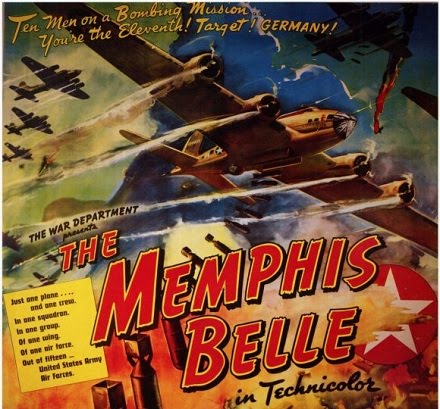
The Memphis Belle (1944)


Only days after the December 7, 1941 attack on Pearl Harbor, William Wyler, who had begun shooting Mrs. Miniver less than a month earlier, applied to the Army Signal Corps as a volunteer. In the event, Wyler was eventually turned down by the Signal Corps, and other projects he tried to develop to help the war effort, including a film for Frank Capra's series Why We Fight, didn't come to fruition. But in June 1942 he was introduced to Major General Carl A. Spaatz, who was organizing Army Air Forces operations in Great Britain, which he invited Wyler to document. After summarily being made a Major in the AAF, Wyler rounded up equipment and a four-man technical crew in Hollywood and left for Britain, arriving in August just as the first American B-17 Flying Fortress bombers began flying combat missions over the Continent.

Between early 1943 and the time aerial filming was completed at the end of May, Wyler and his film crew flew in several B-17 bombing raids, two of them in a B-17 nicknamed the Memphis Belle. The discomfort, not to mention the danger, endured by Wyler and his film unit on these missions was extreme. The noise from the engines was deafening and communication inside the plane impossible without an intercom. Unlike modern aircraft, the B-17 was not pressurized or heated, yet needed to fly at high altitudes, so crews had to wear bulky pressure suits to protect them from below-freezing temperatures and to carry around heavy oxygen tanks. The pressure suits and oxygen tanks, combined with the cramped interiors of the planes and the lack of oxygen at high altitudes, made for miserable working conditions for members of the film unit. "Taking three steps was like walking a mile," Wyler later said (Stevens 211).

The actual filming involved even more difficulties. The handheld cameras, which held only enough film to shoot about three minutes of footage, had to be reloaded frequently and at minus sixty degrees Fahrenheit inside the B-17 often froze. Moving from one side of the plane to the other to shoot completely changed the light exposure. The speed at which enemy fighters came at the bomber meant they were often past before they could even be filmed. Above all, the tremendous personal courage of Wyler and his crew cannot be overstated. Over 80% of the planes in the group they were flying with were lost, and the unit's sound engineer was killed when the plane he was flying in was shot down returning from France. Wyler in particular showed a remarkable willingness to take risks, although he evidently didn't see himself as especially brave. "You didn't even think of the danger," he said in an interview at the American Film Institute. "There wasn't time; you only thought of getting it on film" (Stevens 212).

From the beginning Wyler aimed for absolute authenticity. "Of course it was the real thing," he explained. "It was all done under the conditions of complete reality" (Stevens 211-12). Rather than a newsreel-style documentary, General Spaatz wanted Wyler to emphasize the human element of the soldiers flying these dangerous missions. With this is mind, Wyler decided to structure the film around the idea of a crew flying their twenty-fifth mission, after which their tour of duty would be over, and began to look around for a plane whose crew were nearing the end of their tour. There were several possibilities, but when he got a good look at the pinup-like figure painted on the nose of the Memphis Belle, his unerring instinct for telling visual detail told him he had found his plane and crew.

In June 1943 Wyler returned to California to fashion a picture from the 19,000 feet of film he had, silent and shot in 16mm after the equipment he had assembled in Hollywood was lost in transit to Britain and never recovered. He brought the crew of the Memphis Belle to Hollywood to record voice-over dialogue for the film, which had now been blown up to 35mm. His original intention of a two-reel picture, though, quickly became more ambitious. To the dialogue of the plane's crew, Wyler added sound effects, music, and voice-over narration, tightened the initial seven reels to four (about 40 minutes), and pressed for commercial distribution of the film, tentatively titled Twenty-Five Missions.

After a special screening at the White House which left FDR deeply moved, the President agreed: "This has to be shown right away, everywhere," he told Wyler (Herman 265). Retitled The Memphis Belle, the film opened in April 1944 in New York, where it received an unprecedented front-page rave review by Bosley Crowther, in which he called it "thorough and vivid" and praised its "real and exciting detail." The Memphis Belle was later shown in more than 16,000 theaters in the U.S. In 2001 it was added to the National Film Registry.

The Memphis Belle covers one day in the lives of a B-17 bomber crew as they fly the last mission of their tour of duty before shipping home. It documents step by step a high-altitude daylight bombing raid on the submarine base at Wilhelmshaven in northern Germany, beginning with the ground crew prepping the plane at an air base in Britain on the morning of the mission. Early in the film we are introduced individually to the ten members of the plane's crew, who are presented as ordinary men not much different from people the viewer is likely to know. While keeping our attention firmly on these men and their activities, Wyler manages to subtly include a great deal of factual detail about the nature of aerial warfare—"the new battle front: the air front."

Even though Wyler frames the film as the story of the air raid told from inside the Memphis Belle, he places its role in the raid clearly in the context of the complex operation of which it is only one element, one plane of the one thousand taking part. The explanation of the operational procedures involved in the mission is detailed, lucid, and concise. Wyler deftly balances information and narrative, using the skill at succinctly making his point through potent images that was evident in the studio films he made in Hollywood. The Memphis Belle is always dramatic and compelling and suffused with a real sense of urgency, while at the same time being patriotically stirring in the best possible way, avoiding the jingoistic excess of much of the wartime output of Hollywood. Anyone watching it for the first time is almost certain to be moved by its simple message, presented without sentiment, that when placed in trying circumstances, ordinary people are capable of extraordinary behavior.

Thunderbolt (1947)


Wyler's military career as a documentary filmmaker very nearly ended in March 1944, the month before The Memphis Belle was released, when he punched a hotel bellman in Washington, D.C., after the bellman made an anti-Semitic remark in his presence. (Wyler later reproduced this incident in The Best Years of Our Lives when Dana Andrews is fired from his job in a drug store after he socks a customer for making offensive comments.) Wyler was threatened with court-martial for misconduct but offered a way out if he would accept an official letter of reprimand. At first determined to fight the charge, he reluctantly agreed to the letter of reprimand so that he could continue with his next project for the War Department, a documentary about fighter squadrons involved in the Mediterranean campaign, which became the film released in 1947 as Thunderbolt.

In early June 1944 Wyler arrived in Italy accompanied by John Sturges, a film editor and future director whom Wyler chose as his assistant director, and scriptwriter Lester Koenig, who had written the narration for The Memphis Belle. The subject of the new picture was the P-47 Thunderbolt, a single-engine fighter-bomber whose mission was air support of ground troops. This time there was no film crew. Not only was there no room in the plane for a cameraman, but the planes were already equipped with cameras connected to the machine gun triggers. To these Wyler added more cameras mounted in various parts of the plane, which the pilot could turn on and off. Wyler and his film crew spent their time getting additional footage to combine with the film shot by the cameras on the P-47s—footage at the air base of the air crews between missions, ground footage of the combat the P-47s were involved in, and also aerial footage of the P-47s in flight taken from B-25 Mitchell bombers.

By the end of September, Wyler felt he had shot enough film and traveled to London to begin putting the movie together. After sending Sturges and Koenig back to Hollywood to do more work on the film, he stayed behind, returning to the Continent to follow the Allied invasion. In February 1945 he returned to Rome to shoot more footage from a B-25, what he called "atmosphere shots" of the Italian landscape. During one of these sessions, Wyler suddenly lost his hearing. As he described it, "My hearing just went" (Herman 275). He had suffered nerve damage which left him permanently deaf in both ears, a devastating experience that resulted in a period of deep depression. When Wyler finally accepted his condition and began working again after the war, he was able to compensate for his hearing loss by wearing headphones connected directly to the sound recording equipment.

Thunderbolt focuses on a squadron of P-47s stationed at the Alto air base on Corsica. The film deals with a two-month long operation in central Italy, Operation Stranglehold, the purpose of which was to strike behind enemy lines to cut off supply routes. The footage of the low-level raids conducted by the P-47s gives a much more vivid sense of the damage done—we can clearly see buildings, bridges, trains and trucks being strafed and bombed—than the rather remote and indistinct damage of the high-altitude bombing mission described in The Memphis Belle. Later in the film, after Allied forces have liberated Rome and moved north into the area involved in Operation Stranglehold, we see from the ground just how extensive was the destruction.

Not only does the depiction of warfare seem more graphic and specific in Thunderbolt than in The Memphis Belle, but the film has an altogether less idealized attitude toward the airmen in it. Thunderbolt shows much more of the lives of the pilots between missions, emphasizing the alternation of the routine activities of daily life with comparatively brief periods of intense danger. "In danger a couple of hours a day. The rest of the time, you're out of it," the staccato, Hemingway-style narration tells us as we're shown footage of the airmen going about their daily lives. The film also has a more grim attitude toward the danger these airmen faced. At one point we see the wreckage of a P-47 that crashed a few hundred feet short of the runway at Alto, then a gruesome shot of men pulling the body of the pilot from the smoldering wreckage. "For some the war is expensive," the narrator says. "You wish the people back home could at least see it." And this is the biggest difference between Thunderbolt and The Memphis Belle: here we're shown much more explicitly the war's human cost.

By the time Thunderbolt was finished in 1945, its time had passed: the Second World War had been over for six weeks. The Memphis Belle had been considered so vital to the war effort that it was distributed free to exhibitors by the government, but the new film aroused no interest at the War Department. Nor were commercial distributors interested, feeling that the public had had enough of war documentaries. Thunderbolt was finally released by the Poverty Row studio Monogram Pictures in July 1947. After all the work Wyler had put into it, risking his life repeatedly and even sacrificing his hearing, the film caused little enthusiasm, even with a prologue by James Stewart added to it, and quickly became a historical relic. As Stewart says in his introduction, only three years after the events described in the film happened, they seemed to war-weary Americans as distant as "ancient history."

Making Thunderbolt and The Memphis Belle changed William Wyler irrevocably. As his biographer Jan Herman wrote, "Wyler came back from the war a changed man. Like millions of returning veterans, he had been radically altered not just physically but emotionally" (278). The things Wyler experienced and witnessed while making those two war documentaries created lasting impressions that were to play a huge part in inspiring him to make his first Hollywood film after the end of the war, one of his greatest and the one that would bring him the second of his three Oscars for directing: The Best Years of Our Lives.

Sources

Herman, Jan. A Talent for Trouble. New York: Putnam, 1995.

Madsen, Axel. William Wyler: The Authorized Biography. New York: Crowell, 1973.

Stevens, George, Jr., ed. Conversations with the Great Moviemakers of Hollywood's Golden Age. New York: Knopf, 2006.

You might also like:
This post is part of the William Wyler Blogathon. For more information and a schedule of posts, visit the William Wyler Blogathon page at The Movie Projector. The Memphis Belle and Thunderbolt are included in the DVD WWII: In Color (Topics Entertainment, 2008).

William Wyler Blogathon: The Big Country

Tuesday, June 26, 2012


(Background information and quotations are taken from the William Wyler biography “A Talent for Trouble” by Jan Herman (G.P. Putnam & Sons, 1995) and liner notes to the limited edition CD of “The Big Country” soundtrack).

William Wyler started his directing career making two- and five-reel westerns for Universal in the twenties. In 1930 he directed his first sound feature, “Hell’s Hinges”, which many consider the best version of the famous western novel, “The Three Godfathers” by Peter B. Kyne.

Wyler brought to “The Westerner” (1940) a flinty look that is quite atypical of westerns of the period, but it would be in 1958 in “The Big Country” that marked, in a large-scale manner, a return to his directorial roots.

A modest hit at the time, and only generating mildly enthusiastic reviews, “The Big Country”, for me, looks better with each passing year. Despite the lack of large-scale action set pieces, the almost three-hour running time flies by as we watched a gallery of flawed characters and hesitant heroes and heroines.

Like John Ford’s “Stagecoach” (1939), it’s a western for people who don’t like westerns. Rather than having stock characters dealing with outlaws or Indian attacks, “The Big Country” boasts half a dozen fascinating characters and their interweaving dynamics as they face each other over control of the Big Muddy, the large, watered acreage lusted after by Major Henry Terrill (Charles Bickford), the largest and most powerful cattle baron in the territory, and Rufus Hannassey (Burl Ives), a coarser and, for want of a better word, “hillbilly” cattle rancher who wants the Big Muddy so he can readily water his cows. The Terrills and the Hannasseys clans detest each other like the Hatfield and the McCoys, and neither wants to give into the other.

At one time, the Big Muddy was shared by both families, as it was under the control of the grandfather of the local school teacher Julie Maragon (Jean Simmons). While she owns the Big Muddy, she doesn’t have the time, money or manpower to work it. But she desperately wants peace in the valley and does not want to sell it to either the Terrills or the Hannasseys.


The spark is lit with the arrival of Jim McKay (Gregory Peck), a former sea captain and fiance of Patricia Terrill (Carroll Baker), daughter of Major Terrill. Ranch foreman Steve Leech (Charlton Heston) picks McKay up in town to take him to the ranch and can barely conceal his contempt for Eastern dude McKay. (There are hints of a romantic past between Leech and Patricia).

Despite his derby hat and dandified clothes, McKay is no pushover. He thinks the feud is silly and offers to buy the Big Muddy from Julie as a wedding present for Patricia, with the understanding that the Big Muddy will be available to everyone, even the Hannasseys. Despite the peace this would bring, McKay’s plan is not acceptable to any of the parties.

Hannassey’s oldest son, Buck (Chuck Connors) is a mean, sadistic drunk who is sweet on Julie and tells Rufus that Julie is attracted to him and when they get married, the Big Muddy will be theirs. Julie can barely stomach Buck, but Buck tells Rufus otherwise.


McKay gets grief from all sides. Buck picks on McKay, Leech wants to show up McKay in front of everyone, and Patricia wants McKay to stand up for himself. But McKay knows who he is and doesn’t think he has to prove anything to anyone.

Wyler said, “The Big Country was about courage and cowardice. It was about a man’s refusal to act according to accepted standards of behavior. Customs of the Old West were sort of debunked.”

“The Big Country” was based on a Saturday Evening Post serial titled “Ambush at Blanco Canyon” written by Matt Helm creator Donald Hamilton. Screenwriter James Webb brought the story to the attention of Gregory Peck who was looking for a story to re-team with his “Roman Holiday” (1953) director William Wyler. Peck and Wyler had formed a production venture and were looking for a project that interested them both. Production stalled on a script called “Thieves’ Market”, about the planned robbery of some paintings from the Prado Museum in Madrid.

Script problems could not be licked and the Hamilton story seemed the ideal back-up. Herman writes: “The setup seemed perfect. Peck had a development deal with United Artists, which would finance and distribute the picture, but he and Wyler would be the bosses. The pair divided their producing responsibilities and formed separate companies. Wyler’s was World Wide Productions; Peck’s was Anthony Productions, named for his infant son. Wyler would be in charge of all things artistic. Peck would have casting and script approval, and he would handle the ranching aspects of the picture: hire the wranglers, rent the livestock, choose the horses, in effect serve as foreman.”

Filming took place in the Mojave Desert and in the Stockdale, California area, deliberately chosen for their remoteness. Wyler “wanted to be able to look around 360 degrees and not see any telephone poles or TV antennas…any signs of civilization,” remembers second unit director Robert Swink.
 
“The Big Country” is a big movie, and never was a movie’s title more appropriate. The country is big, and Wyler often keeps his camera far, far away, showing how insignificant his characters are amidst the splendor of the country. One justly famous sequence is a fist fight between McKay and Leech. Wyler keeps the camera at a very great distance and while there are some close-ups, much of the fight is filmed from a great distance, showing how petty the fight really is.

Scenes of Terrill and his ranch hands riding to the Hannassey spread are often shot from a great distance, making the riders look like ants as they traverse the magnificent countryside.

An underlying theme is the advent of civilization, as represented by Peck’s character. Rough men like the Major and Rufus may have been needed to tame the wilderness, but there’s no place for blood feuds anymore. If the territory is to be tamed, it’s up to the McKays and Julie Maragons to make the frontier a civilized place.


Peck said art be damned, they were out to make money. “We wanted to make money out of this. We were going after a commercial hit, not the Academy Awards.”

Come Oscar time, “The Big Country” was only nominated for two Academy Awards, but both richly deserved. Burl Ives was nominated, and won, the Best Supporting Actor award for his role as the patriarchal Rufus. It’s a great, memorable performance. The same year, Ives appeared in the role he’s probably best remembered for, Big Daddy, in “Cat on a Hot Tin Roof.” Likely some voters were awarding him for that as well, as the two characters are a lot alike. But I think even if Ives didn’t essay his Big Daddy portrayal, he would have won that year. Competition was Arthur Kennedy for “Some Came Running”, Gig Young for “Teacher’s Pet”, Lee J. Cobb for “The Brothers Karamazov” and Theodore Bikel for “The Defiant Ones.” Ives’s closest competition was likely the criminally underrated Arthur Kennedy, but Ives is so memorable in “The Big Country that he easily dwarfs the competition.

His Rufus is talked about for the first half of the film and we know him only as the avowed enemy of the Terrills. If he’s anything like his son Buck and his wranglers, then he’s a scourge to the countryside.


We first see his hulking presence from the back, as he is ready to crash a fancy dance at the Terrill Ranch. Much more coarse than the Major, and living in poverty for years, Rufus begins to appear curiously sympathetic as he berates his rich neighbor.  All he wants is water to water his cows. Looking at his clothes, Rufus doesn’t have one eighth the material wealth that the Major possess, and while he has a mean streak a mile wide, we do sense a strange kind of honor within him.

Ives also delivers one of my all-time favorite movie lines in a response to Buck, his son he doesn’t like.

Buck: “You want me Pa?”

Rufus: “Before you was born, I did.”

Ouch.

The film’s other Oscar nomination was for Best Score by Jerome Moross, a true landmark score, and one of the most splendid examples of musical Americana every composed. Even decades later, the music was used in commercials and is one of the most identifiable ever for a western. I say give Aaron Copland’s western ballet scores a short rest in the concert hall and program selections from “The Big Country” score instead. Sit back and listen to the audience go nuts.

Wyler was known in Hollywood as a perfectionist, but he was busy prepping “Ben-Hur” and was not present at any of the scoring sessions, leaving that in the hands of supervising editor and second unit director Robert Swink. Swink said Gregory Peck, wearing his co-producer hat, attended several of the scoring sessions.


Charlton Heston, who has probably had more genuinely great film scores written for his movies than any other actor (with the possible exception of Errol Flynn), said, “I saw the final cut just before they added the music…and I’ve got to say, the difference that music makes for the better is immeasurable.”  

Moross should have won the Oscar that year for Best Score, but in one of the injustices in Oscar history, he undeservedly lost to that grand publicity hound Dimitri Tiomkin for “The Old Man and the Sea.” Just goes to show that Academy members were just as tone deaf then as they are now. Other nominees for Best Score that year were David Raksin for “Separate Tables”, Hugo Friedhofer for “The Young Lions” (my choice for runner-up winner) and Oliver Wallace for Disney’s “White Wilderness.”

While “The Big Country” movie ranked eleventh for 1958 releases, it barely broke even, grossing $5 million. The original budget was $3 million but production problems and delays caused the budget to eventually reach $4.1 million.

It was not a happy experience for many of the cast members, thanks to the lack of creature comforts in a remote location, and new script pages that were being written as filming was going on.


Peck and Wyler fought on the film, to the point where Wyler was using an intermediary to direct Peck. Jean Simmons wouldn’t talk about the film for years. Only Connors, Ives and Heston seemed to have escaped unscathed.

Herman quotes Peck: “There were a lot of good things about the movie, but I frankly don’t think it was audience’s fault. It was our fault.”

Heston said, “A good film, ‘The Big Country.’ I’d have to say it falls short of being a great film, but that’s not to suggest that it does not contain greatness.”

Still, Peck and Wyler have nothing to be ashamed of. “The Big Country” stands far over many of the same westerns that year, and the incredible production logistics, on-location shooting and balancing character dynamics over a long and demanding production no doubt stood Wyler in good stead for his next film, “Ben-Hur” (1959) the biggest film of his or anyone’s career.


To read about “Ben-Hur” and other Wyler masterpieces, visit the William Wyler blogathon page at The Movie Projector http://themovieprojector.blogspot.com/p/wm-wyler-blogathon.html

My very great thanks to R.D. Finch of The Movie Projector for inviting me to participate in the blogathon.

Top Ranked Films of William Wyler

Tuesday, October 25, 2011


William Wyler
4 titles, 61st in points 13,007
If all films were included, would be 50th in pts

Still the record for most Oscars for his films, 39
Still the record for most Oscars for actors in his films, 13
Still a record for five best picture nominees in consecutive years, 5 (38-42)


1. The Best Years of Our Lives (1946)#175
2. Ben-Hur (1959) #221
3. Roman Holiday (1953) #319
4. Funny

Top Ranked Directors on the Net

Sunday, March 20, 2011

© 2009-11, William L. Sinclair

All Directors in the top 1011 list that we compiled from all the internet surveys we could find, ranked by total points for all films on our spreadsheet. Alfred Hitchcock led the list [photo above with fellow director, artist Andy Warhol]. John Ford and Jean-Luc Godard had the most films listed at 16 each. Charles Laughton made the list highest with only one film

Directors with the Most Oscars and More

Saturday, May 9, 2009

These directors have won the most Oscars® for Directing:

John Ford (4) [photo left]: The Informer (35), The Grapes of Wrath (40), How Green Was My Valley (41), The Quiet Man (52) - no westerns
Mister Roberts, my favorite Ford film
Frank Capra (3): It Happened One Night (34), Mr. Deeds Goes to Town (36), You Can't Take It With You (38)

William Wyler (3): Mrs. Miniver (42), The Best Years of

Fairy Tales Can Come True

Tuesday, April 21, 2009

There was nobody like her before or since. . . . In talent, in looks, in character, in temperament. . . . And very early it became obvious she was a brilliant actress.
—Henry Fonda on Margaret Sullavan


The actress Margaret Sullavan starred in only seventeen movies in her screen career, all but one of them released in the ten years between 1933 and 1943. I first saw her in Ernst Lubitsch's The Shop Around the Corner (1940) a comedy in which her accomplished performance—she expertly suggests the seemingly contradictory character traits of confidence and vulnerability, strength and fragility, maturity and innocence—completely won me over. I thought I knew the great American actresses of the 1930s studio era, but I had barely even heard of her and never before seen her in anything. I did know she had won the New York Film Critic Circle award for best actress for her performance in Three Comrades (1938) and had also been nominated for an Oscar for that performance (her only nomination).

So more than twenty years later, when I got the chance to see Three Comrades I made a point of not missing it. It is indeed a great performance in which Sullavan expresses many of the same paradoxical character qualities as in The Shop Around the Corner, but in a completely different context and to very different effect. Three Comrades is no charming Lubitsch confection, but rather an ultra-romantic tragedy directed by the master of such movies, Frank Borzage, for whom Sullavan made four pictures all together. Like Greta Garbo in Camille, Sullavan plays the mistress of a wealthy older man (although the movie is coy about the exact nature of their relationship) who falls in love with an innocent young man played, as in Camille, by Robert Taylor. Like Garbo in that film, Sullavan is a doomed tragic heroine dying of consumption. And she is very, very good. The entirely natural charm and undertone of wistful melancholy she projects makes it utterly believable that all three war buddies of the title would fall in love with her. Since then I've made an effort to see her in every movie of hers shown on TCM. Recently I was able to catch one of her earliest, The Good Fairy (1935), Sullavan's third movie.

The Good Fairy is, like The Shop Around the Corner, a comedy set in Budapest and also based on a play, this time by Ferenc Molnár. In it, Sullavan plays Luisa Ginglebuscher, a young woman plucked from an orphanage to work as an usherette in a large movie palace. Her character is immediately established as the personification of naïveté. She is first seen exuberantly telling a fairy tale—complete with a wicked fairy and a good fairy—to the youngest residents of the orphanage. She takes completely to heart the simplistic moral instruction she has received at the orphanage, including the admonition to perform one good deed a day, and sees herself as a real-life good fairy helping others realize their wishes. Few actresses could have made such a child-like character so convincing without making her seem childish, but Sullavan does.

No sooner is she out in the world than she is besieged by lecherous men seeking to take advantage of her obvious inexperience and vulnerability. Accosted outside the cinema one night by a glib would-be lothario (Cesar Romero), she escapes by claiming to be married and seizing as her mock-husband the first innocuous-looking man she sees walking down the street (Reginald Owen). He turns out to be a waiter at a grand hotel who, charmed by the girl, gets her an invitation to a ritzy ball at the hotel. Here she is approached by a horny millionaire (Frank Morgan) who immediately sets out to try to seduce her. When, with the help of her self-appointed protector the Waiter, she finally catches on to his intentions, she repeats the trick of claiming to be already married and while Morgan is out of the room picks the name of a lawyer, Max Sporum (Herbert Marshall), at random from the telephone book.

I have so far described only the first fifteen minutes or so of the movie. For the rest, suffice it to say that the situation Luisa has created quickly lurches out of control, snowballing into a series of deceptions, misunderstandings, and impromptu coverups that keep the complications coming without letup. Luisa is required to keep all these multiple fictions spinning in the air like balls while at the same time falling in love with Marshall, following her philosophy of doing good deeds, being a good fairy by attempting to engineer happy outcomes for those in whose lives she has become involved, and preserving her virtue by evading the sexual advances of the various men pursuing her. The plot might sound like Lubitsch, but the result is like a Lubitsch movie on speed.

The screenplay is based on a translation of a play by Ferenc Molnár, whose novels and plays were the basis of many, mostly light-hearted, movies, including The Guardsman (1931), starring Lunt and Fontanne, Rogers and Hammersein's Carousel (1956), The Swan (1956) with Grace Kelly and Alec Guinness, and Billy Wilder's One, Two, Three (1961). But for the screenplay of The Good Fairy, the material was considerably reworked by Preston Sturges, and it is his hand more than any other that comes through in the final film. This is a movie driven not by a genteel Eastern European sensibility but by pungent, wit-drenched dialogue, double-entendre (when Luisa talks about leaving "the asylum," nobody realizes she's referring to the orphans' asylum), farcical misunderstandings, risqué sexual innuendo, and a frenetic pace that resembles the most breathless of Howard Hawks's screwball comedies.

One episode that bears the unmistakable stamp of Sturges occurs in the movie theater where Luisa works. After showing a couple to their seats, she is so captivated by the movie, which is already playing, that she sits down and starts watching it. This movie-within-a-movie is a hilarious send-up of an overwrought tearjerker, complete with edits and tracking shots. The scenes we are shown consist of a distraught upper-class woman being separated from her child and evicted from their sumptuous apartment by her stiff-necked husband for some unstated moral transgression. As she pleads with him not to reject her, he sternly repeats one word over and over: "Go!" Always pointing to the door, he says this at least twenty times—never altering his delivery or intonation—until it becomes absurdly funny. The scene has Luisa in tears, but the viewer in stitches.

The director, surprisingly, is William Wyler, whose specialty was adaptations of novels (by authors including Sinclair Lewis, Emily Brontë, Theodore Dreiser, Somerset Maugham, even John Fowles) and plays by heavyweight dramatists like Sidney Kingsley and Lillian Hellman. By their nature, then, these were quite serious movies. This makes it all the more amazing that The Good Fairy, about the only outright comedy he ever directed, is such a funny movie.

Wyler was not associated with any one studio. Instead he worked at various studios and with various producers (he was for many years closely associated with the producer Samuel Goldwyn before he began producing his own pictures in the late 1940s) and thus had an unusual amount of control over his projects. This control meant he was able to use the best technicians, writers, and performers available, and there is no doubt that, as with his best work, the success of The Good Fairy is in large measure the result of this knack for assembling and presiding over the right personnel for the movie. I have already mentioned the contribution of Preston Sturges to the film. But even a script by a genius like Sturges achieves its full expression only with the right actors delivering those brilliantly written lines, and this movie is blessed with an exceptional cast.

Herbert Marshall was for several years in the 1930s a romantic leading man before moving on to supporting character roles. (Wyler himself would later use Marshall in this way in The Letter and The Little Foxes.) In Lubitsch's Trouble in Paradise (1932) he was a debonair conman romancing both Miriam Hopkins and Kay Francis, in Blonde Venus (1932) Marlene Dietrich's husband, and in The Painted Veil (1934) Greta Garbo's husband. In The Good Fairy he gives a wonderful leading performance first as Luisa's dupe and then as the object of her romantic feelings. Under Luisa's influence, his pompous moralizing and emotional remoteness eventually give way to an unexpected capacity for warmth, humor, and affection, rather like the transformation effected by Katharine Hepburn's ditzy heiress on Cary Grant's uptight paleontologist in Bringing Up Baby. Marshall succeeds so well in his role not by trying to be funny but by playing it straight, by finding and bringing out the humor in the character rather than imposing it on the role with overtly comic mannerisms.

The supporting cast, on the other hand, is filled with character actors who rely on a comic persona, the kind of supporting players who contribute immeasurably to the pleasure the best American comedies of the 1930s and 1940s bring to viewers. Eric Blore, so memorable in the Astaire-Rogers movies and in The Lady Eve and Sullivan's Travels for Sturges, is great fun in the early section of the movie, especially in his tipsy scene. For once he plays not a butler or valet, but a government minister. Alan Hale has only a few scenes but leaves a distinct impression as the eccentric who hires Luisa as a movie theater usherette. Reginald Owen is by turns solicitous and overbearing as Luisa's protector the Waiter, who might just have romantic designs on her himself.

Best of all is the splendid Frank Morgan as the business tycoon chasing Luisa. He is really the prime mover of the plot; most of the things she does are in response to his actions. As for his pursuit of her, he is more a blustering, flustered big pussycat than a sly predator, a character not too dissimilar to the one he played in the greatest role of his career, Matuschek in Lubitsch's The Shop Around the Corner. In fact, I would say that his performance in The Good Fairy—the role is really quite large; he has nearly as much screen time as Marshall—is in my estimation exceeded only by his performance in that Lubitsch masterpiece.

That brings us back to Margaret Sullavan, the one person above all others who with her charming and radiant performance as Luisa makes The Good Fairy such a special film. Brooke Hayward, Sullavan's daughter, describes her mother in a way that I think applies equally to her performing style in this movie and others: "She didn't seem to talk, like other people, but to communicate information physically, as if she were leaning into whatever she was saying, not only with her voice—which even in a whisper crackled with electricity—but her entire body."

Earlier I wrote of the way Sullavan embodied in her film roles seemingly opposite qualities of character. Her life off-screen was typified by contradictions as well, specifically the conflict between her attitude to her personal life and her attitude to her professional life.

The slender, petite Sullavan (she was 5 feet 2½ inches tall) was born in Virginia in 1909. Originally she wanted to be a dancer before drifting into acting. She was by all accounts an active, athletic, tomboyish woman (she sometimes rode a motorcycle to the studio) described by her friend James Stewart, with whom she made four movies, as having "great humor." Henry Fonda (to whom she was married briefly, for about two months, in the early 1930s) agreed, calling her a "fun-loving" woman that "everybody loved": "There sure wasn't anybody who didn't fall under her spell."

Yet she had a very serious attitude toward her acting. She seemed to be driven more by a sense of professionalism than by personal ambition and found the trappings of celebrity a bothersome intrusion in her life. Her interest in movie acting apparently ended when the scene was finished; she never watched the daily rushes and never saw any of her completed movies. When her children insisted on seeing her last movie, No Sad Songs for Me (1950), she drove them to Radio City Music Hall in New York, where the film was playing, and waited for them outside the theater until the movie was over.

In 1934, during the filming of The Good Fairy, Sullavan eloped with her director, William Wyler. Quickly realizing the marriage had been a mistake, they divorced a little over a year later. In late 1936 she married Leland Hayward, a high-powered New York and Hollywood talent agent who had been her own agent since 1931. Between 1937 and 1941 they had three children, and in 1943 Sullavan retired from the screen to concentrate on her family. Hayward was apparently a compulsive workaholic, and his devotion to work placed a certain amount of strain on the marriage, with Sullavan feeling that he favored his career over her and the children.

After she stopped making movies, Sullavan's life was not always a happy one. The sense of fun that James Stewart and Henry Fonda noted sometimes crossed the line into capricious behavior, as her impetuous early marriages to Fonda and Wyler suggest. In 1945, against the wishes of her husband, she bought a ninety-five acre farm in Connecticut and moved the family there, isolating her husband, who hated the farm, in California for long periods of time. Then in 1947, ignoring the advice of friends who were aware of problems in the marriage, she suddenly decided to do a six-month tour of England in The Voice of the Turtle, a play she'd had great success with on Broadway a couple of years earlier. During this time Hayward, left alone, began an affair with the ex-wife of Howard Hawks, and after Sullavan returned from England they divorced.

Besides the end of her marriage to Leland Hayward, Sullavan experienced several other setbacks in her personal life in the late 1940s and 1950s. She suffered from a hearing disorder called otosclerosis, which, although treated surgically, still led to progressively greater hearing loss. Two of her three children suffered psychological troubles, evidently exacerbated by the divorce, and were at times hospitalized in psychiatric institutions. As teenagers these two became estranged from their mother, who had doted on them when they were younger, and chose to live instead with their father.

Although Sullavan appeared in several successful plays in the 1940s and 1950s, notably John Van Druten's The Voice of the Turtle and Samuel Taylor's Sabrina Fair, she became more and more ambivalent toward her profession and no longer found in it sufficient inspiration for the total commitment she felt was required. This growing disenchantment with performing ("I loathe acting," she is quoted as saying when she began rehearsals in late 1959 for what would have been her last Broadway play)—along with increasing problems with her hearing and what her daughter Brooke Hayward calls "the terrible anxiety that she had failed as a mother"—led to years of worsening insomnia and depression. Margaret Sullavan died of an overdose of barbiturates on New Year's Day 1960. There were indications that the overdose was unintentional, enough so for the coroner to rule her death accidental.

I think Henry Fonda was right when he described Margaret Sullavan as "unique," something that comes through clearly in the characters she played in her brief movie career. Perhaps because Sullavan's later life was so sad, The Good Fairy seems all the more special. In this movie she is exuberant and fresh, genuinely so, almost beyond what is called for in her role. The innocent, optimistic character of Luisa was the ideal showcase for the youthful sense of fun and energy that those who knew Margaret Sullavan described her as having as a young woman, enchanting qualities that are on full display in The Good Fairy and that make the movie so delightful.

All the quoted material and much of the biographical information come from the memoir written by Margaret Sullavan's daughter, Brooke Hayward, Haywire (New York: Alfred A. Knopf, 1977).
 

Blogger news

Blogroll

Most Reading