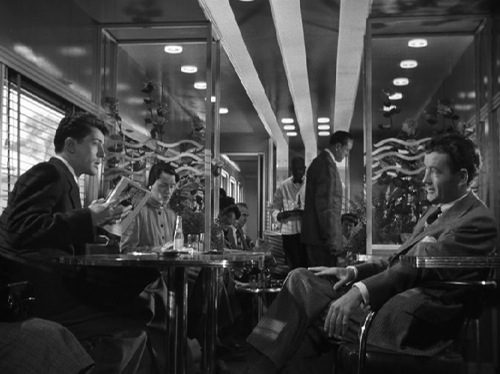
![]() |
| An American in Paris (left) tied A Place in the Sun (right) in '51. |
Oscar Oddity #6: The Split of 1951
Wednesday, December 19, 2012
The Final Conclusion - Best Actress 1951
Saturday, July 28, 2012

- Elizabeth Taylor in A Place in the Sun
Vivien Leigh in A Streetcar Named Desire
Friday, July 27, 2012

"Whoever you are... I have always depended on the kindness ... of strangers." Blanche DuBois
When I reviewed Jane Fonda's performance in Klute, I was talking about those very rare perfect Oscar wins that come at the right time in an actress' career and for a performance of her lifetime. Well, Vivien Leigh was the lady who had not one, but two such Oscar wins. If we go over the list of double winners, we can see at least one win with which we don't agree. But that's not the case with Vivien Leigh as her two Oscar winning performances are regarded as two of the very best performances winning the Academy Award in any category. Even at the time, it was no question who would take home the coveted award. Despite Vivien's modest words that Katharine Hepburn would win, there was no question about the actual winner.
Tennessee Williams was simply a Godsend to actresses, having created
It can always be misleading to viewers who watch actors play parts very close to their own personality because they might even question if there was really an acting achievement behind the character. However, such performance can turn out to be career-best, ground-breaking achievement like the one of Gloria Swanson in Sunset Blvd., Jack Lemmon in Days of Wine and Roses, Mickey Rourke in The Wrestler and Vivien's work in Streetcar. These actors filled their respective roles with their own experiences, pains and sufferings and these all lead to shocking and harrowing results. Vivien, who suffered from manic depression, had to go deep down the recreate the state of horror and loneliness of mental illness. Adding her own experiences lead to (in my opinion) the most real and shocking portrayal of mental illness in the history of cinema, in my opinion. In a movie made in 1951, she lets everybody look into somewhere, which (fortunately) few people get to see first hand.
However, drawing a disturbing picture of mental illness is just one of the many incredible feats of this performance, which combines everything that I love about acting. All these "smaller" achievements are enourmous on their own right and are far ahead of 98% of the Best Actress nominees. Even the way she attaches these parts together is amazing: it's true that she worked from killer material but as Tennesse Williams himself said "She brought everything I intended to the role and even much more than I had dared dream of." Any great actress can give an award-baiting performance in this part so it's about who's able to enrich this character even more, if that's possible. And it certainly was possible for Ms. Leigh.
One of the many incredible things about this performance is how Vivien portrayed Blanche's everlasting desire for magic and denial of reality. In many ways, her character is just like the respective characters of my three other favorite nominated ladies in this category (Jane, Great Glenn, Ingrid): for whatever reason, she's trying to put on a performance. With Great Glenn's Marquise it was all about society's rules and expectations, with Ingrid's Charlotte it was about proving her own kindness and humanity, with Jane's Bree it was about (just like with Blanche) a way of denying reality. Blanche and Bree are almost twin sisters in the sense that they try to cope with their horrendous circumstances with their constant performances. However, while Bree wants to make it in real life with her acts, Blanche is desperate to get away from reality. Vivien so heartbreakingly delivers the line where Blanche says that what she wants is magic, above all (especially real life). And it's so interesting that whenever she's faced with reality, her voice deepens and looks way older and more bitter.
Vivien's acting is extremely theatrical and yet seems to be coming so naturally from her. Moreover, I could feel that Vivien was extremely playful and added way more humor to this character than she's given credit for. Her kick-ass chemistry with Marlon Brando leads to some of the greatest battle of sexes scenes I've ever seen. Actuall, she even made me laugh a couple of times, especially in the beginning. And these moments make the ending even more terrifying and devastating. She covers through every emotion possible in a human being and her brilliance is overwhelming and lot to take at first. She's so damn human and realistic in every possible scene, despite the visible 'overacting'. However, in a way, I felt that Vivien actually gave a very subtle performance despite all the breakdowns and theatricality. She never goes for the 'screaming crazy woman' act that people at the time expected from a mentally ill character (or still do, for that matter).And yes, there are so many brilliant things about this extremely rich performance that I haven't even mentioned, like Vivien's date with Karl Malden, which I consider the greatest scene of the whole movie. Vivien is simply astonishing when she delivers Blanche's long monologue about the suicide of the man she loved and their whole relationship. In each and every sentence, you can feel the pain and grief of Blanche and Vivien makes it all too clear why Blanche turned out to be the person she really is. That extremely difficult and complex scene is just flawless thanks to Vivien's wonderful ability. In fact, it had such an effect on me that I had couldn't even concentrate on anything else but Vivien's incredibly absorbing and masterful acting.
It's just as absorbing to see her interactions with Kim Hunter and Marlon Brando. Kim Hunter gives fabulous support to her, while with Brando, the whole air sizzles. Vivien so subtly and visibly shows how Blanche is turned on by Stanley's brutal, almost animal-like personality, something that's really contrary to her own expectations. The sexual tension between the two actors is really uncanny, especially for a 1951 movie (hah, that's like a mantra for me now, isn't it?).
And the ending is just as much of a masterclass in acting as her date with Karl Malden. The way Vivien shows that Blanche is still clinging desperately to her lies and delusions is just unbelievably painful to witness. Vivien Leigh reached such a high point with her performance where you just can't say anything about her and you're completely captivated by her. In fact, thanks to her exceptional, wonderful interpretation, you can also go through the stages of the passion of Blanche up until her cathartic, deeply disturbing and heartbreaking last sentence: "Whoever you are... I have always depended on the kindness ... of strangers." Her walk with the doctor becomes as much of a terrifying danse macabre as Gloria Swanson's walking down on the stairs, or Great Glenn's sinister last scene in Dangerous Liaisons. And Vivien reaches this with just one weak smile on her face that's a whole movie itself: the hope, the fear and everything. It remains a disturbing last cry for help from Vivien, maybe just as much from herself as it was from the character.
That's why that Vivien Leigh's performance as Blanche DuBois is indescribable. No matter how much I'm sweating and trying to point out parts of her brilliance, I constantly fail as you have to see Vivien's acting for yourself to feel her brilliance. Her acting in A Streetcar Named Desire is something that words cannot really describe so if I have to give a brief summary about what a brutally, unbelievably amazing performance hers is, I have to turn to Brando who said: Vivien Leigh was the best Blanche. She was Blanche DuBois.
Jane Wyman in The Blue Veil
Wednesday, July 25, 2012
Katharine Hepburn in The African Queen
Sunday, July 22, 2012
In movies like The African Queen where it's mostly about the two main actors, the outcome depends on the chemistry. And although Kate outacts Humphrey Bogart in a blink, the sexual tension between them is just brilliant and you can see that the actors and the director approached it with lots of humor. In a way, they reminded me of the legendary Clark Gable-Claudette Colbert couple from It Happened One Night. Many explain their relationship as a metaphor of the USA over the great colonising countries like England and actually, you can easily justify this by examining Kate's work here. You just cannot overlook the way the very polite and proper English lady gradually surrenders to the charming, common American because she depends on him in order to survive. And the greatest achievement about this is that Kate makes her performance really enjoyable and entertaining even without this background. However, you cannot ignore the fact that her performance is more than just loveable romcom acting.
Kate also handles the comedy wonderfully and her sharp delivery is a real treat (as usual). She naturally uses her charisma a lot during the movie, but I could feel that she was perfectly aware of the fact that this character needed something more than that and in the end, Rose turned out to be a really layered and kind of fascinating character. I ultimately felt a strong connection to Rose and I was really taken by her emotions: and Kate impresses without the desperate need to seem amazing (that's a trap that Kate tended to get stuck in).
My only complaint could be that Kate went a little bit over the top with showing Rose's emotions for Charlie and it was a bit unbelievable that a repressed spinster turns out to behave when in love just like a schoolgirl. Although that might even have been just an ironic acting decision, I'm not sure about that. However, I'm certain that I never really loved Katharine more than I did in this film. I have been more impressed by her, but I've never liked her so much, that's for sure. The movie and her duo with Bogart might have had a lot to do with that, but quite simply, despite my previously mentioned complaint, I fell for her here as she's just irresistable and I tend to be more forgiving in these cases.
All in all, in The African Queen, Katharine Hepburn gives a wonderful, enjoyable performance that really makes her movie an exciting, interesting and memorable experience. She uses all her charm and talent to create a character, which she makes twice as intriguing as you would expect. She fills the role of the spinster with real spirit, which makes her a welcome presence everytime you see her. And her her chemistry with Humphrey Bogart is indeed perfect.
Eleanor Parker in Detective Story
Wednesday, July 18, 2012
Shelley Winters in A Place in the Sun
Tuesday, July 17, 2012
Alice is just not an impressive girl: she talks little, her beauty is a bit limited, especially compared to the overwhelming beauty, sexiness and intelligence that just shines from Elizabeth Taylor's character, Angela. Alice represents the old life of George Eastman: poverty and simplicity. However, Angela (as her name suggests) is indeed an angelic presence and it's this contrast between these two ladies is what makes George's struggles even more believable and intense. You can spot this in the approaches of the two actresses: Liz is as graceful as a queen, Shelley is simpler, more quiet and much less radiant.
Shelley's work is one of those rare cases when the performance becomes truly engaging and impressive because of how unimpressive and clumsy the character is. For most of the time, we can see Shelley with an almost dumb expression on her face, which she gradually fills with emotion and real depth. Shelley could have stayed on the surface and would have been just as impressive and yet she chose to go deeper into the mind of this poor girl and we can see the understanding she has for Alice, but in the end she still remains a little bit pathetic and a bit annoying.
Shelley also uses her little screentime to her advantage: she almost becomes like a ghost during the movie. In fact, I thought that she was much more haunting this way as her appearances always brought some tension to the idyllic moments of George and Angela.
Probably my only issue with this performance is that it's sometimes overshadowed by the greatness of Monty Clift and her own movie. If I was reviewing her in the supporting category, this wouldn't be an issue at all as she did perfectly what a supporting part required. I tended to overlook her, even despite the fact that I found her terrific all around. Sometimes I couldn't focus on her, because there were things that amazed me even more and that made her performance a little bit paler and not as grand as it could have been. Don't get me wrong, she was amazing, it's just that she could have kicked ass a little bit more.
The Next Year
Sunday, July 15, 2012
So the nominees were:
- Katharine Hepburn in The African Queen
- Vivien Leigh in A Streetcar Named Desire
- Eleanor Parker in Detective Story
- Shelley Winters in A Place in the Sun
- Jane Wyman in The Blue Veil
131. Two Tickets to Broadway
Saturday, July 7, 2012
It takes nearly fifty minutes before Two Tickets to Broadway reveals it's a "let's put on a show" musical. In the meantime, it introduces a too large cast of amiable characters that sing a handful of instantly forgettable easy-listening tunes intended to slowly progress a thin as paper plot. Much of the last half of the film is watching a television special full of lavish production numbers play out. They're downright dull with the except of "Big Chief Hole-in-the-Ground," a patently offensive number that couldn't possibly have aged worse over the decades. The Best Sound nomination is unremarkable; there's some rain, tap dancing and infinite amounts of singing.
130. The Mudlark
Friday, July 6, 2012
Extravagant makeup effects transform Irene Dunne and Alec Guinness into Queen Victoria and Benjamin Disraeli. Neither really outshines the physical change, giving performances so low-key as to be considered dull. The same principle applies to the film's Oscar-nominated costumes. Victorian era clothing could scarcely look more unremarkable in black-and-white. Dunne and Guinness are both often dressed in all black, their outfits photographing without a hint of detail. Everything else looks like something from summer stock. The plots about a waif and young lovers fall totally flat.
109. Strangers on a Train
Sunday, May 13, 2012
The African Queen (1951) ***
Wednesday, April 18, 2012
Something happened to Katharine Hepburn in the 1950s that was both a blessing and a curse: she started playing a lot of spinsters. Some of these spinsters were painful to watch (think The Rainmaker and Summertime), but thankfully her turn as Rose Sayer in The African Queen (1951) was the perfect vehicle for her maturing talents. She had adept screenwriters (James Agee and John Huston); an accomplished director (John Huston); an award-winning cinematographer (Jack Cardiff); and, an age-appropriate co-star (Humphrey Bograt)—all of these essential elements allowed Hepburn to turn Rose into the best spinster portrayal of her storied career.
Based on C.S. Forester’s 1935 novel The African Queen, the story takes place at the beginning of WWI in 1914 in German East Africa. An old-maid missionary (Hepburn) finds herself in a difficult situation after her Methodist minister brother (Robert Morley) is beaten by German soldiers and later dies of a fever. Alone in the middle of the jungle, Rose is rescued by rough-looking steamboat (a very small one, named, you guessed it The African Queen) captain Charlie Allnut (Bogart), a man who delivers supplies and mail along the Ulanga River. After learning that the boat is carrying the necessary supplies to make a torpedo, Rose attempts to convince Charlie that they should make one and then use it against a German gunboat as an act of patriotism (he’s Canadian, which at the time was still a part of the British Empire). While attempting to dissuade Rose from her suicidal plan, Charlie often finds himself at odds with the headstrong nature of his prim companion. What ensues is an adventurous love story between complete opposites in the middle of the African jungle.
Most people who have read Forester’s novel will tell you that the movie is ten times better. This is not to say that screenwriters Agee and Huston changed a lot when they adapted the book, because they only made a few minor changes—most notably turning Charlie into a Canadian instead of a Cockney Londoner because Bogart couldn’t pull off the accent—but because the story plays better on screen than on the page. They received an Oscar nomination for their crisp, smart dialogue and their ability to turn a somewhat turgid book into a sweeping adventure story. Writing lines for two completely opposite personalities can be challenging (you don’t want one to dominate the other too much) and that’s where I think Agee and Huston do a great job. Perhaps my favorite exchange is this one:
Charlie: A man takes a drop too much once in a while, it's only human nature.
Rose: Nature, Mr. Allnut, is what we are put in this world to rise above.
The characters’ words never seem forced and they always sound appropriate. I wish more screenwriters wrote dialogue like this.
John Huston also received an Oscar nomination for his direction of the film. While he and Bogart were cut from the same cloth, dealing with Hepburn in the middle of the jungle could have been a nightmare if he hadn’t approached her in the right way. He obviously was successful in this endeavor because Hepburn later said that it was “the goddamnedest best piece of direction” she ever received. As if dealing with two of Hollywood’s biggest stars wasn’t enough, the film was shot primarily on location in central Africa (although for safety reasons all of the scenes where Bogart and Hepburn are in the water were filmed in a studio water tank). Just the logistics alone were bad enough, not to mention the fact that it was being filmed by huge Technicolor cameras. Sickness ran rampant on the set and the weather conditions were unbearable at times. In the end, it turned out to be one of the best films of Huston’s career.
Besides the off-beat love story, what is most remembered about the movie is its cinematography. Can you really shoot a film in the middle of the African jungle in anything other than Technicolor? Vivid and lush, the color pops off the screen. Cinematographer Jack Cardiff was known for his experimental use of Technicolor. His use of the dye-process color system made him the go-to cinematographer for the likes of Powell & Pressburger and Hitchcock. Yet, he was also extremely adept in his lighting techniques. There’s a story about how Bogart told Cardiff that it had taken him years to get the lines on his face and that he didn’t want Cardiff to wash them out with lights. Bogart might have kept his lines, but Hepburn never looked better in color. Rose was supposed to be 33-years old, while Hepburn was in her mid-40s when the picture was shot; yet, I can’t recall a color film where Hepburn looked so real—her take me as I am (with limited lighting hijinks) made her look like the beauty she was. What makes this even more impressive is that throughout most of filming Hepburn was extremely ill with dysentery—and still she looked good, which no doubt she owed to Cardiff’s mastery.
Finally, what I think makes this Hepburn’s best spinster role is that her co-star is Bogart. Slightly seven years older than Hepburn, Bogart looked like the kind of man who could fall for an aging old maid. Rough and grizzled, Bogart had the necessary presence to stand next to a woman who could be perceived as domineering. Perhaps this is why he won his only Academy Award for this role—he stood his own against one of the most powerful actresses to grace the silver screen. When you compare his Charlie to the likes of Rossano Brazzi in Summertime (1955) and Burt Lancaster in The Rainmaker (1956) it’s easy to see where those films faltered while The African Queen thrived. While Hepburn received Academy Award nominations for all three of these films, this was the one she seemed the most believable in, which I believe is a direct result of who her co-star was. I believe this is the inherent reason why The African Queen endures while Hepburn’s other spinster films are often pushed aside and/or forgotten.
Strangers on a Train (1951) ***
Tuesday, February 22, 2011
(This article is from guest contributor The Lady Eve and first appeared at http://classic-film-tv.blogspot.com/. The rating in the title is my own.)
It was the middle of the 20th Century and Alfred Hitchcock's last major film had been Notorious (1946). Four years and four films later, he was in a slump.
For his next project, Hitchcock looked to the first novel of young Patricia Highsmith. Intrigued by its clever "criss-cross" murder plot, he bought the rights to Strangers on a Train.
Raymond Chandler was tapped to tackle the screenplay, though Czenzi Ormonde, a protégé of Ben Hecht, rewrote most of it. Cinematographer Robert Burks collaborated with Hitchcock for the first time and earned an Oscar nomination for his efforts. He was nominated again for Rear Window and won for To Catch a Thief. Dimiti Tiomkin, who had last worked with the director on Shadow of a Doubt, composed the film's nimble score. Hitchcock produced and directed for Warner Brothers.
A thriller of mature scope and depth, Strangers on a Train (1951) is also considered one of Hitchcock's most accessible films; its overwhelming success revived the director's reputation at a crucial point. It also signaled the beginning of his final great filmmaking period.Strangers on a Train is pure and classic Hitchcock. It begins as two young men meet very cute in the first class club car of a commuter train. One is a tennis celebrity, the other a wealthy ne'er-do-well, and what seems like casual chit-chat has deadly consequences. A study in Alfred Hitchcock's mastery of visual storytelling and technical wizardry, the film bears all the hallmarks of his style...
There are spectacular visual set pieces, among them...1) Bruno stalks Miriam at a fairgrounds and, in a stunning shot, strangles her on a secluded island, 2) Guy makes a stealthy visit to Bruno's darkened home where a large growling dog adds even more suspense, 3) An intense tennis match is cross cut with scenes of Bruno's harrowing journey to plant evidence, 4) a carousel disaster comes to a breathtaking climax.Prominent historical sites appear; Washington, D.C., landmarks are woven into the scenario with the Jefferson Memorial in a stark cameo.
There is an "innocent man accused" theme and a powerful doppelganger motif.
Though there are no marquee names, the cast is solid. Farley Granger fleshes out handsome, guileless and beleaguered tennis star Guy Haines; Laura Elliott (Kasey Rogers) is delicious as his estranged wife, Miriam; Marion Lorne stands out as Bruno's discombobulated mother. Leo G. Carroll is credibly senatorial as a U.S. Senator and Patricia Hitchcock gives one of her best performances as his quirky younger daughter.Alfred Hitchcock once told Francoise Truffaut, "...the more successful the villain, the more successful the picture. That's a cardinal rule..." The bold, unforgettable performance of Robert Walker as psychopathic Bruno Anthony is proof positive of that rule. Remarkably, Walker had mostly been cast as male ingénues up to then.
Like Joseph Cotten's Uncle Charley in Shadow of a Doubt, Walker's Bruno is a glib, self-possessed charmer - who is also a remorseless killer. Walker is riveting onscreen. His Bruno is confident, slick, erratic...and very, very creepy. His smooth veneer barely masks a simmering rage. With a voice that ranges from sensual as velvet to cold and hollow as tin, his eyes glitter, glare, caress.From the moment Bruno is first seen in the club car insinuating himself into Guy's life, to his final seconds of life, when he mercilessly implicates Guy with his dying breath, Walker dominates and energizes the film. Pat Hitchcock once observed that for all her father's genius, it was Walker's daring performance that 'made' the picture.
Walker died tragically at age 32 less than two months after the film was released. He had appeared in more than 30 films in his career, but it was only Strangers on a Train that allowed him to unleash the devastating range of his talent. Farley Granger later reflected, "he was great in the film; his potential was limitless, his career was just beginning to take wing."
Robert Walker's life had been short and often troubled, and his early death sent shock waves through Hollywood. In time, though, it became clear that he had a bit of good fortune after all; his greatest role, his single virtuoso performance, was preserved within one of Alfred Hitchcock's finest films.British film critic and historian David Thomson noted in a piece on Strangers in 1999, Hitchcock's centennial year, that Walker's was "...a landmark performance. You see it now and you feel the vibrancy of the modernity...he had had that one chance..."
The Day the Earth Stood Still (1951) ***
Saturday, February 12, 2011
(This article is from guest contributor Rick29 and first appeared at http://classic-film-tv.blogspot.com/. The rating in the title is my own.)
If there were a Hall of Fame for Timeless Movies, then one of its founding members would be The Day the Earth Stood Still. I've probably watched it at least once every decade since I first saw it on NBC's Saturday Night at the Movies in the 1960s. When I was a youngster, the film's fantastic elements--and Gort, the coolest robot on celluloid--appealed to me. When I was a teen, its stern warning about the perils of nuclear war resonated with me. With each subsequent viewing, The Day the Earth Stood Still has revealed something new: presenting itself as a Biblical analogy, an editorial on the influence of media on public opinion, a portrait of fear of the unknown, etc.
The films opens with Klaatu (Michael Rennie), a visitor from another planet, and his robot Gort making an unannounced spaceship landing in Washington, DC. When Klaatu exits from his ship and reaches into his space suit, a nervous soldier shoots him. While recovering in Walter Reed Army Hospital, Klaatu meets with the President’s secretary, Harley. The alien explains he must deliver a critical message to all the leaders of the world. Harley explains that’s impossible because of global political tensions. Klaatu confesses that he does not understand human conflict. He decides he needs to learn more about Earthlings from living among them. He escapes discreetly from the hospital and, as “Mr. Carpenter,” takes a room in a boarding house.
The success of The Day the Earth Stood Still hinges, in large part, on the casting of Klaatu. Producer Julian Blaustein and director Robert Wise originally considered Claude Rains, but his stage schedule made him unavailable. 20th Century-Fox head Darryl F. Zanuck suggested Spencer Tracy, but Blaustein worried that a well-known star would be a distraction (interestingly, that concern didn't apply to Rains). It was Zanuck who eventually "discovered" Michael Rennie, who was peforming in the British theatre. The tall, low-key Rennie brought conviction to the role, but his greatest accomplishment was making the alien visitor seem human. This is no small feat, as evidenced by a scene in which Klaatu reads the words of Lincoln and wants to meet him. This sequence could easily have come across as hokey, but Rennie makes it quietly effective and even heartfelt (since Klaatu has finally found someone who gives him hope about the human race).
With a human-like alien, it was left to the robot Gort to bring an eerie, other-worldly quality to the film. To make the robot as physically imposing as possible, the producers hired Lock Martin, a 7' 7" doorman at Grauman's Chinese Theater. To make Gort even taller, Martin wore 4-6" platform shoes. Walking in the heavy rubber suit in high heels was physically exhausting. There were two suits, one that laced on the front and the other in back. Martin changed suits depending on the camera angle, so that it looked like Gort had no "seams." In some shots, a static model of the robot was used. That Gort model was later bought by Larry Harmon, overhauled so it didn't look much like Gort, and used in Harmon's Bozo the Clown television show.
In addition to its visual impact, The Day the Earth Still even sounds other-worldly thanks to composer Bernard Herrmann's innovative use of a theremin (shown on right). One of the first electronic instruments, the theremin is "played" by moving one's hands in front of it to change sound frequencies. Its distinctive sound became almost a cliche through repeated use in other sci fi films of the 1950s. Still, Herrmann' score remains an impressive achievement today.
Loosely based on the Harry Bates story "Farewell to the Master," The Day the Earth Stood Still features strong religious undercurrents. Klaatu becomes a Carpenter (if in name only). He performs a "miracle" of global proportions. He brings a message of peace, but is largely misunderstood. And, of course, he is murdered and resurrected. Producer Blaustein credits screenwriter Edmund H. North for adding these provocative layers on top of a traditional science fiction tale.
The cast, music, and richness of themes contribute mightily to the film's timeless quality. But it's the story--along with that awesome robot Gort--that makes The Day the Earth Stood Still popular with viewers of all ages. I love to watch it with young people and tell them that they will need to memorize the film's classic phrase and repeat it at the appropriate point in the film...or the Earth will be destroyed. You'd be amazed at how many different variations I've heard of: "Klaatu barada nikto!"