Pages

Powered by Blogger.
Showing posts with label cinematography. Show all posts

043. Kismet

Thursday, January 31, 2013

043. (30 Jan) Kismet (1944, William Dieterle) 18


I have a decidedly low tolerance for these '40s forays into exoticism, full of tanned white actors and soundstages that all run together. Especially odd is how Kismet is about as dull as an adventure in a foreign land gets. Marlene Dietrich occasionally breathes life into this, like during an endless dance sequence, but she's not given much to do. The cinematography is vibrant and the score tries to make this more rousing than it is; those are both worthy Oscar nominations. The nods for art direction and sound are totally unnecessary.

312. Django Unchained

Thursday, December 20, 2012

312. (19 Dec) Django Unchained (2012, Quentin Tarantino) 75


Coming off the lean, perfectly structured Inglourious Basterds, it's not really a surprise or much a disappointment that Django Unchained isn't on par. Mostly, it's the absence of Sally Menke as film editor that's deeply felt, since this doesn't have the sharpness her collaborations with Tarantino had. But this is nevertheless engaging and exhilarating. To his credit, the substantial runtime isn't felt for a second due to clever scripting that crafts believable relationships and allows on-screen time to pass fluidly.

Christoph Waltz is certainly the standout here, though Leonardo DiCaprio sinks his teeth into a menacing role. Samuel L. Jackson, offering a variation on his same old schtick, is impossibly fun to watch chew scenery. Jamie Foxx and Kerry Washington could have been recast midway through the film without anyone noting their absence.

Robert Richardson's cinematography is outstanding, as are the sets and costumes. Oscar nominations for most technical aspects are in order.

It took two viewings of Inglourious Basterds to fully appreciate this, so I have every intention of revisiting Django. It's so dense and thoughtful, full of nuanced arcs, all the while being quite reverential to its genre. There's a great deal to take in on a single go-around, and surely much reward in a second or third attempt.

290. Mother Wore Tights

Tuesday, November 27, 2012

290. (26 Nov) Mother Wore Tights (1947, Walter Lang) 35


Betty Grable and Dan Dailey are cute enough as the singing and dancing duo at the center of Mother Wore Tights, but this is quite typical of the unremarkable subgenre of musical comedies about vaudeville. Generic gags, a predictable plot and repetitive numbers make this all the more ordinary. The charming Oscar-nominated "You Do" is the high point. The cinematography remains rich despite the routines all taking place on stage.

281. Abe Lincoln in Illinois

Thursday, November 22, 2012

281. (21 Nov) Abe Lincoln in Illinois (1940, John Cromwell) 37


With Daniel Day-Lewis's definitive Lincoln now on film, Raymond Massey's Oscar-nominated turn seems more clumsy than it might have in years past. His tall, gawky frame allows him to bring physicality to the role, but his Lincoln is an empty-headed yokel. It's no easy task removing the intrigue from such a fascinating man. However, the scenarios here are downright goofy; Lincoln wins respect by wrestling a local bully and charms Mary Todd by hitting his head on a chandelier. Reducing his history to anecdotes, the film does no justice to the man. Ruth Gordon, high-voiced and wild-eyed, is a beguiling Mary Todd, at least. James Wong Howe's accomplished cinematography opens up this stuffy adaptation.

280. Life of Pi

Wednesday, November 21, 2012

280. (20 Nov) Life of Pi (2012, Ang Lee)* 49


Ang Lee regresses with Life of Pi, exploring his trademark themes of repression and grief in a most literal sense. Even his obvious fades and a reliance on cheap imagery like a slow teardrop streaming down someone's face suggest the aesthetic of a director less developed than Lee. Claudio Miranda's cinematography and the visual effects are undeniably stunning, but they serve a narrative that's never emotionally involving or particularly interesting. David Magee's screenplay is a redundancy since he employed all the same tricks, to similarly hackish effect, in Finding Neverland. The ending serves as a ten-minute third act, dissolving all enchantment away from Life of Pi once and for all.

278. Anna Karenina

Tuesday, November 20, 2012

278. (18 Nov) Anna Karenina (2012, Joe Wright)* 74


Though it works better in segments than as a whole, it's hard not to be swept away by Joe Wright's rapturous Anna Karenina. It's a film of which my opinion evolves the more I think on it. Will there be something more breathtaking or perfect as the ball when Anna and Vronsky first dance? I can say now nothing could, or at least should, hope to rival it for the Production Design and Costume Design Oscars.

Joe Wright and Tom Stoppard's adaptation, for all its artifice, gets quite to the heart of Tolstoy's work. There's a passion for the characters and narrative here that makes it irrelevant that a dense, sprawling novel has been condensed into two hours. The quickly shifting set pieces and beautiful segues of sight and sound make the movement completely fluid. Combine that with a strong core performance by Kiera Knightley and Dario Marianelli's evocative score and it's clear there could be no better or more inherently cinematic telling of this story.

272. Skyfall

Thursday, November 15, 2012

272. (11 Nov) Skyfall (2012, Sam Mendes)* 52


There's been enough written about Skyfall's nonsensical plot that my concerns need not be enumerated. However fun Javier Bardem's villainous turn may be, he could scarcely have had a more preposterous revenge plot concocted. Fortunately, that opens things up for the enjoyable opening chase and a colorful, brilliantly photographed sequence in Shanghai. They're high points in a film that's mostly frivolous and amusing, even if this franchise gets all the more self-serious. We're three films into the Daniel Craig era of Bond and still debating the relevancy of secret agents?

268. Lincoln

Sunday, November 11, 2012

268. (10 Nov) Lincoln (2012, Steven Spielberg)* 51


With their decisively titled Lincoln, Spielberg and company have invited the expectation that this will be the definitive film about the man's life and work. This is no sweeping biopic, however, as it narrowly focuses on his efforts to get the 13th Amendment through the House of Representatives. The confinement in time, along with Tony Kushner's careful selections of scenes, the right dramatic moments, and a surprising amount of humor keep this reined in. But other than a superb performance from Daniel Day-Lewis, this in no other way lives up to an overly ambitious title.

Spielberg attempts to play silly tricks on us, trying to draw suspense out of the final House of Representatives vote, for instance, which plays like we're watching C-SPAN more than anything else. A far more questionable decision comes when we're misled into thinking we're at Ford's Theater at the moment of assassination when in fact we're at another theater entirely.

Kushner understandably has to inject expository dialogue here and there, but it's often shockingly clumsy. Scenes with Sally Field, as a thoroughly unconvincing Mary Todd Lincoln, are full of bits where she explains something that's happened in years past, from her buggy accident to the death of their son. It places on undue burden on Field, who has to enlighten us on critical history that would be far more compelling if it had played out on-screen.

The cast is a mixed bag. Tommy Lee Jones and Lee Pace are the strongest scene stealers. Many smaller roles are downright distracting, notably appearances by Joseph Gordon-Levitt, Adam Driver and S. Epatha Merkerson. Work by Michael Stuhlburg and Walton Goggins is shamefully lacking in nuance.

To Lincoln's credit, the film mostly make efforts not to be too much a revisionist history. Only a dopey moment where Mary Todd and Abraham chat about how history will remember them, near the film's end, feels totally unnecessary. Injecting African-American characters into a story that might otherwise have only been about white people granting equality is also well-advised.

In terms of crafts, Janusz Kaminski's cinematography looks like something you'd see on the History Channel. A handful of sets stand out, but the costumes are wholly unremarkable. John Williams has composed a subdued score that reminds me just how shameless and boisterous his work on War Horse was.

143. The Abyss

Thursday, August 2, 2012

143. (29 Jul) /The Abyss/ (1989, James Cameron) 79


As anxiety-producing as ever, The Abyss has such fantastic set-up and payoffs, it's hard not to appreciate it just for its scripting. But it's the visceral intensity that makes this such a singular experience. How Mikael Salomon didn't win an Oscar for his cinematography continues to astound me.

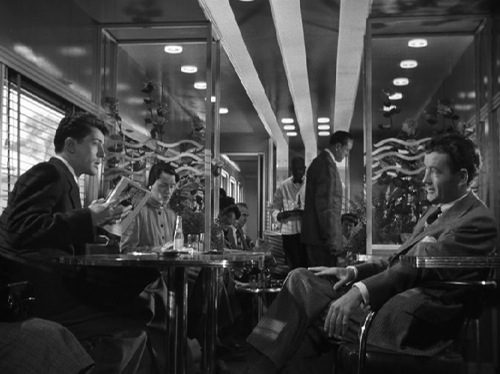
109. Strangers on a Train

Sunday, May 13, 2012

109. (13 May) /Strangers on a Train/ (1951, Alfred Hitchcock)* 79


101. All the Brothers Were Valiant

Saturday, April 7, 2012

101. (06 Apr) All the Brothers Were Valiant (1953, Richard Thorpe) 34


To its credit, I can't tell if All the Brothers Were Valiant was shot with rear projection, using models, or if most of it was actually done at sea. That alone merits a Cinematography nomination even if this can't hold a candle to The Robe or Shane. The balance of interiors and exteriors is especially well-balanced.

The film itself is a bit of a lame disaster. There's certainly action, adventure, and romance, but this is plainly a crummy adaptation of a sprawling novel. A sizable part of the film's middle for instance, fills us in on back-story in seemingly endless flashbacks. Despite having the least similar accents ever, Robert Taylor and Stewart Granger attempt to play brothers; their effort is less than valiant.

492. The Tree of Life

Wednesday, December 14, 2011

491. (11 Dec) /The Tree of Life/ (2011, Terrence Malick)* 94

490. The Girl with the Dragon Tattoo

Tuesday, December 13, 2011

490. (08 Dec) The Girl with the Dragon Tattoo (2011, David Fincher)* 74

478. War Horse

Friday, November 25, 2011

478. (24 Nov) War Horse (2011, Steven Spielberg)* 44


In its first act, it seems War Horse is trying to look and feel like a '40s countryside drama in the vein of Lassie Come Home. There are obligatory elements like an animal that can't be kept and a farm that's at risk of being lost. But where a '40s film like The Yearling would've matched glossiness with emotional impact, War Horse is more tonally akin to a '70s Disney feature. It slides in utterly surreal comic relief like a goose that nips at people's heels while it should be fleshing out characters.

The fundamental failing of the film -- aside from the plot being so incidental and uninteresting -- is that it never allows us to forge relationships with the characters. The horse is the only constant in the film. People come and go from his life. Tom Hiddleston has the most thankless role of all as an English officer who dies before we get even the faintest hint of his backstory. Spielberg's inability to contextualize the death of a significant supporting character at the start of a war is disturbing, and he does it at least a couple more times throughout the course of the film.

The only series of scenes not centered around the horse is where Jeremy Irvine, who trained has an unhealthy attachment to him, is his brief stint in the war where he sees a little bit of combat before being blinded by gas. Neither he nor any other human in the film gains insight into the hardship of war. The very final shot has the horse staring off into the sunset after returning home. It's a totally bizarre closing shot, as the lessons of war's cruelty have all been learned by the horse and not the humans. That might be impactful if this was an animated film where the horse can talk and pontificate, but there are enormous battle sequences and lives lost. It's a bit too serious to not articulate any big themes.

The inevitable conclusion where the boy and his horse are reunited is unabashedly contrived and manipulative. Oscar voters are sure to weep at the silly moment, but I was too exhausted from the preceding and present ridiculousness to care.

The cast is, not surprisingly, totally wasted. No one comes close to making an impression except Emily Watson. She's acting in a more serious, involving movie than everybody else.

The crafts are almost shockingly unremarkable. The cinematography is lacking as the film is supposed to have scope, but there's no memorable imagery to be found. John Williams' score is perhaps his most pounding and dreadful. He emphasizes every little aciton and movement, determined to turn this dull film into something exciting through sheer will. It will likely dominate the craft awards at the Oscars, but I've seen Spielberg do these exact same battles on a grander, more effective scale.

457. The Artist

Monday, November 7, 2011

457. (06 Nov) The Artist (2011, Michel Hazanavicius)* 48


The first thirty minutes of The Artist are lighter than air, suggesting a rather promising comedy. Then the film turns dramatic and whatever momentum was being gained is lost. A charming series of takes where Jean Dujardin and Bérénice Bejo's flirting interrupts filming on a movie they're making gives way to suicide attempts and house fires and all sort of melodramatic nonsense. The movie simply ceases to be any fun and, considering it's sustaining on the gimmick of being silent, that makes the last three-fourths of the film quite a chore. There are amusing moments along the way, mostly involving an adorable dog. It's one of the frothiest, dopiest movies I've seen in quite some time. I guess that certifies it as a Best Picture contender.

455. Hugo

Sunday, November 6, 2011

455. (05 Nov) Hugo (2011, Martin Scorsese)* 57


There are moments of fun and whimsy here that suggest Scorsese doing a kid's movie was not a total misfire. But the film itself can be deadly dull, making it unsuitable for younger viewers. It's also hard to believe they'd enjoy the last act's ode to Georges Melies. Broad supporting characters and their distracting subplots really derail the film. (A train in a dream within a dream literally derails around the same point the film itself does.) When an obligatory chase scene takes place late in the film, it's clear this has outstayed its welcome. Nevertheless, the crafts are lovely and Ben Kingsley is quite good.
 

Blogger news

Blogroll

Most Reading