Pages

Powered by Blogger.
Showing posts with label 1953. Show all posts

Double Feature: Alice Adams (1935) and Shane (1953)

Monday, July 2, 2012

Alice Adams:

Katharine Hepburn headlines as the titular character of George Stevens' comedy of socially-challenging proportions. As the daughter of a working man, she cannot present herself as frivolously as the other girls in town, and she is quite the scandal for it. Her world is shaken up when she must deal with the scandal of a new-found romance with the upstanding Arthur (Fred MacMurray) and the problem of her social position.

The film received only two nominations for Best Picture and Best Actress. It lost both of them, but Hepburn was very deserving of a what would have been her second Oscar at the time. The supporting cast was also passed over sadly.

Shane:

George Stevens' celebrated western (what range he had) features a roaming stranger (Ladd) who helps a terrorized family restore peace to their valley. Under the heel of an aged cattleman, the entire community is plagued with fear as he attempts to drive them out, even hiring a gunslinger (Palance) to intimidate them. Shane, a semi-retired gunman, must fight to keep the peace and take a final stand for his friends.

The film received nominations for Best Picture, Best Director, Best Supporting Actor (De Wilde), Best Supporting Actor (Palance), Best Screenplay, & Best Cinematography (Color). Loyal Griggs took home his (and the film's) only Oscar for Best Cinematography.

Gentlemen Prefer Blondes (1953) ***

Saturday, May 12, 2012

gen

In January 1953 President Truman announced that the United States had developed a hydrogen bomb. Later that same year, 20th Century Fox released its own double-barreled bombshell, Gentlemen Prefer Blondes, starring Jane Russell and Marilyn Monroe.  Christmas had obviously come early for men across America.

Based on the 1925 Anita Loos novel, Gentlemen Prefer Blondes: The Illuminating Diary of a Professional Lady, and the 1949 stage musical starring Carol Channing (really!), this Howard Hawks directed film is as raunchy as a musical could possibly be in 1953.  Start with the risqué costulittlerockmes, then gasp at the double-entendre laced dialogue, and finally delight in the outrageous song lyrics and choreography—it’s a cornucopia of hysterical crassness. 
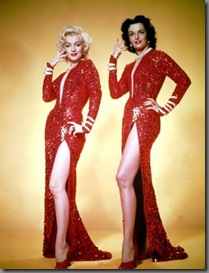
Long before actresses were expected to weigh 95 lbs. women actually had curves in the movies.  Voluptuous is the best word to describe Jane Russell and Marilyn Monroe—they had curves in all the right places.  Costume designer Travilla (read Christian Esquevin's article) did a spectacular job of showcasing the assets of his leading ladies.  From the very first scene, where the ladies sing “Just Two Little Girls from Little Rock” wearing red sequin gowns with slits up to the hinterlands and suicidal plunging necklines, you know this is a film about sex.  Even when they aren’t wearing their showgirl outfits their clothes are form-fitting and sexy.  Of course, the most iconic outfit is the dress that Monroe wears when she performs “Diamonds Are a Girl’s Best Friend.” Often imitated (think Madonna) but never surpassed, gentlemen-prefer-blondes-marilyn-monroe-02Monroe looks sensational—and like she’s eaten a few meals in her life.  Perhaps I shouldn’t say this, but I have often wondered if this dress was a metaphor for the female vagina (please cover the children’s eyes).  O’Keefe had her orchids, maybe Travilla had his pink silk gown with a huge bow on Monroe’s derriere?  Anyway, the first thing I think about whenever I see this movie is that all of the costumes are absolutely fabulous. 

This was certainly Charles Lederer’s best musical comedy screenplay.  It’s really a simple story about two showgirls looking for the right man. Lorelei Lee (Monroe) wants to marry a rich man (Tommy Noonan) to fulfill her lust for jewels—preferably diamonds—but she also wants love.  Dorothy Shaw (Russell) is a straight-talking gal who just wants an honest man.  When Loremarilyn-monroe-jane-russelllei’s man gets cold feet after his father threatens to cut him off, the ladies head off on a luxury liner to France. Along the way they meet the U.S. men’s Olympic team, a diamond mine owner (Charles Coburn), and a private detective (Elliott Reid).  When Lorelei gets caught with her hand in the jewelry box the girls find themselves down and out in Paris, and they have to begin performing again as showgirls. 

One of the best lines comes at the beginning of the film when one guys asks: “Say, suppose the ship hits an iceberg and sinks. Which one of them do you save from drowning?” and another guys answers, “Those girls couldn't drown.” Russell gets most of the best lines—she is playing opposite Monroe’s rather vapid character—but Monroe gets some zingers in too, such as when she responds to one of the Olympians who says he’s the only 4-letter man on the team with, “You should be ashamed to admit it.” No one played stupid as well as Monroe, and Russell always shined as a straight-shooting woman. 

So we have gorgeous costumes and witty dialogue and then we pair those two together with great musical numbers and we have a really good film.  Two songwriting teams (Leo Robin/Jule Styne and Hoagy Carmichael/Harold Adamson) were responsible for such memorable songs as: “Diamonds Are a Girl’s Best Friend”, “A Little Girl from Little Rock”, “When Love Goes Wrong”, and “Anyone Here for Love?”.  Of course, my favorite Monroe number is “Diamonds”.  The song itself is catchy:

A kiss may be grand, but it won't pay the rental on your humble flat.

Or help you at the automat.

Men grow cold as girls grow old, and we all lose our charm in the end.

But square-cut or pear-shaped, these rocks won't lost their shape.

Diamonds are a girl's best friend.

jane-russell-anyone-here-for-love-outfit1When you combine the set design and the choreography with such memorable lyrics it becomes musical magic.  While it is often overshadowed by Monroe’s “Diamonds” number, I find Russell’s “Anyone Here for Love?” production with the Olympic team highly entertaining.  The song is bawdy and Russell’s strutting amongst the inattentive athletes is overtly sexual, with such lyrics as:


I like big muscles

And red corpuscles

I like a beautiful hunk o' man

But I'm no physical culture fan

Ain't there anyone here for love, sweet love

diamEach song seems to be perfectly matched to the woman performing it.  As an extra treat, of course, we get to see Russell parody Monroe’s “Diamonds” number when she takes her place in court. 

Hollywood made some outstanding musicals in the 1950s (Singin’ in the Rain and Seven Brides for Seven Brothers being the finest), and I think Gentlemen Prefer Blondes falls into this group.  Which is strange, because I also think that it is an often overlooked musical gem.  People will always remember the “Diamonds” number, but I think that the overall film deserves more respect than it gets. 

101. All the Brothers Were Valiant

Saturday, April 7, 2012

101. (06 Apr) All the Brothers Were Valiant (1953, Richard Thorpe) 34


To its credit, I can't tell if All the Brothers Were Valiant was shot with rear projection, using models, or if most of it was actually done at sea. That alone merits a Cinematography nomination even if this can't hold a candle to The Robe or Shane. The balance of interiors and exteriors is especially well-balanced.

The film itself is a bit of a lame disaster. There's certainly action, adventure, and romance, but this is plainly a crummy adaptation of a sprawling novel. A sizable part of the film's middle for instance, fills us in on back-story in seemingly endless flashbacks. Despite having the least similar accents ever, Robert Taylor and Stewart Granger attempt to play brothers; their effort is less than valiant.

082. The Conquest of Everest

Thursday, March 8, 2012

082. (08 Mar) The Conquest of Everest (1953, George Lowe) 58


The clearest accomplishment here is giving a sense of the true height of Everest. At every turn, we're reminded that the peak dwarfs the highest mountain in Europe and that the venture to the top is seemingly endless. Photographing this was no doubt a nightmare, so the fact that it's a perk that it looks as good as it does. There are numerous pans upward to give an idea of how much further there is left to go.

The obvious issue here is that we don't interact with the men making the trek. They're often dots on the horizon. We're aware that their goal is near impossible, but without any interaction it's not easy sharing in their triumph.

065. Young Bess

Sunday, February 26, 2012

065. (25 Feb) Young Bess (1953, George Sidney) 39


Jean Simmons determines that she'll be an iconic Elizabeth I in Young Bess, but her overwrought, unconvincing performance says otherwise. Having seen Vanessa Redgrave in Anonymous in recent months, it's interesting to see another person approach Elizabeth I in such a baffling way. While Redgrave went for senility, Simmons goes for brattiness. She really doesn't have a singular moment that distinguishes her as a capable actress, though she's clearly been great in other things. It doesn't help that this finds Elizabeth in one of her least interesting phases of life profiling her romantic interest in Thomas Seymour.

The print on TCM looks clean, so I'm fairly certain this was restored recently. Some of the brighter colors pop, but for the most part this is absurdly dingy. It makes this a peculiar nominee for Art Direction and Costume Design. Most of the costumes are downright dowdy, albeit detailed. Those from The Virgin Queen from two years later put them to shame. The sets regularly look like typical sound stage fare. Only a couple banquets are particularly noteworthy.

The Rosza score is about as subtle as a slap to the face. (That's a nod to a hysterical scene where Simmons laughs at Stewart Granger while he insists she stop where it becomes clearer and clearer he'll slap her to make her stop.) The only saving graces here are Deborah Kerr as a genial Catherine Parr and Charles Laughton reprising his Henry VIII.

Double Feature: King Solomon's Mines (1950) and Julius Caesar (1953)

Monday, September 26, 2011

King Solomon's Mines:

Deborah Kerr and Stewart Granger star in this Technicolor adaptation of Allan Quatermain's quest to find a woman's husband who went looking for the mysterious diamond mines of King Solomon. Though it is dated, it is easy to see why an adventure film like this got nominated for Best Picture amidst films like All About Eve and Sunset Boulevard.

The film received nominations for Best Picture, Best Cinematography (Color), and Best Film Editing. Though it won for the latter two nominations, the Best Picture nomination could have been given to something like Harvey or The Third Man.

Julius Caesar:

This rendering of Shakespeare's tragedy features solid performances from James Mason (as Brutus), Marlon Brando (as Mark Antony), and John Gielgud (as Cassius). Director Joseph L. Mankiewicz allows the material (and what material!) to speak for itself, and Miklos Rozsa's score complements it nicely.

The film received nominations for Best Picture, Best Actor (Brando), Best Art Direction (B&W), Best Cinematography (B&W), and Best Score (Dramatic or Comedy Picture). Though Brando is good, Mason and Gielgud deserved to be nominated along with him.
 

Blogger news

Blogroll

Most Reading