Pages

Powered by Blogger.
Showing posts with label ***. Show all posts

Psycho (1960) ***

Wednesday, February 13, 2013

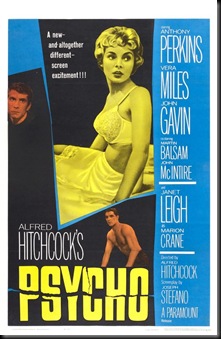
psycho (1)

Hello, my name is Marion Crane (Janet Leigh), and what you’re about to read is filled with what some call “spoiler alerts”.  If you wish to hear my story, spoilers included, then continue reading.

th (1)That’s me in the poster above—the blonde wearing a brassiere. Yes, it’s rather odd that a movie poster from 1960 would prominently display a woman clothed as such. What can I say, when the director (Alfred Hitchcock) is a complete pervert things like that happen. For example, my first scene finds me wearing that exact outfit and basking in the glow of just completing the act of copulation in a no-tell motel with my half-clothed lover, Sam Loomis (John Gavin). A few scenes later, after stealing $40,000th (2) (what the pervert refers to as a ‘MacGuffin’) from my boss (Vaughn Taylor), I am in another scene wearing a black bra.  I guess the white bra represented a cleaner state of mind—I was after all trying to end my illicit affair with Sam, who couldn’t marry me because he was paying alimony to his ex-wife and couldn’t afford a new one. Yes, I know that sounds lame, but that didn’t stop me from taking the money and thinking we could run away together. Hence, why I suspect I was wearing the black bra: dark thoughts had crept into my mind.

Anyway, after I put clothes on, I set out for Fairvale, California, to show Sam that we now had enough money to get married. We wouldn’t have to worry about his ex getting her greedy hands on any of it, as we would be on the lam. Ha! take that, bitch!  The drive from Phoenix to Fairvale was a long tmb_950_480one, so I pulled off the side of the road and took a nap. I awoke to a creepy, sunglass-wearing cop (Mort Mills) knocking on my window.  I must have aroused his suspicions because he gave me the once over and proceeded to follow me to a used car lot, where I was trading in my car for one with California plates. Tsk, tsk, copper, I was a law-abiding person when I bought my car, so you stopped following me. Too bad…

Once back on the road and away from the prying eyes of the police I encountered a torrential downpour that prohibited my migration to Fairvale, and psycho9so I stopped off at a roadside motel called the Bates Motel.  The owner, Norman (Anthony Perkins), immediately struck me as an oddball.  He, like the pervert, had a strange fascination with birds (he stuffed them) and a proclivity for voyeurism. I should have known he was a complete Psycho (1960) when after being invited into his parlor (oh, I hate parables!) he confided in me that “a boy’s best friend is his mother.”

Yet, that conversation convinced me that I should repent my wicked ways and return to Phoenix with the money (sans $700 that I paid for my new car). Wanting to wash away my sins I decided to take a shower. Off went my clothes, which Norman got more than an eyeful of by spying through his peephole, and into the shower I went.  I really enjoyed that shower—it felt (and looked) extremely sensual. Oh, that was until violins started screeching (thanks, Bernard Herrmann) and someone decided to carve me up like a Thanksgiving turkey. There I was: slowly, sliding down the bathroom wall, watching my blood being washed away—I quite literally got to see my life psycho-1960-showergo down the drain. Ah, such is life.  Later, Norman found me face-down on the bathroom floor and decided to use the shower curtain I tore down on my way to death as my burial shroud.  He then “buried” me and the $40k in the trunk of my car and placed us in a swamp behind the motel. Oddly enough, the car’s license plate read: NFB 418. I later learned that it stood for Norman Francis Bates. Coincidentally, St. Francis was the patron saint of birds (and many other animals) and my last name was Crane and I was planning on returning to Phoenix to resurrect my former innocent ways.  Now that I think of it, maybe it wasn’t such a coincidence after all.

About a week after that, my sister, Lila (Vera Miles) contacted a private detective (Martin Balsam) to find me.  They went to Fairvale and met with Sam, and once they ascertained that he knew nothing about either my theft or disappearance they began to work together.  Poor Detective Arbogast soon joined me in the john-gavin-e-vera-miles-in-una-scena-del-film-psycho-1960-133434swamp after he “met” Mrs. Bates.  Then, Sam and Lila came calling on Norman and his '”mother”. They soon learned the shocking truth: Norman suffered from a dual personality—he’d murdered Mrs. Bates and her lover ten years prior and kept her preserved bones in the house with him. Ah, such a perverted story could only be told by a complete master of perversion (as well as suspense).

Looking back on it all, I have to admit that it was a masterful tale of Oedipal psychological sexual repression tol1960-PSYCHO-0011d in a completely new and shocking way. Personally, I’d never heard of the central character (even if that bitch Lila/Vera got top-billing!) getting the axe before the story was halfway over. Oh, and the way that I got it (well, it was a knife) was just so shocking. I’m glad I can only remember it in black and white, because I’m sure it would have been much gorier in color.  And, of course, the twist at the end has inspired countless imitators (M. Night Shyamalan anyone?) over the years.  If I must forever be remembered as the first slashed horror victim, I say so be it. I had a scream doing it!

The Sting (1973) ***

Tuesday, January 15, 2013

1060173

Other than my husband, Mr. Clooney, there never was a sexier man than Paul Newman. As such, I would enjoy watching The Sting (1973) even if the story wasn’t extremely clever and the music memorable.  Thankfully, Oscar-winning director George Roy Hill’s Best Picture winner is all of those things and so much more. Nominated for ten Academy Awards (it won seven), The Sting is loaded with great performances and is a stylish production.

the-sting-1973The Oscar winning screenplay by David S. Ward was inspired by real life grifters Charley and Fred Gondorff.  In the film, Newman plays Henry Gondorff, an accomplished confidence man who knows how to stack the deck like no other person.  He becomes paired up with a hot-headed hustler named Johnny Hooker (an Oscar nominated Robert Redford) when a mutual friend (Robert Earl Jones) is rubbed out by no-nonsense crime boss Doyle Lonnegan (Robert Shaw).  To “sting” the mobster out of $500,000 the pair constructs an elaborate con game based on something called “the wire”. They enlist dozens of known con artists in and around Chicago to reign down their own special braTheStingnd of revenge on Lonnegan.  Along the way they must also evade a crooked cop (Charles Durning) and a cold-blooded assassin (Dimitra Arliss), and they must also try to do the one thing that no con worth their salt wants to do: they must trust one another to finish the big score.

It goes without saying that the story keeps you guessing. Will there be a double-cross? Who’s telling the truth?  How can Newman still look that hot at 48?  Ward’s script is smart and well-constructed.  I didn’t notice any fat that could have been trimmed; and, all of the elements of the plot folded together very nicely right up to the end.  I’m a fan of smart scripts, and this is definitely one of the smartest of the 1970s.

Strangely, what most people remember about the movie is its score. Marvin Hamlisch’s Oscar-winning adaptation of Scott Joplin’s rag is memorable.  For days after watching this I had the tune bouncing around in my head.  Both Joplin and ragtime saw a resurgence in popularity during the 19sting-2 (1)70s because of Hamlisch’s inspired (quite literally) soundtrack.

This was the second time Newman, Redford, and Hill worked together (they’d done Butch Cassidy and the Sundance Kid in 1969) and it showed.  There’s a familiarity to the two leads interactions onscreen that builds an instant camaraderie between their characters. Newman plays the elder splendidly, and Redford looks like he’s really taking mental notes from a master.  Personally (and perhaps selfishly), I wish Newman’s Gondorff was featured more in the film, but I can’t really complain about how much time is spent on Redford’s Hooker.  Still, a few2019-18278 more shots of those Newman eyes would have been nice…

Of course, no film can be good without a gifted supporting cast.  I adore Eileen Brennan, so of course I loved her Billie here.  While she may have not gotten as much screen time or dialogue as I would have liked, who can play a tough broad like Brennan?  And, of course, no one played an SOB like Robert Shaw, either.  It is reported that no one wanted to play Lonnegan and that Newman hand-delivered the script to him in London. The limp he incorporated into this role wsting79as a real one, as he had an accident one week prior to filming that injured his knee. 

Finally, kudos must be sent out to Edith Head’s Oscar-winning costume design and James Payne and Henry Bumstead’s Oscar-winning art direction.  The story takes place in 1936 and it looks like it.  The clothes, hairstyles, and mise en scène are all spot on.  Heck, they even used title cards to educate the audience on the various parts of a sting. 

Overall, I enjoyed The Sting. It’s a highly entertaining film that is filled with good performances and smart writing.  Plus, Newman just looks so damn sexy!

Apocalypto & the Mayan Prophecy (2006) ***

Thursday, December 20, 2012

apocalypto

It is rumored that the world will come to an end on December 21, 2012.  By whom, you ask?  Well, there’s a whole host of oracles out there, but the most famous doomsayers have to be the Mayans.  Their 1500+-year calendar ends on that date, and some believe this indicates that the Apocalypse will be upon us.  For my part, I feel as though I’ve been living through an apocalypse ever since the McRib was taken off McDonald’s full-time menu, so I eagerly await the four horseman as long as they are grilling McRibs over the fires of Gehinnom year-round.  MMMM…but back to the Mayans. Yes, there are many people who are predicting the end of the world—granted, mostly insane individuals. That said, who better to take on the Mayans’ own personal apocalypse than director Mel Gibson, who believes the Apocalypse began with Vatican II.

APOCALYPTO2Mel Gibson has directed four films (The Man Without a Face, Braveheart, The Passion of the Christ, and Apocalypto), all of which are unique in their own way. Still, his Passion and Apocalypto are significantly different, in that one is primarily in Aramaic (with a bit of Latin and Hebrew thrown in for good measure) and the other is in Yucatec Maya.  Gibson said he wanted his audience to suspend reality and engross themselves in the visual elements of these films.  I think it adds a realistic touch to both pictures, but I can’t help but wonder if he contemplated the fact that when some people are reading subtitles they can’t focus on anything but the words and then they miss the images. Ah, but who am I to argue with Gibson—I have it on good authority (his) that he is one tough motherf___er ( you fill in the blank, I don’t want the censors to get me).

If you haven’t seen the film (perhaps you don’t like foreign films…or films that appear foreign but really aren’t) let me give you a quick tutorial.  The story takes place on the eve of the Spanish conquest of the Yucatan Peninsula (think that place where Survivor likes to go all the time, Guatemala and lower Mexico) apocalypto-7and the Mayan people in the mid-1500s. Jaguar Paw (Rudy Youngblood) and his tribe are jungle dwellers who find themselves overtaken by warriors sent to capture human sacrifices and slaves.  It would seem that a plague has descended on the tribes who live outside the jungle, and the priests have said that only human blood will satisfy the god Kukulkan.  Prior to being taken captive by some really scary men, Jaguar Paw drops his pregnant wife and son down a hole.  His only goal is to escape his captors and return to what is left of his family. 

heartSeeing as the Mayans didn’t have guns or any type of sophisticated weaponry, the film is quite violent.  While bombs blow people up and bullets blow people’s heads off, spears, clubs, arrows, knives, and swords still draw blood.  You know a film is going to be bloodthirsty when one of the first scenes is a wild boar impaled by traps and then gutted for its organs which are passed out as gifts.  By the time you get to the human sacrifice scenes at the pyramid you are more than ready to watch the victims partake in this sacred ritual: stomach slit open; beating heart ripped out; head chopped off; head rolled 2680290314_df142ed30edown a very long row of steps; and, for good measure, the lifeless body thrown over the pyramid, too.  No one does human sacrifices like the Mayans—well, actually the Aztecs did them better, but still… If you don’t do blood, don’t do this film.

While the cast is comprised mostly of unknowns, the acting is quite good.  Even though he’s not asked to stretch himself too much, Youngblood is especially good as the determined Jaguar Paw.  Primarily known as a dancer, Youngblood thrives in scenes that require him to show off his agility and athleticism.  The more well-known Raoul Trujillo (who plays Apocalypto2 (1)the warrior leader Zero Wolf) is intimidating as the uncompromising villain. His character is the type of “native” you have nightmares about. 

Overall, what I liked most about the film is its simplicity.  It’s a treat to watch a movie where the plot is simple, the acting is natural, and the setting is not a product of CGI.  In addition, I found the ending jarring, but in a good way.  Plus, it does prove the Mayans were excellent prophets.  They were right about a plague descending upon them in the 1500s—AKA, the conquistadors. Does this spell doom for mankind in 2012? Maybe. According to the Mayan calendar, 2012 does bring an end to the Age of the Jaguar. Yes, that’s right, our hero’s name was Jaguar Pfinalaw.  So, if on December 21 you feel something like a shift in the earth’s magnetic field remember you have only one person to blame for what’s about to come next—Mel Gibson, he’s about to burn the entire motherf___ing world down. For my part, I’ll be looking for the flames that smell like a pork patty, BBQ sauce, onions, and pickles served on a 5½ inch roll.  If you like, feel free to join me.

It’s a Wonderful Life (1946) ***

Wednesday, December 5, 2012

Its-A-Wonderful-Life-its-a-wonderful-life-1237475_1329_1920

It is a myth that the suicide rate increases between Thanksgiving and Christmas.  However, the “most wonderful time of the year” is not always so wonderful for everyone.  Christmas cards, crowded stores, wrapping presents, and mounting debt can weigh heavily on the psyche. And, then there are those who have lost loved ones or feel as though they haven’t any loved ones at all.  For these people, the holiday season is a torturous time, full of regrets and sorrows.  What-ifs, should-haves, and if-onlys play cruel tricks on those who carry around ghosts and faded dreams in their troubled minds.  I suspect this is the reason that It’s a Wonderful Life (1946) has endured as a Christmas tradits-a-wonderful-life-failureition for more than fifty years. Everyone—yes, everyone—has a little of George Bailey running around in their subconscious.  As a wise person once told me, circumstance touches everyone—no one is immune.

I enjoy watching It’s a Wonderful Life every Christmas season because I can relate to George Bailey (James Stewart). An adventurer at heart but a duty-bound person in reality, George and I both made life-altering decisions based on the cards circumstance dealt us—even if that deck was full of jokers we played the game by the rule of responsibility; I expect many others can say the same.

For those unfamiliar with George’s story, it is a simple one. From a very young age George exceeded expectation: he saved his brother (Todd Karns) from drowning and prevented his drunken pharmacist boss (H.B. Warner) from accidentally poisoning someone. When his father (Samuel S. Hinds) died of a stroke he forwent a trip to Europe and then college to head the family’s struggling building and loan company. Instead of spending $2,000 on his tumblr_mbucxk8NL61qfoua5o1_250honeymoon he used it to stave off a run on the bank.  He invested in a town, Bedford Falls, and a group of people that at heart he wanted nothing more to do than to escape.  Along the way he married a girl (Donna Reed) he knew worshipped him, and agreed to live in a ramshackle house filled with children that required he continue in a job he hated in a town too small for his ambition. And then a bit of ironic circumstance slapped poor George in the face: his undoing was to come at the hands of his own obedience to duty and responsibility.  This, no doubt, was the last bitter pill that George could allow himself to swallow, and so he took it believing that at least he did what was best for others.  Ah, but what would have life been like for all those who benefitted from George’s benevolence and self-sacrifice if he had never existed?  It takes an angel (Henry Travers) seeking his wings to show George that what he viewed as a failed existence was of significant importance to so many others.  

In the end, It’s a Wonderful Life, is a redemption tale. Upon release some critics found the movie too sentimental and said that it idealized an unrealistic world.  By this time just about any film from director Frank Capra was labeled as overly-YCURTIS_P1.jpg_full_380sentimental by many critics (perhaps you are familiar with the term “Capra-corn”?), and so many overlooked the universal theme of circumstance—it touches everyone.  And, so this corny film that lost $525,000 in 1946, now draws millions of viewers every Christmas. I’ve heard many people say that they watch it to remind themselves that perhaps they didn’t live the life they wanted, but at least they lived the life they got.  They, like George Bailey (and myself), endure the circumstances of life. Perhaps you are not a religious person—you are the perfect candidate for this film which Capra made to combat atheism—but there is one particular Bible verse that applies to this movie. It is written in James 5:11 that “we count them happy which endure”.  Happily, the spirit of It’s a Wonderful Life continues to endure today. 

Of Gods and Men (Des hommes et des dieux) 2010 ***

Sunday, September 16, 2012

of-gods-and-men-poster-uk

While the Islamic world sets itself aflame with religious zeal due to perceived slights to the Prophet Mohammed by one very intolerant bigot I watched director Xavier Beauvois’ Of Gods and Men (2010). It tells the spiritually courageous story of eight French Trappist monks’ attempt to ride out the Algerian Civil War, which was a.10-year bloody struggle (1992-2002) for power between the government and Islamist rebel groups. The story takes place in the winter of ‘95-96 at the monks monastery, Notre-Dame de l'Atla2010_of_gods_and_men_0051 (1)s of Tibhirine, during a clash between rebels and the government.  As danger knocked at their ancient door, the monks had to decide whether they would remain true to their vocation or give into their fear of death.

Often when people watch films about contemplative religious (monks and nuns) they have a difficult time understanding the austerity and quietness in which these men and women live. As someone with a bit of experience with the religious life I suspect I have better insight into this world than most.  As such, I was not fazed when Beauvois chose to focus in on the internal (mostly silent) struggles of these men as they grappled with their desire to stay true to their calling while at the same time fearing death.  Still, crises of faith, especially ones that remain mostly unspoken, don’t exactly make for riveting cinema for most viewers.  There are many long, static shots of still silence in this, and for some that can come off as boring.  I expect many viewers asked themselves why Beauvois chose not to have the men’s internal dialogues spoken in voiceover.  Ah, but it’s all about their facial expressions and body language—that’s how you understand what they are thinking.  If you can convey this without vocalizing it then you, as a director and as an actor, have done something special. 

GODS-articleLargeOther than Michael Lonsdale, who plays Brother Luc, most of the actors here are relatively unknown to audiences outside of France.  Some may be familiar with the work of Lambert Wilson (especially fans of The Matrix films), who plays Brother Christian, but the other six monks are played by French character actors. The one thing a character actor knows how to do is how to use his/her face and body in a scene.  They don’t always have a lot of dialogue, so they have to make up for this with stage/screen presence.  This is exactly the type of actor Beauvois needed to fill the roles of his often silent monks.  Dialogue hogs have a tendency to become hammy when they have limited lines, so it was an inspired decision to use actors who weren’t used to having to speak a lot on screen.  1018938-18As a result, all eight men give delightfully nuanced performances which make you believe that they are monks.  Of course, for me Lonsdale’s Brother Luc is the most memorable of the men.  Perhaps it was his age-induced haggard look and his lumbering gait, or maybe it was those weary soul-full eyes of his, but he fully embodied so many religious that I have come across in my life.  He deservedly won a Best Supporting Actor César (France’s Oscar) for the greatest performance of his long, storied career. 

While there are many expertly designed scenes to discuss, I would like to focus on my favorite: Beauvois’ homage to The Last Supper. Set to Tchaikovsky’s Swan Lake (op. 20 Moderato), the monks gather around their communal table to partake in what one would assume they viewed as a meal of reprieve. Having overcome their personal struggles about whether to flee danger or to stay true to the words of John 10:12: “a good shepherd does not abandon his flock,” the men are at peace with themselves and one another. As they silently and reverently listen to that beautiful composition a wave of emotion washes over each man’s face.  In one of the more powerful scenes I’ve seen in recent cinema, Beauvois employs extreme close-ups of every man’s face.  This elicits an extremely powerful emotional reaction from the viewer (at least it did for me).  Knowing what will 184006231_640soon befall seven of these men, of course, makes it an even more bittersweet view of what can only be seen as unmitigated joy at being alive and at peace with themselves.  (While I don’t do this often, I invite you to watch this clip: http://vimeo.com/27678110)

Overall, Of Gods and Men is an emotionally riveting film.  The peace with which these men lived is inspirational. At a time when there is so much religious unrest in the world it is good to know that there are some people who still believe in peace, tolerance and human goodness.

Se7en (1995) ***

Wednesday, August 1, 2012


Se7en-1995-mygeeespot.blogspot.com.title

For some reason, cultured serial killers are always the worst. When they base their heinous acts on biblical and classical literature they seem to creep me out more than their illiterate chainsaw wielding counterparts.  Perhaps it’s because I work and live in a world based on knowing and disseminating knowledge. Of course, it doesn’t help that this type of character usually looks harmless, as does Kevin Spacey’s John Doe in Se7en (1995).  Doe bases his murderous acts on the seven deadly sins (more properly known as the Cardinal Sins) and uses quotations from the likes of Aquinas, Chaucer, Dante, and Milton to leave messages for the detectives pursuing him (Brad Pitt and Morgan Freeman).  Atmospheric and edgy, Se7en is an uncomfortable look at the depravity of the times in which we live.

Freeman plays Detective William Somerset, a well-read but world-weary man who finds himself seven days from retirement when he catches a serial killer casese7en-pitt-freeman that he’d rather not have.  He is joined on the case by his soon-to-be replacement, Detective David Mills (Pitt), a jaded but still naïve cop who has recently transferred to the police department. The lead character’s name was not randomly chosen by screenwriter Andrew Kevin Walker—he named Somerset after his favorite author, W. Somerset Maugham.  This only adds to the literary allusions throughout the film, when several well-known passages are referenced throughout.  I would even venture to guess that the character of Mills is some type of  proxy for John Stuart Mill and his utilitarianistic harm principle, where each individual has the right to act as they want, so long as these actions do not harm others.

That philosophy, of course, is put to the test when Mills and Somerset come up against a serial killer who thinks he’s doing the world a favor by ridding it of the dregs of society. When explaining why he murdered his innocent victims he says, “Only in a world this shitty could you even try to say these were innocent people and keep a straight face.” SevenAnd, that’s the point—they live in some type of apocalyptic world where everything is gray-toned and it never seems to cease raining unless you go out into the countryside.  Evidently the horrible acts carried out by Doe in this No-name city are nothing too out of the ordinary.  This is the reason Somerset wants out and says as much when he explains to Mills why he’s ready to retire: “I just don't think I can continue to live in a place that embraces and nurtures apathy as if it was virtue.” It sucks in No-name city, and the people who live there are complicit in every awful thing that transpires there.  Those who think they can rise above it, like Mills, find themselves completely enveloped by its sinister ways. 

While we are spared watching the sickening murders take place, we do have the unwelcome experience of seeing the aftermath of Doe’s actions. Gruesome crime scenes abound, and while they are not as stomach-turning as what you would find in a slasher movie, they are still difficult to look at.  His take on the seven deadly sins is rather imaginative, so I suppose if I were grading his psychopathic artistry I’d have to give him an A.  For me, his '”sloth” endeavor is the more memorable slothof all his “masterpieces”.  That emaciated body sputtering to life sent a jolt throughout my entire body.  Obviously this was the point in Spacey’s career when he embraced his darker side by playing both Doe here and Verbal Kint in The Usual Suspects (1995) in 1995. He must have picked up a few pointers from Anthony Hopkins’ turn in The Silence of the Lambs (1991) about how to play a cool and calculating serial killer, because he does a nice job of not overplaying Doe’s depravity. 

somAs for Pitt and Freeman, both do admirable jobs with their respective characters.  Freeman, in particular, does an outstanding job as Somerset.  Everyone knows he can deliver his lines with that god-like voice of his, but it is more his non-verbal work here that resonates.  When you are playing a man who is tired of the world it only makes sense that your character should appear physically and mentally drained—Somerset does. Perhaps it’s the way he carries Somerset or how he keeps his eyes and facial features in an almost constant state of underlying tension that makes me believe he has had enough of No-name city and the human race.  The look on his face when he opens up the box of vengeance (I won’t spoil it for those who haven’t seen the film) is priceless. 

My biggest complaint with Se7en is Gwyneth Paltrow as Mills’ wife Tracy.  While I know the character is necessary for plot reasons, Paltrow’s performance iseven www.moviesat300.blogspot.com screenshotss just beyond boring.  Sure, her character is depressed about living on a subway line in a city where she doesn’t know anyone, but that doesn’t mean she has to be mind-numbingly tiring  to watch.  This role does not suit her at all and would have been better cast with the likes of Juliette Lewis or Marisa Tomei.  Oh, and to make things worse, it was on this film that Pitt and Paltrow became romantically involved, which resulted in more than 2-years of annoying gossip fodder. 

Overall, I think Se7en is a highly enjoyable psychological thriller.  It makes you really examine the world in which you live and contemplate how complicit you are in what is happening around you.  Plus, the ending is just beyond shocking and memorable. 

Ordinary People with Extraordinary Issues (1980) ***

Saturday, June 9, 2012


53ordinary-people1

Ordinary People (1980) was nominated for six Academy Awards; it won four. To this day, some people are still upset over the fact that Ordinary People won the Best Picture Oscar over Raging Bull (1980).  These same individuals will also debate you to death about how ridiculous it was that the film’s first-time director, Robert Redford, beat out Martin Scorsese as Best Director.  While I find Raging Bull mildly better than Ordinary People, I can’t bring myself to say that Scorsese’s film was robbed, either.  Each had its strengths; it just so happens that voters that year went for an understated drama over a powerful one.  Of course, there is one true issue to be had with the 1980 Academy Awards—how could Timothy Hutton be nominated (and win) Best Supporting Actor for a film in which he was without a doubt the primary lead?  That, to me at least, is the biggest head scratcher. 

OrdinaryPeopleBased on the 1976 novel of the same name by Judith Guest, the film tells the story of an upper-class Midwestern family’s gradual destruction following the death of a child.  Hutton plays Conrad Jarrett, a teenager dealing with survivor’s guilt.  Conrad is plagued with flashbacks of the horrible night in which he and his brother Buck (Scott Doebler), were involved in a sailing accident in which Buck drowned.  Having just been released from a mental hospital after attempting to slit his wrists, Conrad struggles to deal with his depression and his mother’s (Mary Tyler Moore) indifference.  The very shaky glue that attempts to bind mother and son is Conrad’s father, Calvin (Donald Sutherland).  The Oscar winning screenplay focuses on what happens when polite appearances are shattered by callous truths.  Of course, no one in the family is willing to admit wmarhat those harsh truths are, and so it takes a good psychiatrist (Oscar-nominated Judd Hirsh) to bring the Jarrett men to the conclusion that not everything is neat and easy.

Mary Tyler Moore was a complete revelation as Beth Jarrett. Primarily known as a comedic actress, who emitted warmth and enthusiasm in her famous sitcom roles, Moore plays a cold, unfeeling woman in this film.  Beth is always perfect—her hair, clothes, and house are always immaculate.  Yet, she has a dirty little secret: she despises weakness, especially if it involves emotions.  Her interactions with a son who is obviously begging for her love and compassion are almost too brutal to watch.  Mind you, Ordinary_People-Momhugshe is not evil or malicious—she just refuses to connect with him.  The most painful scene in the entire film is when after having an emotional breakthrough of his own Conrad hugs her and she stiffly sits with a frozen look on her face. Moore was nominated for a Best Actress Oscar and she deserved it.  She makes you want to scream at the screen, “Wrap your arms around him you cold-hearted bitch!” Her scenes with Sutherland are just as powerful, especially the final one in which he tells her the truth about who she really is. 

Hutton, for his part, gives an understated performance that is propped up by fine supporting turns by Sutherland and Hirsch. Like Moore, Hirsch was known primarily as a sitcom actor, and so his Dr. Berger’s crass language and matter-of-fact demeanor was a surprise to many.  Still a teenager himself, Hutton had to run the emotional gamut in this role: remorse, guilt, despair, love, fear, and happiness.  As I said ORD003AHearlier, he was the star of Ordinary People and to label him as a supporting actor was completely ridiculous.  And, Sutherland, does an admirable job of playing a man struggling to keep what’s left of his family together. 

Other than the gripping story and the fine acting, what most people remember about the film is its music, specifically the constant presence of Pachelbel’s Canon.  Baroque in style and so composed in such a way as to produce dramatic emotions, the Canon was an interesting choice of thematic music for Ordinary People. For those unfamiliar with it, the Canon employs three voices (or players) that engage in the same music (this is a canon in music) but then there is also a fourth voice (the bass) that plays an independent part.  Right about now you’re asking yourself what is the point of this ordinary peoplemusic lesson, right?  Well, I believe the choice of the Canon has symbolic meaning in that Conrad, Beth, and Calvin play the canon voices, while Buck (or perhaps Dr. Berger) plays the bass voice. Still, whether there was symbolism behind its choice or not, the Canon is expertly used throughout the film. 

Overall, Ordinary People is a gut-wrenching family drama that examines the meaning of both guilt and disconnectedness.  For anyone who may have had a less than warm relationship with a parent or struggled with survivor’s guilt, it might provide some insight into the human condition.  While it may not be as emotionally packed as Raging Bull, it quietly makes a statement about the meaning of loss. 

Gentlemen Prefer Blondes (1953) ***

Saturday, May 12, 2012

gen

In January 1953 President Truman announced that the United States had developed a hydrogen bomb. Later that same year, 20th Century Fox released its own double-barreled bombshell, Gentlemen Prefer Blondes, starring Jane Russell and Marilyn Monroe.  Christmas had obviously come early for men across America.

Based on the 1925 Anita Loos novel, Gentlemen Prefer Blondes: The Illuminating Diary of a Professional Lady, and the 1949 stage musical starring Carol Channing (really!), this Howard Hawks directed film is as raunchy as a musical could possibly be in 1953.  Start with the risqué costulittlerockmes, then gasp at the double-entendre laced dialogue, and finally delight in the outrageous song lyrics and choreography—it’s a cornucopia of hysterical crassness. 

Long before actresses were expected to weigh 95 lbs. women actually had curves in the movies.  Voluptuous is the best word to describe Jane Russell and Marilyn Monroe—they had curves in all the right places.  Costume designer Travilla (read Christian Esquevin's article) did a spectacular job of showcasing the assets of his leading ladies.  From the very first scene, where the ladies sing “Just Two Little Girls from Little Rock” wearing red sequin gowns with slits up to the hinterlands and suicidal plunging necklines, you know this is a film about sex.  Even when they aren’t wearing their showgirl outfits their clothes are form-fitting and sexy.  Of course, the most iconic outfit is the dress that Monroe wears when she performs “Diamonds Are a Girl’s Best Friend.” Often imitated (think Madonna) but never surpassed, gentlemen-prefer-blondes-marilyn-monroe-02Monroe looks sensational—and like she’s eaten a few meals in her life.  Perhaps I shouldn’t say this, but I have often wondered if this dress was a metaphor for the female vagina (please cover the children’s eyes).  O’Keefe had her orchids, maybe Travilla had his pink silk gown with a huge bow on Monroe’s derriere?  Anyway, the first thing I think about whenever I see this movie is that all of the costumes are absolutely fabulous. 

This was certainly Charles Lederer’s best musical comedy screenplay.  It’s really a simple story about two showgirls looking for the right man. Lorelei Lee (Monroe) wants to marry a rich man (Tommy Noonan) to fulfill her lust for jewels—preferably diamonds—but she also wants love.  Dorothy Shaw (Russell) is a straight-talking gal who just wants an honest man.  When Loremarilyn-monroe-jane-russelllei’s man gets cold feet after his father threatens to cut him off, the ladies head off on a luxury liner to France. Along the way they meet the U.S. men’s Olympic team, a diamond mine owner (Charles Coburn), and a private detective (Elliott Reid).  When Lorelei gets caught with her hand in the jewelry box the girls find themselves down and out in Paris, and they have to begin performing again as showgirls. 

One of the best lines comes at the beginning of the film when one guys asks: “Say, suppose the ship hits an iceberg and sinks. Which one of them do you save from drowning?” and another guys answers, “Those girls couldn't drown.” Russell gets most of the best lines—she is playing opposite Monroe’s rather vapid character—but Monroe gets some zingers in too, such as when she responds to one of the Olympians who says he’s the only 4-letter man on the team with, “You should be ashamed to admit it.” No one played stupid as well as Monroe, and Russell always shined as a straight-shooting woman. 

So we have gorgeous costumes and witty dialogue and then we pair those two together with great musical numbers and we have a really good film.  Two songwriting teams (Leo Robin/Jule Styne and Hoagy Carmichael/Harold Adamson) were responsible for such memorable songs as: “Diamonds Are a Girl’s Best Friend”, “A Little Girl from Little Rock”, “When Love Goes Wrong”, and “Anyone Here for Love?”.  Of course, my favorite Monroe number is “Diamonds”.  The song itself is catchy:

A kiss may be grand, but it won't pay the rental on your humble flat.

Or help you at the automat.

Men grow cold as girls grow old, and we all lose our charm in the end.

But square-cut or pear-shaped, these rocks won't lost their shape.

Diamonds are a girl's best friend.

jane-russell-anyone-here-for-love-outfit1When you combine the set design and the choreography with such memorable lyrics it becomes musical magic.  While it is often overshadowed by Monroe’s “Diamonds” number, I find Russell’s “Anyone Here for Love?” production with the Olympic team highly entertaining.  The song is bawdy and Russell’s strutting amongst the inattentive athletes is overtly sexual, with such lyrics as:


I like big muscles

And red corpuscles

I like a beautiful hunk o' man

But I'm no physical culture fan

Ain't there anyone here for love, sweet love

diamEach song seems to be perfectly matched to the woman performing it.  As an extra treat, of course, we get to see Russell parody Monroe’s “Diamonds” number when she takes her place in court. 

Hollywood made some outstanding musicals in the 1950s (Singin’ in the Rain and Seven Brides for Seven Brothers being the finest), and I think Gentlemen Prefer Blondes falls into this group.  Which is strange, because I also think that it is an often overlooked musical gem.  People will always remember the “Diamonds” number, but I think that the overall film deserves more respect than it gets. 

The African Queen (1951) ***

Wednesday, April 18, 2012

The_African_Queen_(1951)

Something happened to Katharine Hepburn in the 1950s that was both a blessing and a curse: she started playing a lot of spinsters. Some of these spinsters were painful to watch (think The Rainmaker and Summertime), but thankfully her turn as Rose Sayer in The African Queen (1951) was the perfect vehicle for her maturing talents. She had adept screenwriters (James Agee and John Huston); an accomplished director (John Huston); an award-winning cinematographer (Jack Cardiff); and, an age-appropriate co-star (Humphrey Bograt)—all of these essential elements allowed Hepburn to turn Rose into the best spinster portrayal of her storied career. 

Based on C.S. Forester’s 1935 novel The African Queen, aqthe story takes place at the beginning of WWI in 1914 in German East Africa.  An old-maid missionary (Hepburn) finds herself in a difficult situation after her Methodist minister brother (Robert Morley) is beaten by German soldiers and later dies of a fever.  Alone in the middle of the jungle, Rose is rescued by rough-looking steamboat (a very small one, named, you guessed it The African Queen) captain Charlie Allnut (Bogart), a man who delivers supplies and mail along the Ulanga River.  After learning that the boat is carrying the necessary supplies to make a torpedo, Rose attempts to convince Charlie that they should make one and then use it against a German gunboat as an act of patriotism (he’s Canadian, which at the time was still a part of the British Empire). While attempting to dissuade Rose from her suicidal plan, Charlie often finds himself at odds with the headstrong nature of his prim companion. What ensues is an adventurous love story between complete opposites in the middle of the African jungle.

Most people who have read Forester’s novel will tell you that the movie is ten times better. This is not to say that screenwriters Agee and Huston changed a lot when they African 5 Ginadapted the book, because they only made a few minor changes—most notably turning Charlie into a Canadian instead of a Cockney Londoner because Bogart couldn’t pull off the accent—but because the story plays better on screen than on the page.  They received an Oscar nomination for their crisp, smart dialogue and their ability to turn a somewhat turgid book into a sweeping adventure story. Writing lines for two completely opposite personalities can be challenging (you don’t want one to dominate the other too much) and that’s where I think Agee and Huston do a great job.  Perhaps my favorite exchange is this one:

Charlie: A man takes a drop too much once in a while, it's only human nature.

Rose: Nature, Mr. Allnut, is what we are put in this world to rise above.

The characters’ words never seem forced and they always sound appropriate.  I wish more screenwriters wrote dialogue like this.

John Huston also received an Oscar nomination for his direction of the film.  While he and Bogart were cut from the same cloth, dealing with Hepburn in the middle of the jungle could have been a nightmare if he hadn’t approached her in the right way. He obviously was successful in this endeavor because Hepburn later huston_hepburn-e1316696277793-550x431said that it was “the goddamnedest best piece of direction” she ever received.  As if dealing with two of Hollywood’s biggest stars wasn’t enough, the film was shot primarily on location in central Africa (although for safety reasons all of the scenes where Bogart and Hepburn are in the water were filmed in a studio water tank).  Just the logistics alone were bad enough, not to mention the fact that it was being filmed by huge Technicolor cameras.  Sickness ran rampant on the set and the weather conditions were unbearable at times.  In the end, it turned out to be one of the best films of Huston’s career. 

Besides the off-beat love story, what is most remembered about the movie is its cinematography.  Can you really shoot a film in the middle of the African jungle in anything other than Techthe-african-queen-katharine-hepburn-everettnicolor?  Vivid and lush, the color pops off the screen.  Cinematographer Jack Cardiff was known for his experimental use of Technicolor. His use of the dye-process color system made him the go-to cinematographer for the likes of Powell & Pressburger and Hitchcock.  Yet, he was also extremely adept in his lighting techniques.  There’s a story about how Bogart told Cardiff that it had taken him years to get the lines on his face and that he didn’t want Cardiff to wash them out with lights. Bogart might have kept his lines, but Hepburn never looked better in color.  Rose was supposed to be 33-years old, while Hepburn was in her mid-40s when the picture was shot; yet, I can’t recall a color film where Hepburn looked so real—her take me as I am (with limited lighting hijinks) made her look like the beauty she was.  What makes this even more impressive is that throughout most of filming Hepburn was extremely ill with dysentery—and still she looked good, which no doubt she owed to Cardiff’s mastery.

Finally, what I think makes this Hepburn’s best spinster role is that her co-star is Bogart.  Slightly seven years older than Hepburn, Bogart looked like the kind of man who could fall for an aging old maid.  Rough and grizzled, Bogart had the necessary praq1esence to stand next to a woman who could be perceived as domineering.  Perhaps this is why he won his only Academy Award for this role—he stood his own against one of the most powerful actresses to grace the silver screen.  When you compare his Charlie to the likes of Rossano Brazzi in Summertime (1955) and Burt Lancaster in The Rainmaker (1956) it’s easy to see where those films faltered while The African Queen thrived. While Hepburn received Academy Award nominations for all three of these films, this was the one she seemed the most believable in, which I believe is a direct result of who her co-star was.  I believe this is the inherent reason why The African Queen endures while Hepburn’s other spinster films are often pushed aside and/or forgotten. 


Blogger news

Blogroll

Most Reading