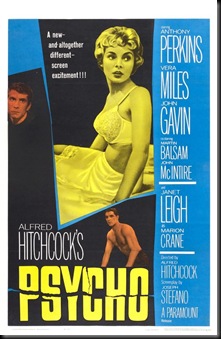
Hello, my name is Marion Crane (Janet Leigh), and what you’re about to read is filled with what some call “spoiler alerts”. If you wish to hear my story, spoilers included, then continue reading.
 That’s me in the poster above—the blonde wearing a brassiere. Yes, it’s rather odd that a movie poster from 1960 would prominently display a woman clothed as such. What can I say, when the director (Alfred Hitchcock) is a complete pervert things like that happen. For example, my first scene finds me wearing that exact outfit and basking in the glow of just completing the act of copulation in a no-tell motel with my half-clothed lover, Sam Loomis (John Gavin). A few scenes later, after stealing $40,000
 (what the pervert refers to as a ‘MacGuffin’) from my boss (Vaughn Taylor), I am in another scene wearing a black bra. I guess the white bra represented a cleaner state of mind—I was after all trying to end my illicit affair with Sam, who couldn’t marry me because he was paying alimony to his ex-wife and couldn’t afford a new one. Yes, I know that sounds lame, but that didn’t stop me from taking the money and thinking we could run away together. Hence, why I suspect I was wearing the black bra: dark thoughts had crept into my mind.
Anyway, after I put clothes on, I set out for Fairvale, California, to show Sam that we now had enough money to get married. We wouldn’t have to worry about his ex getting her greedy hands on any of it, as we would be on the lam. Ha! take that, bitch! The drive from Phoenix to Fairvale was a long  one, so I pulled off the side of the road and took a nap. I awoke to a creepy, sunglass-wearing cop (Mort Mills) knocking on my window. I must have aroused his suspicions because he gave me the once over and proceeded to follow me to a used car lot, where I was trading in my car for one with California plates. Tsk, tsk, copper, I was a law-abiding person when I bought my car, so you stopped following me. Too bad…
Once back on the road and away from the prying eyes of the police I encountered a torrential downpour that prohibited my migration to Fairvale, and  so I stopped off at a roadside motel called the Bates Motel. The owner, Norman (Anthony Perkins), immediately struck me as an oddball. He, like the pervert, had a strange fascination with birds (he stuffed them) and a proclivity for voyeurism. I should have known he was a complete Psycho (1960) when after being invited into his parlor (oh, I hate parables!) he confided in me that “a boy’s best friend is his mother.”
Yet, that conversation convinced me that I should repent my wicked ways and return to Phoenix with the money (sans $700 that I paid for my new car). Wanting to wash away my sins I decided to take a shower. Off went my clothes, which Norman got more than an eyeful of by spying through his peephole, and into the shower I went. I really enjoyed that shower—it felt (and looked) extremely sensual. Oh, that was until violins started screeching (thanks, Bernard Herrmann) and someone decided to carve me up like a Thanksgiving turkey. There I was: slowly, sliding down the bathroom wall, watching my blood being washed away—I quite literally got to see my life  go down the drain. Ah, such is life. Later, Norman found me face-down on the bathroom floor and decided to use the shower curtain I tore down on my way to death as my burial shroud. He then “buried” me and the $40k in the trunk of my car and placed us in a swamp behind the motel. Oddly enough, the car’s license plate read: NFB 418. I later learned that it stood for Norman Francis Bates. Coincidentally, St. Francis was the patron saint of birds (and many other animals) and my last name was Crane and I was planning on returning to Phoenix to resurrect my former innocent ways. Now that I think of it, maybe it wasn’t such a coincidence after all.
About a week after that, my sister, Lila (Vera Miles) contacted a private detective (Martin Balsam) to find me. They went to Fairvale and met with Sam, and once they ascertained that he knew nothing about either my theft or disappearance they began to work together. Poor Detective Arbogast soon joined me in the  swamp after he “met” Mrs. Bates. Then, Sam and Lila came calling on Norman and his '”mother”. They soon learned the shocking truth: Norman suffered from a dual personality—he’d murdered Mrs. Bates and her lover ten years prior and kept her preserved bones in the house with him. Ah, such a perverted story could only be told by a complete master of perversion (as well as suspense).
Looking back on it all, I have to admit that it was a masterful tale of Oedipal psychological sexual repression tol d in a completely new and shocking way. Personally, I’d never heard of the central character (even if that bitch Lila/Vera got top-billing!) getting the axe before the story was halfway over. Oh, and the way that I got it (well, it was a knife) was just so shocking. I’m glad I can only remember it in black and white, because I’m sure it would have been much gorier in color. And, of course, the twist at the end has inspired countless imitators (M. Night Shyamalan anyone?) over the years. If I must forever be remembered as the first slashed horror victim, I say so be it. I had a scream doing it!


