Showing posts with label greer garson. Show all posts
Pride and Prejudice(1940).
Monday, November 26, 2012
A film adaptation of Jane Austen's novel of the same name. Robert Z. Leonard directed. Cast: Greer Garson, Mary Boland, Maureen O'Sullivan. The film begins when the girls are out shopping for new dresses when they see two gentlemen and a lady in a beautiful carriage. They learn that the men are Mr. Bingley, who is renting the estate of Netherfield and Mr. Darcy, both wealthy, eligible bachelors. After the Bennets return home, Mrs. Bennet tries to talk Mr. Bennet, into seeing Mr. Bingley, but he refuses, saying that they have already met.
At the ball, Elizabeth overhears Mr. Darcy talking about not wanting to dance with her. She also meets for the first time Mr. Wickham. Later, as it turns out.. Mr. Darcy does ask her to dance, but she refuses, when Mr. Wickham asks her right in front of Darcy, she accepts.
The Bennets' cousin, Mr. Collins, arrives, looking for a wife and sets his sights on Elizabeth. Mr. Darcy, sees her distress and asks her to dance. After seeing the obnoxious behavior of her mother and younger sisters, he leaves again.
The next day, Mr. Collins asks her to marry him, but she refuses. He then asks her best friend, Charlotte Lucas, to marry him.
When Elizabeth visits Charlotte in her new home, she is introduced to Lady Catherine de Bourgh, and also sees Mr. Darcy there.
Later, he asks her to marry him, because she believes he stole Wickham's fortune, and also because he broke up the romance between Mr. Bingley and Jane, she refuses.
When Elizabeth returns to Longborn, she learns that Lydia has eloped with Wickham. Mr. Darcy tells her that Wickham will never marry Lydia and that Wickham had tried to elope with his 15-year-old sister, Georgiana. Elizabeth, soon realizes that she is in love with him, but believes he will never see her again because of Lydia's disgraceful elopement. Lydia and Wickham, do return home married. Lady Catherine, tells the family that Mr. Darcy found Lydia and forced Wickham to marry her. Will Darcy and Elizabeth ever admit their love for each other?
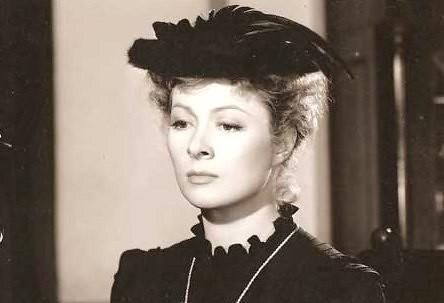
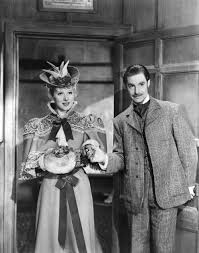
Greer Garson, did a wonderful job playing the feisty, high spirited.. Elizabeth. In this light and humorous classic film adaptation. Laurence Olivier, performed well as the prideful Darcy. The supporting cast also is good, especially Edmund Gwenn, as the very eccentric Mr. Bennet.
Fun Facts:
The studio's first choice for Darcy was Clark Gable.
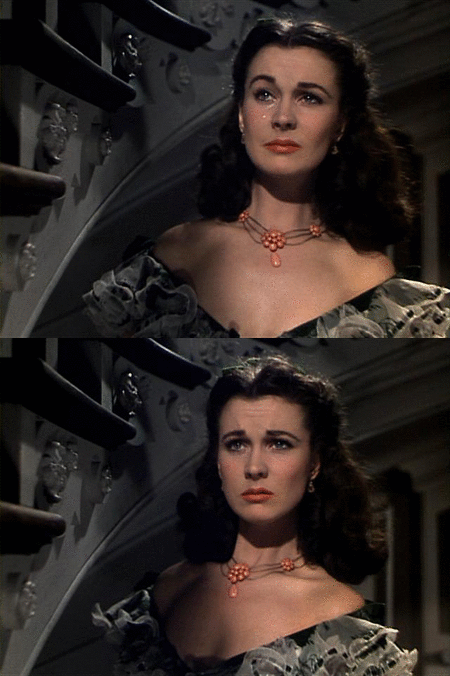
Vivien Leigh was passed over for the role of Elizabeth Bennett in favor of Greer Garson.
According to Edward Maeder, Adrian, the costume designer, asked director Robert Z. Leonard to place the film in a later time period than that of the novel so that the costumes might be more opulent than those of Jane Austen's time.
Initially scheduled to start pre-production in 1936, under the supervision of Irving Thalberg with his wife, Norma Shearer as Elizabeth Bennett, but pre-production was put to a halt after Thalberg's death.
MGM considered Robert Donat and Robert Taylor to play Mr. Darcy, and Norma Shearer supposedly wanted MGM to borrow Errol Flynn from Warner Bros. for the role.
Laurence Olivier ( 22 May 1907 – 11 July 1989) career as a stage and film actor spanned more than six decades and included a wide variety of roles: Shakespeare's Othello and Sir Toby Belch in Twelfth Night to the sadistic Nazi dentist Christian Szell in Marathon Man and the Nazi-hunter in The Boys from Brazil.
A High church clergyman's son who found fame on the West End stage, Olivier became determined early on to master Shakespeare, and eventually came to be regarded as one of the foremost Shakespeare interpreters of the 20th century. He continued to act until the year before his death in 1989.
Olivier played more than 120 stage roles: Richard III, Macbeth, Romeo, Hamlet, Othello, Uncle Vanya, and Archie Rice in The Entertainer.
He performed in nearly sixty films, including: William Wyler's Wuthering Heights, Alfred Hitchcock's Rebecca, Stanley Kubrick's Spartacus, Otto Preminger's Bunny Lake Is Missing, Richard Attenborough's Oh! What a Lovely War, and A Bridge Too Far, Joseph L. Mankiewicz's Sleuth, John Schlesinger's Marathon Man, Daniel Petrie's The Betsy, Desmond Davis' Clash of the Titans, and his own Henry V, Hamlet, and Richard III.
He also preserved his Othello on film, with its stage cast virtually intact. For television, he starred in The Moon and Sixpence, John Gabriel Borkman, Long Day's Journey into Night, Brideshead Revisited, The Merchant of Venice, Cat on a Hot Tin Roof, and King Lear, among others.
Pawsome Pet Pictures: Greer Garson.
Wednesday, October 17, 2012
Personal Quote: (In a 1990 interview, Garson deplored the violence of many modern films) "I think the mirror should be tilted slightly upward when it's reflecting life -- toward the cheerful, the tender, the compassionate, the brave, the funny, the encouraging, all those things -- and not tilted down to the gutter part of the time, into the troubled vistas of conflict."
Pawsome Pet Pictures: Greer Garson
Thursday, August 2, 2012
059. Sunrise at Campobello
Monday, February 20, 2012
059. (19 Feb) Sunrise at Campobello (1960, Vincent J. Donehue) 36

Vincent J. Donehue seems painfully reverential toward his Broadway staging of Sunrise at Campobello. FDR's battle against polio as he pursues politics is far less dramatically compelling than you'd think. The problem's amplified because the film very rarely feels cinematic, confining itself to flat-looking interiors while all the performers shamelessly chew the scenery.
Ralph Bellamy and Hume Cronyn are in especially bad form, boisterously enunciating like they're trying to be heard in the last row of the theater. Greer Garson seems more comfortable, though her voice and prosthetic teeth never seem less than gimmicky. She has a powerhouse crying scene at a pivotal point in the film, giving her an impressive Oscar clip in an otherwise middling performance.
The Art Direction and Costume Design nods are a bit strange (though some others from 1960 are as wacky) since this monochromatic 1920s look has rarely looked so dull. The Sound nomination is insane; there's almost nothing here beyond dialogue.

Vincent J. Donehue seems painfully reverential toward his Broadway staging of Sunrise at Campobello. FDR's battle against polio as he pursues politics is far less dramatically compelling than you'd think. The problem's amplified because the film very rarely feels cinematic, confining itself to flat-looking interiors while all the performers shamelessly chew the scenery.
Ralph Bellamy and Hume Cronyn are in especially bad form, boisterously enunciating like they're trying to be heard in the last row of the theater. Greer Garson seems more comfortable, though her voice and prosthetic teeth never seem less than gimmicky. She has a powerhouse crying scene at a pivotal point in the film, giving her an impressive Oscar clip in an otherwise middling performance.
The Art Direction and Costume Design nods are a bit strange (though some others from 1960 are as wacky) since this monochromatic 1920s look has rarely looked so dull. The Sound nomination is insane; there's almost nothing here beyond dialogue.
Labels:
1960,
actress,
art direction,
costume design,
greer garson,
hume cronyn,
jean hagen,
Ralph Bellamy,
sound
Great On Screen Couples: Greer Garson and Walter Pidgeon
Thursday, February 2, 2012
My first couple that I will talk about is the amazing pair of Greer Garson and Walter Pidgeon. The stars made eight films. And in seven of them, they played a married couple. Always portraying their characters with grace, dignity and good manners. Now out of the eight films they made, I'm sorry to say that I have only seen two of them: Mrs. Miniver and Julia Misbehaves. The other six films they made together are Blossoms in the Dust (1941, their first); Madame Curie (1943); Mrs. Parkington (1944); That Forsythe Woman (1949); The Miniver Story (1950); and Scandal at Scourie (1953).
I love Mrs. Miniver and think it's one of the best films ever made. So I am anxious to see their other films. Julia Misbehaves was pretty good as it was nice seeing the couple in a rare comedy. While onscreen, the pair showed great natural chemistry. I remember watching Mrs. Miniver for the first time many years ago and just enjoyed how they interacted with each so easily and fluidly. It was like watching a great dance team perform unbelievable dance routines. Greer and Walter was about as great a screen couple there was. Right up there with Bogie/Bacall, Gable/Harlow; Tracy/ Hepburn and others.
Eight films over a span of 12 years was an impressive run by this pair. Check out some stats about their history.
Madame Curie was Walter Pidgeon's favorite of his eight films with Greer.
Greer usually wore perfumes chosen to put her in the mood for different types of scenes. Pidgeon gave them his own pet names, like "give him a chance" and "Show him no mercy".
Blossoms in the Dust brought Greer the first of five consecutive Best Actress nominations, tying Bette Davis record (1938-1942) which still stands to this day. Greer would win a Best Actress Oscar for Mrs. Miniver.
Walter was nominated two consecutive years for Best Actor with Mrs. Miniver (1942) and Madame Curie (1943).
That Forsyte Woman (1949) was the only film the pair play an unmarried couple. Greer's character was married to Errol Flynn in that film.
Here is a video clip of Greer meeting Walter for the very first time on screen
in Blossoms in the Dust:
Labels:
great on screen couples,
greer garson,
photo,
video,
walter pidgeon
The Final Conclusion - Best Actress 1943
Sunday, August 21, 2011
So the much anticipated ranking is:
I was quite disappointed by this performance as I expected way more of Greer Garson, a truly wonderful actress. She's trapped in a boring movie, which is the enemy of its on and she's sometimes overshadowed by the boredom of Walter Pidgeon. Under these circumstances, it's a very good performance with its problems.
Everything works perfectly with this performance. Then why am I still a bit disappointed? For some reason, I was never totally blown away by Jean Arthur's work. Although I enjoyed it from the beginning to the end, there wasn't a moment when I said "Wow! She's amazing!". Still, it's a well-played, entertaining comedy role and I really don't have complaints.
It might seem like that I'm collecting many things to prove that I like her (because of my love for Ingrid) but I'm indeed quite fond of this performance. It's nothing groundbreaking but it's quite impressive and interesting. Ingrid does her usual routine and the result of it was positive for me. Not great but certainly good.
I wouldn't say that this is a pleasant surprise because I expected to like Joan but I was really impressed by Joan Fontaine's performance as Tessa. Although this is neither groundbreaking nor amazing work, I enjoyed every minute of it. Joan never fails to make Tessa a sympathetic character and I liked the character overall.
A no-brainer, easy winner. I really did not expect to be impressed by Jennifer THIS much but I was, after all. Jennifer Jones is nothing short of amazing as St. Bernadette. Her grace and dignity shines through the screen and grabs your attention and never lets you go. It's a wonderful, unforgettable performance that's not as frequently talked about as it should be. A real miracle, if I may say so.
So I can proudly announce
the winner is...
Jennifer Jones
in
The Song of Bernadette
Easy win.
Omissions:
- Ingrid Bergman in Casablanca *My Pick* (Do I have to explain????)
Congratulations Louis (once again on your predictions). You can pick another year (which I'll probably do after two years I planned to cover now or if you pick either of them then sooner).
Available years: 1933, 1953, 1956, 1967, 1968, 1971, 1976, 1982, 1985, 1988, 1991, 1993, 1994, 1995, 1999, 2000, 2004, 2007, 2008
Final thoughts: A mixed bag. Jennifer Jones got my vote very easily. I liked the rest of the ladies, too but to a much lesser extent. Joan and Ingrid were almost equal for me, Jean was not far behind them and Greer wasn't much worse than them. I think it's a very even but quite weak year and Jennifer so obviously stands out in this bunch. She's just wonderful. Otherwise, I enjoyed this year but didn't love it.
Note: From now on, I won't rank the years. I don't really see the point of it.
About the next year: Wow, I'm ending the summer with a really strong three-way race. I'm very excited to give clues once again (after such a long time :D). However, I can only start reviewing next Saturday. But I'll annonce the year on Wednesday.
- Mommie dearest (x2)
- Don't get THIS mad!
- Leading or supporting? Vanity will decide. :D
Labels:
1943,
Best Actress,
greer garson,
ingrid bergman,
jean arthur,
Jennifer Jones,
Joan Fontaine
Greer Garson in Madame Curie
Greer Garson received her fourth Best Actress nomination for playing Marie Curie, the famous scientist in the Best Picture nominated Madame Curie. One year after winning the Best Actress Oscar in 1942, Greer was nominated once again for playing a strong female character (and she would receive two other consecutive nods plus another one in 1960). I think there was a lot of leftover love for Greer Garson, that's why I believe that she was ahead of Joan Fontaine or even Jean Arthur. She basically recreated Mrs. Miniver, a character that people were crazy about at the time.
Madame Curie is an extremely dreary, uninteresting and shallow biopic about the Curies. I mean how can you make such a boring film from a quite interesting story. I felt they just wanted to do Mrs. Miniver once again and move the audiences with the inspirational lives of these people. Come on. Everything is very Hollywood here and I bet there's a great difference between reality and this movie. Walter Pidgeon gives one of the most boring and uninspired performances ever to be nominated for an Oscar. I mean he's obviously so bored and he seemingly doesn't give a sh#t about the movie.
And there's Greer Garson who (you may or may not know) is an actress that I love immensely. Many consider her performances dated and not too flashy but I'm not one of them. She has a very radiant and refreshing presence, which seems quite unusual for her era. Her acting is so natural and I especially appreciate that she never seems to be faking. All in all, I really love her (even in the often criticised Mrs. Parkington) and therefore I was really looking forward to Madame Curie.
Truth to be told, my hopes seemed realistic. Greer (an actress I love) plays Marie Curie, a very interesting strong female character and I was sure that Greer would be excellent in the part but, alas, she wasn't. At all. I don't really understand why but there wasn't a moment where I strongly felt Greer's usual wonderful charm that I'm always raving about. It's simply missing and that's quite shocking as I thought that no matter what if a performer has charm it always helps a great deal.
Marie Curie is a very rich character and I think a great actress can get a lot out of her character. However, despite her greatness, Greer was just not able to make her a fascinating character. Or was she really interesting at the first place? Playing scientists may not be that rewarding unless they have serious problems. Biopic performances are mostly applauded when we see scenes of devastation, addiction, singing, marital problems, violence and such things. You can see none of those things here since the Curies were quite ordinary people who happened to be scientists. They were, however, truly dedicated to their work and that's something that Greer did excellently. We can always see Marie's determination to solve problems and work on a better future.
The rest of her performance is just unremarkable. Personally, I would have expected her to get something out of the fact that Marie was obviously more talented than her husband and yet she had to live in his shadow in a way. Or just quite simply the fact that Marie was a woman and how she succeeded in a world of men. These are interesting things rarely discussed in this movie and everything connected to them is just insignificant and boring. All we see is how perfect and wonderful this marriage was and how well these people worked together. Well, I don't think that they never had big rows when experimenting. And then I got to the point: the unspectacular reaction to discovering a new element: I don't know how you feel but I would be much more enthusiastic if I changed the face of science. That might be just me, though. :)
However, I must admit that Greer is still far and away the best thing about Madame Curie (why do I always want to write Mrs. Miniver once again? :D) . You know, everything IS relative. On her own, she's nothing amazing but she's very good compared to the awful performance of Walter Pidgeon. When Pierre died I felt that it was a breath of fresh air to Greer's acting in this movie. Her breakdown with tears and her last speech remined me of the Greer that I love.
To sum up, I was quite disappointed by this performance as I expected way more of Greer Garson, a truly wonderful actress. She's trapped in a boring movie, which is the enemy of its on and she's sometimes overshadowed by the boredom of Walter Pidgeon. Under these circumstances, it's a very good performance with its problems.
What do you think?
The Next Year
Thursday, August 11, 2011
1943
So the nominees were:
- Jean Arthur in The More The Merrier
- Ingrid Bergman in For Whom The Bell Tolls
- Joan Fontaine in The Constant Nymph
- Greer Garson in Madame Curie
- Jennifer Jones in The Song of Bernadette
A weak year apparently but we'll see. :)
What do you think? What's your ranking? What's your prediction for my ranking?
Labels:
1943,
Best Actress,
greer garson,
ingrid bergman,
jean arthur,
Jennifer Jones,
Joan Fontaine
The Final Conclusion - Best Actress 1944
Friday, April 1, 2011
1944
So the much anticipated ranking is:
Many might disagree with me but I think that Bette Davis was fantastic in Mr. Skeffington. Her over-the-top acting, her insane and brave choices all worked well with me. Even after I finished watchin the movie, I was under the effect of Bette's great performance. Although it's not her best work, it's worth watching.
I can say that I was so pleasantly surprised and impressed by this performance of the wonderful Greer Garson. Although she did not blow me away totally, I was utterly mesmerized by her unique presence and talent. Garson illuminates the screen with her radiant self and charisma and she creates a wonderful performance as Susie Parkington.
Although Claudette didn't have the screentime and the screenplay on her side, she still managed to deliver a very emotional and loveable performance as Mrs. Anne Hilton. Claudette's acting is not too sentimental and she's quite heartwrenching occasionally. Had she been given more, she would have been more fantastic (and won the Oscar).
Ingrid Bergman gives a fabulous, extremely memorable performance as Paula a terrified woman on the edge of a total nervous breakdown. Although this is not the type of Bergman's performance that I love obsessedly, I would feel ashamed if I didn't praise her for this work of hers as much as I can. Ingrid's portrayal of this woman is brilliant and really haunting.
But I had to chose Stanwyck's diabolique performance as Phyllis Dietrichson. Stanwyck's performance as the manipulative, irresistable Phyllis Dietrichson is just pitch-perfect. From what I've seen this is absolutely the best work of this silver screen goddess who always blows me away with her wonderful presence and radiant talent. Breathtaking achievement
So I can proudly announce
that my winner is...
Barbara Stanwyck
in
Double Indemnity
Barbara hid a gun in case I picked someone else
Final thoughts: I so needed this year, especially after the awful 1957. All these five women gave fantastic performances and they all would have made worthy winner (except for maybe Bette). I said in my review about Ingrid Bergman that my #1 pick will be a difficult choice. It wasn't to tell the truth. After a while, it was very clear that I would give it to Barbara that scene behind the door is the most significant reason. I mean how could a scene be more brilliant. Ingrid is a great second. I loved Colbert more than it seemed from my review, I think. Garson, poor Garson is fourth once again even though I so loved her. Bette was the obvious fifth, she was the weakest one of this line up (as if I can ever use the word weak in a sentence with this year). Still, the best year so far, I really loved it. And it was great that I was able to cover it first. I usually don't care about it but now I wanted to be the first quite badly. :)
The ranking of the reviewed years:
- 1944
- 1969
- 1974
- 1989
- 1959
- 1964
- 1939
- 1977
- 2010
- 2009
- 1980
- 1941
- 1963
- 1966
- 1973
- 1990
- 1978
- 1954
- 1948
- 2002
- 1957
- 1940
- 1998
About the next year: I got requests, but I'm doing the next year because I'm really interested in it. It seems to be a great year and all the movies are available, right now. So I give clues:
- Comedy, THE box-office hit, period pieces
What do you think?
Labels:
1944,
Barbara Stanwyck,
Best Actress,
Bette Davis,
Claudette Colbert,
greer garson,
ingrid bergman
Greer Garson in Mrs. Parkington
Thursday, March 24, 2011

Greer Garson received her fifth Best Actress nomination for playing the title role of the movie Mrs. Parkington. Thinking about the competition in 1944 is not very easy. Ingrid's win was pretty settled as she lost the previous year, had a huge role. I imagine that Greer was quite probably fourth or fifth because although she was the major Oscar favorite, she had much more successful movies for which she lost. So, she didn't have much of a chance of winning.
Mrs. Parkington is almost NEVER talked about and the things that I've read weren't that positive. Therefore, I was prepared for a very boring movie. I felt that something like Blossoms in the Dust would be just fine. And boy, I was so surprised when I was watching it. The story is so gripping and absorbing, the movie is minimally sentimental and predictable. The whole thing is really enjoyable and entertaining. It's a hard-to-find movie but it's worth waiting for it, I think. I think the actors give quite good performances. Although Agnes Moorehead's accent is a bit too much (she was no Meryl Streep at accents, to put it kindly), she's actually quite good and she just might have deserved the nomination.
Greer Garson was such an interesting actress. In many ways, she's like Deborah Kerr. Quiet, dignified and subtle. However, Greer is somehow very natural and she's not artificial like Kerr. Greer Garson was the best at playing strong women in a very 40s sense and yet her acting style doesn't seem dated at all. I'm sure some disagree with me but I always admire Greer's talent even though none of her performances blew me away yet. Still, I always love that she radiates the screen with her presence. The Academy also fell in love with her. She was very much like Meryl Streep in the 80s. They nominated her for everything as she was an actress at the peak of her career and she just couldn't do wrong.
In Mrs. Parkington, Greer Garson plays Susie 'Sparrow' Parkington, a woman who becomes a rich wife and a matriarch of a famous family. And she's simply wonderful as Susie. When I read the title, I thought this would be Mrs. Miniver part 11 but it really isn't. Although Mrs. Parkington and Mrs. Miniver have got a lot in common, they are quite different characters and Greer approached them very differently. There's much more lightness and humor in Susie and Greer seems to be enjoying this part much more. I always saw that she was doing it with real joy and she just loved it. This kind of affection/dedication always pays off and it really impressed me.
As I said, Greer had this very subtle and dignified acting style, which cannot really copied. She has this luminous presence that becomes so absorbing after a while and it really makes even the most shallow roles very interesting. Whenever Greer got to play a well-written character who actually had some depth, Greer could do miracles with it. Even when she has an extremely sentimental movie like Blossoms in the Dust, she's able to create something utterly wonderful with it. I think it's the word wonderful that fits Greer the best. I often associate gold with this expression and Greer Garson was pure gold, a true treasure of cinema.
For some of the performance, Greer has very heavy make-up as she has to play an 84-year-old. She's not ridiculous at all, though. On the contrary, she handles these scenes with the elderly Susie the best. There's so much wisdom and love in her eyes and you can just spot the experience and kindness inside Susie. Greer made all these great qualities look very natural and they don't seem to be forced at all. Again, it's so wonderful.
Susie goes through a major transformation throughout the movie and Greer's just excellent at showing all these changes in her. I was so happy that it did not have the "Am rich but inside I'm jus' a country girl" mentality because thatcan give me creeps sometimes. Everything is very realistic in this performance and there wasn't a single moment when I thought that it was overly sentimental. Greer also perfectly found the balance between the drama and the comedy in this character. Plus, Greer's legendary chemistry with Walter Pidgeon is really great in this movie. One just keeps wondering why they weren't married in real life. :)
So, after all, I can say that I was so pleasantly surprised and impressed by this performance of the wonderful Greer Garson. Although she did not blow me away totally, I was utterly mesmerized by her unique presence and talent. Garson illuminates the screen with her radiant self and charisma and she creates a wonderful performance as Susie Parkington. Excellent work, which should be much more frequently talked about.
Wow, Greer was just great! If you want to have a great time, watch Mrs. Parkington here.
What do you think?
The Next Year
1944
So the nominees were:
- Ingrid Bergman in Gaslight
- Claudette Colbert in Since You Went Away
- Bette Davis in Mr. Skeffington
- Greer Garson in Mrs. Parkington
- Barbara Stanwyck in Double Indemnity
I can't wait to see all of the performances. It's going to be a tough battle between Bergman and Stanwyck and I haven't even seen the others who might just outdo both of them. Oh, so exciting! :)
What do you think? The predicting contest is on.
Labels:
1944,
Barbara Stanwyck,
Best Actress,
Bette Davis,
Claudette Colbert,
greer garson,
ingrid bergman
The Final Conclusion - Best Actress 1941
Tuesday, February 1, 2011
1941
The much anticipated ranking:
This is a good performance by a great actress, who's unfortunately rarely talked about nowadays. Although Joan's achievement as Lina is quite uneven and a bit unimpressive, there's something interesting and enjoyable about her that makes you keep watching.
After all, I can say that this is a beautiful performance, which might a bit weak and rushed at times, but it's often very moving. Although it's quite forgotten nowadays, I think it shouldn't be, since it is one of the most lovely performances of a great talent. Although it may not be flawless, I still liked it a lot.
Although sometimes Olivia's performance in this movie is a bit slow-paced, she's still able to be very impressive and loveable. I'm not saying that I was blown away, but I was quite impressed by her this time around. Well done.
I can say that Barbara Stanwyck is just great as Sugarpuss O'Shea in Ball of Fire, and despite the fact that I did not expect that much from this performance and that the screentime was working against her, I was certainly really impressed by Barbara and wanted to see more of her.
I can say after all, that Bette Davis gives one of her strongest and most memorable performances as Regina Giddens, the greedy Southern woman. She put all her experience and knowledge into it, worked hard, made it all look easy and created one of the greatest and most complex characters of the 1940s. An excellent, chilling work of a great actress. Bravo.
So I can proudly announce
that my winner is...
Bette Davis
in
The Little Foxes
You could at least stand up Bette! :)
Omissions:
- Barbara Stanwyck in The Lady Eve *My Pick*
Final thoughts: A very strong year. Ranking was quite easy this time, everything went smoothly, I'm quite sure about myself this time. And I like that. This was pretty much unpredictable, since I did not know myself what I would think about this year. Bette was the clear winner (predictably), but the others were very good too. Olivia was the pleasant surprise for me as I usually don't like her, but this time she really impressed me. She grew on me, really. Greer and Barbara (love her) were very-very good and Joan was simply good. After all, I was happy to do this year finally (and I wanted to do it for a while).
The ranking of the already reviewed years:
- 1969
- 1974
- 1989
- 1959
- 1939
- 2009
- 1980
- 1941
- 1963
- 1966
- 1973
- 1990
- 1978
- 1954
- 1948
- 2002
- 1940
- 1998
About the next year: It's going to be a very-very exciting and strong year, which I'm really looking forward to reviewing. I'm just saying the clues that are quotes from the movies.
- I just want to be perfect!
- Marriage is hard.
- I'm not feeling bad enough for you!
Labels:
1941,
Barbara Stanwyck,
Best Actress,
Bette Davis,
greer garson,
Joan Fontaine,
olivia de havilland
Greer Garson in Blossoms in the Dust
Friday, January 14, 2011
Greer Garson received her second Oscar nomination for playing Edna Gladney, who opens a home for orphan and illegitimate children in Blossoms in the Dust. The Academy loved Greer Garson. Basically, she was the Meryl Streep of the forties. She received five consecutive nominations and a win for the title role of Mrs. Miniver. I doubt it, though that she had much of a chance of winning in 1941. I'm not really sure as (just like I said), they loved Greer. Wow, years were so open when there were not other award (except for NYFCC).
Blossoms in the Dust is movie that is almost impossible to find. If it wasn't for a saint called kkiimmiissiipp, I would still search for it. And I actually enjoyed it. Of coure, it's really sentimental and corny, but it was also very entertaining and loveable. It's a typical 40s movie, which is not my cup of tea, but there were certain things I really liked about it. This was the first of the eight movies that featured both Greer Garson and Walter Pidgeon, who really doesn't have much of a role in this one. He's there until the middle and we don't see more of him. Blossoms in the Dust is the story of Edna and the movie of Greer.
Greer Garson is a really interesting actress. On the one hand, she's a typical 40s actress starring in sentimental melodramas. On the other hand, there's something about her personality, which doesn't let you take your eyes off her. Although nowadays she seems to be quite forgotten, I actually visited a fansite of hers, where there were poems about her. And I can understand this, since she has such a unique and heartwarming on-screen presence. I wouldn't say though, that she was very versatile: she kept on playing the same characters for an entire decade, the strong, but loving mother and wife.
I couldn't really imagine anyone else playing the role of Edna this effectively. It's a very standard role in a standard movie. There's not much to say about her. She's a woman, who's life is turned upside down because of the death of her own child and her childhood friend, and despite these difficulites she remains strong and unbeatable.
My first real problem is that Edna is never really developed in this movie. I mean there are small, interesting things about her, but the melodrama of the screenplay really keeps us from really knowing her. The effect of one scene is more important than the overall achievement and therefore, it is never really impressive. And Greer suffers from this, too. At the beginning of it, I was certainly very charmed by her effective and radiant presence, but later on, I felt that it was not enough for me. First of all, everything is really unbelievable. I understand that after the death of her son, she wants to party in order to forget her grief and in the next scene she's taking care of children. Everything is really rushed (it's mostly the screenplay's fault), though Greer really tried to make everything believable.
However, I must say that I was truly captivated by Greer Garson's very natural and subtle acting in soem of the scenes: she has a great chemistry with Walter Pidgeon, and I felt that this was really a match made in Heaven. Also, she's brilliant with the kids. Although Edna cannot be a mother again, she loves and cares about. Edna is a loveable and sympathetic character, one that you could root for. Greer delivers the huge, theatrical monologues excellently. They are very emotional, and thanks to Greer, not that sentimental.
Edna becomes extremely close to one kid, whom she considers her son and it's such a moving scene where she says goodbye to him when she has to give him away. Greer was able to do it with such ease and warmth, that it never became too sentimental. And I salute her for that, because this was a real challenge solved excellently by Greer.
After all, I can say that this is a beautiful performance, which might a bit weak and rushed at times, but it's often very moving. Although it's quite forgotten nowadays, I think it shouldn't be, since it is one of the most lovely performances of a great talent. Although it may not be flawless, I still liked it a lot.
What do you think?
The next entry is timed for Sunday, but I won't be available then. The post will be automatically posted.
The Next Year
Wednesday, January 12, 2011
1941
So the nominees were:
- Bette Davis in The Little Foxes
- Olivia de Havilland in Hold Back the Dawn
- Joan Fontaine in Suspicion
- Greer Garson in Blossoms in the Dust
- Barbara Stanwyck in Ball of Fire
Oh, I always wanted to do this year! It's going to be so exciting. I've seen only two of the ladies yet (and I don't really remember them), so I'm very curious, even though I'm not a fan of any of these ladies. And for the very first time I only have actresses I have previously reviewed.
What do you think? What are your predictions for the contest?
BTW, I am going to France on Friday for some skiing and I'm coming back next Saturday, so I may only start reviewing then. I might post the first profile tomorrow, but it's quite uncertain.
Labels:
1941,
Barbara Stanwyck,
Best Actress,
Bette Davis,
greer garson,
Joan Fontaine,
olivia de havilland
The Final Conclusion - Best Actress 1939
Sunday, October 31, 2010
About the field: This was a legendary year for Best Picture and pretty great for Best Actress. And I can say this very easily. I was so happy to (re-)watch these performances and movies. I liked them all, though sometimes I was a bit disappointed as that nominee is praised everywhere. So that was the only disappointing thing here, but that performance grew on me a bit. My #5 may not have belonged to this category, but actually there wasn't any other Best Actress performance I would have nominated instead of her. #4 was very good, though a bit uneven, I was mesmerized by #2 and #1 (big surprise) REALLY blew my socks off. This was one of the easiest rankings so far, though I believed (before starting) that it would be much more difficult. But let's just see the results (which are not surprising if you read my reviews):
This was a heartwarming and charming performance, which wasn't full of opportunities, but Garson did her best in my opinion and was able to show her immense charisma for the first time on screen. Leading or supporting? Doesn't really matter.
This performance is also quite unusual as it basically consists of two different performances.I can say that I was impressed by Garbo once again and she gave an excellent performance full of charm, humor and her grabbing persona.
I saw a performance that disappointed me to a degree (mostly because the movie is so horrid), but there are extremely strong scenes so I really cannot say that I did not enjoy it (and it considerably grew on me). I did not find her as great as everyone else, but she's quite good.
In a movie, which was her personal favorite, Dunne was able to create a lively, charming, emotional and lovely performance, which might be a bit slow for others, but I was a total sucker for this one. Excellent, intelligent work.
Do I need to explain this? We can be grateful for the miracle that was born on-screen 71 years ago. I could go on and on, I could write a novel as long as Gone with the Wind itself about her, but I just wrap up by saying that I was overwhelmed, entertained, delighted, amazed, moved, amused and mesmerized by Vivien Leigh.
So I can proudly announce
that my winner is (hands down)...
Vivien Leigh in Gone With the Wind
So the ranking of the already reviewed years:
- 1974
- 1959
- 1939
- 2009
- 1963
- 1978
- 1948
- 2002
- 1940
- 1998
So my next year: I thought it would be very uncertain and I had more years to pick from after all, but somehow life decided it for me. This year is very often talked about but mostly only two of the nominees (especially one). So the clues:
- #1 hated loss
- Far From Heaven: The Origin
- Deglam forever!
I think huge fans found it out from the first clue immediately. :-)
Labels:
1939,
Best Actress,
Bette Davis,
greer garson,
Greta Garbo,
Irene Dunne,
vivien leigh
Greer Garson in Goodbye Mr. Chips
Sunday, October 17, 2010
Greer Garson, the Oscar-queen of the forties received her first nomination for playing Katharine the lovely wife in the movie Goodbye Mr. Chips, her movie debut. Now I'm pretty sure that there was only one option for the name of the winner and it wasn't Greer Garson. Frankly, she had the least chance to win. She was a newcomer and did not have a very baity role.
Goodbye Mr. Chips is a very good (though a bit sentimental) movie about a shy, kind and friendly teacher, who's an icon of his school. It's quite probably the first high-profile "inspring teacher movie", it's the origin of films like Dead Poets Society. Robert Donat (in somewhat an upset) won the Oscar which seemed to be going to one of his more highl-profile adversaries. Although I thought that he was occasionally very moving, I cannot say that I agree with his win (I don't know if I would vote for Gable, Stewart or Olivier). But as I said he's quite great and he himself makes the movie.
With the help of a great SUPPORTING player, Ms. Greer Garson. That leading nomination is not that justified as she's quite far from being the lead (or the co-lead for that matter). I think Fritz put it quite well in his review about Garson: in those day it wasn't about the length of the performance. There were stars and no stars. Garson was going to become a real superstar in the forties so you get the picture now I think.
My biggest problem is not the length of the role, you know that it never influences me (Geraldine Page, Patricia Neal etc), but Katharine's character is bit one-dimensional and underwritten. Too bad. That would also be a disadvantage if she was nominated supporting (though she probably would have won that way), because not even the greatest performers can do miracles with a thin part.
However, I must say that I was totally charmed by Greer Garson's presence throughout her time on screen. Greer's beauty, elegance and dignity can always shine and save her from being pale as actually (despite the fact that I thought that the part was underwritten and weak) I never felt that she was herself weak. Also, it's quite great that had I not known that this was her first motion picture performance I really would not have noticed since she moves with such experience, confidence and strength. This is instantly visible and impressive.
She makes it perfectly clear how life-loving and romantic this woman is. She truly wants to be with Chipping, loves her very much and supports her no matter what happens. I may even say that this performance is the origin of the caring wife roles.
Her first scene is rather usual and predictable. Chipping wants to save her, but things turn out oddly and they have to stay together for a while and share a coat. Right here Garson shows a face of Katherine, which is quite loveable, but unfortunately it never changes. I never really felt that her performance was going from point A to point B. There's absolutely no development, all she has to show is charm.
I would not be fair though if I wouldn't mention the very memorable Christmas scene, where she is really heartwarming and moving. When she says that her husband will be the headmaster once, Garson is so astonishingly real, that there wasn't doubt that he will be one day. This is quite probably the most memorable (and unfortunately last) sequence with Garson in it. Too bad.
To sum up, this was a heartwarming and charming performance, which wasn't full of opportunities, but Garson did her best in my opinion and was able to show her immense charisma for the first time on screen. I thought I was giving her less, but I wouldn't be fair if I gave her at least this much.
So I said that I would write on Friday, but things turned out more brightly and I had time. What do you think? It's time to give your last predictions as I made my prediction contest a bit more difficult now.
Subscribe to:
Posts (Atom)