Pages

Powered by Blogger.
Showing posts with label Jennifer Jones. Show all posts

067. Madame Bovary

Sunday, February 26, 2012

067. (25 Feb) Madame Bovary (1949, Vincente Minnelli) 54


Claude Chabrol's Madame Bovary seemed too tame, but it's delightful watching Vincente Minnelli try to sneak in as much scandal as possible into his version. It requires that he literally put Gustave Flaubert on trial in a subplot, but it permits him to make Bovary a full-fledged, arresting trollop. When Emma and Rodolphe go riding for instance, he simply hints that they're more than riding by showing her hat on the ground. It's a simple insinuation that's just smutty enough that the censors couldn't find it too objectionable.

Jennifer Jones's transformation from a wide-eyed innocent to a petulant misanthrope is occasionally delightful. Whenever she's being the slightest bit miserable, she gives the film a weight it would lack without her coldness. It's irresistible hearing her remark, "Do you know why that clock strikes, Charles? To announce the death of another hour."

Unfortunately, she's not so good at conveying other emotions. When she's showing her ruthless ambition, she feels insincere or loony. I've seen Jones try to stretch her limitations before in Duel in the Sun. There's melodramatic territory here she simply shouldn't tread into and she does, on more than one occasion, embarrass herself.

She does come off well by being at the center of the film's clear highlight. It's a marvelous scene where Madame Bovary steals the show in a ballroom. She spectacularly waltzes despite insisting she doesn't know how; Minnelli captures the lightheaded wonder of the moment by spinning the camera in a dizzying fashion. How the numerous enormous gowns missed a Costume Design nomination is inexplicable. The Art Direction, at least, is spectacular in this and almost every other scene and deservedly got a nod.

Chabrol's version is decidedly tighter and more entertaining. Minnelli's film may be stylish and sometimes effective, but the overall film he makes is neutered and episodic. He does what he can to create an accomplished adaptation, but this was plainly the wrong era for a Madame Bovary.

The Final Conclusion - Best Actress 1955

Monday, December 5, 2011

1955


So the much anticipated ranking is:

I would be lying if I said I wasn't really moved by this performance. To some, this work of Jennifer Jones would be flat and uninteresting, but I really enjoyed every minute of it. Although it's not a grand achievement by today's standards, it's an incredibly moving and loveable piece of work. Jennifer excels at showing Suyin's humility and pure emotions. Again, this is nothing fantastic but something really lovely.

In a role that's the least Oscar-baiting of her category, Katharine Hepburn excels. It takes some time to fully realize her greatness as Jane Hudson, but the outcomes are simply astonishing. Kate injected an incredible amount of charm into the character that made extremely loveable. And eventually, it's Kate's charisma and fascinating personality that makes her completely irresistable here. 

Eleanor Parker's vibrant, wonderful performance as Marjorie Lawrence is a real treat to watch. She approached this character in a very odd way (for her time) and the result is something endlessly charming and impressive. She does way more than I expected her to do and gets the most out of this showy, interesting part. A really pleasant surprise coming from a hard-to-find movie.

An unbelievably great performance, which I (sort of unexpectedly) loved from the very first minute. Susan is simply marvelous at showing Lillian's pain and struggle with alcohol and makes her film extremely disturbing and hard to watch. However, she also makes an unforgettable impression that hits you really hard in your guts. In her signature role and personal favorite work, Susan Hayward is fantastic. And she sings, too!

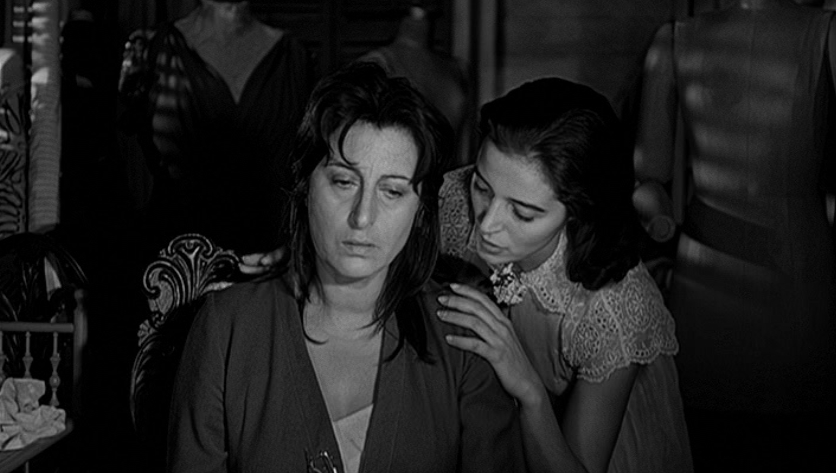
Anna Magnani is all around brilliant as Serafina Delle Rose. The intensity of her work is just amazing and you can't take your eyes off her. Her scene in the church alone deserved an Oscar, not to mention her whole work. She's highly emotional, over-the-top and theatrical and yet it all feels brilliant because of her extraordinary talent. Magnificent, unforgettable performance.

So I can proudly announce
that the winner is...
Anna Magnani 
in 
The Rose Tattoo
Anna has a hard time believing it... :)

Final thoughts: A great year with two amazing performances. Deciding between the two was incredibly difficult. My mind said Susan, my heart said Anna so I went with my heart. :) I was surprised by how great the others were. Yes, Jennifer is the weakest link but she was also really lovely. I've never really warmed up to Kate so after a few days my appreciation for her work cooled down a bit. Eleanor was, however, so wonderful but I need to be less generous with the grades. So the ranking was not that difficult in the last 3 places. 

About the next year: All I can say is FINALLY! A year with at least two iconic quotes, one iconic character (or even more) and at least four brilliant actresses. I've been hunting (literally, well, almost) for one film for a long time and now I have it! I almost gave it up, my mind constantly said "Snap out of it!" but then the year said to me "I'm not gonna be ignored, Dan." 

What do you think?

Jennifer Jones in Love is a Many-Splendored Thing

Sunday, November 20, 2011

Jennifer Jones received her fifth (and last) Oscar nomination for playing Dr. Han Suyin, a widowed Eurasian doctor falling for an American correspondent in the Best Picture nominee Love is a Many-Splendored Thing. Although nowadays most people would say Jennifer Jones was the last because she was a previous Oscar winner, I feel that the Academy really fell for her movie (it received eight nominations and won three of them, after all) and as a result, she was a serious contender for the Best Actress award. I think it was a very heated battle for the Best Actress award and despite the fact Anna Magnani won all the awards possible for her performance, the others were not far behind her. 

Love is a Many-Splendored Thing won the Golden Globe for "Best Film Promoting International Understanding" and that perfectly sums it up. Although in 1955 it must have been a groundbreaking movie, nowadays the most "meaningful" aspect of it seems to be the most dated. Actually, there are many things about it that might have been very brave and even scandalous at the time, nowadays you just keep smiling at the fact that lighting a cigarette   is the symbol of having sex. Despite this, I was surprised to see how much I enjoyed watching this film as there was something really interesting and human about it. At times it was really poignant and wonderful so my intial reluctant attitude towards this movie changed quite rapidly.

Jennifer Jones seems to be a very divisive actress nowadays who has devoted fans as well as people who find her acting incredibly weak. Personally, I'm very fond of her and her very clear and subtle style that's able to impress me at the most unlikely moments. Her performances are always so beautifully understated and that's very most of the hatred towards her might come from. Compared to her fellow nominee Susan Hayward's loud, in-your-face acting style, Jennifer is always so calm and silent. Probably that's what made her work as St. Bernadette a real miracle and Jennifer an overnight success. And as a side note, I love her last motion picture performance as Lisolette in The Towering Inferno (SPOILER!!! Darn, I still cannot believe those sadistic writers so cruelly killed her off!  SPOILER OFF!).

I guess Jennifer Jones was born to play characters like Dr. Han in Love is a Many-Splendored Thing. However, there's one thing: despite her dark hair and hazel(ish) eyes, Jennifer doesn't really look Asian, or even Eurasian, though that seemingly didn't bother the producers enough not to hire her (or God forbid, hire an Asian actress!). Against this really obvious setback, it's a real miracle if Jennifer is able to be even believable, let alone memorable. Despite my resentment towards the decision of the casting directors, I found myself (once again) almost completely fall for Jennifer. Great actresses will be great actresses and is Jennifer great!

Nobody was able to display humility and kindness the way Jennifer did. To some she could seem extremely weak as Suyin but I was impressed by her presence all the time. I think she completely identified with the personality of Suyin. Although there is no showy development in her character (at least not very much), Jennifer at least shows different facets of this woman. She displays her emotions in a very charming and loveable way, which constantly fascinated me.

I probably love this performance more than I appreciate it. In a technical sense, it's not a masterpiece.  Moreover, the political "message" of the movie comes from her mouth and the way she was talking about refugees felt really bored. However, Jennifer does what she's best at: showing the emotions of a character very quietly with lots of dignity. Sometimes, the quiet sufferings of Suyin evoked very fond memories of Jennifer's unforgettable and heart-breaking work as St. Bernadette. The wonderful purity and naturality, that made her Bernadette such a wonderful creation, is a bit transformed in this movie. She's much more Hollywood, she doesn't go that deep into the character. I also must mention, though, that this character is not even half as wonderfully written as her Bernadette. She simply doesn't get that much opportunity to shine with her part.

Love is a Many-Splendored Thing is a typical product of the 1950s and Jennifer just lived up to the expectations of her era. I suppose people wanted to be moved by a simple love story and I can just imagine typical 50s housewives crying at this movie on a Saturday night at the movie theater. Jennifer flawlessly did what she was expected to do at the time, but nothing more and actually, it shows.

Still, I would be lying if I didn't say I was really moved by this performance. To some, this work of Jennifer Jones would be flat and uninteresting, but I really enjoyed every minute of it. Although it's not a grand achievement by today's standards, it's an incredibly moving and loveable piece of work. Jennifer excels at showing Suyin's humility and pure emotions. Again, this is nothing fantastic but something really lovely.


What do you think?

The next review comes tomorrow or even today (I'd like to finish this year this week). 

The Next Year

Friday, November 11, 2011

1955


So the nominees were:

  • Susan Hayward in I'll Cry Tomorrow
  • Katharine Hepburn in Summertime
  • Jennifer Jones in Love Is a Many-Splendored Thing
  • Anna Magnani in The Rose Tattoo
  • Eleanor Parker in Interrupted Melody

What an interesting, rarely talked about year, just the way I like it. I only saw Anna before so four performances will be completely new to me. :) I can't wait!

William Holden: A Many-Splendored Thing

Tuesday, October 11, 2011

I’ve always liked William Holden, but the older I’ve gotten and the more I’ve seen of his work, I’ve changed my opinion of him.

I now think he is one of the movies’ finest, most versatile and most underrated actors.

While this is a purely subjective list, here are William Holden films I consider masterpieces, and some of the greatest movies ever made.

“Our Town” (1940); “Sunset Blvd.” (1950); “Stalag 17” (1953); “The Country Girl” (1954); “The Bridge on the River Kwai” (1957); “The Wild Bunch” (1969); and “Network” (1976).

Just below that are a remarkable list of films that almost made inclusion into the above list, several of which just missed by the taddiest of tads: “Texas” (1941); “Born Yesterday” (1950); “Executive Suite” (1954); “Sabrina” (1954): “The Bridges at Toko-Ri (1954); “Picnic” (1955); “The Horse Soldiers” (1959); “The Counterfeit Traitor” (1962); “The Towering Inferno” (1974, and no, I’m not joking) and his final film, “S.O.B.” (1981).


Here's what’s key: Many actors and actresses have an equally long list of distinguished work, but I’m hard pressed to think of another actor who hit so many home runs in so many different genres and types of movies.

From comedy to drama, from western to war, and from social satire to romance, Holden boasts one of Hollywood’s most impressive and all-encompassing filmographies, one that many actors would kill to possess. .

Oh, William Holden made more than his fair share of average movies and quite a few out and out clunkers, including a couple of titles that re-define the term “unwatchable.” I mean have you ever swum through the syrupy morass of “The Christmas Tree” (1969)? Or prayed for death while watching “When Time Ran Out” (1978)? The less said about the hideous “Satan Never Sleeps” (1962) the better.

But that’s OK. Even superstars have to eat. Still, Holden is always worth watching, and I don’t think he gets the credit he should. Like Cary Grant, he makes it look so easy.

In his book “William Holden” (Pyramid Illustrated History of the Movies, 1976), Will Holtzman astutely points out, “Holden was never a sacred image, and was rarely predictable. He had no tricks or trademarks to tote from picture to picture as an instant index to his character. He was a half generation off pace, too late for the studio-spawned superstars, too early for the stage-trained method actors.

“So Holden followed his own instincts, battled typecasting, and hit up on a blend of technique and repertoire that sired several of the finest performances in motion picture history.”

Looking at the above list, it’s obvious that the 1950s was William Holden’s decade. He fit the image well. As Holtzman suggests, it was probably the perfect decade for him. Not for him the matinee idol heroics of a Flynn or Tyrone Power of preceding decades, Holden’s characters were often cynical and always seeking an edge, giving an audience of what to come in the following decades. Think of his roles in “Stalag 17” or “The Bridge on the River Kwai.”

But Holden could also play sincere with the best of them. There’s a reason Robert Wise cast him as an idealistic architect in “Executive Suite” and Sidney Lumet made him the conscience of “Network.”
.
Smack in the middle of the 1950s Holden had one of his biggest hits, Twentieth Century Fox’s decidedly uncynical “Love Is a Many-Splendored Thing” (1955).


I watched it the other night and enjoyed myself, though, for me, it would not make the above list of great Holden titles. Still, it’s compulsively watchable.

This movie made oodles and oodles of 1955 coinage, with women in droves likely dragging unwilling husbands and boyfriends with them. But I’d be surprised if they weren’t equally entertained by this love story set in Hong Kong between married, though separated, foreign correspondent Mark Elliott (Holden) and the beautiful Eurasian doctor Hun Suyin (Jennifer Jones, in an Oscar-nominated performance).


It helps enormously that Holden and Jones are both magnificent physical specimens, which we see when they both strip down to their bathing suits and decide to swim across Hong Kong Harbor to drop in on some friends on the other side. The house on the other side looks like something Dr. No would live in, and I think this scene illustrates one of the reasons the film was such a big hit.

Cinemascope cameras allowed new wide screen vistas of exotic cities like Hong Kong. Foreign tourism was still fairly rare. One might never make it to Hong Kong, but audiences could go to their local movie house and experience Hong Kong in all its Technicolor, Cinemascope glory.

And with two stars like Holden and Jones holding center court, few audience members could resist. This is no backlot reproduction of Hong Kong, but the real thing.

A winning title song also helped. Played throughout as underscore, the famous Sammy Fain and Paul Webster song won a deserving Best Song Oscar that year. Alfred Newman took home the Oscar that year too for Best Original Score, though I suspect Academy members were voting for the song there too. No one ever said Academy members are the most musically literate people in the world.

Director is Henry King, who I’ve also always liked and also consider underrated. His is a lengthy filmography which dates back to silent cinema, but his films are often full of warm, human touches. One of these days I’ll get around to writing about a small jewel of a film called “I’d Climb the Highest Mountain” (1951) with Susan Hayward.

Despite my fondness for King, I wish he had paid a little more attention to possibilities here. There’s a memorable scene with cigarettes which rivals that of Bette Davis and Paul Henreid.


Still attired in their bathing suits, Holden has a cigarette in his mouth and Jones takes one and puts in her mouth. She needs a light. Holden leans over and lights her cigarette in her mouth using his cigarette in his mouth. It’s a pretty erotic scene, but King doesn’t linger on it. Once that cigarette is lit he fades out to a scene of the two of them driving home. It’s a beautifully played scene but I wish King had allowed it to linger a bit longer.

Without spoiling the movie for anyone, Jennifer Jones’s big emotional scene towards the end first struck me as curiously underplayed, but on thinking about it I can appreciate where Jones is going. Her Eurasian background is at odds here – wanting to let her emotions go but also reining them in so she doesn’t make a scene. She deserved the Oscar nomination she received.


(Jones’s exotic looks are such that I think little make-up was required to make her Eurasian. Maybe a Jones authority would know more about that)

There’s good support to by Torin Thatcher and Isobel Elsom as a spoiled couple who think their every wish should supersede everyone else’s. They’re the personifications of the Ugly Americans.

Holden’s performance is fine, but to be fair he doesn’t do much. His Mark Elliott is not one to show feelings, but we do see him relax after falling in love with Hun Suyin. Their cultural differences are brought up, but not much is made of them. Her being Eurasian probably helps, but the film (based on the book by the real Hun Suyin) shows what is changing during these post-war years. We still have a long ways to go, but in the 1950s the initial steps are there.

The final scenes are quite moving and no doubt sent many audience members out weeping into their handkerchiefs. Let the cynics scoff, but there’s something to be said about a film willing to go full throttle on an audience’s emotions and not be ashamed of it. Some may think such an ending could not work today, but they’re wrong. Just think back on a movie like “Ghost” (1990). Audiences like this type of material, but it has to be done right, not contrived and it has to be earned. “Ghost” accomplished this, and so does “Love Is A Many-Splendored Thing”.

Back to Holden. Today, we do have a couple of actors like him: Kurt Russell and Dennis Quaid. They’ve both been around for decades and I’m afraid audiences take them for granted. Never flashy or drawing attention to themselves, they consistently turn in good performances in every conceivable genre. Russell especially can switch from comedy to drama to action with the beautiful dexterity of a tightrope walker.

But they’re rarely recognized come awards season and I suspect that when they’re gone audiences will realize how much they’ve been missed.

I remember reading an interview with William Holden while he was filming “Damien – Omen II” (1978) in Chicago. The interviewer asked him why he was starring in an Omen movie. Holden said in his long career he had done everything but horror and porn. He wasn’t about to do porn, so a horror movie it was.

When you think of it, William Holden really did do everything in his career. And nobody did it better.

(Note to readers: I’ve been having tremendous computer problems of late. Aargh! I'm trying my hardest not to use language that would have been prohibited by the Production Code. Even placing the pictures here took twice as long as usual. And, the problems are even preventing me from leaving comments on other's bloggers. (Don't worry, I'm still reading my fellow bloggers.) It's likely I may not be able to moderate comments until the evening. I thank everyone for their patience and understanding until this fixed).

The Final Conclusion - Best Actress 1943

Sunday, August 21, 2011

1943

So the much anticipated ranking is:

I was quite disappointed by this performance as I expected way more of Greer Garson, a truly wonderful actress. She's trapped in a boring movie, which is the enemy of its on and she's sometimes overshadowed by the boredom of Walter Pidgeon. Under these circumstances, it's a very good performance with its problems.

Everything works perfectly with this performance. Then why am I still a bit disappointed? For some reason, I was never totally blown away by Jean Arthur's work. Although I enjoyed it from the beginning to the end, there wasn't a moment when I said "Wow! She's amazing!". Still, it's a well-played, entertaining comedy role and I really don't have complaints.

It might seem like that I'm collecting many things to prove that I like her (because of my love for Ingrid) but I'm indeed quite fond of this performance. It's nothing groundbreaking but it's quite impressive and interesting. Ingrid does her usual routine and the result of it was positive for me. Not great but certainly good.

I wouldn't say that this is a pleasant surprise because I expected to like Joan but I was really impressed by Joan Fontaine's performance as Tessa. Although this is neither groundbreaking nor amazing work, I enjoyed every minute of it. Joan never fails to make Tessa a sympathetic character and I liked the character overall.

A no-brainer, easy winner. I really did not expect to be impressed by Jennifer THIS much but I was, after all. Jennifer Jones is nothing short of amazing as St. Bernadette. Her grace and dignity shines through the screen and grabs your attention and never lets you go. It's a wonderful, unforgettable performance that's not as frequently talked about as it should be. A real miracle, if I may say so.

So I can proudly announce
the winner is...
Jennifer Jones
in
The Song of Bernadette
Easy win.


Omissions:
  • Ingrid Bergman in Casablanca *My Pick*  (Do I have to explain????)
Congratulations Louis (once again on your predictions). You can pick another year (which I'll probably do after two years I planned to cover now or if you pick either of them then sooner).
Available years: 1933, 1953, 1956, 1967, 1968, 1971, 1976, 1982, 1985, 1988, 1991, 1993, 1994, 1995, 1999, 2000, 2004, 2007, 2008
Final thoughts: A mixed bag. Jennifer Jones got my vote very easily. I liked the rest of the ladies, too but to a much lesser extent. Joan and Ingrid were almost equal for me, Jean was not far behind them and Greer wasn't much worse than them. I think it's a very even but quite weak year and Jennifer so obviously stands out in this bunch. She's just wonderful. Otherwise, I enjoyed this year but didn't love it.

Note: From now on, I won't rank the years. I don't really see the point of it.

About the next year: Wow, I'm ending the summer with a really strong three-way race. I'm very excited to give clues once again (after such a long time :D). However, I can only start reviewing next Saturday. But I'll annonce the year on Wednesday.
  • Mommie dearest (x2)
  • Don't get THIS mad!
  • Leading or supporting? Vanity will decide. :D
So what do you think? Any thoughts on your mind?

Jennifer Jones in The Song of Bernadette

Monday, August 15, 2011


Jennifer Jones received her first Best Actress nomination and only Oscar for playing Bernadette Soubirous also known as St. Bernadette. Jennifer Jones' Oscar win is one of those star-making wins when a relatively unknown actress wins an Oscar out of the blue and becomes a huge star and receives many more nominations and becomes a star. I mean there was NO way that Jennifer was losing the Oscar. She was in the Best Picture front-runner, won the first Golden Globe, she had David O. Selznick on her side (and with this the most of Hollywood). I guess Jennifer's good friend Ingrid Bergman might have come close to her (combined with her Casablanca performance, she gained many votes, I think).

The Song of Bernadette is a wonderful movie. I mean it two and a half hours long and it doesn't feel that long. There are no useless, boring moments in it and the story flows brilliantly. Personally, I'm quite shocked that this one lost the Best Picture award. Not that it's better than Casablanca but it's definitely bigger and more epic (Why did they pick Casablanca? A mystery. It's brilliant, though.). I guess... no, I don't have an idea. This movie received many other nominations and three very deserved technical awards. I liked all of the supporting players, Gladys Cooper was a standout but I'm not sure if I would vote for her.

You know, winning an Oscar depends on so many things but there's no easier and more powerful way to get the coveted award than surprising the voters. When there's a brilliant actress like Jane Fonda or Maggie Smith, you just except them to be brilliant and you're not satisfied with anything less. However, when an unknown or underrated actress comes along, you just say "WOW! I never imagined she could be that great!". That worked for Mo'Nique, Marion Cotillard, Natalie Portman, just to mention names from the recent past. Well, I think that was also the case with Jennifer Jones. There was this unknown young girl who gave a really unforgettable, huge performance.

The role of Bernadette screams Oscar: scenes of religious experiences, real life person, horrible death at a young age and these are all shown in an epic movie. And while Jennifer Jones' performance is indeed epic, there's nothing loud or exaggerated about it. In fact, it's one of the most subtle performances ever to win the Best Actress Oscar. And thank God for that since this means that Jennifer Jones plays Bernadette the way she should be. You know, I'm kind of relieved that she was chosen to play Bernadette, not a huge star like, say, Loretta Young (OK, I know, why did she come to my mind?). Jennifer is free from all the vanity and modesty radiates through the screen.

When I was thinking about this work, one word came to my mind: humility. Jennifer plays Bernadette with such respect and love. She's not a fascinating personality. She's not great-looking, she's not smart, she's silent and a bit shy. Jones plays these aspects of the character so well and there's something so pure in her work. I can only compare her to one quite similar and yet different performance that I love dearly: that's Audrey Hepburn's in The Nun's Story. Not only are they both testaments to the talents of the actresses, but they also shine so much that it's impossible not to be taken away by them. Just like with Audrey, whenever I looked at Jennifer, I just felt great. It really wasn't anything physical, it was more of something spiritual and that rarely happens. There's so much grace and dignity in this movie and that's 100% thanks to Jennifer Jones. I really can't imagine anyone else.

The scenes with the visions are unforgettable, if I may say so. I was so touched by Bernadette's faith and hope. Wheter you be a believer or not, you can find inspiration in Bernadette's story and Jennifer's performance. It's true what Henry King said in his autobiography. Jennifer doesn't look, she can see. I mean, I was totally blown away by her ability to grab my attention with her unspectacular(-looking) performance. At the trials, there are no big monologues or breakdowns and yet she's able to make a great impression. It's kind of strange but I think people really should see this movie.

The scenes towards the ending are truly heart-breaking and Jennifer plays them with wonderful naturality and ease. I mean there was nothing sentimental about her and yet I felt very emotional about her. Although Bernadette has a long and horrible death in the end, those scenes are not different from the others. Jennifer is just as subtle as she was and she doesn't try desperately to move the audience.

I really did not expect to be impressed by Jennifer THIS much but I was, after all. Jennifer Jones is nothing short of amazing as St. Bernadette. Her grace and dignity shines through the screen and grabs your attention and never lets you go. It's a wonderful, unforgettable performance that's not as frequently talked about as it should be. A real miracle, if I may say so.

What do you think?

The Next Year

Thursday, August 11, 2011

1943


So the nominees were:
  • Jean Arthur in The More The Merrier
  • Ingrid Bergman in For Whom The Bell Tolls
  • Joan Fontaine in The Constant Nymph
  • Greer Garson in Madame Curie
  • Jennifer Jones in The Song of Bernadette
A weak year apparently but we'll see. :)


What do you think? What's your ranking? What's your prediction for my ranking?
 

Blogger news

Blogroll

Most Reading