Double Feature: Picnic (1955) and Auntie Mame (1958)
Thursday, February 7, 2013
Based on the award-winning play by William Inge, director Joshua Logan's melodrama stars William Holden, Rosalind Russell, and Kim Novak in her breakout performance. Most of the film occurs over the course of one day in a small Kansas town, which is holding a Labor Day picnic. Visiting his old college friend Alan (Cliff Robertson), Hal Carter (Holden) arrives that morning and causes great unrest in some of the townspeople, among them Alan's girlfriend "Madge" Owens (Novak), her little sister Millie (Susan Strasberg), a local school teacher (Russell), and her boyfriend (Arthur O'Connell). The whole situation is complicated, but Carter leaves his mark on these citizens in a short period of time. Despite a promising premise, this misses the mark, as the characters are so unbalanced and the drama so overblown and forced that the edgy material feels too contrived and grating by today's standards. Though I can see why it received a Best Picture nomination, it's lost some of the impact it must've had in the 1950s.
The film received Oscar nominations for Best Picture, Best Director, Best Supporting Actor (Arthur O'Connell), Best Art Direction (Color), Best Film Editing, and Best Score (Dramatic/Comedy). It won awards for Best Art Direction (Color) and Best Film Editing.
Trivia: For his dance scenes, William Holden received an additional $8,000 as a stuntman fee.
Auntie Mame - **1/2
Rosalind Russell gives an Oscar-nominated performance as Mame, a wealthy socialite living life as frivolously as possible in the 1920s. When her brother dies, she takes her nephew Patrick (Jan Handzlik/Roger Smith) in, opening his world to art, drink mixing, lavish parties, life, and other adventures. The film consists primarily of scenes depicting Mame's wild lifestyle, but she manages to teach her nephew a few lessons on the way. (Whether or not they're essential ones is another matter.) Through the years that pass, Patrick's future is managed - as much as it can be - by his father's will executor. Patrick's questionable upbringing comes to a head when he brings his girlfriend home to meet Mame. While the film has its problems, Russell is perfect for the lead role, even if the film is excessively farcical. Really, at 143 minutes, it's too much. The Academy liked the film enough to give it a Best Picture nod, but it got in at the expense of more deserving films.
The film received Oscar nominations for Best Picture, Best Actress, Best Supporting Actress (Peggy Cass), Best Art Direction, Best Cinematography (Color), and Best Film Editing. It did not win any awards.
Trivia: Russell and Cass received Tony recognition for their stage performances before reprising their roles in the film.
The Night of the Hunter (1955) **1/2
Wednesday, November 14, 2012
Renowned screen actor Charles Laughton played some of the most memorable cinematic characters ever: Captain Bligh, Quasimodo, Nero, Dr. Moreau, King Henry VIII, Captain Kidd, and Sir Alfred Robarts, just to name a few, but like most actors, he thought he’d like to direct. He’d had experience directing plays but wanted to helm a film that would make moviegoers "sit up straight again” at the theater and take notice. And, so when he became enthralled with David Grubb’s best-selling novel, The Night of the Hunter, Laughton decided he would make it into a film. Unfortunately, it was both a commercial and critical failure and Laughton never directed another movie before his death in 1962. Today, his The Night of the Hunter (1955) is regarded by critics as one of the best films of the 1950s. I’m sure a man with such an ironic sense of humor as Laughton’s would have found this somewhat depressing.
Set amidst the West Virginian countryside during the Great Depression, this is a movie that is one part gothic fairy tale and one part morality tale. It is written in 1 Timothy 6:10 that “the love of money is a root of all sorts of evil, and some by longing for it have wandered away from the faith and pierced themselves with many griefs.” This pretty much sums up ‘Reverend’ Harry Powell’s (Robert Mitchum) sociopathic existence. Plagued with a pathological disgust of women (calling Dr. Freud) but an insatiable need for money to bankroll his false prophesies, Harry finds himself compelled to kill widows. After being incarcerated for stealing a car, Harry shares a cell with a man (Peter Graves) sentenced to death for killing two people in a bank robbery where he stole $10,000 that was never recovered. Once released from prison Harry sets out to find the man’s widow and the missing money. The problem is the widow, Willa Harper (Shelley Winters), has no idea where the cash is stashed, but her two young children, John (Billy Chapin) and Pearl (Sally Jane Bruce), do but have promised never to reveal that it’s hidden in Pearl’s doll. What ensues is a true battle of good versus evil.
The Brothers Grimm and German expressionism obviously influenced Laughton’s vision of this film. James Agee is credited with the screen adaptation of Grubb’s novel, but in reality it was Laughton and his assistant directors, Terry and Denis Sanders, who wrote most of the script that ended up on the screen. Much like the novel, the film focuses on the duality of good and evil, which is quite literally etched on Harry’s knuckles, with one hand reading Love and the other one Hate. When a film starts off by quoting Matthew 7:15: “Watch out for false prophets. They come to you in sheep's clothing, but inwardly they are ferocious wolves,” and the next thing you see is a man in clerical garb, wearing a hat that looks like it has satanic horns, then you know this isn’t your everyday story of good versus evil. Somehow the fact that Harry is perceived as a man of God makes his evil ways even more dark and sinister—a fact that would have not been lost on the Brothers Grimm.
There are two particular shots in the film that are obvious nods to the likes of Fritz Lang and Robert Wiene, pioneers of the German Expressionistic movement. The first comes early in the film when John is telling Pearl a bedtime story about a bad man looking to do harm. Standing in a moonlit window as he relays the story, the boy finds himself silhouetted by the outline of a Puritanical hat belonging to a man singing his abased version of “Lean on Jesus” which he sings as “Leanin’”. When film teachers instruct students on the power of a good foreshadowing scene this is beyond an obvious choice. The other tip of the hat to Lang and Wiene comes in the bedroom scene where Harry kills Willa. By this point in the story, Willa has become a brainwashed disciple of Harry and is so far gone that she can’t see him for the demon that he is, even when it is right in front of her face. As she prattles on about her spiritual shortcomings, the scene is framed in such a way to make the bedroom appear as a church (steeple included)—she quite literally can’t see behind the shadows of delusion.
While the first half of the film is dedicated to the depiction of evil, the second half focuses primarily on good. This is where Lillian Gish comes into the story. Laughton desperately wanted Gish for the role of Mrs. Cooper and did what most could not do: he convinced her to come out of retirement and play what he thought was the lynchpin role of the film. Mrs. Cooper’s Christian compassion and charity are the perfect dichotomy to Harry’s greed and hatred. As she says, she is a “strong tree with branches for many birds.” Reminiscent of the Old Lady in the Shoe, Mrs. Cooper is the caretaker of orphaned children and she takes John and Pearl in when they run away from Harry. She is a formidable adversary to Harry, which is showcased in their pivotal showdown of wills and, well, religiosity. Never has there been a stranger duet than Harry singing “Leanin’” with Mrs. Cooper chiming in to sing the correct version of the song, “Lean on Jesus”. It is here that good and evil meet and only one can win—it helps that one brought a knife to a shotgun fight, though.
Mitchum campaigned hard for the role of ‘Reverend’ Harry and it shows in what is perhaps his finest performance. Cool and cunning, as well as evil and deranged, never looked so good on a man. There are very few actors who could pull off being both vile and charming, but Mitchum does it exceedingly well. It is a shame that he was overlooked by the Academy Awards, but perhaps the world of 1955 wasn’t ready for such a dark and disturbing film.
Overall, I enjoyed The Night of the Hunter. The story was gripping and Stanley Cortez’s photography was inspired. If I have one complaint about the film it has to be the character of Pearl. Was there ever a more helpless child in the world? If I had to see John drag her up steps or attempt to put her uncooperative self in a boat one more time I may have screamed., “O come ye little children indeed!”
Review: The Seven Year Itch (1955)
Saturday, August 25, 2012
![]() |
| Ewell and Monroe in Wilder's classic comedy. |
Directed by Billy Wilder
Produced by Billy Wilder and Charles K. Feldman
Written by Billy Wilder and George Axelrod (adaptation); George Axelrod (play)
Starring Marilyn Monroe and Tom Ewell
****
Widely recognized for its shot of Marilyn Monroe's dress flying up from the subway breeze, the film is actually worthy of larger praise. The humorous script is filled with Wilder's light touch, which shines through in the scenes between Sherman and "The Girl". Ewell, also known for his performance in Adam's Rib, is quite good as a man fighting for control of his animal instincts. He is perfectly suited to Wilder's dialogue, and his comedic timing is impeccable. And Monroe is, of course, completely lovable and the highlight of the film. Forget Sugar, Roslyn, and Cherie. She gives her best performance as "The Girl". Monroe personifies all the qualities of such an enigmatic character, being funny, free-spirited, playful, perceptive, strong, caring, and absolutely stunning. Make no mistake: this is not a one-note performance by any means. Like the best of Wilder's films, Itch is full of charming scenes that make the film one to be watched again and again. This is no hard-hitting piece of cinema, but it is a delightful look at sex in society. While Wilder and Ewell are in fine form, Monroe is the ultimate reason to see this classic film.
Oscar Tally: None (Ewell did win a Golden Globe though.)
Marty
Sunday, June 24, 2012
Directed by Delbert Mann
Nominated for 8 Oscars, Won 4
Up Against: Love is a Many-Splendored Thing, Mister Roberts, Picnic and The Rose Tattoo
Marty is a unique film. The movie is based upon a "teleplay" also called Marty, and is one of only two films to win both the Palm d'Or at Cannes Film Festival, and Best Picture at the Academy Awards.
Marty is the story of a 34-year old man named, well, Marty. He still lives with his mother. He comes from a big family, with many brothers and sister, and all of them are married. So Marty certainly feels pressure to find a girl. However as he himself puts it, "I'm a fat and ugly old man". When his cousin and his wife come over to convince Marty's mother to ask her sister to come live with her (she is making life very hard for Marty's cousins wife), his cousin says Marty should go to the Stardust ballroom as there are tons of "tomatoes" there. Marty gets upset when his mother tells him to go because he's been hurt by women dozens of times before, and has never found a girl there before, but would go just to make his mother happy, telling her the night would endure tons of heartache. But, of course, he meets a girl. She's come with a blind date who's not interested in her, and he tries to blow her off. Marty comforts her, and the two have a nice evening together. However, as the next day comes, it comes out most of the people he knows don't like her because she's not that attractive and Marty "could do better".
In this day and age, where we hear about Hollywood's obsession with marriage, love, sex, dating, we forget that there are tons of people who are "older" that haven't found love and gotten married. No, I'm not quite talking about George Clooney here. That's a different story. We see it all the time, even if we don't like to look or don't recognize it. Not everyone finds love, and that's something hard to deal with. People ignore that fact that some people just don't ever find love.
But the story of Marty is that he did find love. He found it in a girl that his friends said wasn't attractive and that Marty could do way better than her. There's a scene right near the end of the film, the day after Marty meets Clara, and he's sitting around the house with 3 friends. One of them is looking at a "girlie" magazine (if you know what I mean), and the others interrogating him about Clara. Whether they're jealous of Marty finding a girl while they're all still single, they try to convince him not to call her. They're surprised when Marty says he "didn't try anything" and that they just talked. One replied that she must've been a good talker since he looks to be about 40 years old. The other, still looking at his girlie magazine, starts saying that he wished he knew where he could find girls like these. And, for some reason, Marty buys into it. He doesn't call Clara like he said he would. Though eventually realizes she's someone who makes him happy.
I think that's a very interesting look, and is something that is so wrong with our society today. Just because a woman isn't like the girls in those "girlie" magazines (or well, other mediums, today) it means they aren't worth anything. Marty's friends hardly knew her, didn't really speak to her, they only saw her. And that's something that seems to be so wrong with society today. I could go on and on about the objectification of women, how so many men seemed to be so focused on physical beauty, and how that is probably why divorce rates are so high, but I'm sure you get the picture. Marty is a glimmering hope in cinema that tells the story about a man who finds a woman who makes him happy. She's nice, and funny, they had great laughs together and talked all night long. And just because she wasn't "pretty" didn't make her less of a woman in Marty's eyes, and that's something so valuable in him. What we can learn from Marty is that beauty is definitely not everything. Some of the most gorgeous people can also be the worlds worst people, the most unintelligent, and the most vain.
However, enough with the moral lessons on this movie (I could talk about it for so long, I think I'm starting to become an advocate for how woman are more than their bodies and their looks, and society is ruining itself by focusing on it). I found the movie to be quite short, and felt it could probably have gone on a little longer. It's the shortest running Best Picture winner at only 1hr and 30 minutes. Ernest Borgnine was great as Marty. He was socially awkward, and desperate, and very unconventional. Sometimes he was just so hard to watch and listen to, but he nailed it in such a good way. There's not a whole lot else to brag about for this movie. Not that it was bad, but because there wasn't too much in the way of Art Direction, Costumes, Score, etc. The acting was fine, and the screenplay was good. The storyline involving Marty's cousin and wife, with their terror of a mother, and Marty's mother invited the mother (her sister) to stay with her was a little unnecessary and quirky, but overall the film was a good one. It's not a story people like to tell, so it's often not told. It's not a cute romance like The Notebook, it's a real one, and it's awkward and quirky, but that's life isn't it?
Acting- 8/10
Directing- 7/10
Screenplay- 7/10
Music - 7/10
"The look"*- 7/10
Entertaining- 8.5/10
Emotional Connection- 8/10
Rewatchability- 8/10
Did I like It?- 8.5/10
"Total Package"**- 7.5/10
Total Score: 76.5/100
Bob the Gambler (Bob le Flambeur) 1955 **1/2
Saturday, April 14, 2012
When you ask a film lover to name some of their favorite film noirs you might hear such titles as: Double Indemnity (1944), Kiss Me Deadly (1955), Laura (1944), Murder, My Sweet (1944), Out of the Past (1947), or The Maltese Falcon (1941), but you would rarely hear the name of the often overlooked Bob le Flambeur (1955). Perhaps this is due to it being a French-language film from a relatively unknown French director in Jean-Pierre Melville. Whatever may be the reason, Bob le Flambeur is a film noir that should get more attention from cinephiles—and not just the ones who recognize the name Bob le Flambeur because it was mentioned in Jean-Luc Godard’s Breathless (1960), either.
Fans of Melville know that his best films are minimalistic but stylish—think Le Samourai (1967), Le Cercle rouge (1970), and Un flic (1972, with our fave Catherine Deneuve). A French Resistance fighter during WWII, Melville was his own man in every sense. When he couldn’t get a job in the French film industry he started his own studio and made his own unique brand of films. His independent style allowed him to veer away from the then-stagnant nature of French filmmaking, and employ techniques that were hugely influential to New Wave directors like Godard and Francois Truffaut. His films relied on location shots (primarily by handheld cameras), and employed the use of jump cuts (which were a big no-no at the time). While the Cahiers du cinéma are often remembered for their reverence of such directors as Alfred Hitchcock, Fritz Lang, and Max Ophuls, Melville’s work was also viewed favorably. He along with Jean Renoir and Jean Cocteau are perhaps the Frenchmen the Cahiers (and the subsequent French New Wave) most admired.
Cinematographer Henri Decaë filmed primarily on locationn in Montmartre (a section of Paris known for its nightclubs and bohemian culture), but scenes were also shot at a horse track in La Havre as well as in Deauville for the casino sequences. Films shot on location always seem to have a notable edge to them—perhaps this is because they side-step the artificiality of a studio set. I think this is one of the striking features of Bob le Flambeur—it adds to the overall grittiness of the picture. When you start your film with a multi-perspective shot of a street cleaning truck circling the Montmartre rotunda and your main character driving his 1955 Plymouth Belvedere you are making a statement. In addition, the night shots of the busy streets of Montmartre do a tremendous job of exhibiting the world in which Bob Montagné (Roger Duchesne) operates. These shots are completely atmospheric and unl
ike what most French filmmakers were doing at the time. Godard would later borrow heavily from this when he shot the nighttime scenes in Breathless, and I’m sure Eric Rohmer was also thinking of Melville when he worked on My Night at Maud’s (1969).
Still, even though the exterior shots are what most people focus on, there are a number of standout interior shots as well. My favorite one is an extreme overhead (I mean in the ceiling) shot that watches as Bob paces in his kitchen. There is an added element in this scene, because the story has voice-over narration (by Melville nonetheless) and when you watch it you feel almost voyeuristic, as though you are in collusion with the all-seeing narrator. One of the other things I noticed about many of Melville’s interior scenes is his fascination with checks and rectangles—they inundate almost every one. This is a subtle reference to the game of chess, and we the viewer get to watch how the game plays out for Bob.
While the innovative camerawork and set design are what make this a memorable piece of cinema, the overall story and acting is good, too. Penned by Melville and Auguste Le Breton, the film is about a compulsive gambler (and ex-con) and his eclectic crew of associates. Dapperly dressed and graced with the manners of a gentleman, Bob is liked and admired by everyone—including the police, headed by Inspector Ledru (Guy Decomble). He’s the type of man who exudes confidence and has the ability to convince others to go along with whatever he wants to do. Which comes in handy when he decides he wants to rob the Deauville casino. Overall, the story is crisply paced and remarkably believable. I view it is as ironic realism—something you don’t always get with a noir or a heist film.
Early in his career Melville was known for casting relative unknowns—primarily because he never had enough money to pay anyone. While both Duchesne and Daniel Cauchy (who plays Bob’s surrogate son Paolo) were established actors, Melville did launch the career of Isabelle Corey when he gave her the would-be femme fatale role of Anne in this picture. Duchesne is obviously the star of the film, but both Cauchy and Corey bring an added rawness to their roles. Corey, in particular, stands out for how she plays her character as both opportunistic and naive. You don’t know whether to embrace her or slap some sense into her.
There are many reasons to like Bob le Flambeur, and that’s why it’s such a shame that more people aren’t familiar with it. If you don’t believe me, take the word of director Stanley Kubrick, who said Bob le Flambeur is the greatest crime film ever made. High praise indeed.
The Final Conclusion - Best Actress 1955
Monday, December 5, 2011

Anna Magnani in The Rose Tattoo
Sunday, December 4, 2011
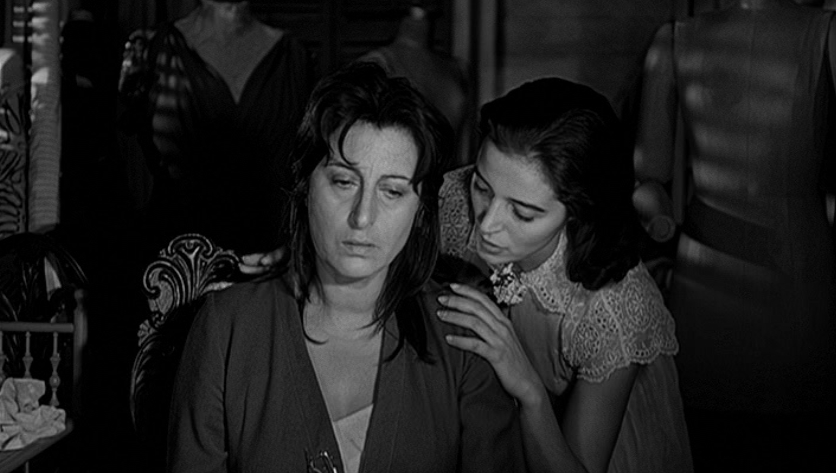
After her husband's death, Serafina goes into despair and she falls apart. Anna is wonderfully worn out in these scenes. She communicates Serafina's lack of interest in living without her husband. I guess it's a great thing that we never actually see her husband in full because that we he becomes more of a myth and a god just like Serafina always talks about him. That man brought all the happiness to her and Anna is so fantastic at showing Serafina's more tender side when she's about to reveal the news of her pregnancy to her sleeping husband who honestly doesn't listen to her. Like Serafina describes it to the priest in a wonderful monologue, she gave her "baron" husband glory despite being only a peasant girl. I think there's a not-so-strange parallel between Anna and Serafina. Anna herself had a very stormy relationship with Roberto Rossellini which ended after he impregnated Ingrid Bergman. Anna thought of Rossellini as an idol and started to write hundreds of letters to "the northern woman". Anna brilliantly used her own inner demons and pain to create this character and the result was something unbelievably intense. Intensity describes Anna's whole acting style that's rarely been better represented than in The Rose Tattoo (I think only Rome Open City and Mamma Roma, her two best performances did that).
The highlight of her work here is undoubtedly the scene in the church where she talks about her marriage and begs the priest to reveal to her what her husband confessed (I especially loved the former). The range of emotions she displays there is just unbelievable. It goes from pure love through bitterness to complete despair. She covers her head and she looks like a ghost who came back to haunt you - and I suppose that scene will haunt anyone who sees it for a long time. Its impact is indescribably strong, which only Anna can do, I think. And I figured that with any other actress, that scene would have been awfully over-the-top and theatrical.
Most people think that from there, her whole performance goes downhill. Although I admit that it doesn't reach the impact of that one scene, I felt it was just as intense as the beginning. It's also incredible - but in a different way. The tone of her work becomes lighter and much more entertaining. I guess it represents how Burt Lancaster's character has changed Serafina and made her feel great again. However, after a while, she returns to the original Serafina who's loud and incredibly devastated. The scene where she sees the rose tattoo once again is just marvelous: it evokes the best parts of the whole film and it really is a fantastic moment. Just like the one where sher confronts her late husband's lover at the blackjack table (=slaps her, I guess she must have thought of Ingrid).
The scenes with Marisa Pavan are, in my opinion, a bit useless for the main storyline but that doesn't prevent Anna from giving her best there, too. She uses them to emphasise Serafina's changes even more, plus they are incredibly entertaining, especially the one where she talks about her daughter's and her boyfriend's "innocence".
Anna Magnani is all around brilliant as Serafina Delle Rose. She gives the essence of her own very unique acting style and she plays Serafina to perfection. The intensity of her work is just amazing and you can't take your eyes off her. Her scene in the church alone deserved an Oscar, not to mention her whole work. She's highly emotional, over-the-top and theatrical and yet it all feels brilliant because of her extraordinary talent. Magnificent, unforgettable performance.
Note: The Final Conclusion comes on Monday or maybe Tuesday.
Susan Hayward in I'll Cry Tomorrow
Wednesday, November 30, 2011
Katharine Hepburn in Summertime
Sunday, November 20, 2011
Jennifer Jones in Love is a Many-Splendored Thing
Love is a Many-Splendored Thing won the Golden Globe for "Best Film Promoting International Understanding" and that perfectly sums it up. Although in 1955 it must have been a groundbreaking movie, nowadays the most "meaningful" aspect of it seems to be the most dated. Actually, there are many things about it that might have been very brave and even scandalous at the time, nowadays you just keep smiling at the fact that lighting a cigarette is the symbol of having sex. Despite this, I was surprised to see how much I enjoyed watching this film as there was something really interesting and human about it. At times it was really poignant and wonderful so my intial reluctant attitude towards this movie changed quite rapidly.
Jennifer Jones seems to be a very divisive actress nowadays who has devoted fans as well as people who find her acting incredibly weak. Personally, I'm very fond of her and her very clear and subtle style that's able to impress me at the most unlikely moments. Her performances are always so beautifully understated and that's very most of the hatred towards her might come from. Compared to her fellow nominee Susan Hayward's loud, in-your-face acting style, Jennifer is always so calm and silent. Probably that's what made her work as St. Bernadette a real miracle and Jennifer an overnight success. And as a side note, I love her last motion picture performance as Lisolette in The Towering Inferno (SPOILER!!! Darn, I still cannot believe those sadistic writers so cruelly killed her off! SPOILER OFF!).
I guess Jennifer Jones was born to play characters like Dr. Han in Love is a Many-Splendored Thing. However, there's one thing: despite her dark hair and hazel(ish) eyes, Jennifer doesn't really look Asian, or even Eurasian, though that seemingly didn't bother the producers enough not to hire her (or God forbid, hire an Asian actress!). Against this really obvious setback, it's a real miracle if Jennifer is able to be even believable, let alone memorable. Despite my resentment towards the decision of the casting directors, I found myself (once again) almost completely fall for Jennifer. Great actresses will be great actresses and is Jennifer great!
Nobody was able to display humility and kindness the way Jennifer did. To some she could seem extremely weak as Suyin but I was impressed by her presence all the time. I think she completely identified with the personality of Suyin. Although there is no showy development in her character (at least not very much), Jennifer at least shows different facets of this woman. She displays her emotions in a very charming and loveable way, which constantly fascinated me.
I probably love this performance more than I appreciate it. In a technical sense, it's not a masterpiece. Moreover, the political "message" of the movie comes from her mouth and the way she was talking about refugees felt really bored. However, Jennifer does what she's best at: showing the emotions of a character very quietly with lots of dignity. Sometimes, the quiet sufferings of Suyin evoked very fond memories of Jennifer's unforgettable and heart-breaking work as St. Bernadette. The wonderful purity and naturality, that made her Bernadette such a wonderful creation, is a bit transformed in this movie. She's much more Hollywood, she doesn't go that deep into the character. I also must mention, though, that this character is not even half as wonderfully written as her Bernadette. She simply doesn't get that much opportunity to shine with her part.
Love is a Many-Splendored Thing is a typical product of the 1950s and Jennifer just lived up to the expectations of her era. I suppose people wanted to be moved by a simple love story and I can just imagine typical 50s housewives crying at this movie on a Saturday night at the movie theater. Jennifer flawlessly did what she was expected to do at the time, but nothing more and actually, it shows.
Still, I would be lying if I didn't say I was really moved by this performance. To some, this work of Jennifer Jones would be flat and uninteresting, but I really enjoyed every minute of it. Although it's not a grand achievement by today's standards, it's an incredibly moving and loveable piece of work. Jennifer excels at showing Suyin's humility and pure emotions. Again, this is nothing fantastic but something really lovely.
What do you think?
The next review comes tomorrow or even today (I'd like to finish this year this week).
Eleanor Parker in Interrupted Melody
Monday, November 14, 2011

The Next Year
Friday, November 11, 2011
So the nominees were:
- Susan Hayward in I'll Cry Tomorrow
- Katharine Hepburn in Summertime
- Jennifer Jones in Love Is a Many-Splendored Thing
- Anna Magnani in The Rose Tattoo
- Eleanor Parker in Interrupted Melody
418/419. Mystery Science Theater 3000: The Movie/This Island Earth
Friday, September 16, 2011

The need to appeal to an audience who hasn't necessarily seen MST3K on television puts Dr. Forrester in the worst position, turned from a nuanced villain into something of a caricature. But the production values and gags are all upgraded to cinematic quality. While the necessity of an MST3K feature film is definitely debatable, this would make me a high-quality TV episode, even if it's not what I would consider a definitive entry.
419. (16 Sep) This Island Earth (1955, Joseph M. Newman) 35
The spoofed movie in question is an odd duck, to be sure. These higher budget studio sci-fi films often had some sort of prestige (e.g. Forbidden Planet's homage to "King Lear"), but there's nothing of the sort in This Island Earth. It would be, at best, a very forgettable Twilight Zone with bad matte paintings. It's campy enough, but it's not even worthy of having a cult following.
Kiss Me Deadly (1955) **
Friday, January 21, 2011
(This article is from guest contributor Sarkoffagus and first appeared at http://classic-film-tv.blogspot.com/. The rating in the title is my own.)
Robert Aldrich's Kiss Me Deadly (1955) opens with a woman's bare feet sprinting on an apparently deserted road. The woman, Christina (Cloris Leachman, in her film debut), stands in front of an approaching vehicle. Gumshoe Mike Hammer (Ralph Meeker) swerves his car to avoid hitting her, and he reluctantly agrees to take her to the bus station. On the way, Christina tells Mike that, should they not make their destination, he needs to do one thing for her: "Remember me," she ominously states. Suddenly, they are forced off the road, and a semi-conscious Mike later sees a congregation of feet, while hearing Christina being tortured and killed. The dazed P.I. and the woman's body are put into Mike's car and pushed down a cliff.
Kiss Me Deadly was based on a novel of the same name by Mikey Spillane, featuring his immensely popular character. Reportedly, screenwriter A.I. Bezzerides, who adapted the book, had such aversion for the source text that the film ultimately took a dim view to Mike Hammer, turning him into a rather vile and despicable character. When initially interrogated, Mike refuses to talk, and the cops seem disgusted by him, asking him questions and patronizing him by "answering" on his behalf. When the gumshoe leaves, one of the men vindictively states, "Open a window." This is a man who knocks someone down a long flight of steps and smirks as he watches him roll down, a vicious person who clearly takes pleasure in slamming an uncooperative man's fingers in a desk drawer. He's the definitive antihero. He drowns the world out with loud classical music and screens his phone calls.There are so many twists and turns in this film that it feels like constant movement. The first shot of Kiss Me Deadly is, appropriately, running feet. There's a distinct impression that Mike is running from place to place, hoping to be two steps ahead of everyone but more accurately having trouble keeping up. The concept of momentum is a significant component of the movie. Mike tries to identify Christina's killers by shoes, the deceased woman is equated with her roommate, Lilly (Gaby Rodgers), as she is likewise introduced with bare feet, and when Mike is taken captive, he is knocked unconscious and dragged (on a beach, as his feet leave a trail), and he is bound by feet and hands.
Mike moves forward with the investigation, and the villains want to stop him. His first car is wrecked, and he is "given" a second car with an explosive surprise. Other people have been killed in "accidents" involving vehicles. It's fitting that one of Mike's only friends is Nick (Nick Dennis), an auto mechanic whose catchphrase is, "Va-va-voom!" He's essentially an antithesis to the villains, wanting to fix what they wish to destroy.With this in mind, the film's title can take on multiple connotations. A superficial view would associate the "kiss" with succumbing to the affection of the opposite sex, letting down your guard and opening yourself to a lethal reciprocation. But it can also refer to what Mike himself calls "the sweet little kiss off," an acknowledgment of death or, more specifically, the very thing which kills you. This gives deeper meaning to a warning provided by Velda: "Keep away from the windows. Somebody might blow you a kiss." Most notably, however, Kiss Me Deadly is a recognition of both good and bad, that sex ultimately leads to violence, as the two go hand in hand. Perhaps the film's quintessential shot is Lilly lying in bed, adorned in a robe and pointing a gun at the door.
Aldrich's film is abundant in atmosphere and style. Furthermore it's surprisingly violent, some of it even by today's standards. The majority of the violence's impact is not from the presentation itself but rather the callous way in which Mike dishes it out. Ralph Meeker has incredible presence, making Mike Hammer the type of character who makes a viewer feel both unassailable and anxious. At one point, Mike is shadowed by a stranger. The P.I. spots him almost immediately and seems to enjoy the moments preceding the inevitable attack. When the stranger pulls a switchblade, Mike forces him to drop the knife with the greatest of ease, before knocking him around and slamming his head against a building several times. It takes an extraordinarily cruel protagonist to make an audience sympathize with a man whose intent was to literally stab someone in the back.The thing that everyone wants -- what Velda calls "the great whatsit" -- will likely be a surprise for anyone who hasn't seen the film (and hopefully hasn't been told how the film ends). Kiss Me Deadly continues its winding plot all the way to the closing credits, creating one of the grandest and most gleefully erratic cinematic endings of all time. Interestingly, for years the film's conclusion was truncated and left a couple of characters' fates in question. More recent copies of the film (the DVD, for instance) have the original ending intact.
Kiss Me Deadly is a solid entry in the film noir genre. Mike Hammer in Mikey Spillane's novels was a driven man, taken to seeking his own brand of justice; just look at some of the titles -- I, the Jury, Vengeance is Mine, etc. But Aldrich's cinematic Hammer is much more brutally simplistic. He just wants the payoff, indifferent to the people he hurts or kills, ignoring the police's requests for information, etc. In the end, it's impossible to tell if Mike wants to solve the mystery, if he's still hoping for monetary compensation, or if he's merely going through the motions. Such an enigmatic and unlikeable character within a baffling plot makes Kiss Me Deadly a beautifully complex and highly recommended feature.