Pages

Powered by Blogger.
Showing posts with label Anna Magnani. Show all posts

The Final Conclusion - Best Actress 1955

Monday, December 5, 2011

1955


So the much anticipated ranking is:

I would be lying if I said I wasn't really moved by this performance. To some, this work of Jennifer Jones would be flat and uninteresting, but I really enjoyed every minute of it. Although it's not a grand achievement by today's standards, it's an incredibly moving and loveable piece of work. Jennifer excels at showing Suyin's humility and pure emotions. Again, this is nothing fantastic but something really lovely.

In a role that's the least Oscar-baiting of her category, Katharine Hepburn excels. It takes some time to fully realize her greatness as Jane Hudson, but the outcomes are simply astonishing. Kate injected an incredible amount of charm into the character that made extremely loveable. And eventually, it's Kate's charisma and fascinating personality that makes her completely irresistable here. 

Eleanor Parker's vibrant, wonderful performance as Marjorie Lawrence is a real treat to watch. She approached this character in a very odd way (for her time) and the result is something endlessly charming and impressive. She does way more than I expected her to do and gets the most out of this showy, interesting part. A really pleasant surprise coming from a hard-to-find movie.

An unbelievably great performance, which I (sort of unexpectedly) loved from the very first minute. Susan is simply marvelous at showing Lillian's pain and struggle with alcohol and makes her film extremely disturbing and hard to watch. However, she also makes an unforgettable impression that hits you really hard in your guts. In her signature role and personal favorite work, Susan Hayward is fantastic. And she sings, too!

Anna Magnani is all around brilliant as Serafina Delle Rose. The intensity of her work is just amazing and you can't take your eyes off her. Her scene in the church alone deserved an Oscar, not to mention her whole work. She's highly emotional, over-the-top and theatrical and yet it all feels brilliant because of her extraordinary talent. Magnificent, unforgettable performance.

So I can proudly announce
that the winner is...
Anna Magnani 
in 
The Rose Tattoo
Anna has a hard time believing it... :)

Final thoughts: A great year with two amazing performances. Deciding between the two was incredibly difficult. My mind said Susan, my heart said Anna so I went with my heart. :) I was surprised by how great the others were. Yes, Jennifer is the weakest link but she was also really lovely. I've never really warmed up to Kate so after a few days my appreciation for her work cooled down a bit. Eleanor was, however, so wonderful but I need to be less generous with the grades. So the ranking was not that difficult in the last 3 places. 

About the next year: All I can say is FINALLY! A year with at least two iconic quotes, one iconic character (or even more) and at least four brilliant actresses. I've been hunting (literally, well, almost) for one film for a long time and now I have it! I almost gave it up, my mind constantly said "Snap out of it!" but then the year said to me "I'm not gonna be ignored, Dan." 

What do you think?

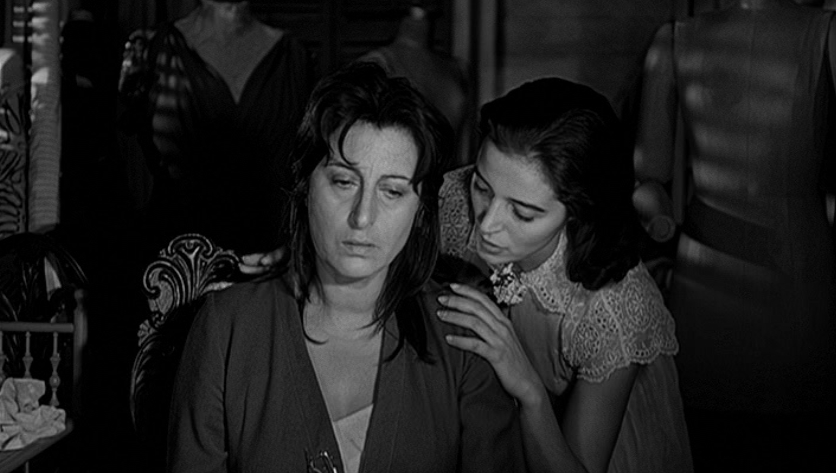
Anna Magnani in The Rose Tattoo

Sunday, December 4, 2011

Anna Magnani received her first Best Actress nomination and won her only Oscar for playing Serafina Della Rose, a devastated widow in the Best Picture nominee, The Rose Tattoo. Looking at the list of awards Anna won for this performance, I wonder why she was so convinced that she would lose the Oscar. I guess she must have thought Susan Hayward was the Hollywood darling who had to win. When she was told she won, she threatened to kill the reporter who informed her that she would kill him if it's not true. It was as true as possible and she even went to receive another nomination (and also should have won another Oscar). 

The Rose Tattoo is an excellent piece of work by Daniel Mann, the same man who directed I'll Cry Tomorrow. It's funny that he played the midwife in the birth of the two finest female performances of 1955. Just like I'll Cry Tomorrow, The Rose Tattoo is endlessly intriguing picture with many interesting aspects. I especially loved the first part of the movie with the focus on Magnani's character but I liked the second half much more than I did last time. Sure, Burt Lancaster overacts as hell in his part as the idiotic guy falling for Serafina but he actually had to play an idiot. He wasn't as awful as I remembered. Marisa Pavan also improved on a repeated viewing. 

However, the most important reason why the whole movie works is the wonderful, superbly talented Anna Magnani. I cannot judge Anna objectively because of the very fond memories of her. I've seen lots of her films when I was a child (she's my father's favorite actress) and I learned not to see her but feel her. Who cannot be charmed by her short scene as herself in Fellini's Roma. The way she says "Ciao! Buona notte!" is just incredibly and has such force with those two short sentences that just blows up the screen. She's 300% talent that shines through the screen even in the smallest part. So I ask again: can I judge Anna objectively? No, and honestly, in her case, you don't even have to. 

Serafina is such a fabulous part which fits Anna Magnani like a glove, it's as if Tennesse Williams had written it for her. Wait, he did write Serafina to the wonderful Anna. :) It's funny that Anna is such a significant presence and her own personality always shines through the movie and yet she disappears in the character of Serafina. To such an extent that it's hard to imagine any other actress (including the wonderful Maureen Stapleton who played Serafina on Broadway) taking on this part. Anna made Serafina her own and she's just incredible at showing her emotions. 

Whenever you see Anna Magnani in any movie, you experience something like an earthquake. Anna is neither like Meryl Streep in precision or Deborah Kerr in her subtlety and dignity. I felt she did what she felt was right and it always work. She was born to become an actress and her instincts came from a magical place, a place that's perfect. I can only repeat myself: what a force on the screen! She's incredible at showing the true love and afterwards the real desperation of Serafina. Just watch the scene when she gots the news of the death of her husband. The way she slowly touches her neck is just just gutwrenching. With this one movement shows so much and its truly a wonderful moment.

After her husband's death, Serafina goes into despair and she falls apart. Anna is wonderfully worn out in these scenes. She communicates Serafina's lack of interest in living without her husband. I guess it's a great thing that we never actually see her husband in full because that we he becomes more of a myth and a god just like Serafina always talks about him. That man brought all the happiness to her and Anna is so fantastic at showing Serafina's more tender side when she's about to reveal the news of her pregnancy to her sleeping husband who honestly doesn't listen to her. Like Serafina describes it to the priest in a wonderful monologue, she gave her "baron" husband glory despite being only a peasant girl. I think there's a not-so-strange parallel between Anna and Serafina. Anna herself had a very stormy relationship with Roberto Rossellini which ended after he impregnated Ingrid Bergman. Anna thought of Rossellini as an idol and started to write hundreds of letters to "the northern woman". Anna brilliantly used her own inner demons and pain to create this character and the result was something unbelievably intense. Intensity describes Anna's whole acting style that's rarely been better represented than in The Rose Tattoo (I think only Rome Open City and Mamma Roma, her two best performances did that).

The highlight of her work here is undoubtedly the scene in the church where she talks about her marriage and  begs the priest to reveal to her what her husband confessed (I especially loved the former). The range of emotions she displays there is just unbelievable. It goes from pure love through bitterness to complete despair. She covers her head and she looks like a ghost who came back to haunt you - and I suppose that scene will haunt anyone who sees it for a long time. Its impact is indescribably strong, which only Anna can do, I think. And I figured that with any other actress, that scene would have been awfully over-the-top and theatrical.

Most people think that from there, her whole performance goes downhill. Although I admit that it doesn't reach the impact of that one scene, I felt it was just as intense as the beginning. It's also incredible - but in a different way. The tone of her work becomes lighter and much more entertaining. I guess it represents how Burt Lancaster's character has changed Serafina and made her feel great again. However, after a while, she returns to the original Serafina who's loud and incredibly devastated. The scene where she sees the rose tattoo once again is just marvelous: it evokes the best parts of the whole film and it really is a fantastic moment. Just like the one where sher confronts her late husband's lover at the blackjack table (=slaps her, I guess she must have thought of Ingrid).

The scenes with Marisa Pavan are, in my opinion, a bit useless for the main storyline but that doesn't prevent Anna from giving her best there, too. She uses them to emphasise Serafina's changes even more, plus they are incredibly entertaining, especially the one where she talks about her daughter's and her boyfriend's "innocence".

Anna Magnani is all around brilliant as Serafina Delle Rose. She gives the essence of her own very unique acting style and she plays Serafina to perfection. The intensity of her work is just amazing and you can't take your eyes off her. Her scene in the church alone deserved an Oscar, not to mention her whole work. She's highly emotional, over-the-top and theatrical and yet it all feels brilliant because of her extraordinary talent. Magnificent, unforgettable performance.

What do you think?

Note: The Final Conclusion comes on Monday or maybe Tuesday. 

The Next Year

Friday, November 11, 2011

1955


So the nominees were:

  • Susan Hayward in I'll Cry Tomorrow
  • Katharine Hepburn in Summertime
  • Jennifer Jones in Love Is a Many-Splendored Thing
  • Anna Magnani in The Rose Tattoo
  • Eleanor Parker in Interrupted Melody

What an interesting, rarely talked about year, just the way I like it. I only saw Anna before so four performances will be completely new to me. :) I can't wait!

The Final Conclusion - Best Actress 1957

Wednesday, March 23, 2011

1957

So the much anticipated ranking:

Lana's performance mostly consits of sleepwalking and sitting in the background. I believe that had Turner been given some more to do, she would have been able to pull of a great performance as Constance. The screenplay always underlines how frigid this character is and it doesn't really let Turner do wonders with it. The overall effect is disappointing.

there isn't a thing about Deborah Kerr's performance that you could be passionate about. You can't love her, can't hate her and the whole thing becomes very standard and uninteresting. I know that many love this work but I just wasn't able to warm up to it. Deborah Kerr is quite good as Sister Angela but she doesn't go beyond good.

Despite my dislike for the acting of Joanne Woodward, this is quite a good job by her. Although it's not groundbreaking by any means and the emotional part of it is a bit lacking, the technical department is just excellent. Woodward made very wise decisions with these characters (despite being relatively new to the craft) and she put on a very good performance.

This performance is a bit mixed. On the one hand, Liz's accent andmannerisms are incredibly annoying and she fails with the technical. On the other hand, there are also some great moments that I just cannot ignore. As I said, Taylor is not really amazing, but there's something in her that stays with me. It's still quite good work and something keeps resonating with me.

You may consider me overenthusiastic and too lenient with performances but I was just blown away by Anna, from the beginning to the very end. Anna Magnani creates this beautiful, wonderful character and single-handedly makes the movie. It might be a bit much for many. For me, it worked and I consider this an astonishing performance.

So I can proudly announce
that my winner is...
Anna Magnani
in
Wild is the Wind
Why do I have to compete?

Omissions:

  • Giulietta Masina in The Nights of Cabiria *My Pick* (oh come on, too easy)


Final thoughts: A really weak year. Yes, I was a bit overenthusiastic but Anna was a shining light in this extremely weak year. So she was the clear winner. Joanne was quite good though a bit dry. Elizabeth Taylor, whom we tragically lost on the day I reviewed her performance, gave a mixed but haunting performance in Raintree County. Deborah was simply good, Lana was not bad. Again, a truly weak year. Still, I'm happy that I did it as I was so interested in Anna's performance, which was really astonishing though the movie dragged her down a bit.
Semi-congrats to Louis, who had it right with his original predictions but changed his mind in the last minute. :)


The ranking of the reviewed years:

  1. 1969
  2. 1974
  3. 1989
  4. 1959
  5. 1964
  6. 1939
  7. 1977
  8. 2010
  9. 2009
  10. 1980
  11. 1941
  12. 1963
  13. 1966
  14. 1973
  15. 1990
  16. 1978
  17. 1954
  18. 1948
  19. 2002
  20. 1957
  21. 1940
  22. 1998
About the next year: You cannot imagine the misery, torture and suffering that I went through to do the next year and get all the films. It's a really interesting one though I've only seen 2 performances but they are both given by two of my all-time favorite actresses (and the others are great performers, too, all three of them previous winners). Clue:
  • I can't give you a real clue as I keep forgetting and losing everything ever since that new insurance I have. ;)
What do you think?

Anna Magnani in Wild is the Wind

Friday, March 18, 2011

Anna Magnani received her second and final Best Actress nomination for playing Gioia, an Italian woman marrying her dead sister's husband in George Cukor's movie, Wild is the Wind. I don't know what to think about Anna's chances of winning her second Oscar. I don't think she had much of a chance of winning as she had just won plus she was a foreign actress. Moreover, her movie was not big and showy enough. I think she must have been fourth or fifth after all. Joanne, Liz and Deborah were battling it out, in my opinion.

Wild is the Wind is not as bad as some may say. Actually, it's quite good and enjoyable thanks to the great performances. It's pretty mediocre, that's true but not as bad as some might say. It doesn't have the typical flaws of a 50s movie though it doesn't mean it's totally flawless. Mr. Sugar*, George Cukor was a great director but this one is one of his lesser efforts. Same for Anthony Quinn: he was an exceptional performer but this one is not his best performance. However, Anthony Franciosa is sometimes laughably bad.

Well, Anna Magnani. You know, it's honor itself just write about her. That woman! That actress! OK, I might be a bit influenced as she's my dad's favorite actress and I've seen many of her Italian movies beforehand which made me also fall in love with her work. She's (very much like Sophia Loren and most of the great European actors) a natural talent who doesn't have to learn acting, it's in her bones, in her soul and it's just a way of expressing herself. She doesn't have to time her tears, practice accents and do method acting. She knows it from her instincts. There's so much fire and music in Anna that I always feel that while she's acting, there's a volcano erupting with the music of Jaws. Anna Magnani was brilliant, quite simply and her talents shines through time and her work lives on.

It's kind of a cliché to say that Hollywood did not get the best out of Anna. I think it's a dumb, stupid thing to say, since anyone who's seen either of her Oscar nominated works is simply astonished by her extraordinary talent. She's very unusually beautiful (she IS beautiful, I think) and she has a very great sense of humor and she adds a lot of that even to her most serious characters. Gioia is a mysterious woman. We don't know anything about her yet Magnani tells thousands of stories with her eyes and face and we just keep wondering about Gioia.

At the beginning of the movie, Gioia feels like a fish out of water because of her bad English and the aggressively kind welcome to America. The dinner scene is a chaos, however, Anna is able to come out of it. Her performance almost failed in the beginning but Anna was wonderfully in control of Gioia. It's an amazing scene when we see her with her stepdaughter/niece under a tree. She's just brilliant there and from that time on, her performance doesn't stop and it really becomes roller coaster that doesn't stop until the very end. It's so intense and extremely gripping. Even when my interest for the movie died down, I still couldn't take my eyes off the screen and that's only because of Anna.

Anna's chemistry with Anthony Quinn is simply marvelous. Although Quinn is not that great, Anna really gets the best out of the both of them. Quinn actually said that despite her dislike for Anna, he loved working with her. I can easily believe that. Anna's talent is so inspiring and stimulating and I guess her co-stars must have felt the very same way. They don't have the usual "loud Italian rows" but they have some great arguments like the one in the kitchen (which is probably one of the most amazing scenes of Anna). There are so many emotions coming out of Magnani that really blow the viewer away.

Her scenes with Franciosa are also excellent. Although he's giving a really bad performance, Magnani holds all the scenes together and she really carries them on her shoulders. Even the most tender moments are quite great and all thanks to Anna. Their last scene together becomes so heartbreaking with Anna's loud screaming. That being said, Anna's acting is indeed loud and very emotional but I think that's the way it should be with this character. Whenever Anna is looking at the sky and putting her hands on her face, we feel that it's natural and it's not la Susan Hayward-like yelling. Anna always remains natural and that's why it works. She has this mentality in her blood. It's interesting that Anthony Quinn uses the same mannerisms as Anna and yet it doesn't work for him. It's like when Penélope Cruz tries to walk like Sophia Loren. No, there are things that work for Anna Magnani or Sophia Loren, but it's for them, exclusively.

Also, Magnani interacts so beautifully with animals in this movie. The scenes with the horses are just so brilliant and heartbreaking. The wild horses might be the symbols of Gioia's desire for freedom and true love. Gioia is stuck in a marriage where she should replace her dead sister (she also has to deal with her memory) but still, in a way, they love each other with Quinn's character. Or do they? I don't really know but it makes the whole case even more interesting.

So, you may consider me overenthusiastic and too lenient with performances but I was just blown away by Anna, from the beginning to the very end. My overall opinion must also be influenced by her brilliant singing scene but I don't care as this is truly haunting and fantastic work. Anna Magnani creates this beautiful, wonderful character and single-handedly makes the movie. It might be a bit much for many. For me, it worked and I consider this an astonishing performance.

What do you think?

I think my opinion about her was pretty predictable but she's really so great.

The Next Year

Monday, March 14, 2011

1957


So the nominees were:
  • Deborah Kerr in Heaven Knows, Mr. Allison
  • Anna Magnani in Wild is the Wind
  • Elizabeth Taylor in Raintree County
  • Lana Turner in Peyton Place
  • Joanne Woodward in The Three Faces of Eve
It is said to be a weak year but I've only seen Joanne previously, so it's going to be an interesting one to explore. I can't wait to see all the movies.

What do you think? What are your predictions for my ranking? Who's your pick? What's your ranking?

The Theater of Life: Jean Renoir's The Golden Coach

Monday, November 30, 2009

"Theatricality always fascinated Renoir."
—David Thomson, The New Biographical Dictionary of Film (2004)

The theater has intrigued many of the great filmmakers, inspiring them to examine the blurring of the distinctions between acting and life. Impersonation, disguise, deception, and hiding behind a false personality—all of these examples of the irruption of theatricality into real life and staples of many genres in literature and film—are devices found, for instance, in a number of Alfred Hitchcock's thrillers (The Lady Vanishes, Spellbound, Notorious, Vertigo, Psycho to name some of the most obvious). Ingmar Bergman was intensely interested in the interplay between personality and performance and probed the subject time and again, from his first masterpiece, Sawdust and Tinsel, to Persona to his last theatrical feature, Fanny and Alexander. Aside from Persona, few movies I've seen have been so thoroughly steeped in the parallels between the theater and reality and in the concept of life as performance as Jean Renoir's The Golden Coach (1952).

In the movie, the great Anna Magnani plays Camilla, the lead actress in a troupe of Italian commedia dell'arte players who travel to Peru in the 1700s. When they arrive, they find the whole trip has been a fiasco. There is no theater for them to perform in, the local innkeeper who has engaged them practically places them in servitude to pay off the cost of their passage, the local nobles shun them as too common, and the natives who attend their performances are unskilled in the respectful behavior of theatergoers. Camilla, who has spent the five-month sea voyage sleeping in a magnificent golden carriage being shipped to the colonial viceroy and seized upon it as the symbol of the golden opportunities waiting in the New World, is bitterly disappointed at the bleak reality she finds there.

When the viceroy, Ferdinand (Duncan Lamont), becomes besotted with her, the fortunes of the troupe begin to change. For the rest of the movie, she not only becomes involved in romantic intrigue, but also becomes the center of political intrigue when Ferdinand gives her the coach she covets as a present. This causes a revolt by the nobles, who proceed to depose Ferdinand and sue the bishop, who is the ultimate authority in all such decisions, to support their wishes and order the viceroy's execution.

The movie is part romantic farce, part social farce, and part political farce. These strains intersect in a very funny sequence in which Ferdinand races from room to room as the council of nobles meets in one room in an attempt to force him to sign a decree taking the golden coach back from Camilla and giving it to them, while the furious Camilla waits for him in another room obstinately refusing to relinquish the coach, and her competitor for his affections, Ferdinand's haughty former mistress, a widowed noblewoman, waits in yet another room trying to persuade him to give up the common Camilla and return to her. The sequence is staged, acted, and filmed in a style straight out of French farce.

The viceroy is attracted to Camilla not only by her earthy dynamism and anarchic spontaneity—a sharp contrast to the affected languor of the local noblewomen, with their mannered behavior and highly artificial appearance—but also by the fact that it is only with her that he can abandon his role as a political figurehead and be himself. This is expressed in their first meeting, at a formal dance for the nobility at the viceroy's palace, when he ushers Camilla to a secluded balcony and removes his wig, complaining that it's far too hot to wear something so absurdly uncomfortable. With everyone else he is formal and calculating, forever in the midst of a political or romantic power game in which he must be constantly on his guard to press his advantage and protect his position. But with Camilla he relaxes, and in the entire movie, it is only when he is with her that he ever laughs.

The central irony of the movie is that the nobility are in a way professional performers just like the actors, their lives governed by prescribed conventions of behavior every bit as formulaic as the set plots of commedia dell'arte that Camilla and her troupe perform nightly. The difference is that the actors have a real life when they are not onstage, and the nobles don't. For the professional performers, there is a clear distinction between acting and being. For them these are discrete states: they are either "on" or "off."

In the lives of the nobility, by contrast, this distinction does not, indeed cannot, exist. They are always "on," always performing, and they don't even seem aware of it. Everything about them—their arch posing, elaborate wigs and attire, pompous manners and diction, and stately dances—exists to sustain the grandiose illusion of entitlement that keeps them in power and wealth. The actors know the difference between acting and life and drop their stage roles when they are not working, but the nobles can never afford to drop their masks, for it is through the manipulation of appearances that they maintain their control over society.

For the viceroy and the other nobles, the golden coach itself is a symbol of privilege. Ferdinand freely acknowledges that this was the purpose of ordering the coach, as a symbol to impress upon the natives (and even though he doesn't say so, clearly upon the other nobles) his social and political status, to remind them as they see him riding in it of the hierarchical power structure of colonial Spain and of his own supreme position in the colony. This is why the nobles become so incensed when Ferdinand gives the coach to Camilla, because he treats it as a personal possession, not as a symbol of power and wealth. And they tell him openly the reason they insist on having it for themselves is the impression it will make on the natives when they see their social superiors riding in it—yet another example of illusion and performance merging with reality.

Romantic complications ensue when Camilla, already being pursued by Felipe, the leading man in her troupe, becomes involved not only with the viceroy, but also with the local celebrity, a toreador named Ramón. While attending a bullfight (itself another kind of highly ritualized performance), she becomes so caught up in the drama of the situation that she impulsively throws the golden necklace the viceroy has given her to the victorious toreador, who interprets it as a token of her affection. In another farcical and highly theatrical scene, in the background Felipe and Ramón fight a duel over Camilla with swords while in the foreground the viceroy, who has refused to give in to the demands of the nobles over the coach and resigned himself to the loss of his power and his life, says goodbye to Camilla on the night before the bishop arrives to sign his death warrant.

But in the end the viceroy is not deposed or executed. The resourceful Camilla outwits all of her noble adversaries by grasping, as they do not, the power of theater over life. How, you may be asking, does she put this knowledge to practical purpose? By recognizing that there is one powerful person with more invested in the maintenance of position through symbolism, ritual, and performance than the nobles themselves: the bishop, the man who has the final say in all that happens in the colony. For what could possibly be more theatrical than the pageantry of the Roman Catholic church? Costumes, props, music, stylized movement, elevated language—the church incorporates in its rites the same elements as the theater. By making a gift of the golden coach to the bishop, Camilla not only saves Ferdinand's life, but proves herself the most masterful dramatic strategist—and plotter—of the lot by correctly gauging the irresistible appeal of the coach's grandeur to the bishop's vanity. In thanking Camilla for her gift, the bishop actually says with a straight face that now when he is driven to give the last rites to a dying peasant, he will arrive in a vehicle befitting his position as spiritual head of the colony!

The Golden Coach benefits greatly from its Technicolor cinematography by the director's nephew, Claude Renoir, who worked with Jean Renoir on several of his movies. Filmed at Cinecittà in Rome, the movie has a gleaming, silvery glow that mirrors the sunblanched desert tones of the sky, sand, stone, and stucco of its setting. The film also benefits from the music of Vivaldi, which is contemporary with its setting and which Renoir says he used as an inspiration while planning the movie. But above all it benefits from the presence of the magnificent Anna Magnani. When unrestrained, Magnani can sometimes be just a bit too much larger-than-life. But here she has just the right amount of exuberance, willfulness, and voluptuousness. It's easy to see why the viceroy becomes so enamored of her, for her appeal shines through not so much in physical beauty as in her sensuousness, her liveliness, and her robust enjoyment of life—all qualities lacking in the effete noblewomen the viceroy normally socializes with and romances.

But most of all, Magnani's beauty is expressed through her huge, soulful, bovine eyes. Nowhere is this more apparent than in the final scene of the movie. Like Olivier's Henry V, The Golden Coach opens and closes in a theater, and the entire movie is framed as a stage performance. In the last scene, the curtain descends, and the camera draws back to show the proscenium. Don Antonio, the manager of the troupe, stands to the left and delivers an epilogue on the superiority of the theater to "so-called real life." As the camera moves in for a medium close shot of Magnani, standing dead in the center of the stage in front of the curtain, she mutters distractedly, "Felipe, the bishop, Ramón, the viceroy . . . disappeared, gone."

"Do you miss them?" Don Felipe asks her.

"A little," she answers wistfully, raising those dark, melancholy eyes and looking directly into the camera, which lingers on her face in a haunting final shot that in its power and beauty rivals the last shot of Garbo in Queen Christina.
 

Blogger news

Blogroll

Most Reading