Pages

Powered by Blogger.
Showing posts with label Katharine Hepburn. Show all posts

Pawsome Pet Pictures: Katharine Hepburn.

Tuesday, January 22, 2013


Personal Quote: "If you always do what interests you, at least one person is pleased".

Undercurrent (1946)

Sunday, December 23, 2012


Undercurrent (1946). A film noir drama directed by Vincente Minnelli. The screenplay was written by Edward Chodorov, based on the novel You Were There by Thelma Strabel. Cast: Katharine Hepburn, Robert Taylor, Robert Mitchum.

In Vincente Minnelli's autobiography, he says that Robert Mitchum was very uncomfortable in the role of the sensitive Micheal.

This was Robert Taylor's first movie since returning from military service in World War II.

Katharine Hepburn and Robert Mitchum didn't get along. One day she told him, "You know you can't act, and if you hadn't been good looking you would never have got a picture at all. I'm tired of working with people like you who have nothing to offer."

The story begins when, Alan Garroway, meets Ann Hamilton, the unsophisticated daughter of chemistry professor Hamilton and it is love at first sight.

After Ann and Alan, are married they travel back to Washington, D.C., where she is introduced to Alan's manager Mr. Warmsley and his wealthy friends. Embarrassed of her appearance, Ann asks Alan to show her how to dress and behave.

Later, Alan tells Ann that after his father died he and his brother Michael took over their father's mechanical gadget business, and that he has not seen or heard from Michael since he was caught stealing from him.

While visiting Alan's Virginia family home, Ann is startled when a horse becomes extremely upset in the stable and learns from a frightened stable-hand that Alan once badly beat the horse.

After, Alan angrily orders Ann to stop playing a familiar tune on the piano, she thinks it is because of the bad memory's from his past. Later, George the caretaker, tells Ann that the song she was playing was one that Michael used to play. Ann decides to help her husband overcome his past.

After, Alan leaves on a business trip, Ann visits his office and asks Warmsley to give her directions to Michael's house near the ocean. At the house, Ann meets Michael... he introduces himself to her as the caretaker.


Later that night, Alan comes back and surprises Ann at the house. He demands to know why Ann is there, and Ann tells him that she wanted to find out more about his past.

Later, the two brothers are alone and Michael accuses Alan, of having killed an engineer at their plant, so he could steal his plans for a remote control explosive device. Michael tells Alan, that he has decided to expose him because.. he met Ann and believes that she should not be involved with a murderer. Then Alan informs Michael, that he has changed and that he plans to tell Ann the truth about his past. For now... Michael, decides to keep quiet about the murder. Alan, lied to his brother and plans to keep his past a secret.

Ann, tells Alan that she is obsessed with thoughts of Michael and that she wants to meet him, so that she can put him out of her mind, once and for all. Alan, accuses her of being in love with his brother. Alan, realizes that he must kill her to prevent her from leaving him. They are out riding on horseback when he decides to push her off a steep ledge, will she be able to get help in time?

Hepburn, gives a very convincing performance as the insecure Ann. Taylor's, performance as the tormented Alan is also perfect, always on the edge of losing control. Mitchum, plays a very different part for him. The ending maybe predictable... but exciting.

Marjorie Main (February 24, 1890 – April 10, 1975). Born Mary Tomlinson in Acton, Indiana, Main attended Franklin College in Franklin, Indiana, and adopted a stage name to avoid embarrassing her father, Samuel J. Tomlinson who was a minister.

She worked in vaudeville on the Chautauqua and Orpheum Circuits, and debuted on Broadway in 1916. Her first film was, A House Divided(1931).

Main was typecast in domineering roles, for which her voice was perfect for. She repeated her stage role in, Dead End in the 1937 film version, and was cast many times as the mother of gangsters.

She again transferred a strong stage performance, as a dude ranch operator in, The Women(1939). Main was signed to a MGM contract in 1940, and stayed with the studio until the mid-1950s.

She made six films with Wallace Beery in the 1940s including: Barnacle Bill (1941), Jackass Mail (1942), and Bad Bascomb (1946).

She played Sonora Cassidy, the chief cook, in The Harvey Girls (1945). The director, George Sidney, said that Miss Main was a "great lady" as well as a great actress who donated most of her paychecks to the support of a school.

Her most famous role was that of "Ma Kettle", which she first played in, The Egg and I(1947) opposite Percy Kilbride as "Pa Kettle". She was nominated for an Academy Award for Best Actress in a Supporting Role for the part and portrayed the character in nine more Ma and Pa Kettle films.

In the 1950s, she had appeared in the MGM musicals: Meet Me in St. Louis, The Belle of New York and It's a Big Country.

In 1954, Marjorie Main played her last roles for the studio; Mrs. Hittaway in, The Long, Long Trailer and Jane Dunstock in, Rose Marie.

In 1956, Main played The Widow Hudspeth in the hit film, Friendly Persuasian. In 1958, Main appeared twice as rugged frontierswoman Cassie Tanner in the episodes "The Cassie Tanner Story" and "The Sacramento Story" on NBC's western television series, Wagon Train. In 1964, she appeared on an episode of Perry Mason.

Main married Stanley LeFevre Krebs, who died in 1935.

In 1974, a year before her death, Main attended the Los Angeles premiere of the MGM film, That's Entertainment. It was her first public appearance since she retired from films in 1958. At the post-premiere party, she was greeted with cheers from the crowd.


Pre-Code: Christopher Strong(1933).

Friday, August 17, 2012


Christopher Strong (1933). RKO film, directed by Dorothy Arzner. Cast: Katharine Hepburn in her second screen role. The screenplay by Zoe Akins is adapted from the novel by Gilbert Frankau. The musical score for this film is by Max Steiner.

At one of Carrie Valentin's socialite parties a "treasure hunt" challenge, begins and Monica Strong and her married boyfriend, Harry Rawlinson, set out to find and bring back a truly faithful husband and a woman over twenty who has never had a love affair.

Harry, has a minor car accident with Lady Cynthia Darrington, an aviatrix with whom he returns to the party with, hoping to win "treasure hunt" challenge. Monica asks her father, Sir Christopher Strong, a respected politician and a faithful husband to join in on the fun.

After the party, Monica and Harry become fast friends with Cynthia, who is attracted to Christopher. Even though he loves his wife Elaine, Christopher is attracted to the head-strong Cynthia and she, to him. Elaine, begins to suspect something is going on forbids Monica from seeing Harry, but.. allows Cynthia to visit their summer villa in Cannes.

Cynthia and Christopher take a romantic midnight boat ride and confess their love for each other. Elaine, waiting for her husband to return sees them kissing through her bedroom window, is heartbroken.

Later, Monica shows up at Cynthia's apartment,threatening to kill herself because the now divorced Harry, refuses to marry her because of a one-night stand she had in Cannes. After preventing Monica's suicide, Cynthia leaves England for New York to participate in the once in a life time around-the-world flying competition.

Although she wins the contest, Cynthia, is pining away for Christopher and is thrilled when she finds him waiting for her at her hotel. After, they consumate their love, Cynthia agrees to give up flying and devote her life to Christopher.

It isn't long before Cynthia's affair is discovered and Monica, who is now married to Harry and pregnant, thanks her for being a such a good friend .. Cynthia learns that she, is also pregnant, but decides to keep it secret and accepts a dangerous flying challenge, even after she promised she wouldn't. What will she do to save Christopher's marriage and career?

I have been wanting to see this film for a long time. Hepburn, is very convincing as an aviation obsessed with the man she loves. One of the best scenes in the film had Hepburn's character appearing at a costume party dressed in a stunning, glittering Moth costume designed by Howard Greer.


Fun Facts:

Newsreel footage of parades and famous flights were used in the movie.

Katharine Hepburn replaced Ann Harding.

Billie Burke's last dramatic role until "In This Our Life, with Bette Davis."

Colin Clive was 33 when this movie was made, 'Billie Burke' who played his wife was 49, and 'Helen Chandler' who played their daughter was 27.

Please click on The greatkh.blogspot Movie Review: The Strength of Christoper Strong. to read Margaret Perry's awesome movie review.


Colin Clive (20 January 1900 - 25 June 1937), attended Stonyhurst College and subsequently Royal Military Academy Sandhurst, where an injured knee disqualified him from military service and contributed to his becoming a stage actor.

On stage, one of his roles was Steve Baker, the white husband of racially mixed Julie LaVerne, in the first London production of Show Boat. This production also featured Sir Cedric Hardwicke and Paul Robeson. Clive first worked with James Whale in the Savoy Theatre production of Journey's End and subsequently joined the British community in Hollywood in the 1930s, repeating his stage role in the 1930 film version of Journey's End, which was directed by Whale.

Although Colin Clive made only three horror films, Whale's two Frankenstein films and Mad Love (1935), he is widely regarded as one of the essential stars of the genre by many film buffs. His portrayal of mad Dr. Frankenstein has proved inspiration and a launching pad for scores of other mad scientist performances in films over the years.

Clive's first screen role, in Journey's End, was incidentally directed by James Whale. Clive played the alcoholic and tormented Captain Stanhope, a character that (much like Clive's other roles) tragically mirrored his personal life.

Clive was also an in-demand leading man for a number of major film actresses of the era, including Katharine Hepburn, Bette Davis, Corinne Griffith and Jean Arthur. He also starred as Edward Rochester in a 1934 adaptation of Jane Eyre opposite Virginia Bruce. He was related to Clive of India and appeared in a featured role in a film biography of his relative in 1935.

From June 1929 until his death, Clive was married to actress Jeanne de Casalis. Although she worked in films and on stage, her greatest success was as a comedienne on radio sitcoms in England, playing the dithering "Mrs. Feather". De Casalis did not accompany her husband to Hollywood.


The Final Conclusion - Best Actress 1951

Saturday, July 28, 2012

1951


So the much anticipated ranking is:

I just don't want to bash Eleanor's work here. I found her approach to the part totally wrong and I thought that she wasted a lot of important opportunities in her character that would have made a lot of difference in the movie and her performance. However, I was still intrigued by her and her magnetic presence kept me interested in her character whose storyline was the most interesting one in the movie. I'm confused.

Jane Wyman gives a beautiful, touching and heartwarming performance that's really worth waiting for it. I instantly connected to the character and Jane constantly captivated my heart and soul. It really is a piece of work that doesn't seem to be a big achievement and yet it really is something special for me. Although I might be a bit too sentimental about this work of Wyman, I'm not ashamed to say I was deeply moved by Wyman's acting here. 

Katharine Hepburn gives a wonderful, enjoyable performance that really makes her movie an exciting, interesting and memorable experience. She uses all her charm and talent to create a character, which she makes twice as intriguing as you would expect. She fills the role of the spinster with real spirit, which makes her a welcome presence everytime you see her. And her her chemistry with Humphrey Bogart is indeed perfect.

Shelley Winters gives a wonderful, heartwrenching performance as Alice in A Place in the Sun. She took a very simple character and made her an intriguing personality, with whom you can easily sympathise. You feel for her from the beginning to the shocking end and the way Shelley develops this character is just extraordinary. Truly memorable, haunting piece of work that really elevates and enriches its movie, one that stays with you long after the credits roll.

Vivien Leigh's performance as Blanche DuBois is indescribable. No matter how much I'm sweating and trying to point out parts of her brilliance, I constantly fail as you have to see Vivien's acting for yourself to feel her brilliance. Her acting in A Streetcar Named Desire is something that words cannot really describe so if I have to give a brief summary about what a brutally, unbelievably amazing performance hers is, I have to turn to Brando who said: Vivien Leigh was the best Blanche. She was Blanche DuBois.


So I can proudly announce
that the winner is...
Vivien Leigh 
in 
A Streetcar Named Desire
This stranger also loved you, Viv.

Final thoughts: What a brilliant, endlessly intriguing year! I've wanted to do it for so long and being able to finally see all the films... I'm amazed. The winner was no surprise, naturally, if it was, check into the next hospital. Yeah, it's all about Vivien (who became a two-time winner joining Jane, Great Glenn, Liz and Barbara), but the others were excellent as well. I have positive feelings even about Eleanor who's the weakest link here. Anyway, I don't want to say too much, it's been one of my favorite years so far. 

Omissions:
  • Elizabeth Taylor in A Place in the Sun

About the next year: We have not one, but TWO winners of the predicting game, so congrats Marc and Nues20! Joe also found it out after the usual deadline (which has always been so), but since he wants 2007 so badly, it'll be AT LEAST the first year I'll do from now since I forgot about the deadline myself. :) So you guys pick a year and those will be the next ones! :) You'll make my life easier because I had no idea what to do next. :) It stars on Monday, I know that for sure. :) 

Available years for me that I haven't done: 1933, 1938, 1942, 1953, 1956, 1960, 1967, 1968, 1981, 1985, 1991, 1993, 1994, 1999, 2000, 2005, 2007, 2008 

What do you think? Any thoughts on your mind?

136. Suddenly, Last Summer

Tuesday, July 24, 2012

136. (11 Jul) /Suddenly, Last Summer/ (1959, Joseph L. Mankiewicz) 74


My assessment of this on a previous viewing seems right on target. Repeat viewings just emphasize how astounding Hepburn's first and Taylor's last scenes are.

Katharine Hepburn in The African Queen

Sunday, July 22, 2012

Katharine Hepburn received her fifth Oscar nomination after a nine-year gap for playing Rose Sayer, a missionary's sister who falls for Humphrey Bogart's Charlie Allnut in John Huston's classic adventure flick, The African Queen. I'm still wondering how much chance of winning Kate had that year. She was a huge star, a previous winner like Vivien Leigh, she even won her Oscar eighteen years before so she might have had her supporters. Actually, Vivien herself thought that Kate would win her Oscar (which says either a lack of confidence or respect with some false modesty on Vivien's side, I guess). In my opinion, Kate was eventually third as I believe Shelley Winters had the edge over her because of her movie. 

Although The African Queen is a lovely movie, I really don't think that much of it or don't consider it that much of a classic. It's entertaining, well-directed, the dialogues are witty, everything works excellently, I just felt that it was a little bit pale for me and I would have loved some more tension in it. Anyway, Humphrey Bogart gives a funny and charismatic performance, giving his usual self, this time in a comedy, but his Oscar win is still ridiculous, especially considering the earth-shattering performances by Marlon Brando and Montgormery Clift. His win was one of the first ones of those career wins that I still cannot really warm up to. 

I cannot really say more about Katharine Hepburn that I haven't already said here on this blog. I really love her as an actress and especially as a personality since I believe that she was the greatest character in Hollywood that ever lived. No kidding here, I strongly believe that they don't make'em like that anymore. I really can't say such an exciting personality like she was (I guess only Bette Davis could get close to her, even back then). Even when I had issues with her performances or more precisely, I wasn't that taken by her, I always enjoyed her work, mostly because of her killer personality. 

But you know, what can you say about her famous spinster period when her killer real personality was much more rarely present on the screen? The African Queen marks the beginning of that fruitful and successful period for Kate, but it also marks the beginning of the performances of Kate by which I seldom get blown away. In her early and later parts, Kate's always present with her let's-cut-the-bullshit character that I so admire and here she's kind, shy, something that I'm not too crazy about. That being said, she's still an excellent actress who's a real thrill to look at every time, isn't she? 

In a way, she isn't as I never really bought Kate as a shy spinster who gets turned on in the end and who goes through significant changes in her life. I always thought that Kate's early scenes in these spinster movies were kind of artificial and I was always a tiny bit turned off as a result. The problem could be that I always expect the grand, confident Kate Hepburn turning up and yet I'm constantly let down. However, in The African things turn out differently (fortunately). I didn't notice a fake movement from Kate. In fact, I felt that she wonderfully disappeared into her character and (even a greater achievement) the always present Kate Hepburn, the star disappeared and she's able to impress not using her brilliant star personality.

In movies like The African Queen where it's mostly about the two main actors, the outcome depends on the chemistry. And although Kate outacts Humphrey Bogart in a blink, the sexual tension between them is just brilliant and you can see that the actors and the director approached it with lots of humor. In a way, they reminded me of the legendary Clark Gable-Claudette Colbert couple from It Happened One Night. Many explain their relationship as a metaphor of the USA over the great colonising countries like England and actually, you can easily justify this by examining Kate's work here. You just cannot overlook the way the very polite and proper English lady gradually surrenders to the charming, common American because she depends on him in order to survive. And the greatest achievement about this is that Kate makes her performance really enjoyable and entertaining even without this background. However, you cannot ignore the fact that her performance is more than just loveable romcom acting.

Kate also handles the comedy wonderfully and her sharp delivery is a real treat (as usual). She naturally uses her charisma a lot during the movie, but I could feel that she was perfectly aware of the fact that this character needed something more than that and in the end, Rose turned out to be a really layered and kind of fascinating character. I ultimately felt a strong connection to Rose and I was really taken by her emotions: and Kate impresses without the desperate need to seem amazing (that's a trap that Kate tended to get stuck in).

My only complaint could be that Kate went a little bit over the top with showing Rose's emotions for Charlie and it was a bit unbelievable that a repressed spinster turns out to behave when in love just like a schoolgirl. Although that might even have been just an ironic acting decision, I'm not sure about that. However, I'm certain that I never really loved Katharine more than I did in this film. I have been more impressed by her, but I've never liked her so much, that's for sure. The movie and her duo with Bogart might have had a lot to do with that, but quite simply, despite my previously mentioned complaint, I fell for her here as she's just irresistable and I tend to be more forgiving in these cases.

All in all, in The African Queen, Katharine Hepburn gives a wonderful, enjoyable performance that really makes her movie an exciting, interesting and memorable experience. She uses all her charm and talent to create a character, which she makes twice as intriguing as you would expect. She fills the role of the spinster with real spirit, which makes her a welcome presence everytime you see her. And her her chemistry with Humphrey Bogart is indeed perfect. 

What do you think? Please check out my other blog to watch my new experiment that I hope you will all enjoy. 

The Next Year

Sunday, July 15, 2012

1951


So the nominees were:

  • Katharine Hepburn in The African Queen
  • Vivien Leigh in A Streetcar Named Desire
  • Eleanor Parker in Detective Story
  • Shelley Winters in A Place in the Sun
  • Jane Wyman in The Blue Veil 
A rarely talked about year where the (legendary) winner seems to be a very easy one with everyone else a little bit ignored (party because the movies are pretty hard to find). Let's see if I go for the very popular winner or one of the four other ladies. 

What do you think? Who's your pick? What's your prediction for my ranking? :)

133. Bringing Up Baby

Tuesday, July 10, 2012

133. (07 Jul) Bringing Up Baby (1938, Howard Hawks)* 94


Essentially so much funnier than almost all other comedies, it's surprising when so much as ten seconds go by without Bringing Up Baby landing a laugh. Katharine Hepburn and Cary Grant are at their comedic best. They're keenly aware of the inherent hilarity in the script and accomplish quite a feat in creating dimensional characters in a screwball this wacky. Howard Hawks likely couldn't have had more fun making this. He sets up each elaborate gag and twist as if it's a labor of love.

The Final Conclusion - Best Actress 1955

Monday, December 5, 2011

1955


So the much anticipated ranking is:

I would be lying if I said I wasn't really moved by this performance. To some, this work of Jennifer Jones would be flat and uninteresting, but I really enjoyed every minute of it. Although it's not a grand achievement by today's standards, it's an incredibly moving and loveable piece of work. Jennifer excels at showing Suyin's humility and pure emotions. Again, this is nothing fantastic but something really lovely.

In a role that's the least Oscar-baiting of her category, Katharine Hepburn excels. It takes some time to fully realize her greatness as Jane Hudson, but the outcomes are simply astonishing. Kate injected an incredible amount of charm into the character that made extremely loveable. And eventually, it's Kate's charisma and fascinating personality that makes her completely irresistable here. 

Eleanor Parker's vibrant, wonderful performance as Marjorie Lawrence is a real treat to watch. She approached this character in a very odd way (for her time) and the result is something endlessly charming and impressive. She does way more than I expected her to do and gets the most out of this showy, interesting part. A really pleasant surprise coming from a hard-to-find movie.

An unbelievably great performance, which I (sort of unexpectedly) loved from the very first minute. Susan is simply marvelous at showing Lillian's pain and struggle with alcohol and makes her film extremely disturbing and hard to watch. However, she also makes an unforgettable impression that hits you really hard in your guts. In her signature role and personal favorite work, Susan Hayward is fantastic. And she sings, too!

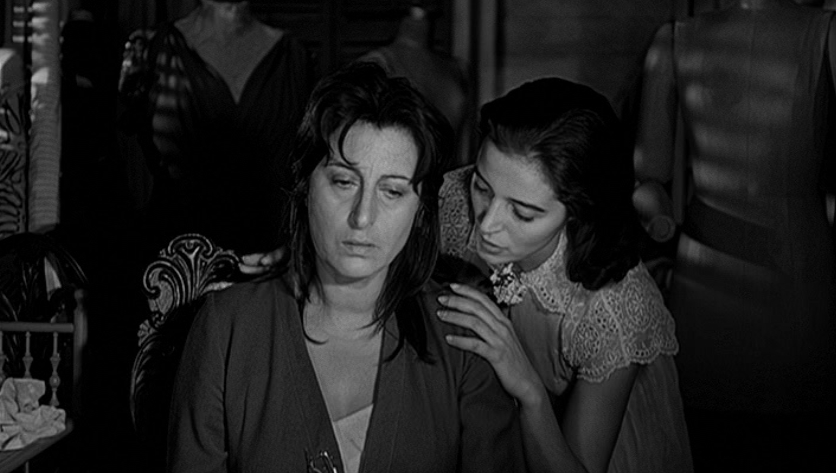
Anna Magnani is all around brilliant as Serafina Delle Rose. The intensity of her work is just amazing and you can't take your eyes off her. Her scene in the church alone deserved an Oscar, not to mention her whole work. She's highly emotional, over-the-top and theatrical and yet it all feels brilliant because of her extraordinary talent. Magnificent, unforgettable performance.

So I can proudly announce
that the winner is...
Anna Magnani 
in 
The Rose Tattoo
Anna has a hard time believing it... :)

Final thoughts: A great year with two amazing performances. Deciding between the two was incredibly difficult. My mind said Susan, my heart said Anna so I went with my heart. :) I was surprised by how great the others were. Yes, Jennifer is the weakest link but she was also really lovely. I've never really warmed up to Kate so after a few days my appreciation for her work cooled down a bit. Eleanor was, however, so wonderful but I need to be less generous with the grades. So the ranking was not that difficult in the last 3 places. 

About the next year: All I can say is FINALLY! A year with at least two iconic quotes, one iconic character (or even more) and at least four brilliant actresses. I've been hunting (literally, well, almost) for one film for a long time and now I have it! I almost gave it up, my mind constantly said "Snap out of it!" but then the year said to me "I'm not gonna be ignored, Dan." 

What do you think?

Katharine Hepburn in Summertime

Sunday, November 20, 2011

Katharine Hepburn received her sixth Oscar nomination for playing Jane Hudson, a(nother) spinster, who spends her vacation in Venice and falls for a man in David Lean's movie, Summertime. 1955 was a very interesting field and given the fact that Anna won all the critics' awards, it's very hard to think about how much the Academy loved the other ladies. I guess Jennifer, Eleanor and Katharine were the ones who had the least chance, however, Katharine Hepburn was Katharine Hepburn and that might have given her the edge over the two other ladies or that might have been the reason why they didn't vote for her. Well, we'll never know for sure though it would be interesting to find out once.

Summertime is not the grand epic you would expect from the director of Lawrence of Arabia and The Bridge on the River Kwai, it's much more like the earlier works of David Lean though it's much less heart-breaking than A Brief Encounter, for instance. Summertime is very entertaining and that's the most I can really say about it. Although it's Lean's own favorite work, I can hardly see why. As I said, there's nothing really special about this film. It's very clear from the beginning that the biggest virtue of this film is the lead performance by Katharine Hepburn. 

As it has been said many-many-many times before, Katharine Hepburn had her very famous "spinster period" when she kept on playing spinsters who find true love when they have already given up on the whole thing. They start out hardened, bitter and shy but in the end, they turn out to be stronger and more self-confident. As I might have said this, I'm not a fan of Katharine Hepburn. I can see that she was a fantastic actress (boy, she really was) and a fascinating personality and yet I still don't get the overwhelming amount of love she gets. I do think she's a bit overrated. And that applies mostly to her famous spinster period, which I just cannot seem to warm up to. 

Or couldn't as (to my surprise) I really liked her performance as Jane Hudson. She makes her character very easy to sympathize with. Jane is a person whose only dream was to go to Venice, she saved up money for it and decided to enjoy her stay. However, things get complicated when she meets a man she eventually ends up falling in love with. The thing I dislike the most about Hepburn's spinster performances that the hardened women turn out to be beautiful violets in just a second and they also become really annoying once they experience love. However, Jane is a bit of an exception and that's probably why it's Katharine's most acclaimed spinster performance. The changes in Jane go gradually and Katharine carefully portrays the development of this character. As a result, she surprisingly avoided being as annoying as she was in other roles like this. 

Kate uses an incredible amount of charm to create Jane and that's probably the reason why it's so easy to sympathize with her. We know that it's not going to work out for her and yet we just keep on rooting for her happiness. She will go back to America, being a spinster secretary but in Venice, she's a beautiful woman who's in love, not only with the man she met, but also herself. In many ways, she's just like Pauline Collins' Shirley Valentine, an unhappy, dissatisified woman who goes on holiday to have fun but ends up finding herself. However, unlike Shirley's development, Jane's changes are not that showy and the character is overall much less exciting. I don't know if it's the fault of the writing, Kate, or the character's nature. I tend to say all. 

Still this doesn't change anything at all. Kate seemingly took this part very seriously (she even got a horrible eye infection because of this movie) and it pays off for sure. In each and every moment of the movie, she's simply adorable. There are lots of unforgettable scenes, like the one she goes to buy a goblet from Renato, the man who eventually becomes her lover. Hepburn portrayed the embarassment of Jane so wonderfully, I kind of felt that she would accidentally break that goblet. But I could mention the infamous moment when Jane falls into the canal. 

However, the most heartwrenching moments were yet to come. Jane gets a flower from Renato and it accidentally falls into the canal, too and Renato is not able to catch it. It's such a wonderful, rich symbol of Jane. She's the flower falling to the canal after the short term of happiness and satisfaction. Kate wonderfully shows the quite breakdown in Jane there: the thing that represented a moment of happiness for her was gone. It's ultimately a very sentimental moment and yet it becomes so heartbreaking because of Kate's excellent acting. 

To my utter astonishment, the ending turned out to be incredibly uplifting and much less soappy then I expected. It evoked the bitterness and sadness of Lean's earlier work, Brief Encounter. Kate was truly heartbreaking there, showing the disappointment of Jane and yet she also emphasised the fact that she became a much stronger and self-confident woman during her journey. 

In a role that's the least Oscar-baiting of her category, Katharine Hepburn excels. It takes some time to fully realize her greatness as Jane Hudson, but the outcomes are simply astonishing. Kate injected an incredible amount of charm into the character that made extremely loveable. And eventually, it's Kate's charisma and fascinating personality that makes her completely irresistable here. Her Jane is full of beauty and heart and that makes Kate's work so lovely. 
What do you think?

The Next Year

Friday, November 11, 2011

1955


So the nominees were:

  • Susan Hayward in I'll Cry Tomorrow
  • Katharine Hepburn in Summertime
  • Jennifer Jones in Love Is a Many-Splendored Thing
  • Anna Magnani in The Rose Tattoo
  • Eleanor Parker in Interrupted Melody

What an interesting, rarely talked about year, just the way I like it. I only saw Anna before so four performances will be completely new to me. :) I can't wait!

The Final Conclusion - Best Actress 1962

Tuesday, August 9, 2011

1962

So the much anticipated ranking is:

Although Lee Remick is overshadowed in many ways, she's just excellent as Kirsten, a pathetic woman, a real victim. Her story is very heartbreaking and you don't get any fun out of it but Remick's realism in this part is really impressive. A great performance that should be much more frequently talked about.

I would kill to see this performance on the stage but instead I have to make do with a great motion picture performance that's nothing short of excellent. Geraldine Page makes Alexandra a very fascinating character and she single-handedly makes the movie worthy of watching. This work is a real treat. Truly-truly memorable effort by a great actress.

I must say that I was thouroughly impressed by the performance of Katharine Hepburn. Although there's something in me that prevented me from totally embrace it, I still find her truly amazing in her part. As Mary Tyrone, she's just chilling and really disturbing but she never overplays Mary's broken personality. Fantastic work.

This is an iconic performance and rightfully so. It's both delicious and shocking, funny and disgusting. Bette's brilliance is at (another) peak here and she's really unforgettable. No matter what she does on the screen, it's going to be something that you'll never ever forget. She nails each and every nuance of Baby Jane and the result is a fantastic, dazzling and intense work by a brilliant actress.

I was totally amazed by Anne Bancroft's star-making turn as Annie Sullivan, the determined and tough teacher. Anne Bancroft created a multi-layered fascinating character that is a real joy to watch. Her beauty shines through the screen and it's effect is just astonishing. I was taken by this work and I can only praise her for this. It's kind of cheesy to say it's a miracle but for me, it is.

So I can proudly announce
the winner is...
Anne Bandroft
in
The Miracle Worker
That was a nailbiter.

Final thoughts: A really great year (the highest grades overall) but somehow I wasn't that blown away. All of these ladies were great but somehow I didn't enjoy this year as much as I expected to. Still, a wonderful year with great performances. The ranking was very difficult for me but I hopw to have made the right decision. I wasn't very sure but eventually, this seemed like the best alternative.

Omissions: Jeanne Moreau in Jules et Jim; Anna Magnani in Mamma Roma; Shelley Winters in Lolita


The ranking of the reviewed years:

  1. 1969
  2. 1944
  3. 1974
  4. 1961
  5. 1989
  6. 1962
  7. 2001
  8. 1959
  9. 2006
  10. 1978
  11. 2010
  12. 1996
  13. 1964
  14. 1939
  15. 1977
  16. 1992
  17. 1997
  18. 2009
  19. 1980
  20. 1941
  21. 1972
  22. 1963
  23. 1966
  24. 1973
  25. 1983
  26. 1986
  27. 1937
  28. 1990
  29. 1954
  30. 1958
  31. 1948
  32. 2002
  33. 1957
  34. 2003
  35. 1940
  36. 1998
  37. 1975
About the next year: It's no secret that it will be 1943. :)

What do you think?

Katharine Hepburn in Long Day's Journey Into Night

Sunday, August 7, 2011

Katharine Hepburn received her ninth Best Actress nomination for playing Mary Tyrone, a depressed, unstable addict in the movie version of Eugene O'Neill's drama, Long Day's Journey Into Night. Although nowadays it's one of Katharine Hepburn's most famous performances (she herself considered this one her best) and it won Best Actress at Cannes, I don't think she had much of a chance of winning her second Oscar. I feel her performance combined with her fame and iconic image got her many votes but I think she only got ahead of Lee Remick (or not even her). It's a very tricky case with her.

Long Day's Journey Into Night is not a bad movie. Although it's overlong and even boring sometimes, the greatness of the real play shines through the material. It's an old-fashioned ensemble piece and there was Sidney Lumet as a director. The whole thing seems very stagy and I imagine it would have been fascinating on the stage. Ralph Richardson gives a great stage performance but he's too mannered for a film and he really overacts sometimes. Jason Robards and Dean Stockwell are great but nothing really amazing (maybe Robards).

Katharine Hepburn plays Mary, the mother of a dysfunctional, unhappy family. She's also mentally unstable and addicted to morphine. She's full of disturbing thoughts and shattered dreams and she's unbelievably depressed. I really cannot think of many other actress in this role besides Katharine Hepburn. Mary is an incredibly hard role to play and any misstep would have ruined it. An incredible talent isn't enough for her. This part needs an extremely confident performer who's no fears of going to places she's never been to before. I guess Katharine Hepburn was the best choice for that in Hollywood. Ironically, I'm not much of a fan of Katharine Hepburn. I mean I do admire her but I don't love her as much as others. Still, I find her stone-cold sober fascinating. This lady had a real personality (just read Jane Fonda's book, she's a fascinating character there) and she's so original.

Mary is a very unlikely Katharine Hepburn character. She's different from everything she had done and would do later. I've got used to watching her being manipulative or an unhappy spinster or a very self-confident, emancipated woman. However, Mary is something else. What I loved the most is that Kate made Mary a real ghost-like presence. As a result, she's always very frightening and disturbing to watch. There's a kind of repetitiveness in her performance that makes it very intense. I was mostly shocked by the way she portrayed Mary's denial of her son's sickness. There's a scene where he reveals where he reveals the truth and Mary slaps him on the face, screams and hugs him obsessedly. It's a very strong moment and it is really unforgettable.

Hepburn is the true standout in the cast of Long Day's Journey Into Night. She steals each and every moment from her co-stars without truly intending to. She feels like a great ensemble player but we know how much she contributed to the movie when she's not on the screen (for about an hour). Without her, the whole thing is quite slow and even boring but with her, the whole movie turns into something brilliant. That previously mentioned haunting presence is just brilliant. And she never overplays these aspects of Mary (there are scenes at the edge, though). In the end, she's very much like Ophelia from Hamlet, she becomes a shadow of her old self. It's very painful to see her suffer but it's also wonderful to see Hepburn act so great.

The movie ends with a great monologue of Mary which is excellently delivered by Katharine Hepburn. However, Sidney Lumet screwed the whole effect with close-ups. The effect would have been even stronger. That's not Hepburn's fault really, I just wanted to say. The way she speaks about the Virgin Mary and her old desire of becoming a nun is fantastic. There's something so brutal about it.

In the end, I must say that I was thouroughly impressed by the performance of Katharine Hepburn. Although there's something in me that prevented me from totally embrace it, I still find her truly amazing in her part. As Mary Tyrone, she's just chilling and really disturbing but she never overplays Mary's broken personality. Fantastic work.
What do you think?

The Next Year

Sunday, July 31, 2011

1962


So the nominees were:
  • Anne Bancroft in The Miracle Worker
  • Bette Davis in Whatever Happened to Baby Jane?
  • Katharine Hepburn in Long Day's Journey Into Night
  • Geraldine Page in Sweet Bird of Youth
  • Lee Remick in Days of Wine and Roses
A legendary year that looks WOW! Which one of these brilliant actresses will get my vote?

What do you think? What's your ranking? What's your prediction for my ranking?

The Films of Spencer Tracy and Katharine Hepburn, Part 4

Monday, May 30, 2011

Desk Set (1957)
***
Director: Walter Lang

In Desk Set Katharine Hepburn plays Bunny Watson, head of the reference department at a national television network, an all-female department staffed by Hepburn and her three coworkers (Dina Merrill, Sue Randall, and a delightful Joan Blondell). When their territory is invaded by an absent-minded "methods engineer," Richard Sumner (Spencer Tracy), who shows up unannounced one day and begins measuring the office space, Bunny assumes Sumner is some sort of efficiency expert hired to reorganize the layout of the office. But nobody knows for sure what he is up to until twenty minutes or so into the film, when he drops a bombshell. He is actually a computer engineer whose job is to install a giant computer (or "electronic brain," in the jargon of 1957) to store all the information currently held in the department's archives of print sources. Bunny, who has an absolutely retentive memory for all sorts of minutiae organized according to her own idiosyncratic method, is intellectually offended by the prospect of being replaced by a machine. "I'd match my memory any day against any machine," she boasts. The other women in the office have a more practical concern: they can't afford to lose their livelihood.

As you might expect, romantic complications soon arise. For seven years Bunny has been dating an executive at the network, Mike Cutler (Gig Young), in the expectation that a proposal of marriage is forthcoming, but to no avail. After she and Richard are caught in a rainstorm, she invites him to her apartment, where they slip into bathrobes and enjoy a comfortable dinner (fried chicken prepared by Richard) while their clothes dry. When Mike shows up unexpectedly, he jumps to the wrong conclusion and leaves in a huff. Things reach the crisis point during the drunken office Christmas party when Mike finally proposes—but on the assumption that Bunny will give up her career and life in New York and follow him to his new job in California—and the entire office learns that the new computer is to be installed the next day. The rest of the movie explains how Bunny's romantic dilemma and the department's uncertain future are ultimately resolved. (Happily, of course, for this is a comedy.)

This was the first Tracy-Hepburn movie shot in color. It was also the first not made by MGM, but instead at 20th Century-Fox, by Fox house director Walter Lang. The British film critic and historian Leslie Halliwell calls him a "director of competent but seldom outstanding entertainments," and I would say that is a fair summation of this film. When the plot begins to drag, you can sit back and admire the elaborate production design and the chic wardrobes of Hepburn and her female costars. Or you can always direct your attention to the imaginative ways Fox house cinematographer Leon Shamroy applies the CinemaScope screen ratio typical of the studio's output in the 1950s to the intimacy of a romantic comedy. Especially interesting is the way he treats the reference department as a sort of stage (the movie was, in fact, based on a play), spreading the actors and props across the screen and using dollops of color to break up the monolithic shape of the frame.

Desk Set is a bit slow to get started, the exposition of its first section more functional than engaging. The situations and characters surrounding Tracy and Hepburn have the slightness of a sitcom, although a very smoothly engineered and not unintelligent sitcom. When the focus settles on Tracy and Hepburn, however, things immediately pick up. Their interactions are quite well written, especially the scenes in which they are the only two characters present, and form the core of the film's appeal. By the time Desk Set was made, these two were so comfortable with each other onscreen that they could have taken turns reading the telephone book and made us believe it was as witty as the dialogue in a play written by Oscar Wilde. There is no doubt that their personal charisma and their star power are the things above all else that put this movie over.


Guess Who's Coming to Dinner (1967)
**½
Director: Stanley Kramer

In Spencer Tracy and Katharine Hepburn's last film together—and Tracy's last film ever—they play a married San Francisco couple, Matt and Christina Drayton. He's the editor of a newspaper and she owns an art gallery. When their 23-year old daughter Joey (played by Hepburn's niece, Katharine Houghton) returns from a vacation and announces plans to marry after a whirlwind romance with a man she has known only a few days—a widower nearly fifteen years older than herself—her mother is alarmed. She is in for an even greater shock when she meets the man and finds he is black. He is Dr. John Prentice, a medical researcher played by Sidney Poitier. As political liberals, the Draytons claim to have no objection to the marriage on racial grounds. It's the reaction of society and the problems they believe their naive daughter will encounter as part of a mixed-race marriage that trouble them. Christina quickly comes to accept the idea but realizes that the greatest obstacle to the marriage will be her husband.

Prentice further complicates matters when he proclaims to Matt that he won't marry Joey without her father's approval, and moreover that since he will be leaving for Geneva the next day, Matt has twenty-four hours to make up his mind. An additional complication ensues when Prentice's parents suddenly announce they are flying up from Los Angeles and plan to come to dinner at the Draytons' home. As the film builds to its long climactic scene, the dinner party, the women have agreed to support the marriage, but sparks are still flying between the men—Matt, Dr. Prentice, and Dr. Prentice's querulous, disapproving father—and the question of Matt's final decision in the matter is still up in the air.

Director Stanley Kramer got his start in the late 1940s as a producer of social issues movies and, after becoming a director in the mid-1950s, directed a series of issues movies of his own. But by 1967 Kramer's once-daring liberalism was beginning to look ponderous and tired. His attempt to make a serious statement about the contemporary state of race relations in the U.S. in Guess Who's Coming to Dinner seems hopelessly dated and unrealistic, and I mean dated not just in today's terms, but in the context of its own time. In the year that Bonnie and Clyde, The Graduate, even In the Heat of the Night were released, the sensibility of Guess Who's Coming to Dinner seems just plain out-of-step with the times. And Kramer's direction of the film, with its obviously fake backdrops of San Francisco and long didactic conversations, is as outdated as his take on its subject.

The movie has two huge flaws that make its central conflict ring false. Reviewers of the time criticized Poitier's character as being such a paragon that it made the Draytons' agonizing over the engagement seem implausible. But I find his behavior quite passive-aggressive. The "choice" he offers Matt seems more an ultimatum. He says that knowing how much Joey loves her mother and father, he couldn't bear it if a marriage without their approval caused a rift between Joey and her parents. But what does he expect to happen if he refuses to marry Joey because her parents object? Can he honestly believe such an outcome would be likely to preserve good relations between parents and daughter? Another major problem with the picture is Matt's ambivalence about the marriage. He says he only wants to protect his daughter from the unhappiness of being shunned by society. But come on. Never mind that the Draytons live in San Francisco, the most liberal city in America. Just consider that Prentice is a world-famous expert on infectious diseases and a consultant to the World Health Organization. Not only does he mix with highly educated, cosmopolitan people for whom interracial couples would hardly be unheard of, but he could choose to work and live anywhere in the world, in cities and countries where such couples were accepted even in 1967.

Then there is the strangely inconsistent tone of the film. William Rose's screenplay and Kramer's direction waver between treating the film's issues seriously and presenting them almost in sitcom trappings. Cecil Kellaway plays a friendly priest who serves as Matt's speaking conscience, urging him to greater tolerance. Kellaway starts out like a priest from a Leo McCarey picture of the 1940s, complete with Irish brogue and blarney-laden platitudes, then midway through the movie unaccountably loses both the brogue and the leprechaun personality. Isabel Sanford, as the Draytons' outspoken housekeeper haranguing Poitier for the brashness of his designs on Joey, whom she considers a surrogate daughter, comes off as a cross between Hattie McDaniel in Gone With the Wind and Thelma Ritter. Still, she steals every scene she's in. Then there's the cringe-inducing sequence where Kramer attempts to deal with the generation gap by contriving to send Christina and Matt to Mel's drive-in, where they have an unpleasant/humorous encounter with a carhop and a pair of middle-aged-looking youths in a jalopy who seem to have strayed in from an Andy Hardy movie. And this is supposed to be San Francisco in 1967, the year of the Summer of Love!

As a finale to the Tracy-Hepburn collaboration, this film seems in every way a mistake. Tracy might have had success earlier in the decade in movies directed by Stanley Kramer, but Kramer's preoccupation with weighty political and social questions and his obvious discomfort with comedy strike me as a terrible mismatch with Tracy and Hepburn, who were at their best in pictures that concentrated on the personal relationship between their characters and leavened any serious issues underlying the plot with airy comedy. There's just no way around the fact that Guess Who's Coming to Dinner is a disappointing end to one of the great acting partnerships of the movies.

The Films of Spencer Tracy and Katharine Hepburn, Part 3

Monday, May 23, 2011

Adam's Rib (1949)
****
Director: George Cukor

Tracy and Hepburn reached what is for me their absolute peak in their sixth movie together, in which they play a pair of married New York City lawyers, Adam and Amanda Bonner. He works for the district attorney's office; she has a private practice. When Brooklyn housewife Doris Attinger (Judy Holliday) shoots her two-timing husband (Tom Ewell) in the apartment of his girl friend (Jean Hagen) and is charged with attempted murder, the Bonners find themselves on opposite sides of the case, he as prosecutor and she as attorney for the defense. Amanda sees the case as a question of the social double standard for men and women. She wants to make this the issue and defend her client by painting the shooting as a gender-reversal crime of passion. "Why 'not nice' if he does it," Amanda asks, "and 'something terrible' if she does it?" Adam, on the other hand, sees the case in strictly legal terms and views Amanda's attempt to put society on trial as an underhanded diversion that threatens to subvert the legal system.

The Bonners begin as friendly adversaries. But as the stubborn Amanda tries harder and harder to use the case to score points for feminism, resorting to courtroom showboating to humiliate Adam, and Adam digs in to restrict the trial to strictly legal issues, the legal dispute becomes a personal one that puts their own marriage in jeopardy. Things come to a head during the famous rubdown scene after a long day in court. Frustrated by Amanda's willingness to use any tactic to get her client acquitted, Adam slaps her behind a bit too hard during the rubdown. She retaliates with a sneaky kick to his rear end, and by the end of the evening Adam has packed his clothes and moved out. Now all is out-and-out warfare both personally and professionally. Things are further complicated when their neighbor Kip (David Wayne), an obnoxious Broadway songwriter with a crush on Amanda, takes advantage of the situation by trying to romance her. The question now is not only will Doris be convicted or acquitted, but will Adam and Amanda's marriage survive or fail.

What makes Adam's Rib such a great movie? Where to begin. There's the great screenplay by Ruth Gordon (yes, that Ruth Gordon from Rosemary's Baby and Harold and Maude) and her husband Garson Kanin, the well-known screenwriter/script doctor, playwright, and film director who specialized in romantic comedy. Adam's Rib, the second of four films they wrote for director George Cukor, may be the best "battle of the sexes" comedy ever written for the screen. The dialogue is never mechanical or perfunctory, but always tells us something about what the characters are thinking or feeling without ever seeming contrived to do so. The characters, especially Tracy and Hepburn, don't seem to be speaking lines so much as having real, although highly intelligent, conversations. And both the dialogue and the situations sparkle with wit and humor. Adam's Rib has as many belly laughs as you'll ever find in a movie, all without ever sacrificing its polished tone. This is humor entirely without vulgarity on the one hand, and artifice on the other.

The direction by George Cukor is flawless. From the opening sequence—nearly five minutes long and almost entirely without dialogue—in which Holliday ineptly stalks and finally shoots Ewell, to the mirror image sequence with Tracy, Hepburn, and Wayne at the end, Cukor's perfect coordination of tone and action never falters. His pacing of that fabulous dialogue is impeccable. The physical comedy is also brilliantly handled—always restrained, never coarse, its degree of physicality always right on the mark. The comedic high point of the film comes when Hepburn, addressing the jury in her closing speech, asks them to imagine their reactions to the crime if the gender of each of the principals were reversed. For a few seconds we see a succession of shots of Holliday, Hagen, and Ewell seated in the courtroom which dissolve briefly to shots of each of them in drag. Ewell in particular is hilarious as his female alter ego, flicking her wrist, pursing her lips, narrowing her eyes, and quickly snapping her head to one side with a defiant smirk on her face.

Above all, Adam's Rib is quite simply one of the most entertaining and realistic depictions of marriage ever to appear on the screen. Adam and Amanda Bonner are the very personification of a mid-twentieth century New York professional couple in the MGM mold—intelligent, sophisticated, rich without being ostentatious, yet all too human in their emotions. Spencer Tracy and Katharine Hepburn seem so responsive to each other's rhythms and moods that it requires no effort at all to accept them as a married couple who, despite their disagreements, have a deep psychic rapport. In this film they offer us a working definition of "screen chemistry." It is without question the pinnacle of the Tracy-Hepburn movies.


Pat and Mike (1952)
***½
Director: George Cukor

The follow-up to Adam's Rib was again written by Ruth Gordon and Garson Kanin and directed by George Cukor and again deals with a battle of the sexes. Hepburn plays Pat Pemberton, a physical education instructor at a California college engaged to an administrator at the college, Collier Weld (William Ching). The very first sequence establishes the nature of their relationship. Pat is meeting Collier after class so they can drive to the golf course for a game with a potential donor and his wife. Collier complains about the slacks Pat is wearing, afraid such masculine attire will make a bad impression on his millionaire, and tells her to change into a skirt. And he reminds her that even though she is an expert golfer, she must lose the game. Collier is condescending and bossy towards Pat, but she is apparently so smitten with him (he does appear a few years younger and rather good-looking in a bland way) that she is willing to tolerate his attitude.

When she blows up after forcing herself to lose the match and impulsively quits her job at the college, she takes up the suggestion of a friendly bartender at the golf club and enters a national golf tournament. Here she meets Mike Conovan (Tracy), a professional sports promoter who, realizing how talented she is, offers to become her agent/trainer and represent her as a professional athlete. The only problem is Collier, who doesn't think it seemly for Pat to pursue a career, especially one in competitive sports, after their marriage. His disapproval becomes a jinx, for every time he shows up at a competition, Pat freezes up and fumbles. As she tells Mike, "I can't do anything well while he's watching me." Now she finds herself in the classic dilemma of romantic comedy. Will she stick with the obviously inappropriate romantic interest, or will she acknowledge the growing affection between her and Mike?

Like Adam's Rib, this film seems specifically tailored to the talents of Tracy and Hepburn, but in a completely different way. Hepburn's character is clearly based on her own natural athleticism. Hepburn was well known as a vigorous, active woman who regularly rode horses, golfed, played tennis, and swam. She reportedly swam daily until well into her eighties. It's obvious that for the most part Hepburn is really playing her own golf and tennis in Pat and Mike, with miminal use of a double. That first scene in the film where Pat's fiancé chides her for wearing slacks is surely an allusion to Hepburn's insistence on wearing slacks in the 1930s, at the time something unheard of for female stars in Hollywood. In fact, one anecdote about her recounts how RKO had her slacks removed from her dressing room to force her to wear a skirt. In protest, Hepburn strolled around the sound stage in her underwear until her slacks were returned.

Spencer Tracy was a gifted naturalistic actor whose typical approach to a role was to slip into it without much emphasis on external details. But his part in Pat and Mike, although the male lead, is essentially a character role. Under Cukor's direction, he appears quite comfortable as Mike, having fun with the mannerisms of the character and with the novelty of playing a colorful huckster conceived almost in the Damon Runyon vein. His Mike is certainly an eyeful in his gaudy faux-mobster attire—suits in loud checks, plaids, and chalk stripes worn over dark shirts and light-colored ties. Tracy manages to find the simple nobility in the character, though, despite his obvious lack of education, social polish, and fashion sense.

As much fun as this movie is—and make no mistake, it's a great deal of fun, the most sheerly enjoyable Tracy-Hepburn picture after Adam's Rib—it has a decidedly serious undertone. Even though Adam's Rib deals more openly with gender inequality as a concept, this issue is just as much at the heart of Pat and Mike. Mike's social and educational background may be a mismatch with Pat's, but unlike the patronizing Collier, a classic male chauvinist who tries to suffocate her personality, he actually respects her athletic accomplishments and treats her as an equal. Pat's association with Mike and her experience as an athlete holding her own in a male-dominated environment help her shed her submissive attitude and find her independence. The movie may wrap its feminist sensibility in a sugar coating of humor, but the message comes through nevertheless. The story of one woman's liberation, Pat and Mike is a worthy companion piece to Adam's Rib.

TO BE CONTINUED
 

Blogger news

Blogroll

Most Reading