Pages

Powered by Blogger.
Showing posts with label 1963. Show all posts

048. Jason and the Argonauts

Monday, February 4, 2013

048. (02 Feb) Jason and the Argonauts (1963, Don Chaffey) 50


The Harryhausen effects are the only thing remarkable in this run of the mill sword and sandals picture. Even then, the scenes with Talos and the skeleton soldiers seem overhyped since they're serving such a weak narrative. Considering they're portraying Greek heroes, you'd think the casting would've found some beefier, more charismatic presences.

262. 55 Days at Peking

Sunday, November 4, 2012

262. (04 Nov) 55 Days at Peking (1963, Nicholas Ray) 34


From the extraordinary number of actors in Asianface to the way the Chinese are vilified, 55 Days at Peking has some pretty serious racist implications that have made it age badly. Still, it does explore the way the West exploited China, so it's not completely oblivious. The production value is exemplary and Dimitri Tiomkin's lush, Oscar-nominated score is quite strong. However, the selling point here is Charlton Heston, who is charismatic and photogenic as usual. He and Ava Gardner have a palpable sexual chemistry that makes their too few scenes together tower above any of the unexciting action sequences. For all its scope, this is surprisingly dull, especially once the rebellion is underway. The dreamy Andy Williams tune "So Little Time" that plays at the film's end is rather sublime.

252. The Birds

Sunday, October 28, 2012

252. (23 Oct) /The Birds/ (1963, Alfred Hitchcock)* 84

137. The Haunting

Tuesday, July 24, 2012

137. (17 Jul) /The Haunting/ (1963, Robert Wise) 54


Having read Shirley Jackson's novel just before this rewatch, it emphasizes how meager Wise's version of it is. There's so much voiceover from Julie Harris, who's not even remotely sympathetic, it's hard to care even the slightest bit as she descends into madness. There are moments of eeriness here, but it's in no way a staple of the horror genre.

8 1/2 (1963 ) **

Tuesday, March 13, 2012

81-2_1963

Most critics refer to 8 1/2 (1963) as legendary Italian director Federico Fellini’s masterpiece. Upon release it was lauded as a brilliant film and received several prestigious awards, most notably an Academy Award for Best Foreign Language Film.  I suppose I’m in the minority when it comes to adoring it.  You see, I don’t really do avant garde, and that’s what Fellini’s 8 1/2 is. I much prefer his La Strada (1954) and The Nights of Cabiria (1957) to his later work because I think his earlier films say something about humanity.  That’s not to say that I found 8 1/2 to be horrible and lacking a message—there are many things that I liked, but there were a few elements I found, at times, tiresome.

This is Fellini’s most personal work—a self-reflection of his status as a director and as a man.  The protagonist (and antagonist—can you be both?) is Guido Anselmi (Marcello Mastroianni), an obvious alter-ego of Fellini. Guido has come to an impasse in his directing 8_thumb1career, where he doesn’t know if he has anything else left to say.  He finds himself overcome with doubt as he struggles to finish a new and costly production.  Lacking inspiration, he escapes into past memories of his past to find something to pull him out of his self-doubt.  At times it is difficult to know if Guido is in the past or the present, as the dream world and reality converge (this is where the surreal Felliniesque world comes into being).  I am not the biggest fan of jumbled narrative, but it isn’t too overwhelming here if you pay attention—if you don’t, then things can go off the rails.  There’s a scene where Guido shoots himself—it took me a minute to realize he only dreamt it, at least I think that’s what happened.

The movie’s look is sleek and stylish.  Shot in black and white 35-millimeter film by cinematographer Gianni Di Venanzo, who employed the spherical cinematographic technique, the overall look is unique and visually stunning.  In additionfellini-bathroom-scene-8_5-marcello-mastriani-knee-jerk, I found the costume design outstanding.  Each strange character has a wardrobe perfectly matched to their personality.  In particular, the women’s clothing is the most defining.  The purer the character’s motivations the more simple but still chic the clothing is, as is the case with Anouk Aimee’s Luisa (Guido’s wife).  The more vexing and morally corrupt characters find themselves clothed in almost ostentatious couture, such as Sandra Milo’s Carla (Guido’s mistress). 

Piero Gherardi won an Oscar for his costume design, but he was also responsible for the set designs—all of which are striking and perfectly Felliniesque. In particular, the scenes at the health spa are812fellini12 eye-catching and memorable. The bathroom scene, with the three vanities and mirrors symbolizes that Guido doesn’t know who he is anymore. And, the sauna scene symbolizes his clouded state of mind and, perhaps, his insignificance.

I never know how to judge the acting in older Italian films—especially Fellini’s—because the sound was dubbed in after filming was completed.  It’s one of those strange nitpicks I have: how can you emote when you don’t know exactly what you’re saying (Fellini had a habit of writing a lot of dialogue after filming was done)?  Still, Mastroianni plays his Guido as a world-weary complex man well. I also enjoyed watching Aimee’s portrayal of a fed up but somewhat apathetic wife.  Claudia Cardinale, 81who plays Guido’s muse, floats in and out of the picture, but doesn’t really make her presence known until the film is almost over.  She has the best, and most insightful, line of the film (which she repeats more than once): “Because he doesn’t know how to love.” Now, I could have done without Milo and her grating character Carla.  Of the two versions of this film (I’m speaking of the Rob Marshall quasi-remake Nine (2009)), I’ll take Penelope Cruz’s Carla every time. 

Yet another thing that stands out about the picture is the music. Composer Nino Rota was Fellini’s favorite composer, and he does a wonderful job of choosing and crafting music for every scene. His circus-inspired composition “La Passerella” is a perfect way to start off (and end) a film about a ringmaster (Guido the director) who is constantly juggling his many responsibilities (and women). I also thought using Wagner’s “The Ride of the Valkyries” was an inspired choice-what better music is there about overindulgence and psychological distress? Rossini’s overture to “The Barber of Seville” and Tchaikovsky’s “Danse des Mirlitons” from the “Nutcracker” are also used.

Overall, 8 1/2 is not my favorite Fellini endeavor.  I don’t hate it, but I don’t love it, either. 

Double Feature: Johnny Belinda (1948) and Lilies of the Field (1963)

Sunday, December 18, 2011

Johnny Belinda:

In this Oscar-winning drama, a young doctor (Lew Ayres) teaches Jane Wyman's deaf/mute character Belinda to use sign language. However, things fall apart when Belinda winds up pregnant and becomes the town scandal.

The film received nominations for Best Picture, Best Director, Best Actor, Best Actress, Best Supporting Actor (Charles Bickford), Best Supporting Actress (Agnes Moorehead), Best Screenplay, Best Art Direction, Best Cinematography, Best Film Editing, Best Score (Drama or Comedy), and Best Sound. Though Wyman deserved her Best Actress Oscar, Olivia de Havilland did give a better performance in The Snake Pit that year.

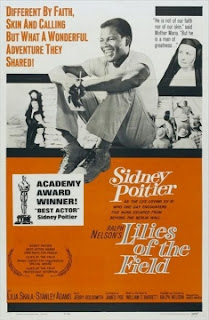
Lilies of the Field:

Sidney Poitier gives an Oscar-winning performance in this comedy-drama about a simple African-American man who helps build a chapel for a group of German nuns. Through his efforts, the locals pull together to complete the chapel, ensuring a sanctuary for future generations.

The film received nominations for Best Picture, Best Actor, Best Supporting Actress (Lilia Skala), Best Adapted Screenplay, and Best Cinematography. While the film is slightly dated, Poitier is very charismatic in this performance and deserved his Academy Award.

The Birds (1963) **1/2

Wednesday, March 9, 2011

birds

(This article is from guest contributor Rick29 and first appeared at http://classic-film-tv.blogspot.com/.  The rating in the title is my own.)

Alfred Hitchcock’s most divisive thriller finds the Master of Suspense in magician mode. On the surface, The Birds is a traditionally-structured horror film, in which the bird attacks build progressively to three of Hitchcock’s most intense sequences. However, this is just Hitchcock performing a little playful sleight of hand with the audience. Our feathered friends play a strictly peripheral part in moving the plot along. In actuality, The Birds is a relationship movie about another memorable Hitchcock mother, her adult son, and the women who threaten to come between the two—a theme explored by Hitchcock earlier in Notorious and Psycho.


In The Birds, the son is the bland, but likable, Mitch Brenner (Rod Taylor). Mitch’s mother (wonderfully played by Jessica Tandy) fears losing her son to another woman—not because of jealousy, but because she can’t stand the thought of being abandoned. Young socialite Melanie Daniels (Tippi Hedren) views Mitch as a stable love interest, something she needs as she strives to live a more meaningful life. And Annie Hayworth (Suzanne Pleshette) is the spinster schoolteacher, willing to waste her life to be near Mitch after failing to pry him from his mother.

These characters come together when Melanie follows Mitch to his home in Bodega Bay after a flirtatious exchange in a pet store. Melanie’s arrival coincides with the beginning of the bird attacks. It’s almost as if the birds arrive to prevent any potential love between Mitch and Melanie, perhaps an extension of Mitch’s mother’s anger at having to defeat another rival for her son’s love. (Taken to the extreme, there could a parallel between the birds and the creature created by Morbius in Forbidden Planet). However, although the birds initially come between Mitch and Melanie, they eventually have a very different impact. They allow Melanie, who first appears spoiled and shallow, to show her courage and vulnerability. In the end, Mitch’s mother no longer sees Melanie as a threat, but as a woman worthy of her son. Once the friction between those two characters is resolved, the bird attacks stop and the movie ends. Hitchcock’s conclusion—often criticized as ambiguous—is perfectly logical.


Hitchcock goes to great lengths to misdirect his audience by disguising The Birds as a conventional thriller. Always concerned with audience expectations, the Master of Suspense told French director/film critic Francois Truffaut in Hitchcock, a brilliant collection of interviews: “I didn’t want the public to become too impatient about the birds, because that would distract them from the personal story….” For that reason, the first bird attack comes at twenty-five minutes into the film and occurs toward the end of a playful scene in which Melanie races her boat while Mitch drives along the lake road trying to beat her to the dock.


From that point on, the birds become progressively more menacing and their appearances more frequent: Mitch sees them on the power lines after Melanie visits for dinner; a bird crashes into Annie’s front door and dies; birds swoop down to break up a children’s birthday party; they fly through the open flue into Mitch’s house; and Mitch’s mother find the first human victim in a farmhouse. (I love how Hitchcock uses broken teacups in this scene to foreshadow the impending horror. Earlier, he shows Mitch’s mom picking up broken teacups after the birds-in-the-flue incident. Then, when she visits the apparently empty farmhouse, she sees broken teacups hanging on their hooks—just before discovering the bloody, eyeless body.)

The remainder of the film consists of the three major set pieces: the bird attack outside the school-house; the attack after the gas station blows up; and Melanie’s struggle with the birds in the attic. Again, following the classic horror film structure, Hitchcock separates each sequence with a transition scene that allows the audience to relax and catch its breath. The scene in the restaurant with the ornithologist is one of Hitch’s rare missteps in The Birds; as Truffaut points out, it goes on too long without contributing to the narrative structure. I won’t dissect the birds’ attack on the school children—it’s an iconic sequence—but I strongly recommend that Hitchcock fans seek out Dan Auiler’s Hitchcock’s Notebooks, which include the director’s hand-drawn storyboard and notes. Though less famous, the burning gas station sequence is no less impressive. In the midst of the terrifying chaos, Hitchcock shows Melanie protected—and trapped—inside a phone booth. This “glass cage” is a marvelous metaphor for her previously sheltered life (also symbolized by the lovebirds in the birdcage) from which she is rescued by Mitch (literally…when he pulls her from the phone booth).


The three years between Psycho and The Birds (1963) comprised the longest gap between Hitchcock films up to that point. Much of that time was spent dealing with the technical difficulties in bringing Daphne du Maurier’s short story to the screen. In Truffaut’s book, Hitchcock admits that he discovered narrative weakness in The Birds as he was shooting it. A compulsive pre-planner, who storyboarded every shot in every film, Hitchcock began to improvise during the shooting of The Birds: “The emotional siege I went through served to bring out an additional creative sense in me.”

That creative genius is captured for all to see in The Birds. From its use of bird sounds in lieu of music to its disturbing closing shot, The Birds is an atypical Hitchcock film which finds the director in a mischievous mood. He gives us a classic chiller, but then reveals that it’s all wrapping paper and that’s what inside is a relationship drama. It’s an unexpected gift and, hey, Hitchcock even includes a birthday party for us—although it’s disrupted by those darn birds!


The Final Conclusion - Best Actress 1963

Tuesday, July 6, 2010

About the field: three terrific and two weaker, but entertaining performances. These five actresses all impressed me to a degree, so I'm definitely shocked that this year is so rarely talked about. These performances are definitely worth watching and reviewing and I hope you watched the movies too, when you could. We saw five simple, working class women dealing with everyday problems: out-of-wedlock pregnancies (in three of the cases) or a violent man's love (in two cases). Despite the similar natures of the characters, the five ladies could not have been more diffenrent. This is actually a very exciting race, and each performance and movie was worth the time. A true pleasant surprise (which I expected a bit). The ranking was really difficult for me and only the #3 was obvious for me (and eventually #1). So here it is:


5. Shirley MacLaine in Irma La Douce

During the movie I was quite impressed and I liked her, but while I was writing the review I suddenly had complaints, doubts and I finished it sourly, struggling to go on. Too bad, as I wanted to love Shirley and I did in a way, it's her performance just lacked something which would have made it special. Still, she's very entertaining and sometimes even hilarious.


4.Natalie Wood in Love with the Proper Stranger

Wood's charm always helps her performance a great deal, because she's so beautiful and radiant, that you can never take you eyes off her. I liked her a lot during the movie, but found flaws in it when I was writing the review about it. I still appreciated it a lot and it certainly impressed me to a degree. But again it's not totally enough to totally satisfy me.


3.Rachel Roberts in This Sporting Life

Roberts is always in control of the character technically, although her performance mostly relies on the emotions and the impact on the audience. This is one of the most effective performances I've ever seen and the most brilliant (and smart) thing about is that you really don't recognize at first how tricky Roberts is with you, the viewer.Heartbreaking, natural, simple, unforgettable.


Neal uses her face and mostly her eyes to tell the story of Alma. Yes she speaks much, but she doesn't tell much with words, it's her facial expressions that let you inside her mind. I cannot really think about any performances like hers among actresses. She hits you hard with her subtlety like a bus, grab you and doesn't let you take your eyes off her.


1. Leslie Caron in The L-Shaped Room

This is not performance with a nice packing and absolutely no content in it (I can say numerous hailed performances lacking content), this is hundred per cent reality. Brutally real, brutally heartbreaking. One of the truly great achievemnents I've ever seen. This is Acting with capital A. The most subtle dynamite. Very few performers are able to achieve such greatness.


So I can proudly announce that my winner for 1963 is...

Leslie Caron
in
The L-Shaped Room
Yes, yes, Ms. Caron.


Also worth of a nomination that year: Ingrid Thulin in The Silence, Klári Tolnay in Skylark, Gunnel Lindblom in The Silence


So, our next year is also a secret that I will reveal tomorrow, but of course I can give you clues (now I give four).

  • Comedy, why not?

  • Blondies suck...

  • Viva La France!

  • Please don't get mad!

Natalie Wood in Love with the Proper Stranger

Popular, beloved actress Natalie Wood received her third and last Oscar nomination for playing Angie Rossini, a pregnant Italian-American girl, who has to deal with responsibility and the father of her unborn child (Steve McQueen) in the dramedy movie Love with the Proper Stranger. I am quite sure (just like in the case of Shirley MacLaine) that Wood received many votes from the Academy as she was Oscarless and a huge star (and was expected to win for Splendor in the Grass). It did not turn out to be enough for her to win the Oscar, which people do not complain much about, except for maybe her biggest fans.


Love with the Proper Stranger is a lovely and enjoyable little movie by Robert Mulligan which cannot live up to his previous masterpiece (To Kill the Mockingbird), but it's still very entertaining. It received five nominations altoghether, which were justified in my opinion. The actors give decent, but not too brilliant performances. Steve McQueen was a good actor, but he was not given that much to do in this movie and he's miscast in my opinion as he does not seem very Italian, if you know what I mean. However, I must mention the actor, who plays Columbo, the clumsy young man courting Natalie.


Natalie, beautiful Natalie. What can I say about her performance here? She could give heavy dramatic performances and there were occasions where she was terribly miscast (West Side Story ahhhem), but one cannot deny her radiant personality, her beauty and above all, her great acting talent. She moves with such ease and naturality in front of the camera, I think she was born to become a movie star. With the character of Angie, she made very wise decisions in my opinion. Although it doesn't have many opportunities, Wood really lifted the not very complicated material. At the beginning of the movie I did not like her performance as it mostly consisted of Italian-American stereotypes and mannerisms, but in time she got me with her warmth and naturality.


Wood shows the most vulnerable and miserable side of this character, her insecurity is so heartbreaking in the scenes where she considers abortion or the scene where she's getting undressed, but breaks down eventually. Those scenes gave me creeps and they were quite probably the highlights of Natalie's whole performance, which turned out to be more lightweight in the end, which is not a big problem to tell the truth, but you have to expect that heavy drama could only be found towards the middle of it, where all the insecurites of Angie are revealed. For those sequences it is definitely worth watching this movie.


It's interesting that this year, two actresses were nominated for playing single and pregnant young girls. Leslie Caron showed the dark side of the situation with her minimal and breathtaking acting, Natalie Wood did not go that deep into the character's mind. I know that it's not fair to compare them for it is also the screenplay's and the director's fault, still I believe that Wood's character should have been a little deeper and probably more complicated.


This whole thing does not mean though, that I wasn't utterly charmed. Wood's charm always helps her performance a great deal, because she's so beautiful and radiant, that you can never take you eyes off her. A brilliant example for that is when she's expecting Steve McQueen for dinner and watches herself in the mirror, being worried and by this she perfectly shows the excitement of the real first date.


Wood dealt with the comedy parts well, although she was did not do wonders with the material (like MacLaine for example). However, I must tell that she was not very convincing in the dinner scene with Columbo's family, where she's very clumsy and almost damages everything, burns herself and so on. I think it was needless and useless in for the movie. When she talks in the same scene about love, it's not solved perfectly either and is probably her weakest part of her performance.


To sum up, I saw a performance again that I liked a lot during the movie, but found flaws in it when I was writing the review about it. I still liked it a lot and it certainly impressed me to a degree. But again it's not totally enough to totally satisfy me. Something's missing.


So now I've finished the reviews and now I'm thinking the whole race over. Only one place is already decided in my ranking, I don't really know how to rank the others, but time (and me too) will tell. If your interested in Love with the Proper Stranger just click here. I am waiting for opinions and predictions in comments! :)

Rachel Roberts in This Sporting Life

Monday, July 5, 2010

British actress Rachel Roberts received her only Academy Award nomination for playing Mrs. Margaret Hammond, a widow having a stormy and tragic relationship with the aggressive and violant rugby player, Frank in This Sporting Life a movie directed by Lindsay Anderson. It's an interesting fact that her husband, Rex Harrison was also among the 1963 nominees in the Best Actor category. And they both went home empty handed, but I don't think that it was much of a shock as when performances like this won, it was always a huge upset (=Simone Signoret in Room at the Top).

This Sporting Life is a typical member of the depressing free cinema movies or as I like to call them, chimney movies. It's quite tragicand mostly raw and tough, however the direction of Lindsay Anderson is great (though it's not as fantastic as If...), the actors give very good and subtle performances even though only the two leads stand out to be honest. Richard Harris' acting is great, though it took me some time to like it or even get used to it (I don't know somehow I felt he was miming Marlon Brando a bit). Nevertheless, I feel he deserved the nomination, but not the win (at least not over Sidney Poitier).

And of course, there's Rachel Roberts. Nowdays, she's not frequently mentioned in discussions about movies in general, despite the fact that in my opinion she's one of the most underappreciated actresses. Her presence is very intense and raw, in my opinion she was born to play these disappointed wives having stormy affairs with violent men (just like in Saturday Night, Sunday Morning, check that one out). She caught the problems of these simple, working-class women with such sympathy and deep understanding, that is quite uncommon among actresses. I never actually felt that it was Rachel Roberts there, acting. I always saw a devastated, ashamed woman, terrified of what she and her life in general is becoming. She's always concerned about her reputation, pride and her children naturally.

The way Roberts captures the grief of this woman is truly outstanding and harrowing. She can never admit that her husband's death (always cleans his boots) was not pure accident and she cannot really live without him or with Frank either. She's doesn't know how to act and this uncertainty is truly heartwrenching to watch. Margaret is a very conventional and simple woman, but Roberts brilliantly shows that she dreams of something better and that she deserves a much better life. Her scene at the restaurant is simply marvellous: she does not know how to act, she's like a scared little animal, but she's simply heartbroken and deeply ashamed of Frank's behaviour. The way she says thank you to the waiter, nearly made me sob: it was so real, so natural and it felt so unforced. Only a real acting genious could do that.

Roberts is always in control of the character technically, although her performance mostly relies on the emotions and the impact on the audience. This is one of the most effective performances I've ever seen and the most brilliant (and smart) thing about is that you really don't recognize at first how tricky Roberts is with you, the viewer. I would not say that her presence is magnetic, because this is not that type of acting, she (just like Leslie Caron and Pat Neal) kills with her naturality and realism. Another perfect example is when she puts the Christmas presents into her children's stockings. Her kindness and love shines through the scene and it becomes nearly divine, which fills your sould with feelings that are hard to desribe.

I must also mention her breakdown scene towards the end, when she's confronted by the sheer, ugly truth about her husband in a very merciless way (led by the selfishness and anger of Frank). She's just unforgettable as she does not want to listen, only wants to hide from the world and get her husband back the only one who could make her happy.

Roberts also brilliantly shows how the relationship between her and Richard Harris becomes more intense and complicated. At first she's very hostile to him, but in the end she's just disgusted and terrified of him. When she leaves the restaurant, we know that everything is over.

So, finally I can say that this is the third fantastic performance of this bunch (in a row and it's so great), so it will be really tough to do that ranking in the end. Heartbreaking, natural, simple, unforgettable. Four words that perfectly describe Roberts' acting in This Sporting Life.
This time I can't give you a link unfortunately. But let's discuss in case you've seen this movie. I'm also waiting for some predictions. Tomorrow, I'll do Natalie Wood in the morning and the final conclusion in the evening or the following day.

Patricia Neal in Hud

Sunday, July 4, 2010

Patricia Neal received her first nomination and only Oscar before and after a series of unfortunate events in her life for playing Alma, the independent and down-to-earth housekeeper in Martin Ritt's classic movie, Hud. That year she was clearly the critics' favorite, but I'm not that sure if she was the front-runner for the Oscar win. Nevertheless, she got the award despite the fact that many people consider this a supporting performance (she was nominated for BSA at the Golden Globe) . In addition, her role is not the most baity ever, so it's really surprising that they went with her.

Hud is great movie (well if Larry McMurthy is associated with a movie, it cannot be bad) about a farmer family whose members have to get rid of the cattle suffering from the foot and mouth disease. Also they have to deal with the age of Homer (Melvyn Douglas), who's getting weaker and weaker. Hud includes four brilliant performances by Paul Newman, Brandon de Wilde, Melvyn Douglas (one of the most deserved Best Supporting Actor wins ever) and of course, Patricia Neal. I'm very upset that it was not nominated for Best Picture as it seems an obvious choice to me. However, the direction of Martin Ritt is great (as always) and deserving of the nomination.

For the first time, I was mainly amazed by the acting of Paul Newman and almost ignored the others. This time I found him to be a bit underwhelming (still great), so I could concentrate on Patricia Neal and by this I found such amazing little things and nuances in her performance, that I did not notice for the first time (or couldn't). It's interesting that although many people say she's supporting (Neal too to tell the truth), I have never heard ANYONE complaining about her lead win. It's interesting, but this time I became 100% certain that she's leading. Actually Paul Newman doesn't have that much screentime either (Melvyn Douglas and Brandon de Wilde have tha most I think and Neal has about 22-23 minutes on screen), but her presence has the strenght of a title role. And this is probably the greatest thing about her. Her impact on you is so intense that you can also feel it when she's not on screen and her 22 minutes seem like an hour to you at least. However, to tell the truth I hate counting the screentime, because for me it's not about the seconds and minutes (it's a useless thing to count).

I loved her subtle, yet hard-hitting character shining through the tough and raw personality of her character, Alma (trivia: her name means apple in Hungarian; it's also an interesting fact that she drinks Hungarian wine). She always says that she can take care of herself, but Neal shows very well how Alma tries to hide her insecurity from others (mostly from Hud) and her attraction towards Hud. She seems to be much more independent than accepting Hud's "compliments" and offers, but in fact we know that she just wants to avoid another disappointment in her life (which she had perviously experienced with her husband) and tries to escape desperately, but again she finds the same people everywhere.

We also must not ignore the humor of her performance and her brilliant line-readings (like when she says that her husband was only good because he scratched her back). She never tries to play the cheeky servant, she's just a simple, yet very stubborn, brave woman. I can even say that she's one of the strongest, yet vulnerable characters ever written. She's completely three-dimensional, totally believable person with natural actions and fears inside her soul. The best scene of her performance is probably the one where Hud tries attacks her but tries to escape from him desperately: here she tells so much without saying a word as She shows how scared Alma is, but Neal also suggests that this may not be the first time that something like this had already happened to her.

Neal uses her face and mostly her eyes to tell the story of Alma. Yes she speaks much, but she doesn't tell much with words, it's her facial expressions that let you inside her mind. I cannot really think about any performances like hers among actresses. Only Heath Ledger's performance comes to my mind from Brokeback Mountain even though the characters are very different. Both hit you hard with their subtlety like a bus and grab you and don't let you take your eyes off them as they are so brilliant.

Alma's last scenes, where she says goodbye to Lonnie simply gave me chills. You can NEVER see Alma crying, she's very proud and doesn't let you feel her weakness. She just breaks your heart and fills you with hope that Alma might make it somewhere else. Also, her scene with Hud where she reveals that they could have become closer as she was attracted to him is unforgettable, it nearly burns you.

OK, to sum up I was very-very impressed once again by a fantastic performance and just like Leslie Caron, Neal was 100% realistic, understandable and a real treat to watch. Amazing feat in an amazing movie and is worth of the amount of love that it receives.

Watch Hud with me here and let's discurss the movie and Neal's performance together. I am waiting for the comments and you can still predict (I accept it until the final conclusion and then we can see how many rounds you needed to find out). I think I just finished my longest review if I'm not mistaken.

Leslie Caron in The L-Shaped Room

Saturday, July 3, 2010

Charming French actress Leslie Caron received her second Best Actress nomination exactly 10 years after her first one for playing a lonely, pregnant young French woman in Bryan Forbes' black and white kitchen sink drama, The L-Shaped Room. She also received the Golden Globe for Best Actress in a Drama (over a LOT of other nominees check it out). Although she received the prestigeous award, I don't think that she was a big contender for the Oscar (or was she, someone should tell me who's the front-runner that year) as the race was probably among the three American nominees.

The L-Shaped Room is a bit watered, but still harrowing (and typical) kitchen sink drama set in Britain in the 1960s and it focuses on the miseries of simple, working-class people, showing complex relationships and also offering great performances by the actors (and boy I just love these films). Brock Peters probably (not probably, definitely) should have received a nomination for playing the neighbour of Lesile Caron, but we should not ignore the others either as they gave magnificent, strong and memorable performances.

However, nearly all the credit goes down to the brilliant Leslie Caron, who completely holds the movie together with her subtle (very-very subtle) brilliance and charm. Even in her first scenes, we can nearly touch her inconfidence and doubts about her future and life in general. However only we are shown of her upcoming brilliance (and boy that's something) when she considers abortion for the first time. That scene alone is so heartwrenching that you instantly feel sympathy for this poor young girl, but she also mercilessly shows the mistakes and flaws of this woman.

And after she's getting less and less isolated and makes some friends, her performance is just getting better and better. She gets to know a young, unsuccessful writer, Toby with whom she starts a very odd type of relationship, with lots of tension and conflicts. The scene after the party when they are kissing, I literally felt the lips of Caron, it was unbelievable.But even with the development of the character, Jane's still inconfident and does not have much confidence in anyone. When she meets the father of her unborn child, Caron creates an emotionally insanely intense scene, where she reveals that her virginity bothered her so much that it's the only reason she slept with him. She'sthe most subtle dynamite.

And the scene, where she gets to the hospital for the first time is just the icing on the cake (but also the highlight of her whole performance and the movie). That scene almost killed me, and right then I had no doubt how many Meryls I'm going to give to Caron. There are not many performances which are so subtle and yet they get under your skin and impress you immensely. I can only think of Dame Edith Evans in The Whisperers (another Bryan Forbes movie, so it's no co-incidence) as such an actress, who amazes you with such (I dare to say) repressed acting. And their characters have a lot in common: both are lonely, isolated, but they both share a deep desire for a better life. The character of Dame Edith finds it in her fantasies and memories, however life was not that merciful on Caron's Jane. She's a perfectly realistic person still longing for something better, which she cannot have. And this is the heartbreaking truth that completely elevates both the performance of Caron and the movie itself.

So to sum up, this is not performance with a nice packing and absolutely no content in it (I can say numerous hailed performances lacking content), this is hundred per cent reality. Brutally real, brutally heartbreaking. One of the truly great achievemnents I've ever seen. This is Acting with capital A. This rating sytem has officially failed.


Watch The L-Shaped Room (and do so please) here and then I hope we can discuss this performance and your opinion in many comments.

Shirley MacLaine in Irma la Douce

Friday, July 2, 2010

Shirley MacLaine received her third Best Actress nomination for playing Irma, a prostitute from Paris in Billy Wilder's amusing comedy Irma La Douce. MacLaine famously (IMO undeservedly) lost to Liz Taylor when she said some not very nice things about why she did not win. In Irma la Douce she reunited with her co-star in The Apartment, Jack Lemmon. The success was sure and MacLaine received her nomination for her rather leightweight work and I think received many consolation votes from some Academy memebers.

Irma la Douce is an ordinarily funny, but very amusing Billy Wilder-Jack Lemmon movie, which is very far from the brilliance, say, Some Like it Hot or The Apartment. But again it's very-very entertaining and definitely has great lines and very good jokes. The actors give decent comedy performances, Jack Lemmon (my favorite actor ever) is not at the top of his game here, so it's no wonder he was not nominated. This is probably the only movie where I did not like him the most (or at least the second.

Shirley MacLaine's performance as Irma is a very underappreciated one and I dare to say that this nomination of hers is quite disliked or even hated. In a way I can understand the criticism or why people do not love it, this is just not the type of nominated comedy role which people like or appreciate. It's very delightful, but not really one of the best of Shirley or the Best Actress nominees.

Yet I don't want to say anything bad about her, because she really stole the show from the beginning. Even with the first scenes she shows her charm and joy and I think it was simply hilarious. Although when I saw it for the first time I was blown away by her first scenes, now my appreciation has cooled a bit, which does not necessarily mean dislike. It's funny though that throughout the movie you are impressed by someone, but after that the whole thing disappears unfortunately.

She's the best at saying the hilarious lines in such a weird and still funny way. She uses every opportunity to shine, but still after all I felt that something was missing from her performance, I feel that it's a bit incomplete as the beginning of the movie completely focuses on her but in the end she becomes a simple co-lead. First we get to know an independent, loveable and (in a way) conventional call-girl, who's far from the hooker-with-a-hear-of-gold type and it's absolutely free from clichés.

The best parts are in the beginning, including my favorite one, where she first meets Jack Lemmon's character, Nestor. The way she acts in that scene is simply hilarious, radiant and joyful and probably one of the best comic scenes I have ever seen. She's very light, in fact a bit too light for my taste. I don't want to see forced acting, but I want to think that she worked hard on her performance.

As I said, in the end her performance becomes very slow, her presence gets much-much weaker and I started to miss the Shirley of the beginning. But again I can't blame her as she was simply not given that much to do in then and simply did not have the oppotunity to show how much she can do. Although she's able to completely steal the show and outdo Jack Lemmon in many scenes (which is quite impressive), I just cannot really overcome the fact that she nearly faded in the end, which always influences the overall opinion about a performance.

So to sum up, I can only compare her to Emily Watson in Hilary and Jackie. a very different performance. During the movie I was quite impressed and I liked her, but while I was writing the review I suddenly had complaints, doubts and I finished it sourly, struggling to go on. Too bad, as I wanted to love Shirley and I did in a way, it's her performance just lacked something which would have made it special. Still, she's very entertaining and sometimes even hilarious. Good job nevertheless and definitely nomination- and Globe-worthy.


So what do you think? Do you agree or not? I would like to see comments! :)

The Next Year

Thursday, July 1, 2010

I'm back from my vacation so we can begin our next year. Well, unfortunately it's no secret that it's 1963, probably one of the most rarely talked about races ever.I've seen only two nominees so far and both of them more than 2 years ago. However, I'm very excited to re-watch them and see the new ones. I really don't know whom I'm going to pick and how the ranking will look like, but that makes it more exciting. (I predict lots of four Meryls)


The nominees were:
  • Leslie Caron in The L-Shaped Room
  • Shirley MacLaine in Irma La Douce
  • Patricia Neal in Hud
  • Rachel Roberts in This Sporting Life
  • Natalie Wood in Love with the Proper Stranger
So, who's your pick? Who's your prediction? If anyone predicticts my exact ranking will get a special mention in the final conclusion. Last time Fritz predicted the whole ranking, so congrats:)

We should try watching these movies together, so I will send links (just click on the title of the movie at the beginning of the entry) in order to discuss them together.
 

Blogger news

Blogroll

Most Reading