Pages

Powered by Blogger.
Showing posts with label 1964. Show all posts

263. Marnie

Thursday, November 8, 2012

263. (04 Nov) Marnie (1964, Alfred Hitchcock) 71


Hitchcock makes his outlandish soap opera as technically proficient, entertaining and moving as is possible. However, Marnie seems quite haphazard when you consider the careful, near-perfect structure of The Birds. It's certainly self-aware, making playful use of the medium, but the sinister tone never quites rings completely true. Still, I'll never look at the color red the same way again.

167. World Without Sun

Wednesday, August 22, 2012

167. (21 Aug) World Without Sun (1964, Jacques-Yves Cousteau) 44


Jacques-Yves Cousteau's look at a group of men participating in an underwater living experiment is most remarkable for its photography. The novelty of seeing so many rare sea creatures in action must have made quite an impression in 1964. Nowadays, darkly lit shots of crabs wandering the ocean floor don't hold much charm. A bombastic score and on the nose editing give this feel too manufactured to be a daily account of these men's lives or, when it strays into showing wildlife, a nature documentary.

My Fair Lady

Friday, May 11, 2012

My Fair Lady, 1964
Directed by George Cukor
Nominated for 12 Oscars, Won 8
Up Against: Becket, Dr. Strangelove, Mary Poppins, Zorba the Greek

My Fair Lady is the story of a poor young English woman, and a rich older speech therapist. When the speech thearpist, Henry Higgins, meets the young English woman, Eliza Doolittle, and hears her horrid Cockney accent, he makes a bet with another speech therapist, Hugh Pickering (a new acquaintence), that he could turn this any woman into a proper speaking woman and present her as a duchess at the Embassy Ball. Eliza, who aspires to work in a flower shop, instead of selling flowers on the streets, goes to Henry the next day, asking for proper English lessons. Henry Higgins is a pompous, slightly sexist man, who is more used to working with upper class people. Eliza reminds him that he said he could pass off any woman as a Duchess after working with her for 6 months, and Pickering decides to pay for Eliza's lessons and clothes, etc, if Higgins will, in fact, train Eliza. He says yes, and the work begins, though Eliza is a loud, stubborn woman, showing his work is cut out for him.

I feel ashamed to say I've never seen an Audrey Hepburn movie before this. That being said, I have no idea what to expect with this movie. It looked like another cutesy musical, and I was interested in seeing it.

First off, Audrey Hepburn was totally awesome in this film. I'd always pictured her as a dainty soft-spoken kind of girl (sort of a back-then's Carey Mulligan). But she totally rocked the crazy Cockney, whining young woman. She was horribly annoying and her accent was terrible (all of that in a good way! you know?). It was fun watching her on screen, making her transformation. Although her transformation was a little abrupt, it was fun. She didn't look all that special in the beginning, but she looked amazing when she got all dressed up.

Rex Harrison, who played Henry Higgins, was also great. He was pompous and arrogant, but also had a sort of lovable side to him, and Harrison really embraced that.

The movie really deserved all the Oscars that it won, Directing, Best Actor, Cinematography, Sound, Score, Art Direction and Costumes. Addition nominations included Supporting Actor (Pickering), Supporting Actress (Mrs. Higgins), Editing and Adapted Screenplay. I was sorely disappointed that Ms. Hepburn wasn't even nominated, but that's the way it goes I guess. She'd gotten her Oscar several years before for Roman Holiday.

The only flaws I found in the movie was it ran on too long. Clocking in at 2hrs and 52 minutes, some of the film (the scenes about Eliza's father, for example) were unnecessary, and the movie could've been solved earlier.

However, all the musical numbers were great. Most musicals there's at least either a) a long slow song that the girl sings (ex, As Long As He Needs Me, from Oliver!), and/or b) a long modern number (Broadway Melody Ballet, from Singin' In The Rain). I was surprised that there was neither of these in My Fair Lady, giving the film an extra few points for me.

Overall, the movie was enjoyable. It was cute, and funny, and Audrey Hepburn was great.

8/10

036. Kisses for My President

Sunday, January 29, 2012

036. (29 Jan) Kisses for My President (1964, Curtis Bernhardt) 35


Rather than focusing on the novelty or intrigue of a female president, Kisses for My President instead is mostly interested in emasculating Fred MacMurray as the "first lady." He's irritating and unsupportive, confessing that he only let his wife run for president because he never thought she'd win. His subplots are totally undercooked like an old flame offering him a job with him realizing much too late it's because his wife is the president. His kids are extremely petulant.

With Polly Bergen playing the only remotely likable character, it makes for an often torturous comedy even if the pacing is rather brisk. In the end, she resigns due to pregnancy. Yikes.

There are some fun costumes like a lavish fur coat and hat and a foreign uniform covered in medals. It's a so-so Costume Design nominee.

411. The Atomic Brain

Wednesday, September 7, 2011

s13. (07 Sep) What About Juvenile Delinquency? (1955, Herk Harvey) 19

411. (07 Sep) The Atomic Brain (1964, Joseph V. Mascelli) 13

The Final Conclusion - Best Actress 1964

Sunday, March 13, 2011

1964


So the much anticipated ranking is:

I can say that I got what I expected, a standard 60s musical performance from Debbie Reynolds. Although this work is really mixed and uneven, there are some scenes to admire or at least like about it. It's nothing mindblowing or ground-breaking but it did not bother me that much, so I don't feel bad about it.
This is a great performance by the magnificent Sophia Loren, which may not be her career best but it's still very good work. Although there are amazing scenes in this work, the really common comedy scenes drag Sophia's performance down. She's still wonderful but she could have been once again mindblowingly brilliant.

This is an incredibly hard performance to judge. Anne chose all the difficult and risky ways with her character but she succeeded and she was able to put on a shocking, perplexing and terrying character study of a woman who has serious problems in her life.

This performance is also extremely hard to judge. It's full of fantastic scenes and it's overall effect is just brilliant and just like with Bancroft, I am not really sure what I am going to think about her. However, I just cannot overlook that Kim Stanley was able to put on a fantastic, chilling and unforgettable performance as Myra Savage.

It's a great achievement and it's no wonder that it became an iconic performance among children. Because if you really want to see the wonders of this role, you must loose yourself and (and just like Banks) become a child again for two hours. I may be alone with this but I think that this is fantastic work.

So I can proudly announce
that my winner is...
Julie Andrews
in
Mary Poppins
Julie is preparing to accept this award... :)
Final thoughts: A superb year but the performances were all so difficult to rate. My reaction to Julie Andrews was just as shocking to me as it was to you. Loren was great as expected, Bancroft was the most difficult to rate ever but now there are small problems that occured. I knew that Reynolds would suck and I loved Stanley when I first saw her, she was in a Bryan Forbes movie, so there was no surprise about her. However, after all Julie Andrews was a clear cut winner despite some tough competition from Kim Stanley. I think many of you think I'm crazy but I was truly captivated by Julie's performance and its mysteriousness.

Omissions: 

  • Audrey Hepburn in My Fair Lady (she was way better than Debbie Reynolds)


The ranking of the already reviewed years:
  1. 1969
  2. 1974
  3. 1989
  4. 1959
  5. 1964
  6. 1939
  7. 1977
  8. 2010
  9. 2009
  10. 1980
  11. 1941
  12. 1963
  13. 1966
  14. 1973
  15. 1990
  16. 1978
  17. 1954
  18. 1948
  19. 2002
  20. 1940
  21. 1998
About the next year: I couldn't decide between two (consecutive) years. Both are said to be quite weak and yet I'm so interested in both of them. Plus they are from the decade I've been ignoring for a while. However, I've chosen the second year as I've seen only one of the nominees and I love when I have new performances to discover. The clues (quite easy ones):
  • (L) Nuns (L)
  • (L) Soaps (L)
  • Viva Italia!
What do you think?

Off-topic: I saw 127 Hours yesterday. It was BRILLIANT and would have deserved Best Picture (tied with Black Swan), Actor, Editing and Song. You lose a lot if you don't watch it in a movie theater (fantastic cinematogrpahy BTW and a directing that should have WON and it wasn't even nominated).

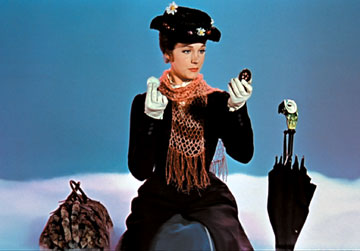
Julie Andrews in Mary Poppins

Saturday, March 12, 2011

Julie Andrews received her first Best Actress nomination and only Oscar to date for playing Mary Poppins, the magic nanny in the Walt Disney movie, Mary Poppins. How did she win exactly? That's one of the biggest questions of the history of the Oscar but the answer is quite simple. Andrews' role of Eliza Doolittle was played by Audrey Hepburn and she had to make do with this role instead. Plus, Andrews was (going to be) a huge star and her movie was a huge success. It's interesting, though that her role is not baity at all. But I'll explain my thoughts on her.


Mary Poppins is a great, moving movie that I HATED for the first time and LOVED now. It's so full of wit, love, beauty and emotions. I guess I needed to become more mature to understand its real message. I think the story is much more complex than one would imagine and nothing is as simple in it as it seems, I think. The technical part of it is great for its age and it's not even that ridiculous by today's standards. I'm not sure if I would vote this movie for the Best Picture but it's definitely close between Zorba the Greek and Mary Poppins.


I think Julie Andrews is a very good actress who's always able to give very proper and entertaining performances which make your evenings in front of the TV pleasant. For instance, there's the queen from Princess Diaries. A very standard role in a standard movie but somehow she was able to create a really loveable and memorable character with her fantastic sense of humor and great acting talent.


The 1960s were a great time for her. She was one of the biggest stars, she got leads in financially and/or critically succesful movies and this is all probably thanks to her starmaking turns in Mary Poppins and The Sound of Music. In both movies, she plays a nanny/governess who has a great relationship with the children and eventually she wins over the fathers. However, the two roles are somehow different. Both characters are free-spirited and joyful, however there's so much more mystery in Mary Poppins' part. Unlike Maria, Mary has a darker and even a bit bitchy side and she's much more firm.


What I really admire in these performances is that Julie Andrews added depth to these characters and a considerable amount of emotions. I know that many of you disagree but I stand staunchly by my opinion. Mary Poppins is not a one-dimensional cartoon character that it could have been. In fact, as I said Andrews added very muh mystery to this woman. I mean, I always kept searching for answers about Mary. Who is she? Why is she a savior of families? Does she have a special gift or she's a witch? Or quite simply, she's just a symbol of the goodness that comes once in a while to save some souls.


Julie Andrews' singing is naturally fantastic and she also dances quite well. Her experience on the stage most certainly helped her a lot in solving the musical parts of the performance. She's always what she should be: sometimes she's funny, sometimes she's superior, sometimes she's strict and occasionally, she's really touching. I mean that song called Feed the bird is extremely moving. Although she's not visible for most of the scene, her voice expresses so many emotions.


One could also mention the scenes where Mary, Bert and the children go inside a picture. It's such a great, long sequence and I loved how clever and playful Julie was there. But I could also mention when they dance on the roofs and the chimnes with dirty faces. Everything becomes so loveable about her and it was just great.


Julie Andrews also has wonderful chemistry with Dick Van Dyke and the children. The four work together incredibly well. It's great that Andrews doesn't act as if she was the mother of them but really as a nanny. However, Mary has deep love for these children. And in the end we can see that Mary Poppins also has a vulnerable side and that she indeed cared about this family. It's also a very touching moment. If you asked me, I woulf say my favorite moment of her whole performance was the one between her and the laughing uncle. That was just dead on.


Julie Andrews comes in, gives a great acting performance as Mary Poppins, The Nanny. Everything is just delightful about her, both the character and the work of the actress. It's excellent work techincally and also in terms of the emotional effect. It's a great achievement and it's no wonder that it became an iconic performance among children. Because if you really want to see the wonders of this role, you must loose yourself and (and just like Banks) become a child again for two hours. I may be alone with this but I think that this is fantastic work.


I bet this was a real shock for some of the haters. :D

Debbie Reynolds in The Unsinkable Molly Brown

Debbie Reynolds received her only Oscar nomination to date for playing the unsinkable Molly Brown in The Unsinkable Molly Brown. Debbie Reynolds was a huge star back then and the fact that she had this very huge musical role with much singing, tears and the opportunity for a great performance might have helped her get some votes. She could even be second after Julie Andrews though the third or fourth place might be more probable. One will never know, though. There might have been some sympathy left for her after the Eddie Fisher/Liz Taylor scandal (though by that time Liz was with Richard Burton already).

The Unsinkable Molly Brown is a movie that is sometimes unbearable to watch (sometimes it even tops Gloria and that's something, really). However, after a time somehow I got used to it and it wasn't much of a torture later on. Whenever there were no "emotional" scenes between Harvey Presnell and Reynolds, the whole thing was quite OK. But whenever Presnell started singing, I could have smashed the screen with an axe. The story is basically about an uneducated, poor girl who's planning to get married to a rich guy. She eventually marries a poor guy who becomes incredibly rich later on. Nothing is easy, though in the snobbish society of Denver.

Somehow, I never really cared about Debbie Reynolds. Besides The Unsinkable Molly Brown, I only saw her in Sining in the Rain, in which she was quite good though I don't really understand the hype about that performance (i's very much like her nominated performance as Molly Brown). Therefore, I did not know what to expect from Debbie here. First of all, I have a thing against 60s musicals as they annoy me incredibly. I don't like that whenever there's an "emotional" or "funny" scene, people start singing (which is more like yelling). There are romantic songs, songs from the poor but honest crowd and so on. And this is something that's true here.

The most important thing I noticed: Debbie Reynolds was clearly acting for that Oscar. This is a typical musical performance which secures at least a nomination for the lead. And the character like Molly Brown is one of the best examples for such baity roles. There's much singing, dancing, there are lot of stupid scenes which were meant to be funny and of course the big tears in the end. The whole thing was so predictable but that did not surprise me. Although I knew that I would get this, I secretly hoped that I would get something different and truly surprising.

The beginning of Reynolds' performance as the poor, loud mountain girl with a stupid face is quite simply horrible. There we go, I said it. It's so loud and she went way over the top with Molly. There isn't a subtle moment at all and every second is incredibly annoying. I mean what was the purpose of those grims on her face? It really did not serve that something which was meant to be a story.

I was about to die, when something happened. The whole performance became quite fun after a while. I don't know if it was because I started to get used to the badness or that it was actually good. I don't know but there was light at the end of the tunnel. Reynolds was quite entertaining in the scenes when Molly and Johnny become rich and are just trying to fit in. She's quite charming when she reacts to not being invited to a party. Right there, I felt some sympathy for this character and it lasted for a while (until they get home from Europe).

The temporary goodness in her performance disappears after a while. However, she's not as horrible as she was in the scenes in the beginning. She's not even bad but she doesn't really have much of a presence anymore and I just wasn't really interested in Molly anymore (not that I had ever really been previously). There wasn't much to care about. There was a drunk scene, which was handled quite well but it was nothing special, really. And then the huge dramatic moment with tears... it was nice but (again) nothing special.

So, I can say that I got what I expected, a standard 60s musical performance from Debbie Reynolds. Although this work is really mixed and uneven, there are some scenes to admire or at least like about it. It's nothing mindblowing or ground-breaking but it did not bother me that much, so I don't feel bad about it. It even had a minor positive effect on me.
I did not feel bad about her, though.

What do you think? It's time for the final predictions!

Kim Stanley in Seance on a Wet Afternoon

Friday, March 11, 2011


Kim Stanley received her first Oscar nomination (out of two) and her only one in the Best Actress category for playing Myra Savage, a woman in possession of a strange "gift". I'm a bit uncertain if I think about Stanley's chances of winning that year. Although Anne Bancroft swept the high-profile awards, Stanley got all the important acclaims from the critics. Still, the movie was too British (much like The Pumpkin Eater) and she wasn't as much of a movie star as Bancroft. Stanley was basically a stage actress and did not make many movies.

Seance on a Wet Afternoon is a very weird and tough movie. It's really full of tension and it's quite different from the other movies of Bryan Forbes. It's not a real kitchen sink drama like The L-Shaped Room and The Whisperers, it's just a very intense psychological drama. Richard Attenborough, who went on to receive an Oscar for Best Directing the year Kim Stanley was nominated for Frances, gives an excellent performance as the coward, terrified husband of Myra. He was totally robbed of the nomination, in my opinion. Anthony Quinn was better as Zorba but Attenborough was great anyhow.

Kim Stanley's performance is so interesting and I am so full of emotions about it. I don't know her work very well and as she worked mostly on the stage, I really doubt that I can see that much of her later. She was a real method actress and that's really visible in this performance. She totally becomes this very complicated woman and Stanley, the actress completely disappeared. As I was watching the movie, I always saw Myra Savage, the British psychic and not Kim Stanley, the American actress.

Myra Savage is a character that requires someone who's an actress first and not a star. She's a very ordinary woman with an ordinary face and a very annoying personality. I mean, we should just imagine Elizabeth Taylor playing her. We would get the tears, the shouting but we wouldn't get the simplicity of Myra. Although it's a very tough and hard role to play, Stanley handled it with visible self-discipline and she never went too over-the-top with her. The part had some traps and difficulties but Stanley managed to avoid all of them.

Kim Stanley added all the layers to this character, step by step. First, Myra seems to be obsessed woman who seems to be acting a lot. However, she sinks deeper and deeper into her madness and her obsession with a terrible secret, which Stanley always suggests us with her acting. She gives little clues with short sentences, words and we just can't see the truth behind them. And it's just astonishing how Stanley managed to always keep Myra very mysterious. Whenever you feel that you're getting to know her, something very extremely surprising comes and you feel so shocked.

Furthermore, Stanley's always so frightening in those seance scenes. One can always feel that Myra really believes that she has this gift and that she's really talking to spirits. It's extremely hard not to talk about this performance without giving away much about the movie and it all the twists of the plot. However, I can say that Stanley's responisble for the suffocating tension of the movie and even its overall effect on you.

Also, Stanley and Attenborough have a marvelous chemistry and they work together astonishingly well. There's a huge confrontation scene between them, which is just perfect. It's great that they never try to outdo each other, they truly co-operate and the result is just fantastic. Attenborough is the more subtle and quite one, Stanley is more loud and emotional and as a result the performances keep the balance and that's amazing, I think. They always remain very believable and one just doesn't have any doubt that they have been indeed married for a long time.

This performance (very much like Bancroft in The Pumpkin Eater) is extremely hard to judge. It's full of fantastic scenes and it's overall effect is just brilliant and just like with Bancroft, I am not really sure what I am going to think about her. However, I just cannot overlook that Kim Stanley was able to put on a fantastic, chilling and unforgettable performance as Myra Savage. Great work.
What do you think?

Anne Bancroft in The Pumpkin Eater

Thursday, March 10, 2011


Anne Bancroft received her second Oscar nomination for playing Jo Armitage, a woman who has a very complicated life in the movie, The Pumpkin Eater. At the time, she was the actual front-runner along with Julie Andrews and I think that she wasn't far behind. Unlike Sophia, her previous win might have helped her but that might also be the cause why she eventually lost the award. She console herself with a Golden Globe, Bafta and a Best Actress award at the Cannes film festival. Apparently, Julie Andrews thought that Anne should have won. We'll se if I agree.

The Pumpkin Eater is a very unusual and extremely weird movie. Sometimes it's incredibly boring but sometimes it can be really fascinating. The main flaw about it is that it tries so hard to serve the needs and demands of its era. It's very 60s, it's very British, it's very artsy though somehow I felt it was a bit forced. Or it can be simply quite dated and that's it. Peter Finch who was a terrific actor, gives a very good performance here though he's quite lost occasionally. James Mason (just like in Georgy Girl) plays quite a pointless and perplexing role and I did not like him at all.

However, I really don't know what to think about Anne Bancroft in this movie. I had previously seen the performance but I did not understand it better this time even though I thought I would. Her whole acting in this movie is rather perplexing and it's very complex. Probably this is what settled her win at Cannes. This is a multi-layered role that must be incredibly hard to play and I don't think that many actresses could have pulled it off or at least not this way. It requires a performer who's fearless and emotional but who's also great at the technical parts. I think Anne Bancroft was a great choice. As I said about her in my review of her work in The Turning Point, she was an extremely versatile and interesting actress. She has the advantage of her great looks and magnificent voice. Whenever I hear her voice, I get chills. However, all these attractive things about her are NOT present in The Pumpkin Eater. Everything that worked on other occasion disappeared here. Surely, Anne did not choose the easy ways with this part.

Anne's performance here is incredibly strange and unusual and therefore it can be a bit distracting sometimes. There were scenes where she's so extremely harrowing and amazing that it made me literally speechless, like the one where she breaks down at the store. It's such an odd moment and it becomes even more weird with her hysterical laugh and cries. That breakdown scene is extremely shocking and it is certainly very depressing. Somehow I felt that Anne also went through this hell along with Jo. With small expressions on her face, Anne showed the pain of this character so thrillingly. I felt so uncomfortable while I was looking at her and sometimes I even resented her work. I felt so many emotions while I was looking at it and it is so intense and really haunting. Actually, when I was watching her, I wasn't that impressed but as I'm thinking about her I feel that she was really shocking and she totally grabbed me. When I turned it off, I felt really dazzled and confused. And let's just admit it: one doesn't like being confused. I realised that this whole thing showed the darkness in this character's head so thirllingly. You only realise it when you really think about (for the first time, she fooled me).

The relationship between Jo and her men are so thrillingly shown by Anne. This becomes so visible in the scenes between Jo and her psychiatrist. She's just sitting there uncomfortably and she's very embarassed. Those sequences are really strong. However, nothing can really live up to the confrontation scene between her and a woman at the hairdresser's. I think she might have been the darker side of Jo. She says "My life is an empty place" and Jo says that later, too. Anne is amazing there even though she mostly acts with her face.

Sometimes I really did not get what the purpuse of the movie really was but now I am beginning to understand it, thanks to Anne's greatness. It's extremely tough material that you see but once you feel the essence of it, it becomes a really fantastic experience. As I was watching it, I felt many times that she was boring and that her performance was just too forced but now I'm totally shellshocked. There's one scene which is quite probably the highlight of her performance and it's going to stay with me forever. After being operated (I'm not telling the reason), she has a minor breakdown when she's laughing hysterically. In its shocking way, that scene is really amazing.

So, this is an incredibly hard performance to judge. My opinion might change in the future but now I'm in awe of Anne Bancroft in The Pumpkin Eater. Anne chose all the difficult and risky ways with her character but she succeeded and she was able to put on a shocking, perplexing and terrying character study of a woman who has serious problems in her life.

So it's a 4.5 after all. I kept changing it 1000000 times but I have to be fair.

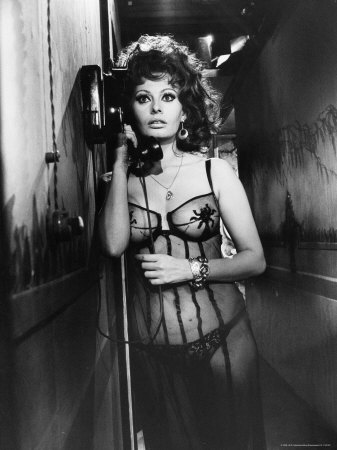
Sophia Loren in Marriage Italian Style

Wednesday, March 9, 2011

Sophia Loren received her second Best Actress nomination (and last to date) for playing Donna Filumena, a kept woman in Marriage Italian Style. Sophia really did not have much chance of winning the Oscar, I think. She had already won (and made history as the first actor winning for a foreign language performance), plus this was another role in an Italian movie. Sophia has always been a great star but I don't really think that it helped her chances considerably that time.

Marriage Italian Style is quite a mediocre movie, in my humble opinion. The last time I saw an Italian movie whose title ended with Italian Style (Divorce Italian Style), I was really entertained and I had a wonderful experience. In addition, I saw a fabulous, unforgettable performance by the fantastic Marcello Mastroianni. Here it is really not the case. Mastroianni is almost sleepwalking through this movie and one would expect much more (in general) from a Vittorio de Sica movie. I mean he directed Bicyle Thieves and Two Women. Marriage Italian Style was a real disappointment for me. Probably I expected too much.

Sophia Loren is, however, wonderful as usual. Of course, this is not her best performance (Two Women is unbeatable, I think and A Special Day is also brilliant) but I did not expect that. I wanted to get something really entertaining and moving from her, which I got. Therefore, she became the only thing about this movie that did not disappoint. It's no wonder, though. Sophia's talent is so great and it shines through even the weakest material. Of course, she's neither a very technical, I dare say calculating actress like Meryl Streep nor a highly emotional (and a bit over-the-top) one like Anna Magnani. Sophia falls somewhere between them, more leaning towards Magnani. However, identifying Sophia's talent is so hard. She's someone who's a natural talent and who would give the exact same, fantastic performances without any acting lessons.

The role of Donna Filumena wasn't really much of a strech for her, I think. Sophia has always been the best at playing earthy and a bit repressed Italian women who have occasional outbursts. Somehow, she makes them so attractive and loveable to us. The essence of this character is given in this movie. When Filumena is walking on the streets, the men and boys are looking at her and she moves her bottom in a very "Sophia" way and starts dancing (this is something that Penélope Cruz cannot copy despite trying desperately, she shouldn't). It's such an instantly likeable sequence, it's just impossible to resist her afterwards. I must say, though, that Sophia totally won me over in the beginning where the seventeen-year-old, scared Filumena looks at Don Domenico during the bombing. The look on Sophia's face is totally ingrained in my memory. It's such a small nuance but it was the real highlight of her performance, I think.

Sophia fantastically showed the toughness of Filumena but she let us know a much warmer and loving side of her, which really made her a sympathetic character. Her reminiscing about her children is so moving, I might even say heartwrenching. Her embarassed face is unforgettable in the scene when she looks at her sick son and she cannot do much about him. Her quiet desperation and final relief is just astonishing to look at. Afterwards (as Filumena has three illegitimate children), she visits the other two children and that's another adorable, luminous scene of Sophia. The role of the mother fits Sophia so thrillingly that if the movie had only been about Filumena's relationship with her sons, it would have been a cathartic masterpiece, much like Mamma Roma (with Magnani).

It's not a coincidence that I haven't talked about her scenes with Marcello. To tell the truth, it's him and his storyline that brings Sophia's performance down. Whenever I see the usual "Italian" fight between these two people, I think "I've seen this before, come on, I want something new, I know you could do better". Those scenes were intended to be hilarious but they did not convince me at all. The screenplay did not give many opportunities to them and I felt that it relied too much on the fact that this duo had been very successfuly together previously. The chemistry works here, too but there's no real sparkling there. When Sophia is there alone, she's just astonishing but when she's together with Mastroianni, the whole thing becomes a bit standard. Good, but standard. However, I must instantly add that Sophia looks once again incredibly great and her beauty is radiant.

So, to sum up, this is a great performance by the magnificent Sophia Loren, which may not be her career best but it's still very good work. Although there are amazing scenes in this work, the really common comedy scenes drag Sophia's performance down. She's still wonderful but she could have been once again mindblowingly brilliant. There was potential but the movie couldn't serve her performance well. Still, I'm very positive about her.

What do you think?

Note: First, I accidentally uploaded 4 Meryls but my original intention was 4,5 (this is a very strong 4,5, almost a 5 actually), so this is not a real change.

Goldfinger (1964) **

goldfinger_poster

(This article is from guest contributor Sarkoffagus and first appeared at http://classic-film-tv.blogspot.com/.  The rating in the title is my own.)

At a beautiful resort in Miami, British secret agent James Bond (Sean Connery) is relayed a message from MI6 head, M (Bernard Lee). Bond’s friend and occasional confidante, CIA agent Felix Leiter (Cec Linder), informs 007 that he is to watch a man named Auric Goldfinger (Gert Fröbe), who the spy catches cheating at a game of gin rummy. However, Bond’s true assignment is to learn goldfingerhow Goldfinger, who by all intents and purposes is a legitimate jeweler, is moving his shipments of gold bullion. As 007 is told, since gold can be melted down, tracing any of the precious metal that has been stolen is nearly impossible. The superspy trails Goldfinger, always accompanied by his mute henchman, Oddjob (Harold Sakata), from London to Switzerland, eventually uncovering Goldfinger’s plan known as Operation Grand Slam. Bond, with the help of a fully loaded Aston Martin DB5 and shaken, not stirred, martinis, must halt an attack on Fort Knox.

Goldfinger has become the “go-to” Bond film since its release in September 1964. It popularized a number of 007 elements, most notably, perhaps, the title song performed by a famous singer, in this case Shirley Bassey. Bassey would also be the only musician to perform a Bond title song more than once, having the honor again in Diamonds Are Forever (1971) and even a third time, as a last-minute replacement for Johnny Mathis in Moonraker (1979). A title song performed by a well known singer would become a staple in the Bond series, with 1969’s On Her Majesty’s Secret Service being the sole exception.

This is the first film of the series that 007 orders a martini “shaken, not stirred” (although in 1962’s Dr. No, the titular baddie serves the secret agent a martini, knowing how he likes it mixed). This is actually taken from Ian Fleming’s novels and would become such a celebrated trait of the films that it was sometimes parodied, such as You Only Live Twice (1967), when he accepts a martini inaccurately stirred, and Casino Royale (2006), when an irate, preoccupied Bond refuses to specify a mix. According to actor Desmond Llewelyn, who plays Q, director Guy Hamilton instructed Llewelyn to play his character as if he disliked 007, since he has no respect for his gadgets. This method led to numerous sarcastic remarks from a perpetually exasperated Q, as well as one of his best known lines spoken in Goldfinger: “I never joke about my work, 007.” Although Bond was given a gadget-laden briefcase in the previous year’s From Russia with Love, Goldfinger popularized Bond’s visit to the Q-Branch, as Q explains to him his latest gadgets (as well as the audience treated to various additional gadgets in the testing phase).

Editor Peter Hunt, who worked on Goldfinger, had reconstructed From Russia with Love into a nicely paced action feature. His most noteworthy contribution was creating a pre-credit sequence. With Goldfinger, Hamilton and screenwriters Richard Maibaum and Paul Dehn turned the pre-credit scene into a movie all its own, with Bond in the midst of an assignment that has nothing to do with the forthcoming mission. Most of the subsequent movies adopted this format.


Goldfinger is likely the most popular of the Bond films. In addition to the distinctively mixed drinks and Q berating Bond, there are a number of things viewers tend to remember about this film: the golden fate of Jill Masterson, the introduction of the Aston Martin, the movie’s theme song (I personally cannot speak the title, choosing instead to sing it). But one of the most memorable components of Goldfinger is Goldfinger himself. Bond’s chief antagonist is a charming, brilliant man, and he’s an impressive and fascinating figure to watch onscreen. One reason for this is an outstanding performance from Fröbe, a German actor who could not speak English and was consequently dubbed for the film. He plays Goldfinger with a style that can easily be equated to 007. But more than anything, the manner in which the villain transports gold and his plan that he ultimately reveals to Bond are ingenious, and even if he is a self-centered, egotistical, malicious person, it is difficult not to respect him for his methods.


Honor Blackman as the provocatively-named Pussy Galore gives a strong showing in Goldfinger. Before being cast in the film, Blackman had just ended her contract on the successful British series, The Avengers. Her co-star, Patrick Macnee, would star in another Bond film, A View to a Kill (1985), and her replacement, Diana Rigg, would catch Bond’s wandering eyes in On Her Majesty’s Secret Service. To round out the Bond-Avengers connections, Joanna Lumley, who would be featured in The New Avengers with Macnee, had a small role in On Her Majesty’s Secret Service. Prior to Goldfinger, both Blackman and Shirley Eaton, who played Jill Masterson, had made appearances in another popular British TV show, The Saint, starring future 007, Roger Moore. Following the film’s 1964 release, Lois Maxwell, who played Moneypenny in numerous Bond films, and one-time Felix Leiter, Cec Linder, both starred in episodes of The Saint.


Toshiyuki “Harold” Sakata, of Japanese descent and born in Hawaii, was a professional wrestler, wrestling under the name Tosh Togo. Although he has no lines, his portrayal of Oddjob would make the character one of the best of the 007 series. The weaponized bowler hat was Fleming’s creation, but it is Sakata who flashes a wicked grin when Bond’s attempts to subdue him prove futile. Reportedly, Milton Reid, who’d previously had a small role as a guard in Dr. No, was up for the part of Oddjob and challenged Sakata to a wrestling match (to determine who would play the henchman) that never materialized. Reid would have a significant villainous role in The Spy Who Loved Me (1977). Linder is a standout among the many actors who would play Felix Leiter, pleasant and a worthy counterpart to Bond.


Goldfinger was a huge international success, breaking box office records and earning back its three-million dollar budget in just two weeks. Just a little more than a month before the premiere of Goldfinger, Bond creator/novelist Ian Fleming died of a heart attack.


Goldfinger is one of my favorite Bond films and is typically the one that I will recommend to potential 007 fans. Connery is terrific, of course, and there are many significant aspects of the film: a great villain, plenty of action, and excellent music.

The Next Year

Saturday, March 5, 2011

1964


So the nominees were:
  • Julie Andrews in Mary Poppins
  • Anne Bancroft in The Pumpkin Eater
  • Sophia Loren in Marriage Italian Style
  • Debbie Reynolds in The Unsinkable Molly Brown
  • Kim Stanley in Seance on a Wet Afternoon
Wow, I know it's surprising that I'm going to do this year now but I just got The Pumpkin Eater and I haven't started reviewing 1991 (I can't resist), so I'm doing this year now and the first review comes next Friday (March 11th). I'm so excited about this year as I don't have a clue on who will get my vote. So interesting and it's rarely talked about besides Andrews.

What do you think? What are your predictions? What's your ranking?

The Umbrellas of Cherbourg (Les Parapluies De Cherbourg) 1964 ****

Thursday, November 4, 2010

umbrellas
Before her role in director Jacques Demy’s 1964 classic musical, Les Parapluies De Cherbourg, Catherine Deneuve was best known for giving birth to Roger Vadim’s illegitimate son. In a way, this was good preparation for her portrayal of an unmarried, 17-year-old who finds herself pregnant by a boyfriend serving in the Algerian War. Just twenty-years old when this film made her an international star, Deneuve’s melancholic performance was greatly enhanced by an unforgettable Michel Legrand musical score. Nominated for five Academy Awards, including Best Foreign Language Film, Best Screenplay, and Best Musical Score, this film won the Golden Palm and the OCIC.

les-parapluies-de-cherbourgLes Parapluies De Cherbourg is my all-time favorite film. I was in graduate school, studying French history, when a colleague asked what I thought of the French New Wave. This discussion naturally included the French’s love of jazz and films with unhappy endings. This, of course, was a perfect time for my colleague to mention that there was a film that encompassed both of these elements: Les Parapluies De Cherbourg. A lover of musicals since childhood, I jumped at the chance to watch this film once a copy could be procured. Nothing could have prepared me for what I saw.

I suspect I was just as shocked as the audience at the 1964 Cannes Film Festival when I realized that the ENTIRE film is sung (in French, of course)—there is no “traditional” dialogue. Instead, it is a modern day (popular) opera, set primarily to a jazz score. This tends to create a problem for American audiences who overwhelmingly dislike reading subtitles at “normal” speed, let alone at song-lyric speed. About fifteen minutes into watching I turned the subtitles off. My French was passable at the time, so I could mostly keep up with what was being sung.

Legendary French songwriter Michel lpdc3Legrand, with the aid of Demy and others, wrote a musical soundtrack/script that is at times playful, romantic, and haunting. The most famous song is the title song, “Les Parapluies De Cherbourg” (more commonly known in English as “I Will Wait for You”). The instrumental version, which closes the film in heart-wrenching fashion (you will never forget it once you experience it), is brilliant all by itself. Then, when you set effortless lyrics to the score, it is a phenomenal love song. The closing pass of the song (finished off with a rousing violin-drenched crescendo) is:

Ils se sont séparés sur le quai d'un gare
Ils se sont éloignés dans un dernier regard
Oh je t'aim' ne me quitte pas
Loosely translated, from French to English:
They separated on the platform of a station
They moved away in one last look
Oh I love you does not leave me

The best recorded version of this song is by the Greek diva-extraordinaire Nana Mouskouri. Often imitated but never surpassed by countless covers (by such artists as Tony Bennett and Carlo Berardinucci), it is a timeless song that even after 45+ years doesn’t sound dated. In addition to this gem there are other seamless songs that carry the film along to its eventual devastating conclusion.

parapluies-de-cherbourg-1963-10-gAnother startling element of the film is the way Demy uses color to carry the story. Cherbourg is an often rainy and dreary port city in Normandy, so the bright blues, oranges, pinks, reds, and yellows that Demy uses in the clothing and overall set design is far from a realistic portrait of the title city. Yet, the virtual Technicolor world that he creates, with bright swatches of color, serves as a co-conspirator in the film. For example, in the beginning of the film everything jumps with color, which corresponds to the happy state of young lovers Genevieve (Deneuve) and Guy (Nino Castelnuovo). In a way the bright pastels serve as blinders—the young, impetuous lovers are surrounded by bright, clear color, but they can’t truly see what lies ahead. However, by the end of the film, when the now irrevocably parted lovers meet by chance one snowy night, there is a notable absence of color. Agnes Varda, Demy’s wife (and a director in her own right) has said that Demy’s use of color was aimed at portraying the violence and the cruelty of the story.

For those who like to see happy endings, there is no crueler ending than what you are given in this film. I have often contemplated why the ending is so emotionally jarring. I think it has a lot to do with the youthful exuberance shown by Genevieve and Guy, who are so much in love at the start of the film. It is a pure and innocent love, which in any other film would have come off as sickeningly saccharin. Then, your heart absolutely breaks at the famous train scene where Guy goes off to Algeria with a teary-eyed Genevieve on the train platform. But that’s okay, because the movie is only half over and you know they are going to get married and have a child named Francoise as soon as he returns—right? After all, she did sing she would wait for him! Oh, but she finds out she’s pregnant and Guy doesn’t write and the next thing you know she’s marrying that wealthy jewel smuggler (Marc Michel) from Lola (another Demy musical, from 1961) who you felt so bad for when his romantic hopes were crushed by that slut Anouk Aimee! Yet, still somewhere in your mind is the thought that Guy will come home and save Genevieve from a loveless marriage and all will be right in Cherbourg. But, alas, that’s not what happens.

Instead, you learn the bittersweet lessons that love does not always conquer all and that not everyone (especially you the viewer) gets a happy ending. Instead, people settle. nino_castelnuovo_parapluies_de_cherbourgGenevieve settles for wealth and security; Guy settles for companionship and loyalty. The one small detail that the viewer can take solace in is the unforgettable final scene, where by revealing the names of their respective children, both named Francoise, the couple are somehow still connected—even if they are living different lives they need only say the name of their child and some semblance of what once was pure love remains: “Oh I love you does not leave me.”

This movie made Deneuve a star. Her Genevieve was innocence personified. Called upon to display every emotion, from love to despair, she transforms a naïve, love-struck teenager into a resigned, world-weary woman who accepts that life isn’t always fair. Of course, Roman Polanski and Luis Bunuel couldn’t wait to tarnish that innocence, but that’s a story for another day.
 
This article was nominated for a 2011 CIMBA in the category of Best Film Review (Musical or Comedy). The CIMBA is the CMBA's award for excellence in classic movie blogging.
 

Blogger news

Blogroll

Most Reading