Pages

Powered by Blogger.
Showing posts with label Sophia Loren. Show all posts

The Final Conclusion - Best Actress 1961

Tuesday, July 19, 2011

1961


So the much anticipated ranking is:

This is not a performance for the ages but Piper Laurie is very good as Sarah in The Hustler. Although sometimes she's too overshadowed by Paul Newman, her work never loses its strength and occasionally, we see truly brilliant, unforgettable scenes. Her achievement is very evenly great and therefore she deserves some praise.

I don't think that this performance of Geraldine Page is all that special. I mean, she's great and she has a lots of great moments but altogether, she's not that brilliant. Apart from the beginning, she played Alma just like she had to and she put on very decent work that could be expected from an actress of her calibre. However, she's not as amazing as some say.

Natalie Wood took on a very difficult role and despite some early mistake, she put on a wonderful performance as Deanie Loomis. She portrayed all the fears and the tension so realistically and exceptionally that she became a truly luminous presence on the screen. She develops the character excellently, avoiding all the traps and obviousness that could have ruined her work.

It really must be my sentimental side that came to surface while I was watching this movie but I couldn't care less. I understand why some could criticise it but for me, Audrey Hepburn's work as Holly Golightly in Breakfast at Tiffany's is deservedly one of the most iconic performances of all time. Not only has Audrey Hepburn created an unforgettable character, but also some marvellous acting.

I know I should sum up his performance somehow but I feel that my whole review was the shortened version of how I feel about her. Nothing can come close to this wonderful emotionality, the radiant, brilliant personality of Sophia Loren (none of the Hollywood stars of her time can come close to her). This watch of the movie and my review was the ultimate test of my love for this performance and it passed. With distinction. :)

So I can proudly announce
the winner is...
Sophia Loren
in
Two Women
Easy win.

Congratulations to Fritz and Louis on the correct predictions! :) You got a prize but since you got it right only after 4 reviews you can both pick only from these 10 possibilities: 1943, 1953, 1962, 1967, 1968, 1976, 1982, 1985, 1988, 1999.

Final thoughts: BRILLIANT year! I so loved this year. All of them interesting, strong performances. Two very good ones, one really great and two legendary ones. I'm happy that I had to opportunity to do this wonderful year. I feel bad about not picking Audrey (so far, she's my best one not to win, I refuse to say loser) as that performance was worthy of an Oscar. However, no tie was possible. This award belonged to Sophia alone and the Academy somehow (what a miracle) realised that. So I've agreed with the Academy 3 years in a row. :)

Omissions: Jeanne Moreau in La Notte


The ranking of the reviewed years:

  1. 1969
  2. 1944
  3. 1974
  4. 1961
  5. 1989
  6. 2001
  7. 1959
  8. 2006
  9. 1978
  10. 2010
  11. 1996
  12. 1964
  13. 1939
  14. 1977
  15. 1997
  16. 2009
  17. 1980
  18. 1941
  19. 1972
  20. 1963
  21. 1966
  22. 1973
  23. 1983
  24. 1986
  25. 1937
  26. 1990
  27. 1954
  28. 1958
  29. 1948
  30. 2002
  31. 1957
  32. 2003
  33. 1940
  34. 1998
  35. 1975
About the next year: It's no secret that it will be 1992. :)

What do you think?

Sophia Loren in Two Women

Monday, July 18, 2011

Sophia Loren received her first Academy Award nomination and only competitive Oscar to date for playing Cesira, a young Italian widow, who's trying to survive the horrors of WWII along with her daughter in Two Women. Sophia Loren basically won every award for this performance of hers, except for the Golden Globe for which she wasn't even nominated (that's about the Hollywood Foreign Press Association). The 60s were such beautiful times when the Golden Globe winner for Best Actress in a Drama never won (I miss those days when there were surprise winners). I guess if this role had been in English it would have been a shoo-in for the win but thankfully, it won. If we think about it it could not have been any other way. I mean can anyone imagine Sophia Loren without an Oscar? Well, at least I can't.

Two Women is a fantastic movie, in my opinion. I guess this kind of Italian realism is not for everyone but I so love the purity it. There are small leftovers in Two Women from the neorealism (after all it was directed by the brilliant Vittorio de Sica) and it's such a wonderful, touching tale about real women. It's also really interesting to see Jean-Paul Belmondo at such an early age (he almost cannot be recognised).

However, Two Women as a title is a little bit misleading. To tell the truth, it's such a stupid translation (very much like the Hungarian title that says A Woman and her Daughter) as the original title means "the woman from Ciociara". And that says something very significant. It says that this story is mainly about one woman and that is Cesira, played by the wonderful, unforgettable, beautiful and talented Sophia Loren. There's a reason why this performance is considered legendary. It gives the essence of Sophia Loren's whole character and it sums up her career so brilliantly. Katharine Hepburn once said that always the right actors win Oscars, for the wrong roles. That's simply not the case with Sophia Loren. She's really the one who got the award for the performance of her lifetime. Before this, in Hollywood, Sophia Loren was considered the sexy, sensual Latin woman who's singing to Cary Grant's children. If you're looking for this Sophia Loren, you'll surely be surprised but not disappointed. I guess that's another reason that contributed to her win: this was such a stunning, shocking achievement that you would never expect from a sex symbol.

It's amazing to see how many faces of Cesira Sophia shows. She's playing with the emotions so confidently and yet she never gets self-satisfied. Obviously, she knows what she's doing but I never felt that she was as self-aware as her fellow nominee, Geraldine Page. While the technical part of the performance, the timing and such are all brilliant, it's the stunning emotions that are really memorable in this work. They range from pride to desperation, through fear, passion, anger, fury, happiness, grief, sorrow, worry and above all, love. Above all, this performance is a beautiful tribute to women's (especially mother's) love. How strong it can be and that it can survive anything and such. It sounds very cheesy but it's all there in Sophia's performance and it seems so natural. In my review of Penélope Cruz in Volver, I was raving about Cruz's ability to recreate the greatness and earthy strength of the women of the European cinema in the twentieth century. However, in Two Women, it's all present in its true, original form, without any irony. Sophia Loren walks on the street, you see her and you're just blown away by her presence. You instantly say "What a woman!".

This performance is much more than that, though. Loren's chemistry with Eleonora Brown (the girl who plays her daughter, Rosetta) is just excellent. You see them as mother and daughter and I alway believe that Cesira would really sacrifice her life for her. Sophia made this relationship so real and so close to the audience that it's really astonishing. The constant worry that we see on Sophia's face in each and every second is so heart-breaking. I knew that horrible things would happen to them and yet I was hoping just like she was hoping. The scene where she tries to collect as much food as possible is just unforgettable. And her small interactions with Jean-Paul Belmondo are utterly fantastic. There's so much tension between them and they make some of the best scenes in this film.

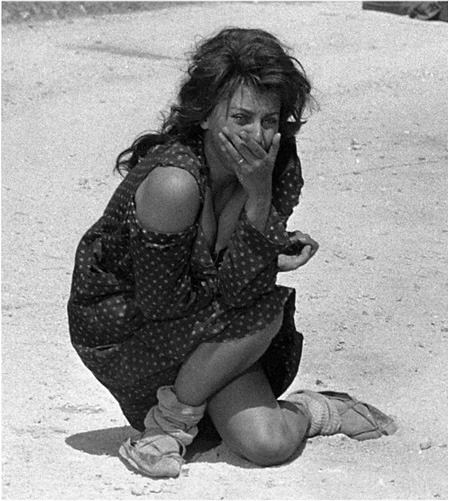
However, the parts that are really unforgettable (and in the worst way possible) are in the last 20 minutes of the movie. Cesira and her daughter are gang raped by soldiers in a church and it's an almost unbearable scene. Those screams, the fear in the eyes. Sophia is so brutally realistic there that I really had trouble trying to go on. After that, Cesira gets deeper and deeper into devastation. Her big monologue (which would be her Oscar clip if she was nominated now) where she attacks some soldiers is almost as terrifying as the rape scene. Sophia mercilessly shows all the effects of this horrible thing. That hysterical cry and the way she puts her hand on her face. Brilliant, heart-breaking, unforgettable. And so are the last seconds of film where we see a broken, devastated and yet somehow hoping Cesira. I identified with Cesira's emotions so much that I totally forgot everything. It was just her, not me. It's chilling to see her tears rolling. So perfect, so natural and so tragic. And the best thing is that Sophia always remains beautiful. It's not a deglam role. Her radiant beauty (which comes from her personality, above all) shines through the screen and matched with her wonderful acting, they make up a cathartic experience. Unbelievable.

I know I should sum up his performance somehow but I feel that this whole review was the shortened version of how I feel about her. Nothing can come close to this wonderful emotionality, the radiant, brilliant personality of Sophia Loren (none of the Hollywood stars of her time can come close to her). This watch of the movie and my review was the ultimate test of my love for this performance and it passed. With distinction. :)


Again, the rating is so useless but the system should work.

What do you think?

The Next Year

Thursday, July 14, 2011

1961


So the nominees were:
  • Audrey Hepburn in Breakfast at Tiffany's
  • Piper Laurie in The Hustler
  • Sophia Loren in Two Women
  • Geraldine Page in Summer and Smoke
  • Natalie Wood in Splendor in the Grass
Sophia Loren made history in 1961 by becoming the first actress to win for an entirely foreign language-speaking performance. Will she be my winner, too or will I pick one of the other incredible ladies?

What do you think? What's your ranking? What's your prediction for my ranking?

The Final Conclusion - Best Actress 1964

Sunday, March 13, 2011

1964


So the much anticipated ranking is:

I can say that I got what I expected, a standard 60s musical performance from Debbie Reynolds. Although this work is really mixed and uneven, there are some scenes to admire or at least like about it. It's nothing mindblowing or ground-breaking but it did not bother me that much, so I don't feel bad about it.
This is a great performance by the magnificent Sophia Loren, which may not be her career best but it's still very good work. Although there are amazing scenes in this work, the really common comedy scenes drag Sophia's performance down. She's still wonderful but she could have been once again mindblowingly brilliant.

This is an incredibly hard performance to judge. Anne chose all the difficult and risky ways with her character but she succeeded and she was able to put on a shocking, perplexing and terrying character study of a woman who has serious problems in her life.

This performance is also extremely hard to judge. It's full of fantastic scenes and it's overall effect is just brilliant and just like with Bancroft, I am not really sure what I am going to think about her. However, I just cannot overlook that Kim Stanley was able to put on a fantastic, chilling and unforgettable performance as Myra Savage.

It's a great achievement and it's no wonder that it became an iconic performance among children. Because if you really want to see the wonders of this role, you must loose yourself and (and just like Banks) become a child again for two hours. I may be alone with this but I think that this is fantastic work.

So I can proudly announce
that my winner is...
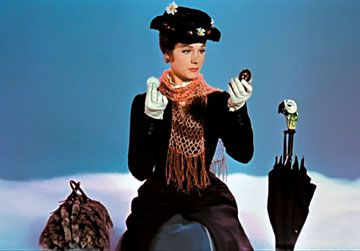
Julie Andrews
in
Mary Poppins
Julie is preparing to accept this award... :)
Final thoughts: A superb year but the performances were all so difficult to rate. My reaction to Julie Andrews was just as shocking to me as it was to you. Loren was great as expected, Bancroft was the most difficult to rate ever but now there are small problems that occured. I knew that Reynolds would suck and I loved Stanley when I first saw her, she was in a Bryan Forbes movie, so there was no surprise about her. However, after all Julie Andrews was a clear cut winner despite some tough competition from Kim Stanley. I think many of you think I'm crazy but I was truly captivated by Julie's performance and its mysteriousness.

Omissions: 

  • Audrey Hepburn in My Fair Lady (she was way better than Debbie Reynolds)


The ranking of the already reviewed years:
  1. 1969
  2. 1974
  3. 1989
  4. 1959
  5. 1964
  6. 1939
  7. 1977
  8. 2010
  9. 2009
  10. 1980
  11. 1941
  12. 1963
  13. 1966
  14. 1973
  15. 1990
  16. 1978
  17. 1954
  18. 1948
  19. 2002
  20. 1940
  21. 1998
About the next year: I couldn't decide between two (consecutive) years. Both are said to be quite weak and yet I'm so interested in both of them. Plus they are from the decade I've been ignoring for a while. However, I've chosen the second year as I've seen only one of the nominees and I love when I have new performances to discover. The clues (quite easy ones):
  • (L) Nuns (L)
  • (L) Soaps (L)
  • Viva Italia!
What do you think?

Off-topic: I saw 127 Hours yesterday. It was BRILLIANT and would have deserved Best Picture (tied with Black Swan), Actor, Editing and Song. You lose a lot if you don't watch it in a movie theater (fantastic cinematogrpahy BTW and a directing that should have WON and it wasn't even nominated).

Sophia Loren in Marriage Italian Style

Wednesday, March 9, 2011

Sophia Loren received her second Best Actress nomination (and last to date) for playing Donna Filumena, a kept woman in Marriage Italian Style. Sophia really did not have much chance of winning the Oscar, I think. She had already won (and made history as the first actor winning for a foreign language performance), plus this was another role in an Italian movie. Sophia has always been a great star but I don't really think that it helped her chances considerably that time.

Marriage Italian Style is quite a mediocre movie, in my humble opinion. The last time I saw an Italian movie whose title ended with Italian Style (Divorce Italian Style), I was really entertained and I had a wonderful experience. In addition, I saw a fabulous, unforgettable performance by the fantastic Marcello Mastroianni. Here it is really not the case. Mastroianni is almost sleepwalking through this movie and one would expect much more (in general) from a Vittorio de Sica movie. I mean he directed Bicyle Thieves and Two Women. Marriage Italian Style was a real disappointment for me. Probably I expected too much.

Sophia Loren is, however, wonderful as usual. Of course, this is not her best performance (Two Women is unbeatable, I think and A Special Day is also brilliant) but I did not expect that. I wanted to get something really entertaining and moving from her, which I got. Therefore, she became the only thing about this movie that did not disappoint. It's no wonder, though. Sophia's talent is so great and it shines through even the weakest material. Of course, she's neither a very technical, I dare say calculating actress like Meryl Streep nor a highly emotional (and a bit over-the-top) one like Anna Magnani. Sophia falls somewhere between them, more leaning towards Magnani. However, identifying Sophia's talent is so hard. She's someone who's a natural talent and who would give the exact same, fantastic performances without any acting lessons.

The role of Donna Filumena wasn't really much of a strech for her, I think. Sophia has always been the best at playing earthy and a bit repressed Italian women who have occasional outbursts. Somehow, she makes them so attractive and loveable to us. The essence of this character is given in this movie. When Filumena is walking on the streets, the men and boys are looking at her and she moves her bottom in a very "Sophia" way and starts dancing (this is something that Penélope Cruz cannot copy despite trying desperately, she shouldn't). It's such an instantly likeable sequence, it's just impossible to resist her afterwards. I must say, though, that Sophia totally won me over in the beginning where the seventeen-year-old, scared Filumena looks at Don Domenico during the bombing. The look on Sophia's face is totally ingrained in my memory. It's such a small nuance but it was the real highlight of her performance, I think.

Sophia fantastically showed the toughness of Filumena but she let us know a much warmer and loving side of her, which really made her a sympathetic character. Her reminiscing about her children is so moving, I might even say heartwrenching. Her embarassed face is unforgettable in the scene when she looks at her sick son and she cannot do much about him. Her quiet desperation and final relief is just astonishing to look at. Afterwards (as Filumena has three illegitimate children), she visits the other two children and that's another adorable, luminous scene of Sophia. The role of the mother fits Sophia so thrillingly that if the movie had only been about Filumena's relationship with her sons, it would have been a cathartic masterpiece, much like Mamma Roma (with Magnani).

It's not a coincidence that I haven't talked about her scenes with Marcello. To tell the truth, it's him and his storyline that brings Sophia's performance down. Whenever I see the usual "Italian" fight between these two people, I think "I've seen this before, come on, I want something new, I know you could do better". Those scenes were intended to be hilarious but they did not convince me at all. The screenplay did not give many opportunities to them and I felt that it relied too much on the fact that this duo had been very successfuly together previously. The chemistry works here, too but there's no real sparkling there. When Sophia is there alone, she's just astonishing but when she's together with Mastroianni, the whole thing becomes a bit standard. Good, but standard. However, I must instantly add that Sophia looks once again incredibly great and her beauty is radiant.

So, to sum up, this is a great performance by the magnificent Sophia Loren, which may not be her career best but it's still very good work. Although there are amazing scenes in this work, the really common comedy scenes drag Sophia's performance down. She's still wonderful but she could have been once again mindblowingly brilliant. There was potential but the movie couldn't serve her performance well. Still, I'm very positive about her.

What do you think?

Note: First, I accidentally uploaded 4 Meryls but my original intention was 4,5 (this is a very strong 4,5, almost a 5 actually), so this is not a real change.

The Next Year

Saturday, March 5, 2011

1964


So the nominees were:
  • Julie Andrews in Mary Poppins
  • Anne Bancroft in The Pumpkin Eater
  • Sophia Loren in Marriage Italian Style
  • Debbie Reynolds in The Unsinkable Molly Brown
  • Kim Stanley in Seance on a Wet Afternoon
Wow, I know it's surprising that I'm going to do this year now but I just got The Pumpkin Eater and I haven't started reviewing 1991 (I can't resist), so I'm doing this year now and the first review comes next Friday (March 11th). I'm so excited about this year as I don't have a clue on who will get my vote. So interesting and it's rarely talked about besides Andrews.

What do you think? What are your predictions? What's your ranking?

Taste the Blood of Angels & Demons; Other Weekend Viewing

Thursday, May 28, 2009

A much too late recap of movie viewing over the Memorial Day weekend.

Taste the Blood of Dracula

It’s Hammer Time.

Another Dracula flick, this one the gloriously titled “Taste the Blood of Dracula” (1970) again with Christopher Lee baring his fangs at some of Victorian England’s loveliest ladies, including the delectable Linda Hayden.

Hayden plays Alice, whose father (Geoffrey Keen, a familiar face from several of the Roger Moore 007 movies) is symbolic of Victorian hypocrisy. Along with two friends, these three men enjoy the highest respectable standing in their communities when not visiting a brothel to taste the darker side of life. They meet Lord Courtney (a wonderfully cast Ralph Bates), the black sheep of an aristocratic family, one whom all sorts of unearthly rumors are spoken about. He promises the three pleasures of the flesh that will extend into infinity if they will only front the money to buy some supplies for a ceremony to resurrect you know who.

The movie is as much a look at hypocrisy as it is a Dracula flick. Keen also has an unhealthy interest in his daughter, staring down the front of her dress and muttering in a drunken state, “I haven’t beaten you since you were a little girl.”

For the first 45 minutes or so out of its 90-minute running time, Dracula barely makes an appearance. The first half of the movie is really quite good, and it seems a shame that Dracula needs to show up at all.

The resurrection scene is nicely staged by director Peter Sasdy, but when the three chicken out at the last minute and kill Lord Courtney in a rage during the rite, Dracula comes back to avenge the death of his disciple.

Since he has limited screen time, and hardly any dialogue, Lee drags out his dialogue into as many syllables as he can.

After the first killing, he intones, “The f…i….r….s….ttttt.”

A little later on, we get, “The s….e….c…o…n….dddddd.”

Finally, “The t….h…i…r….ddddd.”

For such short words, Lee sure does drag them out for maximum effect. It sounds like I’m knocking it and I’m not. I revel in juicy line readings like these. I wish we had more of them in today’s movies.

But as I’ve said before, I fully understand why Lee doesn’t want to be remembered as Dracula. There’s not much for him to do in these movies, except lend his considerable physical presence, stare a lot and snarl.

He’s easily dispatched too, in what is probably the lamest in the Hammer series. Dracula has been using an abandoned church as his base of operations, but when it is re-consecrated again, it’s too much for him and he makes noises and falls on an altar. The basic idea is good, but director Sasdy’s handing is pretty bad. Who does this re-consecrating of the church but Paul (Anthony Corlan), the wispy boyfriend of Alice. Paul knows nothing about vampires save for what his father wrote down in a book.

This is Dracula, the King of the Vampires, done in by a kid who barely knows anything? The nerve. Being dispatched so easily, it’s a miracle Dracula has any reputation at all.

On the plus side, we get one of James Bernard’s best scores, with the love theme being one of his loveliest melodies. There’s a scene where Alice sneaks out of the house to attend a dance with Paul (against the wishes of her father), and climbs out a second-story window and down a tree into Paul’s arms, supported by a lovely treatment of Bernard’s gorgeous theme. The music, set design and lighting put one to mind of a fairy tale. Hammer Films excelled at being fairy tales for adults, and this sequence is one of the best examples I know of in showcasing the Hammer magic.

It’s a terrific film, and I’m very fond of it. But there’s more than a nagging suspicion that it would have been better without Dracula in it.

Angels and Demons

The less said about the humorless and overlong “Angels and Demons” the better. It’s more watchable than “The DaVinci Code” (2006) but that’s not saying much. It’s as contrived as all get out, which is now the norm for thrillers like this.

I do like the fact that its central hero Robert Langdon (Tom Hanks) is an educated man. In a culture that celebrates stupidity and crassness, it’s refreshing to see an intelligent person not be made the butt of a joke. His exchanges of historical lore with Vittoria (Ayelet Zurer) generate some sparks between them, sparks more potent than kisses and foreplay for this highly educated duo.

As a practicing Catholic, I didn’t even object to the film’s central thesis of dark and mysterious conspiracies emanating from the Vatican. After all, I think there’s a rousing movie waiting to be made detailing the sex lives of medieval popes. But I will firmly admit to finding little entertainment in not one but two scenes of priests set on fire while still alive.

Director Ron Howard’s hand is too leisurely for this type of material. Like so many thrillers today, there’s about three climaxes too many. Each time I thought it was going to end, whoosh, off to another climax.

“The DaVinci Code” was one of the murkiest-looking big budget Hollywood movies I can remember seeing, so I was glad that returning cinematographer Salvatore Totino spent money to buy some high-quality bulbs for his lighting equipment. You can actually see what is happening this time.

Alas, we are still subjected to muddy sound recording, with too many actors delivering lines in a hushed excited manner that often makes it hard to understand what they are saying (especially true in the case of Ms. Zurer).

Also returning, unfortunately, is composer Hans Zimmer. I hated the way his scoring of the ending helicopter sequence at the end took away whatever tension the scene had. The scene goes on forever and Zimmer’s faux-inspirational scoring makes the scene appear twice as long as it already is. Rarely in the history of movies has a composer communicated so little using so many notes.

On the plus side, like the book, the movie did make me want to make a trip one day to see Italy and the Vatican. And Ewan McGregor’s Irish accent was good for a few laughs.

Operation Crossbow

Another thriller, but one with real thrills. This is more like it. Based on a true story, “Operation Crossbow” (1965) details Great Britain’s attempts to stop Germany’s rocket experiments during World War II. Germany actually launched V-1 rockets from Germany into London, causing considerable damage. Though Germany was losing the war, the successful rocket program could have gone badly for the Allies. Using engineers smuggled into the missile facility at Peenemunde, British intelligence learned of the imminent launch of a more powerful rocket, the V-2, that could have decimated London. The saboteurs are able to call in an air strike to destroy the underground rocket base.

The fiery conclusion puts one to mind of a World War II version of a James Bond movie. The underground rocket base is manned by many extras, and has the clean, shiny look of a SPECTRE facility. There’s some pretty impressive explosions on display here.

Before that, we get a taut story starring George Peppard as a German-speaking American Army engineer who joins a squad of soldiers with engineering experience in infiltrating the Peenemunde facility using the identities of dead German engineers. All is well and good until Sophia Loren shows up as the wife of Peppard’s character. Peppard pretends to be her husband’s friend and is only traveling with him, but how long can that ruse continue? Loren is top billed but is only featured in the central portion of the film. Top billing came about no doubt to the film’s producer, her husband Carlo Ponti.

Listening to the actors here was pure joy after suffering through the breathy whispers of “Angels and Demons.” Just a quick look at the supporting cast of old pros and one knows one will be reveling in crisp line readings: Trevor Howard, John Mills, Richard Johnson, Tom Courteney, Jeremy Kemp, Anthony Quayle (as a Nazi!), Lilli Palmer, Paul Henreid, Helmut Dantine, Richard Todd, John Fraser, Maurice Denham and Patrick Wymark. Every young actor in Hollywood today should watch this movie for lessons in dictation. Please, do it right now. Please?

That’s Entertainment III

“That’s Entertainment III” (1994) was the third look back at M-G-M musicals and if it doesn’t attain the glories of the first film, it’s certainly better than the second one. The third film touches on some of the less noteworthy aspects of the studio and American Society, especially in the Lena Horne-narrated segment. She notes how many of her appearances in M-G-M musicals were specialty numbers, so could be easily snipped by theater owners in the South. A number from “Cabin in the Sky” (1943) was excised from the final print as it was considered too shocking to show Horne, a black woman, enjoying a bubble bath!

The film showcases other cut numbers, mainly due to length. A splendid movie.

Equally enjoyable was the fourth disc in the DVD box set, containing all sorts of terrific extras. One shows the famous lunch in 1949 celebrating the studio’s 25th anniversary, which gathered as many M-G-M stars as possible for the event. Footage from the lunch appears in the first “That’s Entertainment” film, but here we get extra footage. Some stars look up and smile as the camera passes by, while others could barely be bothered. There’s priceless footage of host George Murphy introducing the stars as they come into the room. Right before Kathryn Grayson is introduced, in comes Errol Flynn, on loan to M-G-M from Warner Bros. to make “That Forsythe Woman” (1949), who cuts through the line, and nods to Murphy, who seems flustered that the carefully planned event has been temporarily derailed. Did bad boy Flynn sabotage the introductions on purpose, or was it an accident? I don’t know, but I was delighted to see it.

Even better is an ABC special promoting the opening of the first “That’s Entertainment” back in 1974. This was a big, old school event celebrating the Golden Age of Hollywood. Dozens of stars attended the premiere and lined up for a picture. I’ve seen the picture reproduced before, but never the gathering for the picture. Amazing stuff. Astaire, Kelly, Ginger Rogers, Glenn Ford, Elizabeth Taylor, etc. Roddy McDowall comes out with Lassie. Jimmy Durante shows up in a wheelchair and gets a huge ovation. Ava Gardner and Charlton Heston stand next to each other. Did they come right from the set of “Earthquake?” There was no love lost between the two, but they seem to be making the best of it. My favorite moment comes when Marjorie Main is introduced. She was no spring chicken when she starred as Ma Kettle, and gets one of the biggest ovations of the night. Great, great, historic footage. I was sorry to see it over.

El Cid

Tuesday, February 5, 2008

“El Cid” (1961), is one of the greatest spectacles ever made, a feast for the eyes and ears. It tells the tale of Spain’s greatest hero, a knight who lives by a code of honor that would bend most other men.

Though made in the early 1960s and dealing with a medieval hero, its story and message echo what is occurring in today’s world. Consider the following:

The film’s opening scene shows the fundamentalist Moslem chieftain Ben Yussuf (Herbert Lom) from Africa exhorting his followers to conquer Spain, the land across the waters, and from there the rest of Europe and eventually the entire world. Allah has willed it to him that the world be made a Moslem one. He is willing to spare no Christian man, woman or child from fulfilling his mission. Sound familiar?

Conquering eleventh century Spain could be easily accomplished, as it is a patchwork of feuding kingdoms, boasting petty rulers with even pettier heirs more concerned about their tiny fiefdoms than the enemy scourge that is gathering across the waters to sweep over Spain.

The knight Rodrigo Diaz de Vivar (Charlton Heston) is on his way to his wedding to his betrothed, the beautiful Chimene (Sophia Loren) when he engages the Moors (not the Moops) in a battle. He captures two Moorish prisoners and since he is their captor, their fate is in his hands. Rodrigo says Moslem and Christian have been killing each other for centuries and to what end? He secures a solemn vow from them that they will never raise a hand against his king, Ferdinand.

One of them, Moutamin (Douglas Wilmer, from “Jason and the Argonauts” (1963), by the way one of the greatest films ever made) tells him a man who shows great compassion towards his enemies is a worthy man and gives him the title “El Cid” which means “The Lord.” Rodrigo and Moutamin become great friends and allies.

Word gets back to Ferdinand’s court that he let Moorish prisoners go. Disapproval and censure is swift, and Rodrigo is dubbed a traitor. To avenge his honor, he engages in a duel with the king’s champion and kills him. The king’s champion is Chimene’s father, and the love story on display here becomes a truly memorable one. Their deep loves turns into a hateful marriage, but that hate melts away years later when she realizes what a man of deep honor her husband is.

Rodrigo redeems himself when he fights in a jousting contest and is awarded the city of Calahorra for his king. This is one of the cinema’s great action sequences. Filmed on the grounds of a real castle, hundreds of spectators stand among colorful pennants as the two champions engage in a grueling lance and swordfight. The sequence took five weeks to film and lasts almost ten minutes long.

Ferdinand dies and the kingdom falls into the hands of his bickering children Urraca (Genevieve Page), Alfonso (John Fraser) and Sancho (Gary Raymond, also from “Jason and the Argonauts”). Rodrigo tries to warn them of the growing threat overseas and brings his Moorish allies to court, saying they need to band together to fight Ben Yussuf. Appalled at the idea of having Moors in their Christian court, the Moorish assistance is rejected by the new rulers.

Rodrigo is exiled and the legend of El Cid begins. Still loyal to the kingdom that has forsaken him, he wins territories and battles for his king while unifying the Spanish kingdoms against Ben Yussuf.

That’s just the barebones of the movie, as it runs almost three hours long, but so well paced is the movie that the 184-minute running time just flies by.

Producer Samuel Bronston independently financed the movie and no expense was spared in recreating medieval Spain. Actual cathedrals and castles were used, and thousands of extras are on display to enact the spectacular battles. No CGI here, and the costumes, sets and props are exquisitely detailed and appointed. I don’t how historically accurate those sets and costumes are, but it sure is a beautiful film to look at.

Equally glorious is the score by master composer Miklos Rozsa. There are background scores and then there are musical scores and Rozsa’s “El Cid” is definitely one of the latter. It’s a stunning symphonic achievement, with the love theme being one of Rozsa’s most heart achingly beautiful.

Heston was born to play roles like this and Loren is exquisite as his wife, as their relationship becomes a roller coaster of emotions. Reportedly, Heston and Loren did not care for each other offscreen, but that doesn’t come through.

Heston is perfect playing the big emotions, but he always seems uncomfortable in his love scenes (in all his movies, not just “El Cid.”). I’ve always been struck by the parallels between “El Cid” and his performance in “The Ten Commandments” (1956). In both movies, they enjoy strong relationships with their wives, but in the second half when they become legendary figures, and the beards become longer, they become such grand figures, that you can’t picture Moses or El Cid sitting down with the wife for a relaxing dinner. They’re too busy changing history. Heston’s performance in these latter scenes in “El Cid” is so good you forgive the awkwardness of his earlier scenes with Loren.

Director Anthony Mann was a master of wide-screen composition and he uses it beautifully. Rodrigo’s and Chimene’s initial meeting from opposite sides of the room until they come together in the middle bathed in a golden light from a skylight above is a particular highlight.

There are a few other minor demerits. While the huge climatic battle scene at the end is an awesome spectacle, with the two armies charging towards each other on the beach, and Rozsa’s furious music propelling them forward, once the armies have clashed, I don’t feel the battle isn’t as exciting as it could be. A director like DeMille was great at capturing individual moments in his action scenes, but here the actual battle could use a little more oomph.

A risible moment is the song that comes up as the exit music, with words sung by a huge chorus set to Rozsa’s indelible love theme. The song is called “The Falcon and the Dove.” Ugh. Rozsa didn’t want a song at the end, but was overruled by producer Bronston, who hoped to have a hit record from it. When Rozsa re-recorded the score for the soundtrack album, he omitted the chorus and gave us his the exit music he wanted, a glorious full blown rendition of the love theme. I wish Rozsa had convinced Bronston to keep his original idea.

But all is forgiven when one thinks of the film’s final scenes, with El Cid riding into legend. I don’t want to spoil it for those that haven’t seen it, but that sunlight, Rozsa’s incredible organ music and that final image of El Cid riding along the shoreline is one of the greatest movie endings of all time.

And one of the film’s messages, that Christians and Moslems can learn much from each other but must join forces to defeat fundamentalist evil in their midst, is needed today more than ever before.

The two-disc DVD is a real treat. I had heard stories about the bad transfer, but it looks splendid to me, albeit a little brown in spots. Due to the film changing ownership hands over the years, much of the original master material is missing, so the film probably looks as good as it ever will. I wish the film’s intermission music, “The El Cid March” (a wonderfully stirring piece) had been placed at the beginning of the second disc instead of the end of the first, but that’s a minor quibble.

The extra features are particularly generous, with segments devoted to producer Bronston, director Mann, composer Rozsa, the making of the film and film preservation. The extra features alone run almost two hours!

Though it’s early in the year, the DVD release of “El Cid” looks hard to top as the DVD event of the year. Let’s hope that the next Bronston release, “The Fall of the Roman Empire” (1964), is equally impressive.

Rating for “El Cid”: Three and a half stars.
 

Blogger news

Blogroll

Most Reading