Pages

Powered by Blogger.
Showing posts with label Errol Flynn. Show all posts

Green Light

Wednesday, November 7, 2012


 I’m always impressed by 1930s black and white medical dramas, and how the black and white photography really highlights the cold, white sterility of the operating room theaters. The whites in these sequences are often really, really white and make the hospitals seem like miracles palaces.

Such an operating room theater is on hand in one of the most unusual medical dramas of the period, “Green Light” (1937), an oddball but affecting drama that throws in everything but the kitchen sink - spirituality, love, self sacrifice and medicine. The fact that it works at all can be attributed to director Frank Borzage, who makes the most melodramatic events seem like everyday occurrences.

Errol Flynn plays Dr. Newell Paige, a successful surgeon who takes the blame for the death of a patient, Mrs. Dexter (Spring Byington), at the hands of his surgeon mentor, Dr. Endicott (Henry O’Neill).

Like the other characters in the movie, he turns to the sermons of Dean Harcourt (Sir Cedric Hardwicke), an Anglican (I think, or at least non-denominational) minister for spiritual comfort, whose sermons are broadcast on the radio to a wide and admiring audience.

Another of Harcourt’s admirers is Phyllis Dexter (Anita Louise), who seeks any kind of understanding from him after her mother’s death. Of course, she falls in love with the handsome Dr. Paige, without knowing who he really is. Paige’s nurse Frances Ogilvie (Margaret Lindsay) is in love with him, but promises to keep his secret about Dr. Endicott. She befriends Phyllis, not knowing how Phyllis feels about Dr. Paige.


After Phyllis finds out who Paige is, and thinking he was responsible for the death of her mother, she rejects him. Paige joins his friend Dr. Stafford (Walter Abel) in the rural west, looking for a cure for Rocky Mountain Spotted Fever, which is decimating the local population and economy.

Frustrated at their inability to find a cure for the disease, Paige injects himself with an experimental vaccine, and his life hangs in the balance.

All this, and a dog named Sylvia, in only 84 minutes!

 “Green Light” was based on a novel by Lloyd C. Douglas, a minister-turned novelist who had a pretty good track record when it came to film adaptations. His biggest novelistic success was “The Robe”, but he died in 1951, two years before the movie version came out. There were also good film versions of his novels “Magnificent Obsession” (twice),. “White Banners” (nicely underrated movie), and two movie adaptations unseen by me, “Disputed Passage” and “The Big Fisherman.”

“Green Light” was made in 1937, an interesting year in Flynn’s career as Warner Bros. still wasn’t quite sure what to do with their latest star. ”Captain Blood” (1935) and “The Charge of the Light Brigade” (1936) were blockbusters for Warner Bros., but Flynn didn’t want to be stuck in costume pictures and the economical Warner Bros. couldn’t afford the expensive adventure films every year. So that year, they cast him in a supporting role in a costume film, “The Price and the Pauper”, a funny screwball comedy “The Perfect Specimen” and two movies of noble self-sacrifice, “Green Light” and “Another Dawn.”

Now, anyone who knows anything about Errol Flynn off screen knows he was anything but altruistic. I often wondered how much eye rolling he did when reading the scripts of these two movies, and found my suspicions were correct when reading one of the best books ever on the actor, “Errol Flynn The Life and Career” by Thomas McNulty ( McFarland & Company, 2004), a book I highly recommend to any Flynn fan.

McNulty carries a quote from Flynn’s thoughts on “Green Light”:

“Green Light extracted from me a noblesse I myself cannot pretend. I am not constituted for noble sacrifice or suffering and so I don’t think the character was really the best I could have been given. Personally, I left that character, as I have done with every other one with which I have struck up a brief studio acquaintance, the moment the director told me the film was through.”


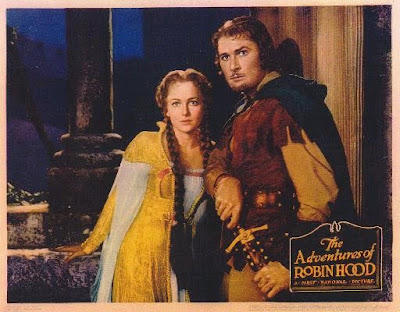
Errol Flynn and Anita Louise make a strikingly handsome couple, and the movie gives a look at what might have been if Warner Bros. had kept to their original casting of “The Adventures of Robin Hood” (1938) with Anita Louise as Maid Marian. The studio was grooming Anita Louise for big things, and saw the role as an opportunity to really make her shine with the public. But saner heads prevailed, Olivia deHavilland was cast in one of her most iconic roles, and movie history was made.

Anita Louise would have made a good, but not great Maid Marian, but Flynn and Louise don’t have quite the same chemistry he had with other leading ladies, like Olivia, Ann Sheridan, Ida Lupino or even Bette Davis. Yes, I know they hated each other, but Flynn and Davis are very good in the two films they made together.

Still, there’s a scene with Flynn and Louise sitting in a cathedral, listening to one of Dean Harcourt’s sermons, and they look like the two most beautiful people who ever lived. If I was a member of that congregation, I would find another place to worship, as I would not be worthy to be in the same building as those two.


“Green Light” won’t make the list of great Frank Borzage movies, and it often does seem like two different movies, if only in terms of setting. But that deep well of self-sacrifice and doing good works for others permeates all the story lines, so it’s not as jarring as one might think. It may not be very good, but it’s never less than watchable.

Finally, one more Flynn quote from the McNulty book, after his perplexing (for him) roles in “Green Light” and “Another Dawn”:

“I want some acting to do, if I am to be called an actor, which seems to be the general idea around Hollywood. If you ask me whether I have any preferences – and I really have – I would pick on light comedy roles. Generally speaking, they seem to be my stuff. I feel light comedy is easier for me to do and, being by nature more than a trifle lazy, I like to take the easiest or at least the most appealing route through the daily grind.”

Warner Bros. bowed to the wishes of their latest star and assigned him another screwball comedy, the agreeable “Four’s A Crowd” (1938).  But it did only middling business at the box office as did the aforementioned dramas. With the success of “The Adventures of Robin Hood” that year, the lazy nature of Flynn would be tested with lots of sword fighting and horseback riding and shooting. It must have galled him something terrible.

The Adventures of Robin Hood

Wednesday, November 9, 2011


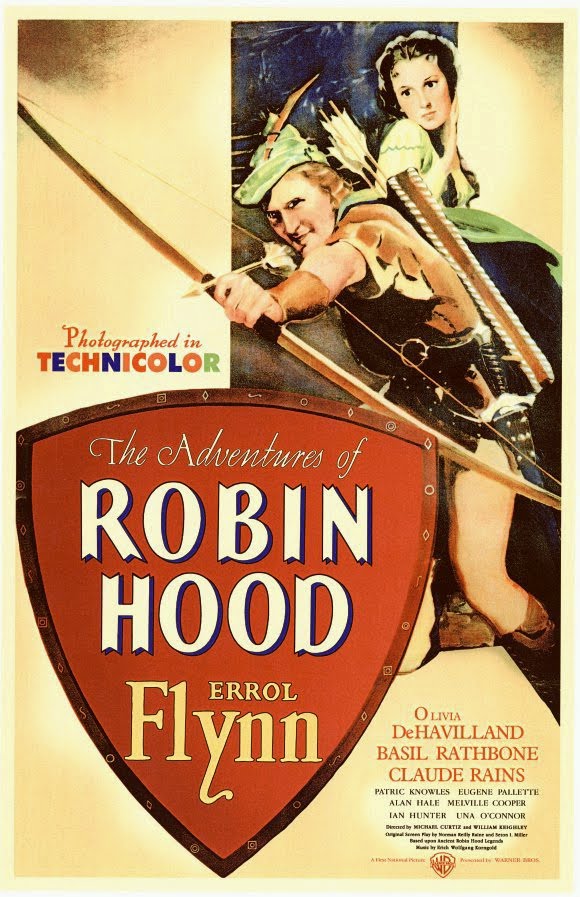
A group of us recently watched “The Adventures of Robin Hood” (1938) in Blu Ray in my friend’s home theater, and its countless viewings haven’t dimmed my enthusiasm one bit. I’ve probably seen it more times than any other film. At least 30 viewings of it and that may be a conservative number. It’s been almost a week now since I last saw it, and I can’t wait to see it again.

As long as I can remember it’s been my favorite movie and no other title has ever supplanted it. The Blu Ray transfer is absolutely gorgeous, but the film doesn’t demand optimum viewing conditions to work its magic.

My first exposure to the film was annual viewings on our black and white television on WGN-TV’s much loved Family Classics movie program, interrupted by commercials and edited to fit a two-hour time slot. Even with these restrictions, the film grabbed me and never let go.

Finally seeing it uncut, uninterrupted and in Technicolor at a revival screening at Chicago’s Biograph Theater in 1975 was a real treat. It didn’t improve the movie, but made a great movie even greater.

“The Adventures of Robin Hood” may be one of the best-loved films of all time and I’m not sure what I can add about it that hasn’t already been written. What I can do, though, is put down some oddball trivia and thoughts I’ve had about the film over the years. Believe me, this will not be a linear essay. I will assume most people reading this are familiar with the movie.

“The Adventures of Robin Hood” was one of those happy instances where the right people came together at the same time. Is it a perfect film? No, but it comes as close to perfection as any film I can think of. So, let me get a few miniscule negatives out of the way.

During the feast sequence after the Merry Men have ambushed Sir Guy’s men, Robin Hood (Errol Flynn) and Maid Marian (Olivia deHavilland) walk through the forest where a group of fugitive peasants are gathered. Why aren’t they at the feast? How come they haven’t joined the other revelers? Is it because they’re too broken and wounded? I always wondered about those folk.

During the archery tournament the archers shoot at the traditional multi-colored bulls eye targets. Were these bulls eye targets really available in medieval England? Maybe someone could fill me in, but those targets look a little too contemporary to me.

And that’s it. Those are my negatives about the film.

Oh, some smart alceks snigger about Robin’s costuming, what with green tights and a jaunty feather sticking out of a cap. Blasphemy, I say!


Robin Hood is a legend, and I want my Robin Hood to wear that green outfit and be a brave and courageous hero, robbing from the rich to give to the poor, risking all to protect the helpless and fighting tyranny with his band of Merry Men, as likeable a group of outlaws that ever existed.

Watching Errol Flynn’s Robin Hood, one understands why the Robin Hood legend has endured for centuries, something you don’t get while watching the Kevin Costner or Russell Crowe versions.

Much like 1960s advertising which proclaimed Sean Connery IS James Bond, Errol Flynn IS Robin Hood. Early casting was not so fortuitous, as in 1935, Warner Bros. toyed with the idea of casting James Cagney as Robin Hood and Guy Kibbee as Friar Tuck.

Initial reaction tells me I can’t picture Cagney in the role. Still, its always fun seeing Cagney stick it to authority figures, which Robin Hood certainly does. He’s an amusing cowpoke in “The Oklahoma Kid” (1939) so maybe he would have been a good swashbuckler after all. His dancing background meant the choreographed duels would have been something to behold. Would lack of an English accent have hindered him?

Personally, I don’t care about such things. I don’t recall any serious criticism regarding the lack of an English accent from Clark Gable’s Fletcher Christian or Gregory Peck’s Horatio Hornblower.

Burt Lancaster plays a Robin Hood-type in medieval Italy in the wonderful “The Flame and the Arrow” (1950) without the slightest, tiniest attempt at an accent. The film doesn’t suffer a bit for it. (I won’t even go into one scene where Virginia Mayo dons a shorts outfit that looks like she just played a set of tennis at the Bel Air Country Club. Yowzah! If this was medieval Italy, I’m sorry the Renaissance ever took place).


Besides Cagney, “The Adventures of Robin Hood” is laden with what ifs. It was a long process between the initial idea to do a Robin Hood film and the final product. In some cases we have glimpses of other films to give us a good idea of what could have been.

Anita Louise was originally slated to play Maid Marian. We have an idea of what she might have been like when she essayed the role in “The Bandit of Sherwood Forest” (1946).

Early versions of the script wrestled with the climax, with several drafts featuring an elaborate siege of Nottingham Castle by Robin’s men and King Richard’s returning Crusaders. This was nixed due to cost considerations. (As it was, “The Adventures of Robin Hood” was Warner Bros. most expensive film to date, costing $1.4 million).

We have an idea of what the siege might have looked like thanks to M-G-M’s “Ivanhoe” (1952). “Ivanhoe” is pretty much the same story as Flynn’s Robin Hood; indeed Robin Hood and the Merry Men take part in the castle siege. It is a marvelous sequence and one almost as satisfying as Warners’ eventual solution. (In a further odd coincidence, Olivia deHavilland’s half sister Joan Fontaine plays the Saxon princess Rowena in “Ivanhoe.”)


A major part of Robin Hood’s success is the landmark and much loved score by Erich Wolfgang Korngold. I personally know rock and roll fans who wouldn’t think of ever going to a symphonic concert or listen to classical music who have Korngold’s Robin Hood score in their CD collections.

It envelops the film in such a feeling of good fellowship, romance and adventure that it’s impossible to consider the film without it. Who was partly responsible for the score? Adolf Hitler.

Producers Hal Wallis and Henry Blanke begged and pleaded with Korngold to score the film, and with each call Korngold got more and more stubborn in his refusals. (Korngold enjoyed a very enviable contract with Warner Bros. He could refuse any assignment offered him and had first pick at the studio’s most prestigious films.)

Korngold wrote to Wallis, “Robin Hood is no picture for me. I have no relation to it, and therefore cannot produce any music for it. I am a musician of the heart, of passions and psychology. I am not a musical illustrator for a 90 percent action picture.”

Warner Bros. Music Director Leo Forbstein went to Korngold’s home to beg and promise him the moon to take the assignment. Korngold finally (partially) relented, saying he would work on it on a week by week basis, with the caveat he could quit at any time.

Korngold finally agreed to finish the film only after learning about the German invasion of Austria and learning his property had been confiscated by the Nazis. Korngold spent the next seven weeks composing the score, which would earn him his second Academy Award and become one of his best loved compositions. No doubt Korngold was inspired by the film’s message exhorting freedom and the struggle against tyranny and oppression.

This also means that if the Cagney version had been produced circa 1935 or 1936, it most likely would not have been scored by Korngold.

On a side note, I always wondered if anyone ever recorded Errol Flynn’s reactions to the musical scores in his movies. Along with Charlton Heston, Errol Flynn probably had more genuinely great film music written for him than any other actor or actress.

The only mention I can find comes from Brendan Carroll’s invaluable biography on Korngold “The Last Prodigy” (Amadeus Press, 1997). In the mid-1950s Flynn was producing a movie based on the William Tell legend, and Flynn contacted Korngold about composing the score. Korngold turned Flynn down, saying he had retired from film scoring. Still, Flynn must have thought well enough of him to approach him with the assignment.


“The Adventures of Robin Hood” earned almost unanimous critical raves, and Warner Bros. earned back its production costs many times over, not only in its initial release but as one of the most popular re-issue titles in the Warner Bros. library.

In “The Adventures of Robin Hood, Wisconsin/Warner Bros. Screenplay Series” (The University of Wisconsin Press, 1979), film historian Rudy Behlmer writes he read countless contemporary reviews of the film, and only found one dissenting opinion. In the London Observer, critic C.A. Lejeune wrote, “It must have been an almost superhuman task to make a dull film on the subject of Robin Hood, but the Warner Brothers, who have never flinched from major difficulties, have almost managed it. I don’t know when I have seen more money, more care and more important workmanship lavished on such a stupendous presentation of the obvious.”

I have one another dismissive comment and it shocked me to the core. Growing up, my favorite film historian was the late film historian William K. Everson. Anything he wrote was an automatic purchase.

In 1981, he made several visits to Chicago to the Film Center at the Art Institute to screen films from his private collection. My dad and I went on a Saturday afternoon to see Fritz Lang’s rarely screened (at the time) “House by the River” (1950). We met Mr. Everson in the lobby and enjoyed several minutes chatting with him and we got several of his books signed.

I was bold enough to ask him about one of his assertions in his book “Love in the Film” (Citadel Press, 1979) where he wrote regarding the Ronald Colman version of “The Prisoner of Zenda” (1937): “One can almost pin down The Prisoner of Zenda as being the last (and best) of the great romanticist adventure films.”

I asked him about the wonderful love story in “The Adventures of Robin Hood” and didn’t he consider it a great romanticist adventure film?

I can’t remember his exact words, but he said no, color was the main star of “The Adventures of Robin Hood” and without it, it was a fairly ordinary adventure film.

My dad and I were both stunned into silence, but we resumed our conversation and it was a most pleasant one. We didn’t agree with him of course, but it was a good lesson to learn that even our critic idols can enjoy wildly different opinions. But I still think he was wrong. I have lots of black and white memories of “The Adventures of Robin Hood” that tell me otherwise.

Gene Hackman Is The Man

Tuesday, June 7, 2011

Gene Hackman has always been one of my favorite actors, but I never knew he had such good taste until I read an interview with him in this week's (June 13, 2011) issue of Time.

Time: I read that you don't even know where your two Oscars are. Can this be true?

Hackman: It is true. I have a poster of Errol Flynn, but other than that, around the house we just kind of keep it civilian.

My estimation of Gene Hackman has always been huge, but now that estimation has increased a thousandfold. Well done, sir, well done.

Too Much, Too Soon

Wednesday, October 6, 2010


I have this pleasant fantasy of Errol Flynn not dying in 1959 at the premature age of 50, but living a decade or two on. He would be one of the prime beneficiaries of the nostalgia boom that swept the country in the 1960s and early 1970s and would be justly celebrated as the great screen presence – and actor – that he was.

Always critical of the action roles he was assigned at Warner Bros., Flynn would look at back at those films and, much like frequent co-star Olivia deHavilland, realize that “We made some pretty terrific movies there. I had no idea.”

I picture an avuncular Flynn, circa 1974 or 1975, as the latest American Film Institute Life Achievement Award winner. The film clips play to a rapt house and thunderous applause greets each clip. Former co-stars pay him homage, and the younger crowd bows in worshipful adoration. Even former boss and scourge Jack Warner pays respect to his former bad boy star, and he and Flynn have put the past behind them, enjoy the occasional social drink together and reminisce about their former battles. .

The sad thing is I know exactly what he would look like as he sits at the table enjoying the AFI honor. It’s because I recently watched “Too Much, Too Soon” (1958), one of Flynn’s last pictures, and Flynn, at 48 years of age, looks much, much older. Like a 70+-year-old man would look.

In the film, the story of actress Diana Barrymore (Dorothy Malone), Flynn plays Diana’s father, the legendary John Barrymore, and he’s first rate. When Barrymore dies about halfway through, the movie never recovers and slogs its way through another hour before mercifully wrapping up.
Errol Flynn and John Barrymore were great buddies and drinking companions, so you know Flynn took extra care to deliver a good performance. And deliver he does, but boy is it hard to watch, especially when you consider only 20 years have passed since his triumph in “The Adventures of Robin Hood” (1938). Rather than two decades passing, Flynn’s appearance looks more like four or five decades have passed.

Much heavier and jowly, with a husky voice, there are times it looks like Flynn can barely finish a scene. Still, that magnetism is still there and can’t be denied. One can understand the adoration that Diana has for her father, who probably loved his daughter in his own way, but was too caught up in the whirlwind of his own life to give her the attention and love she desired. .

Diana Barrymore had a minor career as an actress. Her film credits are few and her starring roles were in a couple of Universal pictures I’ve never seen, “Eagle Squadron” (1942) with Robert Stack and “Between Us Girls” (1942) as the daughter of Kay Francis.

Unfortunately she suffered from the same demons as her father, and was drinking regularly to keep the pain away. The problem with the movie is she’s not that interesting a character.

Barrymore published her autobiography, “Too Much, Too Soon” in 1957, and the movie followed a year later. She did not live long to enjoy the book’s success as she died of a combined overdose of alcohol and sleeping pills in 1960. She was 38 years old. (I’ve also read she died as a result of third degree burns following a kitchen fire).

The always underrated Malone is excellent in this film, ably playing Diana as a shy little girl in awe of her famous father, to aspiring actress to the hellish spiral downward. It’s a tough and gusty performance, and I think it would be more remembered today if the film were better.

I’m sure the film is highly fictitious. There’s a scene where she and the cast and crew come out of a preview of “All Through the Night” (1942), the Bogart picture, and proclaim it an utter disaster, which will require lots of re-shooting and the eventual editing out of all of Diana Barrymore’s scenes. I’ve never heard that about that film, and can’t conceive that the well-oiled Warner Bros. machinery ever allowed the so-called disaster to be previewed like that.

Diana’s taste in men didn’t work out too well either. First husband was the much older Bramwell Fletcher, who is probably best remembered today for his role in “The Mummy” (1932), and his insane screams when he first sees the walking corpse of Im-ho-tep. In “Too Much, Too Soon” this role of the older matinee idol actor has been re-named Vincent Bryant (Efrem Zimbalist, Jr.)

Second husband was a tennis player named John Howard, played in the movie by a spectacularly oily Ray Danton. I don’t know what Howard was like in real life, but here he’s portrayed as the ultimate Hollywood leech. (In reality, Howard was convicted of later participating in white slavery!)

A third husband was Robert Wilcox, played here by Edward Kemmer. According to the Wikipedia entry on Diana Barrymore, “Diana might have found Wilcox to be the love of her life, but he nearly beat her to death in one of his assaults.” Boy, that name sounded familiar. Didn’t Robert Wilcox star in a Republic serial? I looked him up and sure enough, Robert Wilcox played the hero Copperhead in the great Republic serial “Mysterious Doctor Satan.” (1940). The Copperhead a wife beater? Very disheartening and I don’t know if I will be ever to enjoy that serial like I have in the past. I always try to separate the person from the actor, but wife beating is very tough to forgive.

The film was directed by Art Napoleon, and it’s only of three films he directed. It’s not very well directed, overall. The 121-minute running time really drags, but there are individual sequences that are very well done.

Early in the film, the young Diana, so happy to be with her father on a fishing trip, talks and talks and talks the whole time, and we can see John trying so hard not to tell her to be quiet. They’re sitting on the deck at night when another boat approaches. We never see who is on the boat, just the boat’s outline through the fog. It’s like a ghost ship, a metaphor for the eternal wanderlust in John Barrymore’s heart. We hear voices from the boat. They’re social acquaintances of John, and they invite him to come to Rio with them for additional festivities. Barrymore looks wistfully at his daughter before swimming away from his boat to join the party, waving goodbye to Diana.

There’s also a painful scene were a drunken Diana performs an impromptu striptease to a bored and jaded audience.

Helping the film enormously is the score by Ernest Gold, with a highly dramatic piano-based theme showcased throughout. Flynn was remarkably lucky with his musical accompaniment throughout his career, and always received good musical support.

There was talk of a possible Supporting Actor nomination for Flynn for “The Sun Also Rises” (1957) but it didn’t come to pass. A Supporting Actor nom would have been appropriate for “Too Much, Too Soon” as well. He’s that good in it.

You can have a good film with bad things in it, and a bad film with good things in it. “Too Much, Too Soon” has two very good performances in a very mediocre film.

Taste the Blood of Angels & Demons; Other Weekend Viewing

Thursday, May 28, 2009

A much too late recap of movie viewing over the Memorial Day weekend.

Taste the Blood of Dracula

It’s Hammer Time.

Another Dracula flick, this one the gloriously titled “Taste the Blood of Dracula” (1970) again with Christopher Lee baring his fangs at some of Victorian England’s loveliest ladies, including the delectable Linda Hayden.

Hayden plays Alice, whose father (Geoffrey Keen, a familiar face from several of the Roger Moore 007 movies) is symbolic of Victorian hypocrisy. Along with two friends, these three men enjoy the highest respectable standing in their communities when not visiting a brothel to taste the darker side of life. They meet Lord Courtney (a wonderfully cast Ralph Bates), the black sheep of an aristocratic family, one whom all sorts of unearthly rumors are spoken about. He promises the three pleasures of the flesh that will extend into infinity if they will only front the money to buy some supplies for a ceremony to resurrect you know who.

The movie is as much a look at hypocrisy as it is a Dracula flick. Keen also has an unhealthy interest in his daughter, staring down the front of her dress and muttering in a drunken state, “I haven’t beaten you since you were a little girl.”

For the first 45 minutes or so out of its 90-minute running time, Dracula barely makes an appearance. The first half of the movie is really quite good, and it seems a shame that Dracula needs to show up at all.

The resurrection scene is nicely staged by director Peter Sasdy, but when the three chicken out at the last minute and kill Lord Courtney in a rage during the rite, Dracula comes back to avenge the death of his disciple.

Since he has limited screen time, and hardly any dialogue, Lee drags out his dialogue into as many syllables as he can.

After the first killing, he intones, “The f…i….r….s….ttttt.”

A little later on, we get, “The s….e….c…o…n….dddddd.”

Finally, “The t….h…i…r….ddddd.”

For such short words, Lee sure does drag them out for maximum effect. It sounds like I’m knocking it and I’m not. I revel in juicy line readings like these. I wish we had more of them in today’s movies.

But as I’ve said before, I fully understand why Lee doesn’t want to be remembered as Dracula. There’s not much for him to do in these movies, except lend his considerable physical presence, stare a lot and snarl.

He’s easily dispatched too, in what is probably the lamest in the Hammer series. Dracula has been using an abandoned church as his base of operations, but when it is re-consecrated again, it’s too much for him and he makes noises and falls on an altar. The basic idea is good, but director Sasdy’s handing is pretty bad. Who does this re-consecrating of the church but Paul (Anthony Corlan), the wispy boyfriend of Alice. Paul knows nothing about vampires save for what his father wrote down in a book.

This is Dracula, the King of the Vampires, done in by a kid who barely knows anything? The nerve. Being dispatched so easily, it’s a miracle Dracula has any reputation at all.

On the plus side, we get one of James Bernard’s best scores, with the love theme being one of his loveliest melodies. There’s a scene where Alice sneaks out of the house to attend a dance with Paul (against the wishes of her father), and climbs out a second-story window and down a tree into Paul’s arms, supported by a lovely treatment of Bernard’s gorgeous theme. The music, set design and lighting put one to mind of a fairy tale. Hammer Films excelled at being fairy tales for adults, and this sequence is one of the best examples I know of in showcasing the Hammer magic.

It’s a terrific film, and I’m very fond of it. But there’s more than a nagging suspicion that it would have been better without Dracula in it.

Angels and Demons

The less said about the humorless and overlong “Angels and Demons” the better. It’s more watchable than “The DaVinci Code” (2006) but that’s not saying much. It’s as contrived as all get out, which is now the norm for thrillers like this.

I do like the fact that its central hero Robert Langdon (Tom Hanks) is an educated man. In a culture that celebrates stupidity and crassness, it’s refreshing to see an intelligent person not be made the butt of a joke. His exchanges of historical lore with Vittoria (Ayelet Zurer) generate some sparks between them, sparks more potent than kisses and foreplay for this highly educated duo.

As a practicing Catholic, I didn’t even object to the film’s central thesis of dark and mysterious conspiracies emanating from the Vatican. After all, I think there’s a rousing movie waiting to be made detailing the sex lives of medieval popes. But I will firmly admit to finding little entertainment in not one but two scenes of priests set on fire while still alive.

Director Ron Howard’s hand is too leisurely for this type of material. Like so many thrillers today, there’s about three climaxes too many. Each time I thought it was going to end, whoosh, off to another climax.

“The DaVinci Code” was one of the murkiest-looking big budget Hollywood movies I can remember seeing, so I was glad that returning cinematographer Salvatore Totino spent money to buy some high-quality bulbs for his lighting equipment. You can actually see what is happening this time.

Alas, we are still subjected to muddy sound recording, with too many actors delivering lines in a hushed excited manner that often makes it hard to understand what they are saying (especially true in the case of Ms. Zurer).

Also returning, unfortunately, is composer Hans Zimmer. I hated the way his scoring of the ending helicopter sequence at the end took away whatever tension the scene had. The scene goes on forever and Zimmer’s faux-inspirational scoring makes the scene appear twice as long as it already is. Rarely in the history of movies has a composer communicated so little using so many notes.

On the plus side, like the book, the movie did make me want to make a trip one day to see Italy and the Vatican. And Ewan McGregor’s Irish accent was good for a few laughs.

Operation Crossbow

Another thriller, but one with real thrills. This is more like it. Based on a true story, “Operation Crossbow” (1965) details Great Britain’s attempts to stop Germany’s rocket experiments during World War II. Germany actually launched V-1 rockets from Germany into London, causing considerable damage. Though Germany was losing the war, the successful rocket program could have gone badly for the Allies. Using engineers smuggled into the missile facility at Peenemunde, British intelligence learned of the imminent launch of a more powerful rocket, the V-2, that could have decimated London. The saboteurs are able to call in an air strike to destroy the underground rocket base.

The fiery conclusion puts one to mind of a World War II version of a James Bond movie. The underground rocket base is manned by many extras, and has the clean, shiny look of a SPECTRE facility. There’s some pretty impressive explosions on display here.

Before that, we get a taut story starring George Peppard as a German-speaking American Army engineer who joins a squad of soldiers with engineering experience in infiltrating the Peenemunde facility using the identities of dead German engineers. All is well and good until Sophia Loren shows up as the wife of Peppard’s character. Peppard pretends to be her husband’s friend and is only traveling with him, but how long can that ruse continue? Loren is top billed but is only featured in the central portion of the film. Top billing came about no doubt to the film’s producer, her husband Carlo Ponti.

Listening to the actors here was pure joy after suffering through the breathy whispers of “Angels and Demons.” Just a quick look at the supporting cast of old pros and one knows one will be reveling in crisp line readings: Trevor Howard, John Mills, Richard Johnson, Tom Courteney, Jeremy Kemp, Anthony Quayle (as a Nazi!), Lilli Palmer, Paul Henreid, Helmut Dantine, Richard Todd, John Fraser, Maurice Denham and Patrick Wymark. Every young actor in Hollywood today should watch this movie for lessons in dictation. Please, do it right now. Please?

That’s Entertainment III

“That’s Entertainment III” (1994) was the third look back at M-G-M musicals and if it doesn’t attain the glories of the first film, it’s certainly better than the second one. The third film touches on some of the less noteworthy aspects of the studio and American Society, especially in the Lena Horne-narrated segment. She notes how many of her appearances in M-G-M musicals were specialty numbers, so could be easily snipped by theater owners in the South. A number from “Cabin in the Sky” (1943) was excised from the final print as it was considered too shocking to show Horne, a black woman, enjoying a bubble bath!

The film showcases other cut numbers, mainly due to length. A splendid movie.

Equally enjoyable was the fourth disc in the DVD box set, containing all sorts of terrific extras. One shows the famous lunch in 1949 celebrating the studio’s 25th anniversary, which gathered as many M-G-M stars as possible for the event. Footage from the lunch appears in the first “That’s Entertainment” film, but here we get extra footage. Some stars look up and smile as the camera passes by, while others could barely be bothered. There’s priceless footage of host George Murphy introducing the stars as they come into the room. Right before Kathryn Grayson is introduced, in comes Errol Flynn, on loan to M-G-M from Warner Bros. to make “That Forsythe Woman” (1949), who cuts through the line, and nods to Murphy, who seems flustered that the carefully planned event has been temporarily derailed. Did bad boy Flynn sabotage the introductions on purpose, or was it an accident? I don’t know, but I was delighted to see it.

Even better is an ABC special promoting the opening of the first “That’s Entertainment” back in 1974. This was a big, old school event celebrating the Golden Age of Hollywood. Dozens of stars attended the premiere and lined up for a picture. I’ve seen the picture reproduced before, but never the gathering for the picture. Amazing stuff. Astaire, Kelly, Ginger Rogers, Glenn Ford, Elizabeth Taylor, etc. Roddy McDowall comes out with Lassie. Jimmy Durante shows up in a wheelchair and gets a huge ovation. Ava Gardner and Charlton Heston stand next to each other. Did they come right from the set of “Earthquake?” There was no love lost between the two, but they seem to be making the best of it. My favorite moment comes when Marjorie Main is introduced. She was no spring chicken when she starred as Ma Kettle, and gets one of the biggest ovations of the night. Great, great, historic footage. I was sorry to see it over.

Virginia City

Monday, January 5, 2009


There’s a lot to like in “Virginia City” (1940), but it never quite comes together. There are some fatal casting problems, and the script is all over the place, but it’s all quite watchable and has the Warner Bros. professionalism stamped all over it. Still, despite being directed by the great Michael Curtiz, this is one of the lesser Errol Flynn entries of his starring years.

I would think some 1940 moviegoers must have felt terribly cheated after watching “Virginia City” if they were expecting a sequel to one of 1939’s biggest hits “Dodge City.”

Flynn had one of his biggest successes with “Dodge City”, a Technicolor town-taming western that holds up quite well today. At the end of that film he is asked to clean up another rough and tumble western town, Virginia City in Nevada. He agrees to the assignment, and the last scene shows him and frequent leading lady Olivia deHavilland off to Virginia City, accompanied by a triumphant Max Steiner music cue.

“Virginia City” appeared a year later, not as a sequel, but as a Civil War western, and based on an actual historic incident. It also boasts the same director (Curtiz), screen writer (Robert Bruckner) and composer (Steiner), but, alas, no Technicolor.

Having escaped from Libby Prison with pals Alan Hale and Guinn “Big Boy’ Williams (also holdovers from “Dodge City” and the three would play together in “Santa Fe Trail” a year later), Flynn realizes the dying Confederacy needs one last daring plan to keep it going. The mining town of Virginia City is home to many Confederate sympathizers and its possible some of the gold and silver mined there will be used to refinance the Confederacy. It turns out he’s right, and it’s no less than Randolph Scott as the Libby warden who agrees to guide the treasure-laden ($5 million worth) wagon train from Nevada to the South. Randolph Scott is a welcome presence in any movie and he plays the Southern gentleman here to a T. Supposedly he was Margaret Mitchell’s choice to play Ashley Wilkes. I wish he had.

It’s a lot of fun to see Flynn and Scott recognize each other in a Nevada saloon, with both thinking the other was back East.

Of course there’s a woman both men love, a Confederate sympathizer played by Miriam Hopkins. I adore Hopkins in “Trouble in Paradise” (1932) and “Dr. Jekyll and Mr. Hyde” (1932) but she’s too brittle and harsh for the role and is arguably one of Flynn’s least effective leading ladies. They go together like pickles and milk. It’s not an enjoyable screen coupling, and her rendition of “Rally Round the Flag Boys” is also pretty rough on the ears. I prefer her singing “Jazz Up Your Lingerie” in Lubitsch’s “The Smiling Lieutenant” (1931), one of the greatest songs ever written.

The second miscasting mistake is the Mexican bandit John Murrell, played by, of all people, Humphrey Bogart. Yikes! His Mexican accent is strictly of the Frito Bandito type, and why they had to make him Mexican I’ll never know. They should have just made him a regular black-clad outlaw, like his role in the marvelously entertaining “The Oklahoma Kid” (1939). Many people feel Bogart’s worst screen performance is in “The Return of Dr. X”, his only horror film, but I have to give the nod to “Virginia City.”


Despite the miscasting, and the often unwieldy script, there’s much to enjoy. Curtiz’s compositions during the action scenes remain a marvel, and Steiner provides some of the best traveling stagecoach music ever. Flynn and Scott provide some stirring self-sacrifice at the end and we even get a climatic plea to Abraham Lincoln that is corny but somehow fits.

The film runs 121 minutes, and, unusually for a Curtiz film, one feels the whole two hours. A little trimming would have helped.

But it’s not a bad film by any means, and I will no doubt re-visit it again in the years ahead. Errol Flynn and Randolph Scott in a big budget western is not something to be ignored.

Rating for “Virginia City”: Two-and-a-half stars.

San Antonio

Wednesday, November 12, 2008


Another Alamo movie, though this time the famous church only plays a cameo role. “San Antonio” (1945) is a big-budget “A” western from Warner Bros. that seems to me to be the studio’s answer to the kinds of “B” westerns Roy Rogers was churning out at Republic Studios. Contemporary viewers may scoff at these Rogers westerns, but he was one of the biggest box office attractions of the era.

Like a Roy Rogers western, most of the action takes place at the end while the beginning is loaded with musical numbers and comedy. It’s an enjoyable two hours, but if it was any lighter it would float right out of the DVD player. Just look at the poster and you can see we’re not talking serious western fare here.

Star Errol Flynn was likely bemused to find himself a western hero. At the time of filming “San Antonio” he referred to himself as “the rich man’s Roy Rogers” which leads me to believe he also saw the parallels. (Not that I could picture Flynn watching Roy Rogers movies in his spare time).

Filmed in gorgeous Technicolor, the plot of “San Antonio” is strictly routine fare, having to do with Flynn as gunfighter Clay Hardin out to settle a score with crooked Roy Stuart (Paul Kelly). That’s about it.

Before the gunplay though, we get comedy courtesy of S.Z. “Cuddles” Sakall, manager of singing star Jeanne Starr (Alexis Smith). Jeanne was led to believe San Antonio was more cultured than it was, and she’s somewhat horrified she’s been hired by Stuart to sing in his saloon. This she does with the Oscar-nominated song “Some Sunday Morning”, a most catchy tune. Flynn and Smith also enjoy a dance together and there’s comedy provided by Sakall and Smith’s servant, the always enjoyable Florence Bates. We also get one more song from Smith before it’s over.

Oh, there is a gunfight towards the beginning with Flynn beating Tom Tyler to the draw. Tyler had one of the most interesting faces in Hollywood, like a hawk ready to pounce on his prey. Ironically, he’s best known today for putting that visage under tons of make-up in “The Mummy’s Hand.” (1940).

There is plenty of action at the end, including a mass gunfight that starts in the saloon and ends in the streets outside, complete with bodies falling off the balcony and into the street. Dramatically it makes no sense, as a potshot is taken at Flynn, who returns fire. Pretty soon everyone in the saloon is shooting at each other for no reason. But it sure is loud. In fact, I would reckon that every piece of blank ammunition on the Warner Bros. lot was used for that sequence.

The gunfight concludes with Flynn chasing Kelly into the Alamo, a marvelously atmospheric sequence filled with shadows and menace. It’s a terrific sequence.

I greatly enjoyed Flynn’s performance in this. He’s very relaxed and loose, and from what I’ve read it probably captures his real-life personality. At one point, he’s visited by his friend John Litel, who surprises a young senorita taking a bath in a barrel in his courtyard. She jumps out screaming and runs away with a towel wrapped around her.

Flynn looks at Litel and says very gentlemanly, “We wouldn’t look.” Then he does a double take and says, “Would we?” He then turns to watch the girl run away and continues watching her even as he’s talking to Litel. One can well imagine Flynn doing the same thing in real life.

“San Antonio” was written by a couple of heavy hitters, W.R. Burnett, author of “Little Caesar”, “The Asphalt Jungle”, “High Sierra” and other celebrated crime novels, and Alan LeMay, author of “The Searchers.” It’s a pretty routine effort, though their fingerprints can be found in the scenes between the villains Paul Kelly and his partner Victor Francen. These two don’t trust each other, and you can tell they would turn on each other in an instant if it became worthwhile to them. There’s some interesting dynamics there.

I think the stress on music and comedy was the reason the film was assigned to director David Butler, rather than, say, a Raoul Walsh. Butler seems a most affable chap as seen in his cameos in “Thank Your Lucky Stars” (1943) and “It’s a Great Feeling” (1949), and he specialized in musicals and comedies at Warner Bros. No doubt that background gave him the assignment.

Max Steiner contributes another good score, and offers over the main titles a reprise of his title music from “Dodge City” (1939), the first Flynn western, though orchestrated differently.

“San Antonio” is no great shakes, but it’s pleasant entertainment, with nice color, songs, good action and a most unusual use for the Alamo.

Rating for “San Antonio”: Three stars.

Montana

Monday, October 13, 2008


It’s the cattlemen versus the sheep herders in “Montana” (1950), a B western gussied up with A-level talent. Errol Flynn stars as Australian Morgan Lane, who brings sheep to the grazing grounds of Montana, much to the consternation of the cattlemen there. The cattlemen are afraid the sheep will ruin the grazing grounds for their cattle, while Lane insists there’s plenty of land to go around for everyone. Perhaps if the sheepherders had opened up a gyros stand, a lot of violence could have been avoided? Surely the cattlemen get tired of eating steak all the time.

Actually, there’s not a lot of action in “Montana” but it’s a relatively painless way of spending 76 minutes. That’s a short running time for an Errol Flynn movie, but at this point in his career his box office was waning. The previous year Warner Bros. spent a small fortune on “Adventures of Don Juan” a wry, and very expensive, swashbuckler that was a big hit overseas, but less so here. So the budgets, and running times, were Flynn’s films were cut drastically.

The bad guys in “Montana”, led by Douglas Kennedy, are as bland and colorless a lot you will ever find in a Flynn film. We’re a far cry from Basil Rathbone and Bruce Cabot here. Heck, even Bogart’s turn as a Mexican bandit in “Virginia City” (1940) is at least amusing to watch. The direction by Ray Enright is pretty pedestrian.

But it’s not a total loss. The Technicolor photography is pretty, and Alexis Smith makes for a most fetching co-star (she sides with cattle barons, naturally) and Flynn and Smith have a nice rapport between them. They even get to sing a song called “Reckon I’m in Love” together which is very pleasant. Flynn had a nice singing voice and between this and his turn in “Thank Your Lucky Stars” (1943) makes one wish Warner Bros. had used this talent a little more. Oh, Sinatra would not have worried about the competition, but Flynn seems to be enjoying himself during these little musical interludes.

Rating for “Montana”: Two stars.

A Missed Opportunity for Warner Home Video

Wednesday, April 23, 2008

I was very pleased to read that Warner Home Video (WHV) will be releasing in July a box set called “Home Front Collection” featuring “Thank Your Lucky Stars” (1943), “Hollywood Canteen (1944) and “This is The Army” (1943). Pleased, but also thinking that a better collection could have been offered featuring the first two titles. Let me explain.

“Thank Your Lucky Stars” and “Hollywood Canteen” are Warner Bros. contributions to the all-star musical genre. These movies were a studio’s showcase of their biggest stars and contract players in musical numbers or comedy skits. There might be up two dozen (or more) stars in each movie.

Paramount did it with “Star Spangled Rhythm” (1942), M-G-M offered “Thousands Cheer” (1943), United Artists contributed “Stage Door Canteen” (1943) and Universal gave us “Follow the Boys” (1944).

They’re all hugely enjoyable, if incredibly corny. They show that Hollywood’s biggest stars are really just regular folks, ready to drop everything and help our armed forces by staging an elaborate show or benefit.

The Warner Bros; contributions are among the most enjoyable, especially “Thank Your Lucky Stars”, which is loaded with great songs and comedy, and showcases stars like Errol Flynn and Bette Davis as surprisingly capable song and dance performers. It’s one of my favorite movies. In fact, when WGN ran it one night against the 1975 Oscars, I passed on the annual ceremony and opted for “Thank Your Lucky Stars” instead. (I never did see Jack Nicholson or Louise Fletcher pick up their Oscars for “One Flew Over the Cuckoo’s Nest.”)

So I’m glad to see these titles coming out, but wish WHV had included them instead in an all-star musical box set. Besides the aforementioned “Hollywood Canteen” and “Thank Your Lucky Stars”, the set could include “Thousands Cheer” and two Warner Bros. entries that came after World War II, “It’s a Great Feeling” (1949) and “Starlift” (1951).

I thought such a box set was what WHV may have been planning, since they have already released most of Doris Day’s musicals, but “It’s a Great Feeling” was not among their earlier two box sets of Day titles. That’s another marvelously entertaining film, with gorgeous Technicolor and most of action taking place on the Warner Bros. back lot. We get to see such directors as Michael Curtiz, Raoul Walsh and King Vidor in amusing cameos, and fun glimpses of the studio back lot. What a marvelous time capsule of sights. Edward G. Robinson has a funny scene, and there’s a riotous Errol Flynn cameo. For film music fans, it’s a treat to see a sequence filmed on the Warner Bros. soundstage, where all those glorious musical scores of Korngold, Steiner and Waxman were recorded. We even get glimpses of the orchestra members. Look, there’s cellist Eleanor Slatkin, who performed the Korngold Cello Concerto in “Deception” (1946).

“Starlift” has not been seen anywhere, to the best of my knowledge, in decades. It’s one of the very few James Cagney screen appearances I’ve never seen. I don’t know if there are rights issues involved with this title, but a lot of film buffs would love to see “Starlift” and would spring for the box set just to get that title.

Kudos to WHV for at least releasing two of these all-star musical gems. It will also be nice to a see a restored “This is the Army”, which has been languishing in public domain hell for too long.

Still, I hope they will eventually get around to releasing “Thousands Cheer”, “It’s a Great Feeling” and “Starlift”, but what a lost opportunity to include a marvelous collection of all-star musicals in one box set.

1408, Mr. Brooks, The Snake Pit, Dive Bomber

Thursday, June 28, 2007

Due to a busy work schedule of late, I have not been able to blog as much as I would like, so here is a quick run down of a few films I’ve watched the last week or so.

“1408” is a pretty good adaptation of a Stephen King short story about a haunted hotel room in downtown Manhattan. Or as Samuel L. Jackson, manager of the hotel says, an evil hotel room. There are some pretty good scares in it, and it held my attention, but in the end I felt curiously unsatisfied. It could be I prefer my haunted scenes less expansive, such as when the room turns into a large ice cavern or water rushes from a seascape painting. I can only suspend my belief so much.

It’s pretty much a one-man show for John Cusack, who stars as a debunker of haunted places. It’s good to see a horror film relying on suspense and mood, much more difficult to pull off than gross-out torture scenes. There are no great revelations about why the room is the way it is. That didn’t bother me; I just assumed the room was “born evil.”

Jackson is absolutely mesmerizing in his big scene where he explains to Cusack why he should not stay in the room. If Cusack were smart, he would have fled the hotel, taken a cab to the airport and hightailed it back to California. But there wouldn’t be much of a movie if he did that, would there?

More entertaining was “Mr. Brooks” with Kevin Costner as the title character, a serial killer, egged on by his bad side, played with relish by William Hurt. “Mr. Brooks” is too long, gets downright wacko towards the end, and has some subplots involving cop Demi Moore that could have easily been done away with. If anything, there’s too much in here for its own good. But the performances are all fine, Costner is especially good as the model family man (on the outside) who can’t control his lust for killing. If the script needs tightening, it’s never boring, which is the cardinal sin of bad movies.

From the new to the old: In a classic film class I’m taking at the College of DuPage, we watched “The Snake Pit” (1948) as part of a class on social issues films. “The Snake Pit” stars Olivia DeHavilland as a mental patient in an insane asylum. While some of the psychology and treatment may seem dated today, it’s still pretty strong stuff. There’s a shock therapy sequence that’s hard to watch. DeHavilland is absolutely marvelous. When one thinks of the great actresses in Hollywood’s Golden Age, one tends to think of Bette Davis, Ingrid Bergman or Katherine Hepburn, but DeHavilland is right up there. She won the Academy Award for Best Actress in 1946 for “To Each His Own” and again in 1949 for “The Heiress”, so “The Snake Pit” falls in the middle of that period. Ingrid Bergman was originally slated for the role, but I don’t she could have pulled off the vulnerability that DeHavilland does here.

From the Errol Flynn Volume Two DVD box set , I watched “Dive Bomber” (1941). It’s an odd film. It’s long (133 minutes) and there’s no action in it. Despite what the title promises, “Dive Bomber” features no combat but concerns itself with aviation medicine. It’s almost a documentary on the treatment of such pilot ailments as blackouts. No big action scenes per se, but it held my interest throughout. There’s no love story to speak of. Alexis Smith shows up for a few scenes but at one point Flynn would rather sketch a design for a new piece of medical equipment on a nightclub tablecloth than romance Ms. Smith. The Technicolor photography is gorgeous, the flying scenes with the planes in formation are thrilling to watch, and historically it’s interesting to see Warner Bros. doing its part to prepare the nation for the war everyone knew was inevitable. The U.S. Navy allowed full cooperation, including allowing a film crew to film aboard the aircraft carrier U.S.S. Enterprise, one of the most famous ships of WWII. All this and a Max Steiner score, with a title tune so infectious it may cause you to enlist.

Gentleman Errol

Monday, June 4, 2007

Due to a heavy weekend schedule of high school graduation parties and cook outs, I did not see any new releases this weekend. I would have liked to have checked out “Mr. Brooks”, Kevin Costner’s serial killer movie, but that may have to wait a few weeks.

I did manage to squeeze in a DVD viewing of “Gentleman Jim” (1942), a splendid biopic of 1890s boxer James J. Corbett played by Errol Flynn. This was reportedly Flynn’s personal favorite of all his films, and it’s easy to see why. It’s one of his best performances and, I would even go as far to say he should have been nominated for a Best Actor Oscar.

The boxing scenes are first rate and Flynn worked very hard to recreate the dancing style and the ferocious left jabs of Corbett, and he appears to be having the time of his life both in and out of the ring.

He’s very childlike in his enthusiasms, like an overgrown kid enjoying his life to the fullest. He even gets to do a short Irish jig with his family, a charming scene I had forgotten about. Some may find his Irish family too broad and stereotypical, but when the father is played by Alan Hale (a good friend of Flynn’s offscreen) all is forgiven.

His leading lady is Alexis Smith, and they always seemed to have a good rapport, even when the films aren’t particularly interesting, such as “Dive Bomber” (1941) or “Montana” (1950).

The 1890s setting is brought to life in a typically splendid Warner Bros. fashion. Director Raoul Walsh is in his element with this material, and watching it I always feel, as I do with so many other Walsh films, that he genuinely likes his characters, from the main players to supporting players and even the extras. Crowd scenes in Walsh movies always seem to be extra boisterous and energetic.

Another highlight is the performance of Ward Bond as the champion fighter John L. Sullivan. It’s one of his best loved performances, portraying Sullivan as a loud, tough bragging, thick brogued Irish fighter. However, in his final scene when he comes to Corbett’s victory party to congratulate him on his win, that persona is turned completely on its head as he graciously concedes to Corbett. It’s a beautifully written and played scene, and ends the movie on a memorable note.

Check out “Gentleman Jim” if you want to see Errol Flynn, one of Hollywood’s most magnetic stars, in one of his best performances.
 

Blogger news

Blogroll

Most Reading