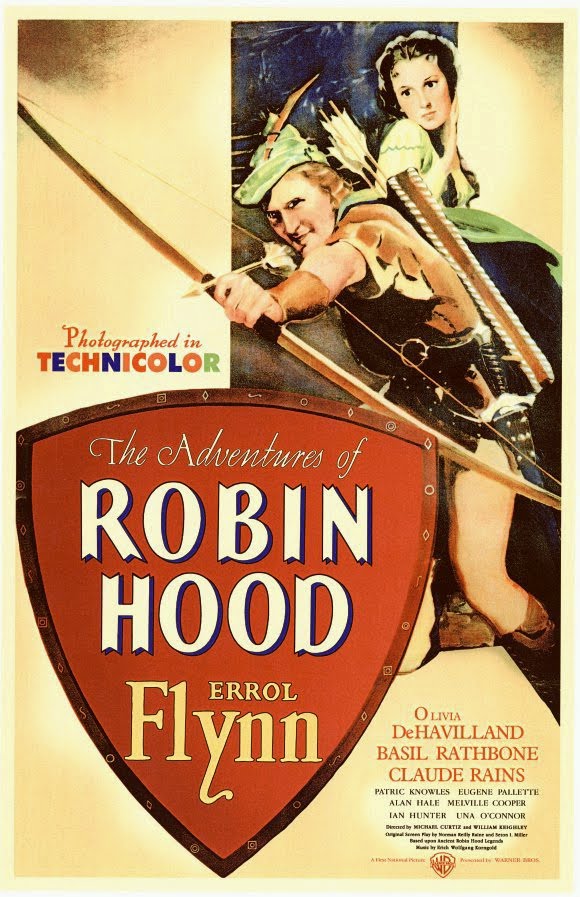
 A group of us recently watched “The Adventures of Robin Hood” (1938) in Blu Ray in my friend’s home theater, and its countless viewings haven’t dimmed my enthusiasm one bit. I’ve probably seen it more times than any other film. At least 30 viewings of it and that may be a conservative number. It’s been almost a week now since I last saw it, and I can’t wait to see it again.
As long as I can remember it’s been my favorite movie and no other title has ever supplanted it. The Blu Ray transfer is absolutely gorgeous, but the film doesn’t demand optimum viewing conditions to work its magic.
My first exposure to the film was annual viewings on our black and white television on WGN-TV’s much loved Family Classics movie program, interrupted by commercials and edited to fit a two-hour time slot. Even with these restrictions, the film grabbed me and never let go.
Finally seeing it uncut, uninterrupted and in Technicolor at a revival screening at Chicago’s Biograph Theater in 1975 was a real treat. It didn’t improve the movie, but made a great movie even greater.
“The Adventures of Robin Hood” may be one of the best-loved films of all time and I’m not sure what I can add about it that hasn’t already been written. What I can do, though, is put down some oddball trivia and thoughts I’ve had about the film over the years. Believe me, this will not be a linear essay. I will assume most people reading this are familiar with the movie.
“The Adventures of Robin Hood” was one of those happy instances where the right people came together at the same time. Is it a perfect film? No, but it comes as close to perfection as any film I can think of. So, let me get a few miniscule negatives out of the way.
During the feast sequence after the Merry Men have ambushed Sir Guy’s men, Robin Hood (Errol Flynn) and Maid Marian (Olivia deHavilland) walk through the forest where a group of fugitive peasants are gathered. Why aren’t they at the feast? How come they haven’t joined the other revelers? Is it because they’re too broken and wounded? I always wondered about those folk.
During the archery tournament the archers shoot at the traditional multi-colored bulls eye targets. Were these bulls eye targets really available in medieval England? Maybe someone could fill me in, but those targets look a little too contemporary to me.
And that’s it. Those are my negatives about the film.
Oh, some smart alceks snigger about Robin’s costuming, what with green tights and a jaunty feather sticking out of a cap. Blasphemy, I say!

Robin Hood is a legend, and I want my Robin Hood to wear that green outfit and be a brave and courageous hero, robbing from the rich to give to the poor, risking all to protect the helpless and fighting tyranny with his band of Merry Men, as likeable a group of outlaws that ever existed.
Watching Errol Flynn’s Robin Hood, one understands why the Robin Hood legend has endured for centuries, something you don’t get while watching the Kevin Costner or Russell Crowe versions.
Much like 1960s advertising which proclaimed Sean Connery IS James Bond, Errol Flynn IS Robin Hood. Early casting was not so fortuitous, as in 1935, Warner Bros. toyed with the idea of casting James Cagney as Robin Hood and Guy Kibbee as Friar Tuck.
Initial reaction tells me I can’t picture Cagney in the role. Still, its always fun seeing Cagney stick it to authority figures, which Robin Hood certainly does. He’s an amusing cowpoke in “The Oklahoma Kid” (1939) so maybe he would have been a good swashbuckler after all. His dancing background meant the choreographed duels would have been something to behold. Would lack of an English accent have hindered him?
Personally, I don’t care about such things. I don’t recall any serious criticism regarding the lack of an English accent from Clark Gable’s Fletcher Christian or Gregory Peck’s Horatio Hornblower.
Burt Lancaster plays a Robin Hood-type in medieval Italy in the wonderful “The Flame and the Arrow” (1950) without the slightest, tiniest attempt at an accent. The film doesn’t suffer a bit for it. (I won’t even go into one scene where Virginia Mayo dons a shorts outfit that looks like she just played a set of tennis at the Bel Air Country Club. Yowzah! If this was medieval Italy, I’m sorry the Renaissance ever took place).
Watching Errol Flynn’s Robin Hood, one understands why the Robin Hood legend has endured for centuries, something you don’t get while watching the Kevin Costner or Russell Crowe versions.
Much like 1960s advertising which proclaimed Sean Connery IS James Bond, Errol Flynn IS Robin Hood. Early casting was not so fortuitous, as in 1935, Warner Bros. toyed with the idea of casting James Cagney as Robin Hood and Guy Kibbee as Friar Tuck.
Initial reaction tells me I can’t picture Cagney in the role. Still, its always fun seeing Cagney stick it to authority figures, which Robin Hood certainly does. He’s an amusing cowpoke in “The Oklahoma Kid” (1939) so maybe he would have been a good swashbuckler after all. His dancing background meant the choreographed duels would have been something to behold. Would lack of an English accent have hindered him?
Personally, I don’t care about such things. I don’t recall any serious criticism regarding the lack of an English accent from Clark Gable’s Fletcher Christian or Gregory Peck’s Horatio Hornblower.
Burt Lancaster plays a Robin Hood-type in medieval Italy in the wonderful “The Flame and the Arrow” (1950) without the slightest, tiniest attempt at an accent. The film doesn’t suffer a bit for it. (I won’t even go into one scene where Virginia Mayo dons a shorts outfit that looks like she just played a set of tennis at the Bel Air Country Club. Yowzah! If this was medieval Italy, I’m sorry the Renaissance ever took place).

Besides Cagney, “The Adventures of Robin Hood” is laden with what ifs. It was a long process between the initial idea to do a Robin Hood film and the final product. In some cases we have glimpses of other films to give us a good idea of what could have been.
Anita Louise was originally slated to play Maid Marian. We have an idea of what she might have been like when she essayed the role in “The Bandit of Sherwood Forest” (1946).
Early versions of the script wrestled with the climax, with several drafts featuring an elaborate siege of Nottingham Castle by Robin’s men and King Richard’s returning Crusaders. This was nixed due to cost considerations. (As it was, “The Adventures of Robin Hood” was Warner Bros. most expensive film to date, costing $1.4 million).
We have an idea of what the siege might have looked like thanks to M-G-M’s “Ivanhoe” (1952). “Ivanhoe” is pretty much the same story as Flynn’s Robin Hood; indeed Robin Hood and the Merry Men take part in the castle siege. It is a marvelous sequence and one almost as satisfying as Warners’ eventual solution. (In a further odd coincidence, Olivia deHavilland’s half sister Joan Fontaine plays the Saxon princess Rowena in “Ivanhoe.”)

Anita Louise was originally slated to play Maid Marian. We have an idea of what she might have been like when she essayed the role in “The Bandit of Sherwood Forest” (1946).
Early versions of the script wrestled with the climax, with several drafts featuring an elaborate siege of Nottingham Castle by Robin’s men and King Richard’s returning Crusaders. This was nixed due to cost considerations. (As it was, “The Adventures of Robin Hood” was Warner Bros. most expensive film to date, costing $1.4 million).
We have an idea of what the siege might have looked like thanks to M-G-M’s “Ivanhoe” (1952). “Ivanhoe” is pretty much the same story as Flynn’s Robin Hood; indeed Robin Hood and the Merry Men take part in the castle siege. It is a marvelous sequence and one almost as satisfying as Warners’ eventual solution. (In a further odd coincidence, Olivia deHavilland’s half sister Joan Fontaine plays the Saxon princess Rowena in “Ivanhoe.”)
A major part of Robin Hood’s success is the landmark and much loved score by Erich Wolfgang Korngold. I personally know rock and roll fans who wouldn’t think of ever going to a symphonic concert or listen to classical music who have Korngold’s Robin Hood score in their CD collections.
It envelops the film in such a feeling of good fellowship, romance and adventure that it’s impossible to consider the film without it. Who was partly responsible for the score? Adolf Hitler.
Producers Hal Wallis and Henry Blanke begged and pleaded with Korngold to score the film, and with each call Korngold got more and more stubborn in his refusals. (Korngold enjoyed a very enviable contract with Warner Bros. He could refuse any assignment offered him and had first pick at the studio’s most prestigious films.)
Korngold wrote to Wallis, “Robin Hood is no picture for me. I have no relation to it, and therefore cannot produce any music for it. I am a musician of the heart, of passions and psychology. I am not a musical illustrator for a 90 percent action picture.”
Warner Bros. Music Director Leo Forbstein went to Korngold’s home to beg and promise him the moon to take the assignment. Korngold finally (partially) relented, saying he would work on it on a week by week basis, with the caveat he could quit at any time.
Korngold finally agreed to finish the film only after learning about the German invasion of Austria and learning his property had been confiscated by the Nazis. Korngold spent the next seven weeks composing the score, which would earn him his second Academy Award and become one of his best loved compositions. No doubt Korngold was inspired by the film’s message exhorting freedom and the struggle against tyranny and oppression.
This also means that if the Cagney version had been produced circa 1935 or 1936, it most likely would not have been scored by Korngold.
On a side note, I always wondered if anyone ever recorded Errol Flynn’s reactions to the musical scores in his movies. Along with Charlton Heston, Errol Flynn probably had more genuinely great film music written for him than any other actor or actress.
The only mention I can find comes from Brendan Carroll’s invaluable biography on Korngold “The Last Prodigy” (Amadeus Press, 1997). In the mid-1950s Flynn was producing a movie based on the William Tell legend, and Flynn contacted Korngold about composing the score. Korngold turned Flynn down, saying he had retired from film scoring. Still, Flynn must have thought well enough of him to approach him with the assignment.
It envelops the film in such a feeling of good fellowship, romance and adventure that it’s impossible to consider the film without it. Who was partly responsible for the score? Adolf Hitler.
Producers Hal Wallis and Henry Blanke begged and pleaded with Korngold to score the film, and with each call Korngold got more and more stubborn in his refusals. (Korngold enjoyed a very enviable contract with Warner Bros. He could refuse any assignment offered him and had first pick at the studio’s most prestigious films.)
Korngold wrote to Wallis, “Robin Hood is no picture for me. I have no relation to it, and therefore cannot produce any music for it. I am a musician of the heart, of passions and psychology. I am not a musical illustrator for a 90 percent action picture.”
Warner Bros. Music Director Leo Forbstein went to Korngold’s home to beg and promise him the moon to take the assignment. Korngold finally (partially) relented, saying he would work on it on a week by week basis, with the caveat he could quit at any time.
Korngold finally agreed to finish the film only after learning about the German invasion of Austria and learning his property had been confiscated by the Nazis. Korngold spent the next seven weeks composing the score, which would earn him his second Academy Award and become one of his best loved compositions. No doubt Korngold was inspired by the film’s message exhorting freedom and the struggle against tyranny and oppression.
This also means that if the Cagney version had been produced circa 1935 or 1936, it most likely would not have been scored by Korngold.
On a side note, I always wondered if anyone ever recorded Errol Flynn’s reactions to the musical scores in his movies. Along with Charlton Heston, Errol Flynn probably had more genuinely great film music written for him than any other actor or actress.
The only mention I can find comes from Brendan Carroll’s invaluable biography on Korngold “The Last Prodigy” (Amadeus Press, 1997). In the mid-1950s Flynn was producing a movie based on the William Tell legend, and Flynn contacted Korngold about composing the score. Korngold turned Flynn down, saying he had retired from film scoring. Still, Flynn must have thought well enough of him to approach him with the assignment.
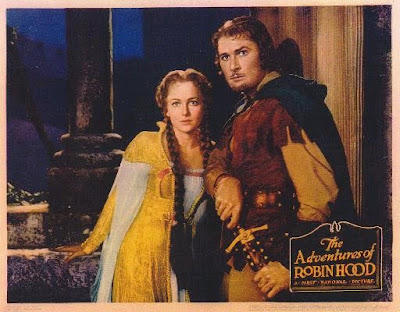
“The Adventures of Robin Hood” earned almost unanimous critical raves, and Warner Bros. earned back its production costs many times over, not only in its initial release but as one of the most popular re-issue titles in the Warner Bros. library.
In “The Adventures of Robin Hood, Wisconsin/Warner Bros. Screenplay Series” (The University of Wisconsin Press, 1979), film historian Rudy Behlmer writes he read countless contemporary reviews of the film, and only found one dissenting opinion. In the London Observer, critic C.A. Lejeune wrote, “It must have been an almost superhuman task to make a dull film on the subject of Robin Hood, but the Warner Brothers, who have never flinched from major difficulties, have almost managed it. I don’t know when I have seen more money, more care and more important workmanship lavished on such a stupendous presentation of the obvious.”
I have one another dismissive comment and it shocked me to the core. Growing up, my favorite film historian was the late film historian William K. Everson. Anything he wrote was an automatic purchase.
In 1981, he made several visits to Chicago to the Film Center at the Art Institute to screen films from his private collection. My dad and I went on a Saturday afternoon to see Fritz Lang’s rarely screened (at the time) “House by the River” (1950). We met Mr. Everson in the lobby and enjoyed several minutes chatting with him and we got several of his books signed.
I was bold enough to ask him about one of his assertions in his book “Love in the Film” (Citadel Press, 1979) where he wrote regarding the Ronald Colman version of “The Prisoner of Zenda” (1937): “One can almost pin down The Prisoner of Zenda as being the last (and best) of the great romanticist adventure films.”
I asked him about the wonderful love story in “The Adventures of Robin Hood” and didn’t he consider it a great romanticist adventure film?
I can’t remember his exact words, but he said no, color was the main star of “The Adventures of Robin Hood” and without it, it was a fairly ordinary adventure film.
My dad and I were both stunned into silence, but we resumed our conversation and it was a most pleasant one. We didn’t agree with him of course, but it was a good lesson to learn that even our critic idols can enjoy wildly different opinions. But I still think he was wrong. I have lots of black and white memories of “The Adventures of Robin Hood” that tell me otherwise.
In “The Adventures of Robin Hood, Wisconsin/Warner Bros. Screenplay Series” (The University of Wisconsin Press, 1979), film historian Rudy Behlmer writes he read countless contemporary reviews of the film, and only found one dissenting opinion. In the London Observer, critic C.A. Lejeune wrote, “It must have been an almost superhuman task to make a dull film on the subject of Robin Hood, but the Warner Brothers, who have never flinched from major difficulties, have almost managed it. I don’t know when I have seen more money, more care and more important workmanship lavished on such a stupendous presentation of the obvious.”
I have one another dismissive comment and it shocked me to the core. Growing up, my favorite film historian was the late film historian William K. Everson. Anything he wrote was an automatic purchase.
In 1981, he made several visits to Chicago to the Film Center at the Art Institute to screen films from his private collection. My dad and I went on a Saturday afternoon to see Fritz Lang’s rarely screened (at the time) “House by the River” (1950). We met Mr. Everson in the lobby and enjoyed several minutes chatting with him and we got several of his books signed.
I was bold enough to ask him about one of his assertions in his book “Love in the Film” (Citadel Press, 1979) where he wrote regarding the Ronald Colman version of “The Prisoner of Zenda” (1937): “One can almost pin down The Prisoner of Zenda as being the last (and best) of the great romanticist adventure films.”
I asked him about the wonderful love story in “The Adventures of Robin Hood” and didn’t he consider it a great romanticist adventure film?
I can’t remember his exact words, but he said no, color was the main star of “The Adventures of Robin Hood” and without it, it was a fairly ordinary adventure film.
My dad and I were both stunned into silence, but we resumed our conversation and it was a most pleasant one. We didn’t agree with him of course, but it was a good lesson to learn that even our critic idols can enjoy wildly different opinions. But I still think he was wrong. I have lots of black and white memories of “The Adventures of Robin Hood” that tell me otherwise.


 I hardly know my Shakespeare, so can’t tell how it works as an adaptation, but as a movie it’s quite entertaining and a visual marvel. Most of the Warner Bros. contract players turn up, including such non-Shakespeare types as James Cagney and Joe E. Brown, and it’s another one of those delicious Hollywood ironies that the most urban of studios gave us one of the movie’s most memorable Shakespeare adaptations.
 Reinhardt had selected de Havilland to appear in his Hollywood Bowl production as Hermina and retained her for the film. She signed a seven-year contract with Warner Bros., and while it was her official film debut, due to the film’s lengthy post production, a film she made afterwards hit theater screens first. Fortunately it was opposite comedian Joe E. Brown in the very popular baseball comedy “Alibi Ike” (1935), where movie audiences first saw de Havilland. “Captain Blood” her first film with Errol Flynn, would appear later that year. Quite a year for Olivia.
 Some of the film’s best scenes involve the traveling troupe of actors who get lost in the forest. One hardly thinks of James Cagney, Joe E. Brown, Dewey Robinson, Hugh Herbert and Frank McHugh as Shakespearean actors, but they rise to the occasion, with Cagney especially turning in a wonderful performance as Bottom, who gets his head turned into that of a donkey thanks to a mischievous sprite named Puck (Mickey Rooney, supremely irritating and the film’s low point. Oh, he’s OK, but that laugh has got to go). Bottom’s donkey head attracts the attention of Titania, Queen of the Fairies (Anita Louise), who falls in love with him.


