Pages

Powered by Blogger.
Showing posts with label The Adventures of Robin Hood. Show all posts

300th Post: Oscar Chances for "The Avengers", and Other Stuff

Thursday, May 31, 2012


This will be my 300th post and I never figured my blogging efforts would last this long. I wanted to do something special for my 300th post, but was at a loss as to what to write about.

I had a couple of topics in mind, but couldn’t make a final decision. You would think I was deciding the fate of the world.

No more muddling though, so this post will be a mix of those topics, ideas that have been noodling around in my mind of late, with the recent box office sensation “The Avengers” at the center of all this upcoming meandering. I beg for lots of indulgence.

I’ve been happily participating in the weekly Alternate Oscars series at the wonderful Wonders in the Dark website. They’re up to 1941 now, the year John Ford’s “How Green Was My Valley” beat “Citizen Kane” for Best Oscar honors.

I love “Citizen Kane” and, audaciousness and inventiveness aside, I think it’s a hugely entertaining movie. But “How Green Was My Valley” is an equally glorious achievement in its own way, and I don’t have a problem with it earning top prize that year.

It’s very easy to pick on the Oscars, and how they often get it wrong, and how they honor conservative, playing-it-safe movies instead of more groundbreaking work. How rarely, we say, the Oscars get it right.  

But I love the Oscars and always have, and while the Oscars may not always get it right, I think the Oscars often act as a fascinating barometer reflecting society – and movies – in that given year.

The Artist’s Oscar Win

The 2011 Best Picture Oscar winner was the charming “The Artist”, a black and white silent movie about a matinee idol’s fear of the upcoming talking picture revolution. Some might think “The Artist” to be a slight fable, a nice enough movie, but hardly Best Picture material.


I’m wondering how it may have resonated with Academy voters. “The Artist” is set in the late 1920s when silent movies were giving way to talkies. There was much fear in the air in the early years. Stars were afraid how their voices would record, there were sound synchronization problems and the formerly mobile cameras were now still.

Today, the motion picture industry is facing a different kind of revolution, but one that has many in the industry looking similarly askance.  35mm film gives way to digital projection, distribution patterns change from theaters to home viewing, not to mention watching the latest blockbusters on handheld devices. There’s also the fear that someday, CGI figures will replace the performers themselves. Not to mention costume designers, set designers or construction crew people who will see their jobs go away as more and more images are added via greenscreen in the post-production process.

I wonder if many Academy members were subconsciously identifying with George Valentin, the lead character in “The Artist” and wondering what their futures hold. The clothing styles may change, but the trepidation of what new technology means to the motion picture industry is the same whether its 1928 or 2012.

The Amazing Popularity of “The Avengers”

Like I said, there is often more to popular entertainment than meets the eye. I wonder what is so appealing about “The Avengers?” I know two people who loved it, and thought it was one of the best movies they had ever seen. But the Marvel Comes universe was new to them, had never seen any of the Marvel movies that preceded “The Avengers.” and no idea of the back stories of Iron Man, Thor, the Hulk, etc. So it wasn’t the continuation of the story they were responding to, or the appeal of seeing their comic book heroes come to life.


“The Avengers” is a happy surprise, well cast in a smart screenplay, and a marvelous turn by Tom Huddleston as the villain Loki, There’s some solid laughs here, and a couple of crowd-pleasing moments that elicited more audience cheers than any movie I’ve seen in ages.

Still, I wonder how much of it may be wish fulfillment? For the first half of the movie, The Avengers are a most dysfunctional group bickering and sparring. But when the alien menace attacks New York City, differences are put aside, the Avengers work together as a team and defeat the enemy, all for the common good.

Surely I was not the only one thinking why couldn’t this happen in real life with our politicians? The country is currently faced with seemingly insurmountable problems, yet much of Washington remains fiercely partisan. Instead of coming together to face our challenges, they continue to bicker, stall and point fingers at each other. Nothing gets done.

I think audiences may be seeing “The Avengers” as a wish fulfillment experience, especially as its coming in the midst of ever-increasing bad economic news. If the idiots in Washington can’t get their act get together, at least our movie heroes can.

Could “The Avengers” Be Nominated For Best Picture?

Back to the Oscars.

Like millions of other people around the world, I’ve seen “The Avengers” and found it a most enjoyable time at the movies. If I had to rate it on a scale of one to four stars, I would award it three stars.

Since its immense popularity among all age spectrums, I began to wonder if the Academy will honor it with a Best Picture nomination?

Initial thought tells me no, it doesn’t deserve it. Another thought tells me no comic book movie should get a Best Picture nomination. As enjoyable as some of them are, most of them come down to adults running around in costumes surrounded by CGI effects.  I can’t think of a single comic book movie deserving of a Best Picture nomination except for “Superman” (1979). (No, I haven’t forgotten about “The Dark Knight” (2008), and think it’s one of the 10 most overrated movies of all time.)

But then I began thinking of my Oscar history. The Academy has a long history of awarding a Best Picture nomination to the most financially successful movie of the year. If movies like “The Ten Commandments” (1956), “Airport” (1970), “The Towering Inferno” (1974) and “Star Wars” (1977) can get the nod, why not “The Avengers”?

Yet another thought tells me comic book movies are unworthy of serious Oscar consideration. As a genre, comic book movies are like swashbucklers. They have a pretty basic plot, good guys vs. bad guys, a pretty girl or two, action, intrigue, and a rousing action conclusion. Pretty basic stuff, and all cut pretty much from the same cloth.

But if I was a member of the Motion Picture Academy in 1938, I would not hesitate to mark my ballot for “The Adventures of Robin Hood” as Best Picture of the Year. It may be the easiest Oscar vote I’d ever make.


Sure, it’s as basic a plot as you can get, with little or no subtext at all. It’s an adventure film in the best sense, and while hardly a film for academic studies and one to be pondered over afterwards, it remains as satisfying a movie as I can imagine. It’s the one swashbuckler that I can see winning a Best Picture Oscar.

So maybe one day a comic book movie will come along as exhilarating as “The Adventures of Robin Hood”. It’s not “The Avengers”, but maybe the next one will be the comic book equivalent of Errol Flynn’s classic.  

More on “The Avengers”

If I do a Ten Best list at the end of the year, I don’t see “The Avengers” making the top 10, but top 20 for sure. I can’t get totally behind it for several reasons.  It’s a bit overlong (as most movies today tend to be), is lacking a good musical score and peters out with a wimpy final scene. Plus, the idea that superheroes on display here are seemingly invulnerable takes away from the overlong battle scene at the end.


Regular readers of this blog will know how important I consider a film’s musical score to be. Some films need minimal, or no scoring, and some can get along with just source music, But darn it, there are times when a big, brassy, triumphant, melodic, thematic score is called for. A movie like “The Avengers.”

Instead, the usually reliable Alan Silvestri delivers a routine score that could have been placed in any generic action movie.

It doesn’t ruin the movie, but it doesn’t do it any favors either.  I forget who said it, but a famous film composer once said a film composer’s job is akin to a mortician’s. They can’t bring a body to life, but they can make it look pretty.

A memorable score can’t save a bad movie. It’s never happened and never will. But a memorable score can make a bad film bearable, a memorable score can turn a good film into a great one and a memorable score can turn a great film into an iconic one.

I don’t blame Mr. Silvestri, as he probably delivered what was asked of him. Too many directors today are afraid of music and don’t know how it works. They’re afraid it will take away from their “vision.” So they ask for it to be as bland and unobtrusive as possible. Films today suffer because of it.

Also in the demerit column is the film’s final scene. I’m not talking about the scene showing an upcoming menace during the film’s credits or the hilarious post-credits sequence, but the film’s final scene. It’s a scene between non-superhero characters played by Samuel L. Jackson and Cobie Smulders and it’s dull. It’s so dull I can barely remember it. To end an exciting comic book movie with a scene as dull as anything found in the dullest night in Dullsville, USA is disappointing.  

I’m thinking of the final shot of a smiling Christopher Reeve flying over Earth in “Superman” (1978) backed by that exhilarating John Williams score. I wished “The Avengers” had ended in a similar way, something to send the audience out soaring.

I swear filmmakers today are afraid of using music to elicit an emotional response from viewers, as if that were a bad thing. I recently saw the teaser trailer for the new 007 film “Skyfall” and it’s OK, but it’s backed by the most generic music imaginable, making it look, and sound, like every other action movie in the marketplace. It’s a Bond movie, for God’s sake, put the Bond theme in there and make it something special. It’s not rocket science folks.


I promise to be more cohesive in Post #301. I do hope to blog several more times before my participation in the William Wyler blogathon, hosted by The Movie Projector,  June 24-29. I’m thrilled to be writing about the great western classic “The Big Country” (1958) on Tuesday, June 26. That post will also be more cohesive.

The Adventures of Robin Hood

Wednesday, November 9, 2011


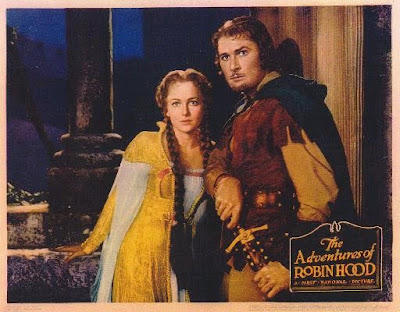
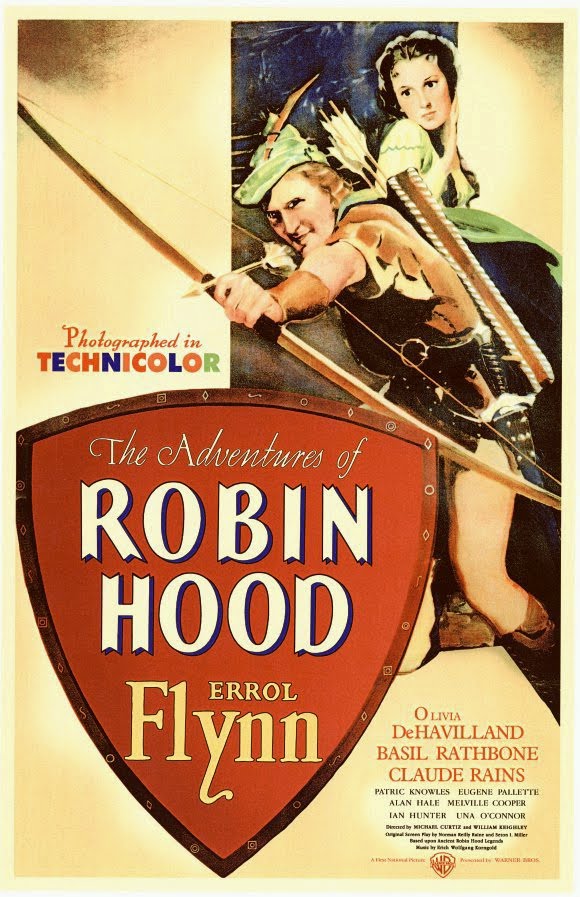
A group of us recently watched “The Adventures of Robin Hood” (1938) in Blu Ray in my friend’s home theater, and its countless viewings haven’t dimmed my enthusiasm one bit. I’ve probably seen it more times than any other film. At least 30 viewings of it and that may be a conservative number. It’s been almost a week now since I last saw it, and I can’t wait to see it again.

As long as I can remember it’s been my favorite movie and no other title has ever supplanted it. The Blu Ray transfer is absolutely gorgeous, but the film doesn’t demand optimum viewing conditions to work its magic.

My first exposure to the film was annual viewings on our black and white television on WGN-TV’s much loved Family Classics movie program, interrupted by commercials and edited to fit a two-hour time slot. Even with these restrictions, the film grabbed me and never let go.

Finally seeing it uncut, uninterrupted and in Technicolor at a revival screening at Chicago’s Biograph Theater in 1975 was a real treat. It didn’t improve the movie, but made a great movie even greater.

“The Adventures of Robin Hood” may be one of the best-loved films of all time and I’m not sure what I can add about it that hasn’t already been written. What I can do, though, is put down some oddball trivia and thoughts I’ve had about the film over the years. Believe me, this will not be a linear essay. I will assume most people reading this are familiar with the movie.

“The Adventures of Robin Hood” was one of those happy instances where the right people came together at the same time. Is it a perfect film? No, but it comes as close to perfection as any film I can think of. So, let me get a few miniscule negatives out of the way.

During the feast sequence after the Merry Men have ambushed Sir Guy’s men, Robin Hood (Errol Flynn) and Maid Marian (Olivia deHavilland) walk through the forest where a group of fugitive peasants are gathered. Why aren’t they at the feast? How come they haven’t joined the other revelers? Is it because they’re too broken and wounded? I always wondered about those folk.

During the archery tournament the archers shoot at the traditional multi-colored bulls eye targets. Were these bulls eye targets really available in medieval England? Maybe someone could fill me in, but those targets look a little too contemporary to me.

And that’s it. Those are my negatives about the film.

Oh, some smart alceks snigger about Robin’s costuming, what with green tights and a jaunty feather sticking out of a cap. Blasphemy, I say!


Robin Hood is a legend, and I want my Robin Hood to wear that green outfit and be a brave and courageous hero, robbing from the rich to give to the poor, risking all to protect the helpless and fighting tyranny with his band of Merry Men, as likeable a group of outlaws that ever existed.

Watching Errol Flynn’s Robin Hood, one understands why the Robin Hood legend has endured for centuries, something you don’t get while watching the Kevin Costner or Russell Crowe versions.

Much like 1960s advertising which proclaimed Sean Connery IS James Bond, Errol Flynn IS Robin Hood. Early casting was not so fortuitous, as in 1935, Warner Bros. toyed with the idea of casting James Cagney as Robin Hood and Guy Kibbee as Friar Tuck.

Initial reaction tells me I can’t picture Cagney in the role. Still, its always fun seeing Cagney stick it to authority figures, which Robin Hood certainly does. He’s an amusing cowpoke in “The Oklahoma Kid” (1939) so maybe he would have been a good swashbuckler after all. His dancing background meant the choreographed duels would have been something to behold. Would lack of an English accent have hindered him?

Personally, I don’t care about such things. I don’t recall any serious criticism regarding the lack of an English accent from Clark Gable’s Fletcher Christian or Gregory Peck’s Horatio Hornblower.

Burt Lancaster plays a Robin Hood-type in medieval Italy in the wonderful “The Flame and the Arrow” (1950) without the slightest, tiniest attempt at an accent. The film doesn’t suffer a bit for it. (I won’t even go into one scene where Virginia Mayo dons a shorts outfit that looks like she just played a set of tennis at the Bel Air Country Club. Yowzah! If this was medieval Italy, I’m sorry the Renaissance ever took place).


Besides Cagney, “The Adventures of Robin Hood” is laden with what ifs. It was a long process between the initial idea to do a Robin Hood film and the final product. In some cases we have glimpses of other films to give us a good idea of what could have been.

Anita Louise was originally slated to play Maid Marian. We have an idea of what she might have been like when she essayed the role in “The Bandit of Sherwood Forest” (1946).

Early versions of the script wrestled with the climax, with several drafts featuring an elaborate siege of Nottingham Castle by Robin’s men and King Richard’s returning Crusaders. This was nixed due to cost considerations. (As it was, “The Adventures of Robin Hood” was Warner Bros. most expensive film to date, costing $1.4 million).

We have an idea of what the siege might have looked like thanks to M-G-M’s “Ivanhoe” (1952). “Ivanhoe” is pretty much the same story as Flynn’s Robin Hood; indeed Robin Hood and the Merry Men take part in the castle siege. It is a marvelous sequence and one almost as satisfying as Warners’ eventual solution. (In a further odd coincidence, Olivia deHavilland’s half sister Joan Fontaine plays the Saxon princess Rowena in “Ivanhoe.”)


A major part of Robin Hood’s success is the landmark and much loved score by Erich Wolfgang Korngold. I personally know rock and roll fans who wouldn’t think of ever going to a symphonic concert or listen to classical music who have Korngold’s Robin Hood score in their CD collections.

It envelops the film in such a feeling of good fellowship, romance and adventure that it’s impossible to consider the film without it. Who was partly responsible for the score? Adolf Hitler.

Producers Hal Wallis and Henry Blanke begged and pleaded with Korngold to score the film, and with each call Korngold got more and more stubborn in his refusals. (Korngold enjoyed a very enviable contract with Warner Bros. He could refuse any assignment offered him and had first pick at the studio’s most prestigious films.)

Korngold wrote to Wallis, “Robin Hood is no picture for me. I have no relation to it, and therefore cannot produce any music for it. I am a musician of the heart, of passions and psychology. I am not a musical illustrator for a 90 percent action picture.”

Warner Bros. Music Director Leo Forbstein went to Korngold’s home to beg and promise him the moon to take the assignment. Korngold finally (partially) relented, saying he would work on it on a week by week basis, with the caveat he could quit at any time.

Korngold finally agreed to finish the film only after learning about the German invasion of Austria and learning his property had been confiscated by the Nazis. Korngold spent the next seven weeks composing the score, which would earn him his second Academy Award and become one of his best loved compositions. No doubt Korngold was inspired by the film’s message exhorting freedom and the struggle against tyranny and oppression.

This also means that if the Cagney version had been produced circa 1935 or 1936, it most likely would not have been scored by Korngold.

On a side note, I always wondered if anyone ever recorded Errol Flynn’s reactions to the musical scores in his movies. Along with Charlton Heston, Errol Flynn probably had more genuinely great film music written for him than any other actor or actress.

The only mention I can find comes from Brendan Carroll’s invaluable biography on Korngold “The Last Prodigy” (Amadeus Press, 1997). In the mid-1950s Flynn was producing a movie based on the William Tell legend, and Flynn contacted Korngold about composing the score. Korngold turned Flynn down, saying he had retired from film scoring. Still, Flynn must have thought well enough of him to approach him with the assignment.


“The Adventures of Robin Hood” earned almost unanimous critical raves, and Warner Bros. earned back its production costs many times over, not only in its initial release but as one of the most popular re-issue titles in the Warner Bros. library.

In “The Adventures of Robin Hood, Wisconsin/Warner Bros. Screenplay Series” (The University of Wisconsin Press, 1979), film historian Rudy Behlmer writes he read countless contemporary reviews of the film, and only found one dissenting opinion. In the London Observer, critic C.A. Lejeune wrote, “It must have been an almost superhuman task to make a dull film on the subject of Robin Hood, but the Warner Brothers, who have never flinched from major difficulties, have almost managed it. I don’t know when I have seen more money, more care and more important workmanship lavished on such a stupendous presentation of the obvious.”

I have one another dismissive comment and it shocked me to the core. Growing up, my favorite film historian was the late film historian William K. Everson. Anything he wrote was an automatic purchase.

In 1981, he made several visits to Chicago to the Film Center at the Art Institute to screen films from his private collection. My dad and I went on a Saturday afternoon to see Fritz Lang’s rarely screened (at the time) “House by the River” (1950). We met Mr. Everson in the lobby and enjoyed several minutes chatting with him and we got several of his books signed.

I was bold enough to ask him about one of his assertions in his book “Love in the Film” (Citadel Press, 1979) where he wrote regarding the Ronald Colman version of “The Prisoner of Zenda” (1937): “One can almost pin down The Prisoner of Zenda as being the last (and best) of the great romanticist adventure films.”

I asked him about the wonderful love story in “The Adventures of Robin Hood” and didn’t he consider it a great romanticist adventure film?

I can’t remember his exact words, but he said no, color was the main star of “The Adventures of Robin Hood” and without it, it was a fairly ordinary adventure film.

My dad and I were both stunned into silence, but we resumed our conversation and it was a most pleasant one. We didn’t agree with him of course, but it was a good lesson to learn that even our critic idols can enjoy wildly different opinions. But I still think he was wrong. I have lots of black and white memories of “The Adventures of Robin Hood” that tell me otherwise.
 

Blogger news

Blogroll

Most Reading