Pages

Powered by Blogger.
Showing posts with label Film Noir. Show all posts

The Dark Corner

Wednesday, August 15, 2012


I’m guessing that if someone else besides Mark Stevens played the detective in “The Dark Corner” (1946) it would be better known today. Nothing against Stevens, who is fine but comes off a bit bland. Cast someone with an interesting face like Dana Andrews or Richard Conte in the role, and you would have a noir for the ages.

Stevens isn’t a total demerit however, and what we have is really nifty little noir, filled with enough colorful characters, gloriously moody black and white photography and on-location shooting to make it a prime entry in the post-war noir sweepstakes.

Stevens plays Bradford Galt (a terrible name for a detective, don’t you think?), who years before had taken the rap for his former partner Anthony Jardine (Kurt Kreuger). Jardine is now a big-time lawyer carrying on an affair with Mari Cathcart (Cathy Downs), younger wife of Hardy Cathcart (now that’s a name!), the city’s most prestigious art dealer.


Cathcart is played by Clifton Webb, who I will happily watch in anything. It was first role after his star-making turn in “Laura” (1944) and his Hardy Cathcart possesses as keen a wit as Waldo Lydecker, if not as barbed. Waldo had to bow to no one, but Hardy has to make nice to his customers. But he’s still the magnificently superior Clifton Webb we all know and love. Some people have said how it was an honor to have been insulted by Groucho Marx. Me, I would have liked to have been sneered at by Clifton Webb.

It looks like Jardine is looking to ensnare his old partner in another web of murder and deceit, with the help of Stauffer (William Bendix), an ex-detective with a penchant for white suits. Galt has a loyal secretary Kathleen (Lucille Ball) who helps clear him of a murder charge.


I’ll admit to not seeing all of Lucy’s movies, but I’ve never seen her as warm as she is here. She’s not the manic Lucy we all know, but a quiet, working girl possessing lots of street smarts. Her honest working girl character stands in strong contrast to all the upper class duplicitous characters here.

Galt also keeps a bottle of booze which he keeps in his bottom desk drawer, which is one of my favorite staples of detective fiction. I had a grin a mile wide when he pulled out that bottle. All detectives should have a bottle of rye in their desk drawer. I’ve thought about becoming a detective just so I can keep a bottle of rye in my bottom desk drawer, and I don’t even drink.

Director Henry Hathaway rarely made a film that I haven’t liked. He may not be a critic’s favorite – not enough of an “auteur” - but his films move with nary a wasted scene. His films are always so unfussy, and I mean that in the best way possible. Hathaway had scored a monster hit the year before with “The House on 92nd Street”, a semi-documentary film, based on a true story about how the FBI cracked a nest of Nazi spies in the early years of World War II.

“The House on 92nd Street” was celebrated for its use of on-location shooting, a rarity at the time, and in “The Dark Corner” Hathaway and his camera crew returned to the Big Apple’s streets for some fascinating on-location photography, even a car chase through the busy downtown streets. I’m not talking “The French Connection” here, but pretty good all the same.

I don’t want to talk too much about the plot, because there are some intriguing twists to be had here. Without giving anything away, what I liked about this movie is how tight the script is. So many mystery movies feel there has to be a never-ending series of twists and revelations that sometimes the story’s main focus gets lost. Here, everything happens for a reason and makes sense. It’s not contrived and one can see how the events could happen as they are playing out. 

A good script, taut direction, moody photography, a fine cast and the always watchable Clifton Webb make “The Dark Corner” a real winner.


THIS GUN FOR HIRE (1942) is top notch film noir

Monday, April 30, 2012

Starring Veronica Lake, Robert Preston, Laird, Cregar and Alan Ladd. Directed by Frank Tuttle. Running time: 80 minutes. Release date: May 13, 1942

Excellent film noir classic about a hitman named Raven (Ladd's break-through film) who after taking out a blackmailer and his girlfriend in San Francisco, realizes he has been set up by his anonymous employer. Now on the run from the police, Raven wants to find out why he was duped and score a little payback. The middle man named Gates (terrific performance by Cregar) who works for the anonymous employer informs police that Raven stole money from the company Gates works, Nitro Chemical. Detective Crane (a young Robert Preston, miles away from Professor Harold Hill of The Music Man) is assigned the case.

Crane's girlfriend, nightclub singer/magician Ellen (a sultry Veronica Lake) winds up meeting Raven on board a train headed to Los Angeles by accident. Raven ends up taking Ellen hostage. He finds out that Ellen also knows Gates, as Gates owns the nightclub where she works. So now Raven starts to play detective to find out what's going on.

With the police in hot pursuit, the pair are trapped at the train yards where Raven shares his hard upbringing that led him to his life as a hitman. She begins to sympathize with him. And as a final gesture, takes his coat and hat to pretend to be him to confuse the police while Raven escapes. He heads to Nitro Chemical to take down the man who set him up.

Man, this is one awesome movie. A perfectly tuned film noir film that just grabs you from the opening credits and doesn't let go. Alan Ladd is terrific as Raven, who is more than just your average gun for hire. His back story explains quite a bit about the life he has led. This is a true star making performance. His first pairing with Lake is really good as their had wonderful chemistry. Lake plies her usual trademark sultry good looks and smoky voice to good effect. And in the quieter moments with Ladd, is quite a revelation. Preston is all gung ho as the detective and Cregar makes a good slimy, sniveling middleman who says he is just following orders. No hard feelings Mr. Raven. Right?..Heck no. You're going down too big man.

This Gun For Hire is excellent entertainment.

The Criminal (1960)

Monday, February 6, 2012

***½
Country: UK
Director: Joseph Losey


In a recent post on They Made Me a Fugitive (1947), I cited that film as a rare British example of American-style film noir. Joseph Losey's 1960 picture The Criminal (released in the US two years later under the rather misleading title The Concrete Jungle) is another example of a film noir made in Britain with genuine fidelity to the conventions of the genre, although with some updating—it's more lurid and more sexually explicit than earlier American examples of the genre—that brings it closer to the spirit of the then-emerging Swinging Sixties. Losey was, of course, actually an American with previous experience directing Hollywood noirs (M, The Prowler, The Big Night), a refugee from the film industry witch hunts of the early fifties. Relocating to Britain and working at first under various pseudonyms, he continued his film directing career as an expatriate until his death in 1984.

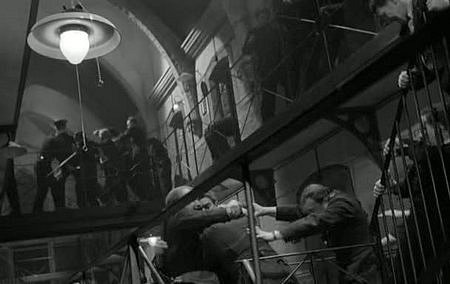
The Criminal opens with a shot of three men sitting around a table playing poker with tense concentration. As they make their final bet of 7,000 pounds and lay down their cards, the camera draws back for a longer shot—to reveal that the men are actually sitting in a prison cell and the 7,000 pounds is really seven cigarettes. Almost immediately the credit sequence begins, a two-minute long take of numerous prisoners and guards and the roving camera performing an elaborately choreographed dance around each other while the credits roll and on the soundtrack Cleo Laine sings the mournful, bluesy theme song: "All my sadness, all my joy / Came from loving a thieving boy." It's a remarkable opening which announces unequivocally that this is going to be a film that uses image and sound in ways which will keep us constantly surprised.

In the film Stanley Baker plays a career criminal named John Bannion who is due to be released on parole the next day. During his three years inside, he has been planning a racetrack robbery in meticulous detail. Upon his release he reconnects with an old criminal crony, Mike Carter (played by the American actor Sam Wanamaker, another refugee from the Hollywood witch hunts), who helps him handpick a team to assist in the heist. The evening of his release, Carter organizes a welcome home party for Bannion, where he meets the sexy and seductive Suzanne (Margit Saad), who throws herself at him, and soon he has fallen in love with her. The robbery succeeds, and Bannion takes the stolen money to a field in the countryside, where he buries it, planning to retrieve it to be laundered after it has cooled off.

When Bannion makes the mistake of taking 500 pounds from the loot to buy an engagement ring for Suzanne, this allows the police to trace the money back to him, and he quickly finds himself back in prison. As soon as he arrives, he begins to plan an escape so that he can make his way to the loot, the escape to be covered by a riot engineered by Bannion's prison friends to divert attention away from him. The riot and escape form a stunningly conceived sequence, sensationally staged by Losey, photographed by Robert Krasker (Carol Reed's Odd Man Out and The Third Man), and scored by jazz composer John Dankworth. It's a good example of what David Thomson identifies as the defining feature of Losey's early films, the melding of the contradictory qualities of "subtlety" and "hysteria"—subtle in its precisely controlled visual choreography, hysterical in its typically flamboyant Losey touches and its hyperkinetic sense of organized chaos.


The screenplay, credited to Alun Owen (A Hard Day's Night) but according to the British Film Institute actually a rewrite of a script by veteran Hammer Films writer Jimmy Sangster, gives the film a tidy four-act structure. The first and third parts—about half the film's running time—take place in prison. In many ways these sections are an update of the traditional Warner Brothers-style prison movies of the thirties. The power structure of the inmates with Johnny as "top man," the opposing alliances of prisoners enforced by violent intimidation, the autocratic head guard, the weak prison warden—all the elements associated with this type of movie are present, only depicted here with even greater than usual emphasis on prison corruption and brutality. As bleak as this prison world is, though, it's a world that is totally ordered and self-regulated. The rules that govern it are understood, each man has a defined place in its power hierarchy, and its concepts of justice and ethics—as peculiar as they may be—are clear. At the same time it's also a world whose sense of order allows for a certain amount of individuality and fluidity within its social structure.

One of the great ironies of The Criminal is that when Bannion leaves prison, he finds in the criminal world outside its walls an even more oppressive environment, and the film takes an unexpected turn from a prison/heist movie to a movie about a loner battling the power elite (a type of narrative strategy Losey would use with even more startling results in his next film, the juvenile delinquent thriller turned sci-fi chiller These Are the Damned). At this point the film noir ethos really comes into play. Maybe Losey did in fact have a Marxist world view, because what happens to Bannion outside prison could almost be considered analogous to the plight of the individual worker in the face of a monolithic power structure, here a criminal syndicate organized on corporate principles. As Mike Carter warns Bannion at one point when he attempts to rebel against the dictates of the higher-ups in the criminal world, "Your sort doesn't fit into an organization. So we can't have you running about messing things up, now can we, Johnny?"

An even greater irony is that while Bannion might believe he's in control of his destiny, in this deterministic film noir universe the concept of choice turns out to be largely illusory. It is only toward the end of the film that he realizes he has been played and betrayed by the criminal organization the whole way to get him to lead them to the money. Every decision, every action he has taken has actually been preordained. Subtle forces have been exerted on him to move him in a certain direction, and his every reaction to these forces has been predicted and plotted in advance. Bannion thinks he has been acting on his own initiative, but the entire time since his release from prison, about twenty minutes into the movie, he has been callously manipulated like a piece in a chess game.

If like Bannion you think there is any possibility of his overcoming the odds against him, forget it. "Don't be a silly boy, John," Carter tells him smugly. "You can't win." And of course he's right.

You might also like:
These Are the Damned (1963)
They Made Me a Fugitive (1947)

They Made Me a Fugitive (1947)

Monday, January 16, 2012

***½
Country: UK
Director: Alberto Cavalcanti


For about ten years after the end of World War II, until the mid-1950s, the influence of film noir in the American film industry was pervasive. Every year dozens of films were made in the genre, and even pictures not in the genre were influenced by the visual style and the attitude of film noir. Although many British crime films were made in this period, few that I've seen come as close to the look and spirit of postwar American film noir as Alberto Cavalcanti's They Made Me a Fugitive (released in the US in 1948 as I Became a Criminal).

In one of his earliest film roles, Trevor Howard plays Clem Morgan, a recently discharged Royal Air Force pilot having trouble adjusting to the routine of civilian life after the daily risk of being a wartime flier. So when he is recruited by a small-time London gang leader involved in the postwar black market, Clem eagerly accepts to put a bit of excitement and danger back in his life. The gang leader, Narcy, short for Narcissus (Griffith Jones), is a ruthless Cockney looking for the upper-class Clem to add a bit of cachet to the gang. Working out of an undertaker's office, the gang specializes in the usual postwar black market items like cigarettes and nylon stockings, smuggled into their headquarters in coffins.

When Clem discovers that Narcy is smuggling drugs as well and threatens to leave the gang, Narcy promises to stop this, but it's clear that he resents Clem's challenge to his power. This, combined with Narcy's interest in Clem's posh, slutty girl friend, seals Clem's fate. Framed by Narcy during a robbery in which a policeman is killed, Clem is convicted and sent to prison. But he manages to escape and make his way back to London in search of the one gang member who can prove his innocence. After a series of misadventures, he hooks up with Narcy's former girl friend, a showgirl named Sally Connor (Sally Gray) who, bitter about being dumped by Narcy, agrees to help Clem. While simultaneously avoiding both the police and the vicious Narcy, Clem and Sally gradually find themselves attracted to each other.

The reason French film critics called this type of picture film noir is the pervasive darkness of the world it depicts, a darkness that extends far beyond the predominance of nighttime scenes, the night clubs, the criminal activities, the treacherous urban settings, and the underworld milieu typical of the genre. They Made Me a Fugitive certainly has these—along with the Expressionist-inflected cinematography, courtesy of the Prague-born Otto Heller, and the striking editing of the great film noirs—and more. Like the best film noirs, it has a sense that the world is a place where corruption is endemic, a place where people are ruled by self-interest and where nobility, morality, and any kind of ethical behavior are rare commodities indeed. There are no heroes in this world, with its relentlessly bleak view of human nature. Even the people the fugitive Clem encounters on his way to London turn out to be selfish manipulators intent on using him for their own ends.

Instead we see arrogant psychopaths like Narcy, an ego-driven dandy who stops at nothing to get what he wants, whether it's money, material goods, unearned status, or the girl he fancies at the moment. Most of all, he wants power, the ability to control other people through their terror of him and use them as instruments of his will. Griffith Jones gives a chilling performance as the vain, tyrannical Narcy. Even in a film as brutal as this one, his sadism is startling. The scene where he punches and kicks Sally in her dressing room after he finds she has visited Clem in prison seems strong even by today's standards of violence. But in 1947 it must have been downright shocking, far more graphic than anything similar I've seen in an American film of the time.

Matching Jones's performance is Trevor Howard as Clem. In his long film career Howard didn't often play such an unrepentantly unsympathetic character, but when he did—in pictures like Outcast of the Islands (1951), Sons and Lovers (1960), as Capt. Bligh in the 1962 Mutiny on the Bounty—he was most effective. His Clem is as cynical an antihero as you'll find in postwar British cinema. He is not motivated by any abstract sense of justice. His world is too pitiless a place and too indifferent to the suffering of any one individual to expect any such thing, and he is too aware that he is in the eyes of society himself a villain. Instead he is driven by a strictly personal sense of having been wronged. It's a stark, amoral take on the kind of film Alfred Hitchcock made time and again, the story of the wrongly accused man on the run desperately trying to prove his innocence.

The thing that most closely allies this film to postwar American film noir, though, is its unrelenting sense of fatalism. This aura of doom is the thing that for me distinguishes film noir from the gangster and crime films from which it developed—that feeling that the main character is enmeshed in circumstances beyond his control from which there is little possibility of escape. In the conventional gangster picture, the main character's fate is the result of flaws in his own nature, an ego that becomes so bloated that it spins out of control and leads to self-destruction. In film noir, the main character is a victim controlled by external forces. Like Clem, he may be responsible for putting himself in the situation that leads to his downfall, but in the end he becomes controlled by the situation. Unlike the gangster, the film noir antihero's downfall is ultimately caused not by internal, but by external forces.

One of the most intriguing things about They Made Me a Fugitive is the way it teases us at the end with the possibility that Clem might be able to avoid his fate after all. This comes about after a Hitchcock-like set piece that forms the picture's finale. With the police looking on from below, Clem chases Narcy across the roof of the undertaker's parlor which is the gang's hideout, a building with a huge sign that reads RIP on its roof. (Did I mention what a bizarre sense of humor and an almost Dickensian feel for the macabre the film has—perhaps not surprising from the director of the 1947 Nicholas Nickleby and the best episodes of Dead of Night.) Will Narcy relent and exonerate Clem in the end? Not on your life. Narcy remains true to character, continuing to insist that Clem is responsible for the policeman's death. Will Clem take comfort from Sally's vow to wait for him? "I was afraid you'd say that," he tells her coldly as he is led away.

There are no bogus happy endings in They Made Me a Fugitive, no contrived reversals intended to restore the viewer's sense of security and comfort. The movie doesn't draw back from following through on the implications of its cynical view of the world, but is faithful to its downbeat film noir sensibility to the end.

Turner Classic Movies is airing They Made Me a Fugitive on March 8. Check local listings for times. It's also available from Kino Video as part of the set Film Noir: Five Classics from the Studio Vaults.

The Best Films I Have Never Seen Before: Blast of Silence (1961)

Friday, October 14, 2011

Blast of Silence (1961) *** ½
Directed by: Allen Baron.
Written by: Allen Baron and Waldo Salt (Narration).
Starring: Allen Baron (Frank Bono), Molly McCarthy (Lori), Larry Tucker (Big Ralph),  Peter H. Clune (Troiano),  Danny Meehan (Petey),  Howard Mann (Body Guard),  Charles Creasap (Contact Man),  Bill DePrato (Joe Boniface), Lionel Stander (Narrator).

Allen Baron’s Blast of Silence (1961) came right after what most historians consider to be the age of classic film noir – which ended in 1959. Yet the film would fit easily alongside the film noirs of the 1940s and 1950s. It is also one of the first truly independent films in America, and has echoes of John Cassavetes Shadows (1959), although it tells a tighter, more cohesive plot than the Cassavetes film. It is an odd, one of a kind film, perhaps because writer/director Allen Baron only made three films after this one – and none of them are very well regarded. His career, which seemed to get to such a promising start with Blast of Silence, never really amounted to anything behind the camera. And that’s a shame, because Blast of Silence is pretty damn good.

The movie stars Baron as Frank Bono, a hit man from Cleveland who has come to Manhattan at Christmastime to kill a low level mobster named Troiano (Peter H. Clune). We don’t know why Troiano needs to be killed, and neither does Bono, but he doesn’t really care either. Both the fact that Bono is from out of town, and that it’s Christmas, are key to the movie. Bono is a perpetual outsider – an out-of-towner if you will – everywhere he goes. He doesn’t seem quite comfortable in his own skin and is completely miserable. He tries to grasp onto something in his life – a girl he used to know, Lori (Molly McCarthy), but she rejects him, as well she probably should.

Bono has a lot of time to kill in New York. He has stalked Troiano to get to know his routine, and the best way to kill him, but he has to wait for days on end for the morbidly obese gun dealer Big Ralph (a brilliantly creepy Larry Tucker) to get the gun he needs. So Bono stalks the streets of New York – seeing the happy, holiday shoppers, the displays in the windows, and just getting lonelier and lonelier.

One of the most striking things about Blast of Silence is the narration. It was written by Waldo Salt (who was blacklisted at the time, so he went under another name) and delivered by fellow blacklistee Lionel Stander, with the perfect gravelly voice. Oddly, the narration is in the second person – which means it refers to Bono in personal pronouns like “you” – as if God himself is talking directly to Bono, whispering dread into his ear for the whole movie. I looked to try and find another example of second person narration in film, and I simply can’t, although I’m sure there are some (and would love to hear about other examples). This mode of narration is odd, and yet it works wonderfully well for the film.

Blast of Silence has had some big time supporters over the years (Martin Scorsese has called it a “key New York film”), but probably because Allen Baron never really had much of a career after this film, it has pretty much languished in obscurity until Criterion released a special edition DVD a few years back. What emerges is a unique film, part film noir, part messy, independent film, and wholly original. It isn’t a perfect film by any means – although the cinematography is for the most part superb, the film does have some of the uneasiness that many first films do. The acting isn’t particularly great (I was never sure if Bono’s unease was really his own, or the unease of Baron himself – no matter it works), with really only Larry Tucker (better known as a writer than actor) delivering a great performance, although one that is all too brief. And yet, Blast of Silence is a wonderful curiosity piece – a one of a kind film that should have been the start of great career for Baron. It didn’t, but we should be thankful he made this one.

The Best Films I Have Never Seen Before: The Big Steal (1949)

Friday, October 7, 2011

The Big Steal (1949) ***
Directed by: Don Siegel.
Written by: Daniel Mainwaring & Gerald Drayson Adams based on the story by Richard Wormser.
Starring:  Robert Mitchum (Lt. Duke Halliday), Jane Greer (Joan Graham), William Bendix (Capt. Vincent Blake), Patric Knowles (Jim Fiske), Ramon Novarro (Inspector General Ortega), Don Alvarado (Lt. Ruiz), John Qualen (Julius Seton), Pascual García Peña (Manuel).

There is something about Robert Mitchum that I cannot help but love. He was an actor who always claimed he didn’t care about his work or his career. He admitted to Roger Ebert in the 1970s that he had never even seen Out of the Past (1947), perhaps his greatest movie ever, because he wasn’t much interested. He often said that Midway (1977) was his favorite role because he got paid a lot of money, and got to hang out all day in bed in pajamas.  He said yes to seemingly every movie, and that is why his resume is filled with clunkers. And yet, in pretty much every role Mitchum played, there are at least moments where he is brilliant. He had more charisma and commanded the screen better than just about anyone. Not every one of his films is a masterpiece – in fact precious few are – but Mitchum was a one of a kind actor. In 1948, Mitchum was arrested for marijuana possession, and ended up serving a week in county jail (which he described as “Palm Springs without the riff-raff”) and then 48 days on a work farm. For most young actors in the 1940s, this could have been a career killer – after all, Mitchum had only recently become a star with The Story of GI Joe (1945), but while the studio ordered him to clean up his act, the arrest didn’t seem to faze Mitchum or dim his rising star in the public’s eye. He was signed to star in Don Siegel’s The Big Steal (1949), but the studio had a problem – the young starlets they wanted didn’t want to be in the film with Mitchum because of his arrest. So in stepped Jane Greer, Mitchum’s Out of the Past co-star. While The Big Steal is nowhere near the same level as Out of the Past, it is fast paced and fun. Kind of film noir lite if you will. Of course, the chemistry between the two stars is pretty much what makes the film good.

The movie has a twisty, turny plot involving Lt. Duke Halliday (Mitchum) being accused of stealing $300,000 in payroll, that was really taken by Jim Fiske (Patric Knowles). Halliday is chasing Fiske, while Captain Vincent Blake (William Bendix) is chasing Halliday, because he thinks he is guilty. Getting off a boat in Mexico, Halliday first has to subdue Blake, and then meets Joan Graham (Greer), who was Fiske’s fiancée, and is after him because he stole $2,000 for her and then took off. Soon, Halliday and Graham have teamed up, and are chasing Fiske throughout Mexico, with Blake on their tail, and a Mexican cop named Ortega (Ramon Navarro), sitting back and watching.

The film is often referred to as a film noir, but I’m not really sure it qualifies. For one thing, the film certainly does not have the same darkness – either visually or thematically – as most film noirs. This is more of a straight ahead caper film – essentially one big, long chase sequence that moves at a breakneck pace from its opening scene right down to the end. The tone is far lighter – the witty banter between Mitchum and Greer a highlight. No one seems to be taking it all that seriously, and everyone seems to be having fun. The film was directed by Don Siegal – making only his fourth film as a director – but he keeps the pace moving. He had to shoot around Mitchum – who showed up to the set well after everyone else because of his jail time – and yet, the transition is pretty much seamless. He gets the most out of his actors, and Siegel was convinced that no matter what Mitchum said publicly, that he really did care about his work. Watching The Big Steal, it’s hard to argue with him. This is a lightweight, breezy entertainment – the type of film that many stars sleepwalk through. But Mitchum doesn’t. He carries the movie with his charm and screen presence. He does what all great actors do – he makes it look effortless.

The Big Steal is far from a great movie. It is completely disposable entertainment. Like many action films today, it fades from your memory just as the end credits come up. By while it’s playing – for barely 70 minutes – it is entertaining and fun.

His Kind of Woman: A Priceless Affair

Wednesday, May 25, 2011


Is it too great a pun to call His Kind of Woman, Priceless? If so, slap the cuffs on me and take me away to jail because His Kind of Woman is a film which lives and dies by the vocal wonder that is Vincent Price. A constant reminder that the greatest flaw our society will always face is that he failed to live long enough to do a GPS voice over.

When dealing with a movie of the flair of His Kind of Woman, it's important to categorize just what kind of film it is. Setup and packed with all the markings of a fly by night, run of the mill noir tale, His Kind of Woman injects a lovely dose of self-awareness, and light hearted adventure along the way. The interplay and romantic tinglings between our picture of masculinity (Mitchum) and the epitome of sex appeal (Russell), reaches a chemical overload, exploding off the screen. And it's a good thing to, because the story just isn't that great.

But His Kind of Woman has a good enough story to do what it wants to do: spin noir on its head. Vincent Price's overblown tour de force finale, matched with Mitchum's tough guy looking for answers setup, all at the background of a beautiful costal resort in South America, it's just too much to handle. In most other hands, this film would be inept, generic, or so cheesy even milk would pass. Yet, it never falters.

True to the course, and willing to take a chance, His Kind of Woman shines in the most nuanced, twilight lit light. Of course, it doesn't hurt that the film features Jim "the Thurston Howell III Mr. Magoo" Backus as a bumbling background loafer - obviously present to supply this film with the necessary street cred. Oh, this is just a joy to be had.

Every character just works. Not only on their own right, but with respect to the personas of those around them. Their conversations bounce off one other flawlessly. It's almost as if the cast was born to work together. From bit players to big stars, everyone pulls their own weight. And the film is all the better for it!

Overall Rating: 8.00/10

CMBA Hitchcock Blogathon: The Wrong Man (1956)

Monday, January 17, 2011

***½
Country: US
Director: Alfred Hitchcock


The opening shot of The Wrong Man, in which Alfred Hitchcock makes his customary appearance, immediately lets us know this is not going to be a typical Hitchcock film. Not only does Hitchcock come right out and say so, addressing the audience directly just as he did in his television series, but the shot itself, with an unidentifiable Hitchcock walking onto a dark sound stage lighted in extreme chiaroscuro, emphasizes how different this is going to be from the escapist fare we expect from this director. Even though Hitchcock was closely identified with movies of suspense, he clearly liked a change of pace now and then, for he regularly dabbled in other genres than the suspense film—Gothic romance (Rebecca), courtroom drama (The Paradine Case), whimsical black comedy (The Trouble with Harry), screwball comedy (Mr. and Mrs. Smith), toward the end of his career edging ever closer to the outright horror genre (Psycho and The Birds). Although elements of film noir can be detected in Strangers on a Train (1950) and I Confess (1953), the opening shot of The Wrong Man announces in the strongest visual terms that this movie is going to be Hitchcock's deepest—and bleakest—foray into the territory of film noir.

The Wrong Man deals with a subject Hitchcock returned to time and again during his more than fifty years of filmmaking—the wrongfully accused man desperately trying to prove his innocence before it is too late. This time around, as Hitchcock points out in his introduction, the film is based on an actual case, and he adjusts his typical approach, where the gravity of the situation is tempered by a sense of whimsy and the certainty that in the end all will turn out well, to reflect the seriousness of the story's origins. Here he doesn't set out to entertain by placing us in a situation where we know, just as when we step onto a ride at a carnival, that for the duration this may be a frightening experience but it's all for fun and the ride will eventually end and we can return to the normality of ordinary life. Instead he sets out to give us a sense of danger so convincing that for once we question whether the movie really will have a happy ending.

The main character is Manny Balestrero (Henry Fonda), a musician at the Stork Club in New York City. The film's opening passage establishes that apart from his job, Manny's life is pretty ordinary. After finishing work in the small hours of the morning, he returns home on the subway, checks on his two young sons, safely asleep in their bedroom, then goes upstairs, where he finds his wife Rose (Vera Miles) still waiting up. She can't sleep because she is having problems with her teeth and is worried about the cost of the dental work she needs. During this scene Manny and Rose have an exchange that tells us a lot about them. Manny tells Rose not to worry, that they will find a way to pay the dentist: "I think we're pretty lucky people mostly." Rose responds with her own concerns: "Sometimes I'm so frightened waiting up for you to come home at night." These two statements not only limn their basic personalities—Manny the optimist and Rose less confident and more than a bit phobic—but also foreshadow the way each will react to the disaster about to happen to them.

When Manny goes to the insurance company the next day to borrow against Rose's life insurance policy, three clerks in the office are certain he is the man who has twice robbed the office, and the nightmare begins. Picked up by the police, the naive Manny meekly cooperates with the detectives, trusting their reassuring platitudes: "It's nothing for an innocent man to worry about. . . . If you haven't done anything, you have nothing to fear." But Manny is positively identified not only as the robber of the insurance company but also as the culprit in a whole series of armed robberies. Manny is never advised of his rights or offered a lawyer, and the entire process is riddled with procedural flaws that invite misidentification and which today would never be allowed, but the movie takes place in 1953, and we have to believe that such practices were the norm then.

The remainder of the first half of the movie concentrates on Manny's arrest, incarceration, and arraignment, and in depicting this the film is truly harrowing in a way Hitchcock's lighter examples of this kind of movie never are. That this more serious treatment of the subject is never heavy-handed or overly pointed makes it all the more unnerving and all the easier for us to identify with the ordeal of the hapless Manny. At the station, as Manny is booked and locked up, the atmosphere is utterly mundane and muted, completely lacking the melodramatics of many station house movies of the time. This section of the film reaches its peak after Manny is locked in the cell. As he looks around the cell, shots of his face, with Fonda's expression subtly registering a stunned feeling of dislocation, alternate with close-ups of the physical details of the cell. There is no dialogue, no interior monologue, no background noise of any kind after the cell door slams, only the quietly sinister music of Bernard Herrmann suggesting the nightmarish unreality of the experience, as close to the mood of a story by Kafka as I've ever seen on film.

After Manny's arraignment and his release on bail (his brother-in-law manages to raise the money), the second half of the movie deals with the aftermath of the arrest, including meetings with his lawyer (Anthony Quayle), futile attempts to establish alibis for the two dates the insurance office was robbed, and finally the trial. Gradually the focus shifts more toward Rose and the effect the experience is having on her. Lacking the resilience of Manny, she slowly begins to unravel. During the meetings with the lawyer, you can see her becoming more distracted and withdrawn. When their last chance at establishing an alibi fails, she loses all hope, breaking down in hysterics. Her insomnia and loss of appetite soon progress to irrational feelings of guilt and paranoia. From blaming herself ("I've let you down, Manny. I haven't been a good wife."), she begins to question whether Manny is really innocent ("How do I know you're not guilty?"), and it becomes clear she is in a severe depressive state. Her breakdown suddenly culminates in a brief but electrifying sequence in their bedroom, shot and edited in the kinetic, fragmented style of the shower scene in Psycho, in which Rose completely loses control, repulses Manny's attempts to comfort her, and lashes out at him with a hairbrush, breaking a mirror and lacerating his forehead. Finally, Manny has no choice but to hospitalize his wife.

In his commentary on The Wrong Man, Richard Schickel notes how many references there are in the film to Manny's Catholicism. (As those familiar with Hitchcock know, he was raised as a Roman Catholic and educated in a Jesuit school.) That's certainly an accurate observation by Schickel. When Manny is booked, the desk sergeant gives his rosary back to him to keep in his cell. During the trial, he is repeatedly shown clutching the rosary under the table where he is seated in the courtroom. But perhaps the most noteworthy reference to Manny's Catholicism happens in the climactic scene of the film, one of the few times besides the scene between Manny and Rose in the bedroom that Hitchcock intervenes to heighten the moment with technical embellishment. And a stunning moment it is, the moment that signals the beginning of Manny's redemption.

With the situation at its most hopeless, Manny's mother tells him to pray. Manny goes to his bedroom and, clutching the rosary, stares at a picture of the Sacred Heart while silently mouthing a prayer. Suddenly overlapped with the close-up of Fonda praying is a quite different image—a man in a hat and overcoat, the same as Manny habitually wears, slowly walking down a dark city sidewalk toward the camera (at first I though this was Manny and that I was watching a suspended dissolve to the next scene) until finally his face and Manny's merge. At this point the overlapped image dissolves as the man turns and steps inside a shop. This man, who bears an unmistakable resemblance to Manny without being an exact double, is the real armed robber, and the shopkeepers recognize him. Is this divine intervention, or is it pure chance? In a classic example of dramatic ambiguity, Hitchcock leaves the interpretation of the event completely up to the viewer.

One thing that is never in question, though, is Manny's innocence, and that is due largely to the presence of Henry Fonda in the role. Fonda did on occasion play scoundrels, but normally his entire persona radiated that this was an honorable man, a man of simple and unpretentious integrity. Those words—simple and unpretentious—just about sum up Fonda's elusive acting technique. The decision to cast an actor known for his honesty and his wholly natural Everyman quality, rather than the charismatic movie star type Hitchcock was apt to prefer for his more commercial entertainments, is key to the effectiveness of The Wrong Man. Fonda was a great actor and in his day one of Hollywood's most undervalued, and I can't adequately express my admiration for him or for his incredibly affecting performance here, all the more moving for his skillful underplaying of Manny's alternation between bewilderment and hopefulness. This role brings out the best in Fonda's acting, above all his seemingly effortless ability to merge completely with his character without resorting to actorly gimmicks or mannerisms. You can add his Manny to the long list of his performances during the 1940s and 1950s that should have gotten him an Oscar nomination but didn't.

Then there is Vera Miles as Manny's wife Rose. In "Revenge," the pilot Hitchcock directed for his television series Alfred Hitchcock Presents, made the year before The Wrong Man, he cast her as a rape victim who comes unhinged as a result of her traumatic experience. It's a fantastic episode, far more elaborately filmed than any other episode of the series or any typical TV episode, and well worth watching for that reason alone. But the most interesting thing about it in relation to this film is how much it almost seems Vera Miles's audition for the part of Rose. As her performance in that TV episode predicts, she portrays Rose's slow disintegration with subtle poignancy. "Vera Miles breaks up in a way that shows how seldom one has seen untheatrical distress," writes David Thomson. "She turns plain and inept." The scene at the end of the film when Manny visits Rose in the hospital and she calmly rejects him ("Nothing can help me. You can go now.") is just heartbreaking. The dreadful misunderstanding about the robberies has been resolved and Manny has his life back, but he has lost the one thing in his life he loved the most.

It's well known that at the time the movie was made, Hitchcock was grooming Vera Miles to replace Grace Kelly as his iconic leading lady. If The Wrong Man has a weakness, it is that the second half of the film dwells just a bit too much on Rose's psychological problems, as Hitchcock shifts his attention more toward her character. I can't help wondering if Hitchcock was becoming a bit too interested in Miles as his intended muse and couldn't resist playing up her part. The story is that Hitchcock's plans for Miles, which included the role of Madeleine/Judy in his next film, Vertigo, had to be scuttled when she became pregnant and that after this the miffed Hitchcock turned his attention elsewhere. But after seeing The Wrong Man, I can't help wondering if Miles might also have had second thoughts about becoming the notoriously controlling Hitchcock's new muse and indeed about being turned into a major star. She continued to work in television and in smaller movie roles for forty more years, although she worked only one more time with Hitchcock, in an unglamorous supporting part in Psycho.

The Wrong Man may be one of Hitchcock's most atypical films, perhaps even his most atypical film. Yet although Hitchcock moves as close as he ever would to the the quasi-documentary realism and noir sensibility of films with a similar subject like Boomerang! or Call Northside 777, he never goes all the way in that direction and certainly makes little attempt to give the illusion of fading into the background as did the Italian neorealist directors like Roberto Rossellini who in part inspired such an approach. Hitchcock's presence—his role as the guiding force behind the film, the authority of his personal stylistic vision, his need to control every detail to elicit a specific response from the audience—is very much in evidence and clearly marks The Wrong Man as a product of The Master, an unusual one certainly, but nevertheless still identifiably a Hitchcock film.

For more on the Classic Movie Blog Association Hitchcock Blogathon click here. You might also be interested in my Featured Retrospective Post on Hitchcock's Young and Innocent. (See the sidebar.)

Pickpocket (1959) / Classe Tous Risques (1960)

Monday, December 20, 2010

Pickpocket
***½
Country: France
Director: Robert Bresson

When I took a cinema course in college, the instructor showed the class Bresson's Diary of a Country Priest, a film in which a young priest finds himself assigned to a diocese in rural France. He struggles in vain to make a spiritual impression on his thoroughly hateful parishioners, enduring the mental anguish of his failure as he suffers the physical torment of slowly dying from cancer. I understood that Bresson intended the young curate's anguish as an expression of transcending earthly pain and failure to a higher level of spirituality. Yet for me watching the film was a grim, torturous, almost masochistic experience in which the contemplation of suffering became an end in itself. I have never been able to watch this type of movie with any enjoyment, and I felt little desire ever to see another film by Bresson. Reading about his later works like Au Hasard, Balthazar and Mouchette only strengthened this feeling. But when I watched Pickpocket recently, I found it a rewarding, if predictably somber, experience.

The main character in Pickpocket is a young man named Michel (Martin La Salle, who resembles the young Montgomery Clift). Unemployed, disaffected, but apparently well educated, he lives a solitary, bleak, and impoverished life in a grungy one-room apartment in Paris. One day in the Métro, he observes someone picking the pocket of a fellow passenger and decides to give it a try. Encouraged by the success of his first attempt, he continues. But he's not a professional and is soon arrested. The police don't have enough evidence to press charges, though, and an inspector who recognizes that Michel is no ordinary petty criminal releases him. The two strike up a curious relationship as friendly adversaries in which the inspector tries to convince Michel that crime is not a valid way of life, while Michel tries to convince him that some people are by nature above the law. It's hard to say whether Michel's attraction to thievery arises from practical necessity or really is a philosophical stance; there is probably a bit of each in it. In either case, there is plainly more than a little defiance and self-centeredness in Michel's personality.

Things get really interesting when Michel attracts the attention of a pair of professional pickpockets who then recruit him to work as a third member of their team and teach him the tricks of the trade. At this point the film becomes a fascinating semi-documentary on the techniques of pickpocketing, culminating in a brilliant sequence in which Bresson temporarily abandons his minimalist filmmaking style, which consists largely of lengthy conversations alternating with contemplative shots of his actors' faces, to illustrate the three men at work in a train station. Watch the following clip to admire Bresson's ability to advance the narrative solely through masterful framing and editing. I don't think you'll ever feel safe in a large crowd again.


Running only seventy-five minutes, Pickpocket has the compression of a short story, concentrating exclusively on Michel and eschewing any narrative embroidery like subplots, its only embellishment the stately music of Lully. Michel is given virtually no backstory, expresses few emotions, has no strong emotional attachments, and dwells almost obsessively on a single idea, the Nietzschean one that the concepts of good and evil are relative and do not apply universally to everyone. Bresson preferred to use non-professional actors, and the passive, slightly wooden acting of Martin La Salle seems wholly congruent with the anomie of the character he plays. Nothing in the film is in the least glamorized, and that includes Bresson's direction, which is devoid of cinematic gimmickry or artistic pretension. This austerity of style combined with an emphasis on ideas over action and emotion gives Pickpocket a kind of surface purity. The film has a quality that is difficult to put into words, but if pressed, I would say it seems in some way turned inward upon itself. This introspective quality in Bresson's work seems to be what most strongly appeals to his admirers, and Pickpocket presents it with what I take to be rather greater palatability than most of his films. Only the upbeat ending, which somehow doesn't ring true, keeps me from giving the film a full **** rating.


Classe Tous Risques
***½
Country: France-Italy
Director: Claude Sautet

Sautet's Classe Tous Risques, released only one year after Pickpocket, is in many ways its polar opposite—a visceral, noirish crime thriller to Bresson's cerebral meditation on crime and punishment, the yang to Bresson's yin. In Sautet's film, Lino Ventura plays Abel Davos, a career criminal who has already been condemned to death in absentia, who has been hired along with his partner Raymond to rob a bank courier in Turin before fleeing to France with Abel's family. The robbery is successful, but the proceeds are far less than expected. Their elaborate plans to escape to France end in disaster, with Raymond and Abel's wife being killed in a shootout with police and Abel on the run with his two young sons. Abel has no choice but to seek help from his old criminal cronies in Paris, who send a young man, Eric Stark (Jean-Paul Belmondo, in his first role after his breakthrough performance in Breathless), to help him escape. Along the way, Eric picks up a young actress (Sandra Milo), with whom he begins a relationship. The rest of the film deals with Abel's attempts, aided by Eric, to escape the police.

The film sits squarely in the tradition of French film noir of the 1950s and 1960s, the kind of movie directed by Jean-Pierre Melville and Jacques Becker and was in fact written by José Giovanni, who also wrote Melville's Le Deuxième Souffle (1966) and Becker's Le Trou (1960), both excellent films I highly recommend. Like many American and French noirs, Classe Tous Risques places great emphasis on the issue of loyalty among a group of criminals, while taking the genre in unusual directions (the most interesting of which is making Abel a family man). Abel's former cronies in Paris are all criminals who have redirected their energies into legitimate businesses and are now members of the law-abiding establishment—one a bar owner, another a hotelier, a third a jeweler (played by Marcel Dalio). One reason they hire the inexperienced Eric to go to the south of France to bring Abel back to Paris is that none of them is willing to take the risk of doing so himself, the first indication of their ambivalence toward their former ally. When the police locate them and press them to betray Abel, they must grapple directly with the conflicting demands of loyalty and self-preservation.

Abel, by contrast, is an idealist for whom the concept of loyalty is absolute, and in the young Eric he finds a man who shares this attitude, in a sense a younger version of himself who becomes his protégé. In this way, the film resembles those Westerns where the hero finds that his ethos has become outdated and that his inability to adapt to changing times dooms him. Of course, from the beginning of the film there is already the strong air of fatalism endemic to the genre—Abel's status as a wanted criminal and condemned man, the unsuccessful heist, the botched escape, the dependence on unreliable allies, his increasing desperation as the police close in.

As Abel, Lino Ventura is flawless. He combines ruthlessness with honor, toughness with sensitivity in the same way as exemplars of this type of role like Humphrey Bogart and Jean Gabin. Ventura's Abel accepts his fate with the stoicism of the classic film noir antihero, while still persisting in his futile attempts to avoid the circumstances ensnaring him, playing the game right up until the end even though there is little doubt of its outcome. Sautet's direction is also admirable. Unlike Melville, he was not a specialist in this type of film, yet he seems perfectly comfortable with the genre. Classe Tous Risques might not be as well known as more familiar examples of similar movies, but it compares favorably with the best of them and is certainly worth seeking out by anyone with an affinity for French film noir of this era.

Sudden Impact

Thursday, October 28, 2010


When one thinks of modern film noir, obvious candidates include “Chinatown” (1974) and “L.A. Confidential” (1997). An equally strong candidate is “Sudden Impact” (1983), the penultimate Dirty Harry film starring Clint Eastwood. With its vengeance-wielding femme fatale (whose musical motif is a haunting saxophone solo), a world where past sins carry enormous consequences into the present, and a setting that looks bucolic on the surface but at night turns into an unimaginable hellhole, it’s a true film noir classic.

Director Howard Hawks said a good movie has three good scenes and no bad scenes. “Sudden Impact” is loaded with good scenes throughout – and no bad scenes.

Take the film’s first 15 minutes, which play like a highlight reel of Inspector Harry Callahan’s (Clint Eastwood) career. We first have a grisly murder scene where a woman shoots a man in the genitals and forehead after a make out session in a car parked on a cliff overlooking San Francisco.

A courtroom appearance by Harry gets him a scolding from a judge offended by Harry’s tactics and potential civil rights violations of the defendant, who is immediately set free.

This is followed by a memorable scene in an elevator where the slimy defendant and his buddies taunt Harry, who grabs the guy and compares him to various forms of dog****.

Harry then confronts a Mafia leader at his granddaughter’s wedding, causing him to have a heart attack.

We then get the film’s most famous scene, where Harry gets his morning coffee at a diner (served by his old Universal 1950s contract player buddy Mara Corday) only to interrupt a robbery in progress, and uttering his famous phrase, “Go ahead, make my day.”

Of course, this is followed by the obligatory scene of Harry being criticized by his superiors for his tactics.

Violence is a way of life for Harry, who can’t walk down a street without someone trying to plug him. To get him out of town, Harry is assigned a case of a seeming serial killer (the genitals and face shots have turned up in another victim). He traces the first victim to the town of San Paulo, and this is where the film plunges headfirst into noir territory and doesn’t let up until the end.

Harry meets Jennifer Spencer (Sondra Locke), an artist who is in town to restore the hobby horses on the town’s carousel. Other bodies soon pop up in San Paulo, also shot execution style in the genitals and forehead.

I’m hardly giving anything to say that Jennifer is the killer, taking revenge on the participants of a horrendous gang rape of Jennifer and her sister, an event that left her sister institutionalized. Jennifer is an avenging angel who dispenses her own brand of justice – a kindred spirit to Harry.

On its surface, the beachfront community of San Paulo looks like the most pleasant place on Earth, but at night ugly things happen. Awful, despicable things, and a populace that turns monstrous once the sun goes down. The thing is, no one seems to care.

Harry goes to a bar for a beer and is looking for anyone who knew the first victim. All the customers start laughing when informed of their friend’s death. No small town friendliness on display here.

Harry shows up in San Paulo just in time to foil bank robbery. He later takes out a mob hit man in the halls of the local hotel.

Oddly, the local law enforcement, headed by local sheriff Pat Hingle, barely raises a shrug at the mayhem descending on the town.

We don’t even get stereotypical dialogue along the lines of, “This used to be a peaceful town until you showed up.” No, murders and violence seem to be the norm here. Harry’s presence seems almost like an afterthought to the local carnage.

The climax is a good one, with Harry taking on three thugs on a carnival boardwalk late at night. The silhouette shot of Harry standing there with his Magnum, backed by Lalo Schifrin’s first-rate musical accompaniment, is an iconic moment in Eastwood’s directing career.

By the time the movie ends, one gets the impression Harry is more than happy to leave San Paulo. In Harry’s world, small town America is every bit as vile and corrupt as the big city.

P.S. “Sudden Impact” does teach a very important life lesson, courtesy Inspector Callahan. Never, ever put ketchup on a hot dog. I haven’t done it since.

The Lady from Shanghai (1948)

Monday, May 31, 2010

***
Country: US
Director: Orson Welles

What a dilemma The Lady from Shanghai provokes. Orson Welles is in my directors' pantheon, so I want to like the movie more than I do. Individual parts of it contain moments of great brilliance, originality, and imagination—all the things I admire in Welles. But as a whole the film lacks coherence. The result is that it seems better in retrospect than it does during the actual watching of it. I suppose that's because memory can be selective, focusing on the best things in the movie, whereas while watching it I'm constantly aware of its flaws.

The paradox is that this failure to cohere both is and isn't Welles's fault. His original cut was taken out of his hands, tinkered with for nearly two years by Columbia, and reduced by about an hour before being released. Yet if Welles had shown more artistic self-control and greater ability to follow through on the project—problems that seemed to plague his entire career as a director—maybe the studio powers wouldn't have felt compelled to take the movie away from him and reshape it. Some of Welles's movies managed to withstand such tampering. The Magnificent Ambersons was revised by people who were sympathetic to the elegiac mood he had aimed for and able to preserve that mood more or less intact. Touch of Evil was a brilliant movie in its original release version and improved even further in the 1998 version after being re-edited according to Welles's notes. The Lady from Shanghai was not so fortunate as those two films, and the greatness that comes through so clearly in its best parts must forever remain a potentiality, a frustrating tease to admirers of Welles like me.

The plot of the movie is in the classic film noir mold of the late 1940s. A loner, Michael O'Hara (Welles), an Irish seaman who fought in the Spanish Civil War against the fascists, meets a beautiful, mysterious woman by chance one night in New York. The woman, Elsa Bannister (a rather enervated Rita Hayworth, her normal ardor damped down by her cropped, icy blonde hair), is trapped in an unhappy marriage to an older man (Everett Sloane, who's terrific—alternately sinister and funny). Her husband, a rich, brilliant criminal defense lawyer, has some kind of hold over her and has apparently blackmailed her into marriage. She also believes she's in danger and seeks O'Hara's protection while at the same time obviously coming on to him.

At first he resists her advances then finds himself lured into signing on as a seaman on the yacht (tellingly named the Circe) she and her husband are sailing from New York to San Francisco. Soon he is not only her protector but her lover. To get the money to run away with her, he agrees to a very unlikely scheme proposed by the husband's business partner (Glenn Anders, who with his flamboyant performance manages to steal every scene he's in) that involves O'Hara's helping him fake his suicide. Of course, nothing in the situation is what it seems: the true purpose of the shady scheme is entirely different from what O'Hara has been told, Elsa is just as likely a manipulative opportunist as a helpless victim, and O'Hara is soon set up as a fall guy and framed for murder.

The plot is really just a framework for a series of elaborately photographed and edited set pieces. It's questionable whether the rather conventional plot merits such stylistic exuberance, but I for one am willing to accept this as a way to add visual appeal and the veneer of substance to an intriguing but superficial melodrama. The opening sequence in Central Park and the streets of New York, the beach party in Mexico so reminiscent of the picnic in Citizen Kane, the aquarium scenes, the Chinese opera in Chinatown in San Francisco, the finale at the amusement park Fun House culminating in the famous shoot-out in the Hall of Mirrors—these are all justly renowned and leave an indelible impression.

And yet as I watched, I found myself wanting more. While these set pieces can be enjoyed as eye-catching ends in themselves, I kept craving greater narrative coherence. It's clear that the extensive re-editing and reduction of the film's length weakened it. It has a jumpy, decidedly unfluid feel to it, lurching ungracefully from one segment to the next. This air of fragmentation does nothing for the opaque plot. In its final form, the movie is the Last Year at Marienbad of film noir—arty eye candy with a nearly impenetrable plot. In Marienbad that's just fine because it's the whole point of the film. But The Lady from Shanghai is a conventional mystery, the kind of story that doesn't completely satisfy unless it can untangle its snarled plot and offer a lucid explanation of mystifying events. The surviving version of the movie just doesn't adequately do that.

The astounding Hall of Mirrors finale was perhaps intended as an allusion to the convolutions of the film's plot, and the final shattering of the mirrors to signify the return to order from a state of deception and illusion. But the memory of this sequence most viewers retain is of multiple reflections fragmenting into yet more reflections, not the simple reality of the final images. That is in a way appropriate, for even though its many exhilarating moments give tantalizing glimpses of what might have been had Welles been able to see the film through to completion, in the end The Lady from Shanghai delivers not clarity, but confusion—beautiful confusion, but confusion nevertheless.

Black Angel (1946)

Monday, March 8, 2010

***
Country: US
Director: Roy William Neill

Cornell Woolrich (1903-1968) was an American author who after writing several unsuccessful literary novels in the 1920s and 30s turned to genre writing and, sometimes publishing under the pseudonyms William Irish and George Hopley, became a prolific writer in the thriller and mystery genres. His eerie, convoluted tales, whose surprise endings were often based on far-fetched psychological premises, proved to be ideal fodder for the movies of the 1940s and early 50s, and according to Wikipedia more screenplays for films noirs (apparently using a pretty broad definition of the term) were adapted from his works than from those of any other writer. As a failed writer of serious literature, he reportedly had little respect for these commercial novels and short stories, considering them little more than potboilers. But he was unquestionably successful at producing them and earned a comfortable living from their sale. Robert Siodmak's early film noir The Phantom Lady was based on one of his novels as was The Leopard Man, one of the Val Lewton horror films. In the late 1960s François Truffaut made two movies adapted from his work, The Bride Wore Black and Mississippi Mermaid. Alfred Hitchcock's Rear Window was an elaboration on Woolrich's short story "It Had to Be Murder."

In 1946 Universal released a nifty little psychological noir called Black Angel, based on Woolrich's 1943 novel of the same title. The film is essentially a murder mystery that centers on the killing of a blackmailing floozie named Mavis Marlowe. The two main characters of the film are a former nightclub singer, Cathy Bennett (June Vincent)—whose husband, Mavis's former lover and one of her blackmail victims, is arrested for the murder, then convicted on circumstantial evidence and sentenced to die—and Mavis's ex-husband, the alcoholic songwriter Martin Blair (Dan Duryea). Cathy is convinced that her husband, whom she still loves even though he was cheating on her with Mavis, is innocent and persuades Martin to join forces with her to find the real murderer. As the execution date draws nearer, the two locate intriguing clues that at first seem to be drawing them closer to the real killer but always end up leading them down blind alleys.

The most promising clues have to do with the shady owner of a nightclub, Marko (Peter Lorre), another of Mavis's blackmail victims. To get more information about Marko, Cathy and Martin audition for, and get, a job performing at Marko's club as a singer and piano accompanist. A great deal of the action takes place at the club, and highlights include their humorous audition—a bizarre touch of black comedy in an otherwise somber movie—a couple of good song performances, some imaginative camera work in the eye-poppingly elaborate nightclub set, and a very suspenseful sequence with Cathy trying to burgle the safe in Marko's private office before he returns.

The cast is uniformly good. The attractive, sweet-natured Vincent is a bit lacking in charisma but still makes a determined heroine and is quite a good singer too. This was the biggest movie role she ever got, but she did a great deal of work in television in the 1950s and 60s. Lorre, of course, is a reliably sinister presence. Broderick Crawford, in one of his first roles after military service in WW II, plays the detective investigating the murder, and his performance is a revelation. He acts with uncharacteristic restraint, giving the quietest, most controlled, and most sympathetic performance I've ever seen by him. This movie makes it clear that Crawford's physique and vocal timbre resulted in typecasting that severely limited the range of characters he was allowed to play. Best of all is Duryea, whose atypically introspective performance is quite affecting. Duryea made a career of playing despicable rats in movies like Scarlet Street and Winchester '73, and he was great in those roles. But this film makes it clear that, like Crawford, he was capable of much more. He succinctly underplays his part and convincingly comes off as a nice guy. He is in a sense the real victim of the movie—a hapless loser whose creativity is stifled by his alcoholism, a man in love first with a woman who despises and exploits him, then as he falls in love with Cathy, with a woman who cannot return his affection.

This was the last film directed by Roy William Neill (he died in 1946), best known for Universal's Sherlock Holmes series with Basil Rathbone. Like the best of those movies, Black Angel shows him as a craftsman-like director capable of finding and revealing the strengths and subtleties in his material and especially suited to atmospheric stories of crime and suspense. If he had lived longer, he might well have become one of the more dependable directors of the American noir movement of the late 1940s.
 

Blogger news

Blogroll

Most Reading