Pages

Powered by Blogger.
Showing posts with label Joseph Losey. Show all posts

Eva (1962)

Monday, February 13, 2012

***
Country: France-Italy
Director: Joseph Losey


Last week in a post on The Criminal I discussed David Thomson's idea that the early films of Joseph Losey combine the contrary qualities of hysteria and subtlety. None of his early work I've seen, though, contains such extremes of those two qualities as his 1962 film Eva (originally released in the US in a truncated version called Eve). Moreover, while in Losey's early work these two opposites tend to be fully synthesized, here they remain curiously separate, the element of hysteria pretty well confined to the movie's plot, the element of subtlety found largely in Losey's impressive direction. It's almost as though he realized that the events of the film were so outlandish that only a subdued presentation had any chance of putting them over successfully. The nearly schizophrenic result is one of Losey's most restrained jobs of directing in one of his most dramatically excessive pictures.

The film opens in Venice during the film festival there. A writer, Tyvian Jones (Stanley Baker), who has just had a big success with his first novel, is attending because the book has been adapted into a movie that is being exhibited at the festival. When his fiancée Francesca (Virna Lisi), a production assistant to the film's director, has to travel to Rome for a production conference, he returns to his house on Torcello to find that a mysterious woman, Eva Olivier (Jeanne Moreau), has broken into the house and is occupying his bed. The aloof Eva teases him, tempts him, rejects him, then finally seduces him. This is only the beginning of a relationship in which this pattern of heartless treatment by Eva continues with complete unpredictability, even after Tyvian and Francesca have married, until she has wrecked his marriage, his self-esteem, his mental equanimity, in short his entire life—all apparently just for the hell of it.

As played by Stanley Baker, Tyvian, a former Welsh coal miner, is a confident, ultra-masculine man, a working-class intellectual with a brutish streak who drinks too much and is not above pushing people around to get his way. He seems genuinely to love Francesca, but the arrival of Eva in his life creates a situation in which he finds himself pulled in opposing directions. On the one hand, the gentle Francesca inspires in him the striving toward a more noble and sensitive nature than, aside from Francesca, others perceive in him. On the other hand, the sudden presence of Eva in his life begins to strip away his self-control and his civilized veneer. Under her corrosive influence he becomes a self-centered, id-driven man blindly willing to destroy in order to satisfy urges he cannot withstand. Worse, she causes him to strip off the mask he presents to others and confront what he has successfully concealed from everyone else—that he is in truth an impostor, a fraud passing off the writing of someone else as his own.


Jeanne Moreau plays Eva with ferocious intensity, pulling out all the stops to portray the most wantonly predatory temptress seen on the screen since Dietrich's Lola-Lola in The Blue Angel. She acts like a dangerous drug on Tyvian—irresistible, addictive, and ultimately destructive. She manipulates him, lies to him, and humiliates him. Her one object seems to be to control him. Why she does this and why she focuses her toxic attention on Tyvian and not someone else is never explained. The most that can be said is that if she is his addiction, then her power over him is her own addiction.

The motivation of her actions may be enigmatic, but her dedication to purpose and the disastrous effect of those actions are plain. On the moral level, the film is a tale of the competition for a man's soul, with the benign influence of Francesca losing out to the corrupting influence of Eva. Once she has him under her control, she does not stop until she has razed his soul. Tyvian may appear too well-armored a personality to be vulnerable to Eva, but she senses the chinks in that armor and is able to get inside, to find his weaknesses and exploit them to cast him out of his Venetian Paradise. With her seductive poses and magnificent face—her huge eyes, swollen lips, and nearly immobile expression—Moreau makes an imposing presence, dominating the screen like a glacial goddess of destruction.


Losey almost seems to use the film as an opportunity to pay homage to the two men who were at the time the supreme masters of Italian cinema—Federico Fellini and Michelangelo Antonioni. He combines the narrative histrionics and character eccentricities of Fellini with the cool, precise, deliberately paced visual style of Antonioni. He is aided in this by his cinematographer, Gianni di Venanzo, who photographed some of the greatest films of those two masters. (The camera operator is the soon-to-be renowned Pasqualino de Santis, and the great New Wave cinematographer Henri Decaë did uncredited additional photography, the film festival scenes early in the picture.) The film is a visual treat, each sequence planned in painstaking detail and executed with remarkable but unshowy artistry.

One sequence that especially stands out for me takes place near the end of the picture when Tyvian follows the drunken Eva home from the casino in Venice after she has ignored him there. He lurks outside her building and when she comes home watches her as she moves through her second-storey flat. Losey films this sequence from Tyvian's point of view, the camera in the street outside, level with the windows. As Eva enters the darkened flat, the camera follows her, tracking laterally and framing her in the windows as she progresses from one room to the next, turning on the lights in each room as she enters it. The effect is to transform her flat into the equivalent of a theater stage set. It's a masterful blend of lighting, movement, and voyeurism that ends with Tyvian climbing into the flat from the balcony and the outraged Eve pushing him through the window onto a heap of garbage in the street below.

David Thomson is hugely enthusiastic about Eva, calling it "one of the great lost films of all time." I wouldn't go that far myself. It is at times quite melodramatic, a touch too obvious in its Biblical parallels, and rather simplistic in its moral alternatives. But it certainly is something to behold, with such a virile presence as Baker so thoroughly unmanned by the malignant Moreau, whose Eva must be included among those signature performances of the late fifties and early sixties that form the basis of her cinema legacy.

You might also like:
• The Lovers (1958)
• Bay of Angels (1963)
• The Criminal (1960)
• These Are the Damned (1963)

Note: The copy of Eva I got from Netflix, released by Kino, contained both the theatrical release version and the longer director's version, which is the one I watched. Both the picture quality and the sound quality were only fair. The picture was on the fuzzy side and the outdoor scenes often appeared washed out. The DVD transfer was apparently made from a Swedish copy, because I could find no way to turn off the Swedish subtitles. This was a minor annoyance during the occasional brief conversation in Italian, which was translated into Swedish in the subtitles. The only help for Anglophones was that the subject of these conversations was sometimes alluded to in the English-language dialogue.

The Criminal (1960)

Monday, February 6, 2012

***½
Country: UK
Director: Joseph Losey


In a recent post on They Made Me a Fugitive (1947), I cited that film as a rare British example of American-style film noir. Joseph Losey's 1960 picture The Criminal (released in the US two years later under the rather misleading title The Concrete Jungle) is another example of a film noir made in Britain with genuine fidelity to the conventions of the genre, although with some updating—it's more lurid and more sexually explicit than earlier American examples of the genre—that brings it closer to the spirit of the then-emerging Swinging Sixties. Losey was, of course, actually an American with previous experience directing Hollywood noirs (M, The Prowler, The Big Night), a refugee from the film industry witch hunts of the early fifties. Relocating to Britain and working at first under various pseudonyms, he continued his film directing career as an expatriate until his death in 1984.

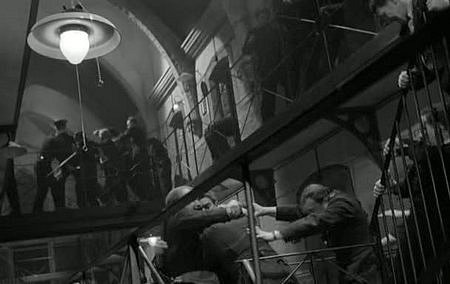
The Criminal opens with a shot of three men sitting around a table playing poker with tense concentration. As they make their final bet of 7,000 pounds and lay down their cards, the camera draws back for a longer shot—to reveal that the men are actually sitting in a prison cell and the 7,000 pounds is really seven cigarettes. Almost immediately the credit sequence begins, a two-minute long take of numerous prisoners and guards and the roving camera performing an elaborately choreographed dance around each other while the credits roll and on the soundtrack Cleo Laine sings the mournful, bluesy theme song: "All my sadness, all my joy / Came from loving a thieving boy." It's a remarkable opening which announces unequivocally that this is going to be a film that uses image and sound in ways which will keep us constantly surprised.

In the film Stanley Baker plays a career criminal named John Bannion who is due to be released on parole the next day. During his three years inside, he has been planning a racetrack robbery in meticulous detail. Upon his release he reconnects with an old criminal crony, Mike Carter (played by the American actor Sam Wanamaker, another refugee from the Hollywood witch hunts), who helps him handpick a team to assist in the heist. The evening of his release, Carter organizes a welcome home party for Bannion, where he meets the sexy and seductive Suzanne (Margit Saad), who throws herself at him, and soon he has fallen in love with her. The robbery succeeds, and Bannion takes the stolen money to a field in the countryside, where he buries it, planning to retrieve it to be laundered after it has cooled off.

When Bannion makes the mistake of taking 500 pounds from the loot to buy an engagement ring for Suzanne, this allows the police to trace the money back to him, and he quickly finds himself back in prison. As soon as he arrives, he begins to plan an escape so that he can make his way to the loot, the escape to be covered by a riot engineered by Bannion's prison friends to divert attention away from him. The riot and escape form a stunningly conceived sequence, sensationally staged by Losey, photographed by Robert Krasker (Carol Reed's Odd Man Out and The Third Man), and scored by jazz composer John Dankworth. It's a good example of what David Thomson identifies as the defining feature of Losey's early films, the melding of the contradictory qualities of "subtlety" and "hysteria"—subtle in its precisely controlled visual choreography, hysterical in its typically flamboyant Losey touches and its hyperkinetic sense of organized chaos.


The screenplay, credited to Alun Owen (A Hard Day's Night) but according to the British Film Institute actually a rewrite of a script by veteran Hammer Films writer Jimmy Sangster, gives the film a tidy four-act structure. The first and third parts—about half the film's running time—take place in prison. In many ways these sections are an update of the traditional Warner Brothers-style prison movies of the thirties. The power structure of the inmates with Johnny as "top man," the opposing alliances of prisoners enforced by violent intimidation, the autocratic head guard, the weak prison warden—all the elements associated with this type of movie are present, only depicted here with even greater than usual emphasis on prison corruption and brutality. As bleak as this prison world is, though, it's a world that is totally ordered and self-regulated. The rules that govern it are understood, each man has a defined place in its power hierarchy, and its concepts of justice and ethics—as peculiar as they may be—are clear. At the same time it's also a world whose sense of order allows for a certain amount of individuality and fluidity within its social structure.

One of the great ironies of The Criminal is that when Bannion leaves prison, he finds in the criminal world outside its walls an even more oppressive environment, and the film takes an unexpected turn from a prison/heist movie to a movie about a loner battling the power elite (a type of narrative strategy Losey would use with even more startling results in his next film, the juvenile delinquent thriller turned sci-fi chiller These Are the Damned). At this point the film noir ethos really comes into play. Maybe Losey did in fact have a Marxist world view, because what happens to Bannion outside prison could almost be considered analogous to the plight of the individual worker in the face of a monolithic power structure, here a criminal syndicate organized on corporate principles. As Mike Carter warns Bannion at one point when he attempts to rebel against the dictates of the higher-ups in the criminal world, "Your sort doesn't fit into an organization. So we can't have you running about messing things up, now can we, Johnny?"

An even greater irony is that while Bannion might believe he's in control of his destiny, in this deterministic film noir universe the concept of choice turns out to be largely illusory. It is only toward the end of the film that he realizes he has been played and betrayed by the criminal organization the whole way to get him to lead them to the money. Every decision, every action he has taken has actually been preordained. Subtle forces have been exerted on him to move him in a certain direction, and his every reaction to these forces has been predicted and plotted in advance. Bannion thinks he has been acting on his own initiative, but the entire time since his release from prison, about twenty minutes into the movie, he has been callously manipulated like a piece in a chess game.

If like Bannion you think there is any possibility of his overcoming the odds against him, forget it. "Don't be a silly boy, John," Carter tells him smugly. "You can't win." And of course he's right.

You might also like:
• These Are the Damned (1963)
• They Made Me a Fugitive (1947)

These Are the Damned (1963)

Monday, June 28, 2010

***½
Country: UK
Director: Joseph Losey


Black leather, black leather
Smash smash smash
Black leather, black leather
Crash crash crash
Black leather, black leather
Kill kill kill
I got that feeling
Black leather rock

So goes the song chanted by a group of leather-jacketed, motorcycle-riding British Teddy Boys at the beginning of Joseph Losey's astonishingly bizarre film These Are the Damned, released in April as part of the Icons of Suspense: Hammer Films collection. Part romance, part thriller, part teen alienation picture, part nuclear age angst movie, part government conspiracy paranoia, part science fiction—the film synthesizes elements from all these genres into a unique form that defies categorization. It does, however, plainly show what David Thomson identifies as Losey's defining trait as a director—his blending of the apparently contradictory qualities of "subtlety" and "hysteria."

The movie opens with an American tourist, Simon Wells (Macdonald Carey), guide book in hand, being brazenly picked up on the street in the southern English coastal town of Weymouth by a young woman, Joan (Shirley Anne Field). It turns out she is acting as bait to lure gullible male tourists into being robbed by a gang of motorcycle thugs led by her sadistic brother, King (Oliver Reed). When the bloodied Simon is taken to a hotel by a couple of friendly strangers (who are actually military officers in civilian clothing) to recover, he meets their colleague Bernard (Alexander Knox, like Losey a victim of the Hollywood blacklist who relocated to Britain), a scientist working with them on a top-secret government research project, and Freya Neilson (Viveca Lindfors), the Swedish sculptor who is possibly Bernard's former lover and who has rented his cottage, The Bird House, located next to the research center, for the summer season.

Later as Simon, recovered from the attack, leaves Weymouth in his boat, he reconnects with Joan, now fleeing from the possessive brother who seems to have an unhealthy obsession with her sex life. ("You think I'll let a man put his filthy hands on you?" King angrily asks after she admits her attraction to Simon.) Pursued by the brother and his gang, Joan takes off with Simon in his yacht and the two begin an affair. When they are followed by the gang and forced to hide out, Joan directs him to the secluded Bird House. Soon all these characters—Simon, Joan, King, Freya, and Bernard—meet up again and become involved in the top-secret government project, which involves psychological experiments on a group of decidedly spooky children. When the two lovers realize the children are being held against their will, they determine to help the children escape.

These Are the Damned was distributed by Columbia but was a Hammer production, and it shows, especially in the lurid and rather misleading publicity for the movie, clearly intended to capitalize on the success of Village of the Damned (1960). Like many Hammer horror films, especially those with a modern setting, it deals with outsiders who find themselves enmeshed in the peculiar goings-on in a strange place where they have just arrived. But just as Alfred Hitchcock did in Psycho, Losey subverts audience expectations by turning a predictable genre on its head, in this case by transforming what at first seems an odd but basically conventional Hammer thriller—two lovers on the run from a pack of predatory monsters—into a movie about repressed incestuous impulses, fear of nuclear destruction, distrust of government, the inhumanity of scientific research, existential angst, and the social disintegration of the modern world.

One thing that distinguishes These Are the Damned from typical Hammer fare is the attention paid to the visual element of the film. It is the haunting look Losey creates for the movie that gives the film its thematic gravity and visual urgency. That this is going to be no ordinary Hammer horror film is apparent from the opening shots. The first thing we see is a static, picture postcard view of the sun-drenched southern English coast in high summer, the gently curving cliffs receding to the horizon, crowned by lush meadows, with waves breaking languidly at their base. After a few moments the camera pans to the right, and when it stops we now are looking at the edge of the clifftop stretching horizontally across the vast CinemaScope screen, a group of grotesque post-modern sculptures silhouetted against the blank sea and sky. These are the sculptures of Freya arrayed outside The Bird House, and most seem to be either monstrous, gargoyle-like birds (she refers to one of her works in this style as "my graveyard bird") or misshapen human forms that resemble nothing so much as the anguished victims at Pompeii.

Such strong visual contrasts are found throughout These Are the Damned. The traditional streets of Weymouth typified by the clock tower where Simon first meets Joan, with its unicorn statue and large plaque of Queen Victoria, contrast vividly with the fortified, ultra-modern research facility where Bernard conducts his experiments on the children, with its array of high-tech gadgetry used to spy on the children and its walls decorated with semi-abstract paintings whose dominant mood is of dread and alienation. The open-air scenes of sea, sky, and meadows and The Bird House, built right into the cliff so that its whitewashed walls and grass-covered roof seem almost a natural extension of the landscape, form striking counterpoints to the futuristic underground dormitory excavated deep in the cliff face where the children live, deprived not only of natural light and air, but of any direct human contact except with one another.

This is a movie whose details of plot and production design cumulatively relay an atmosphere of hopelessness, a movie that shows the futility of any attempt to escape by the people trapped in the bleak world it depicts. Bernard, the representative of order (government) and knowledge (science), decries the "senseless violence" of youth culture yet has no qualms about subjecting the children in his experiments to psychological cruelty. He regretfully accepts the inevitability of nuclear war and the destruction of the human race while at the same time coldly sanctioning the deaths of those who oppose his scientific aims and even committing murder himself. The ultimate irony of the film is that those individuals with the most humanity are in the end destroyed by those with the least humanity, who justify their actions as a means of ensuring the survival of humankind after a nuclear holocaust. One of the most weirdly entertaining movies of the Cold War is also one of the darkest, most disturbing, and most cynically anti-authoritarian of that anxiety-ridden time.
 

Blogger news

Blogroll

Most Reading