Pages

Powered by Blogger.
Showing posts with label British Cinema. Show all posts

The Spy Who Came In from the Cold (1965)

Monday, October 1, 2012

***½
Country: UK
Director: Martin Ritt

A few weeks ago I wrote about The Ipcress File, one of the finest of the Cold War spy films of the 1960s. Just months after that film was released, another Cold War spy thriller that ranks among the very best films of its type was released—The Spy Who Came in from the Cold. The first of many movies and television shows based on the works of John le Carré, it introduced filmgoers to the peculiar—and very British—espionage world of le Carré, a world whose surface of utter mundanity masks an interior of deception, treachery, betrayal, and psychological manipulation as distorted and illusory as Lewis Carroll's Wonderland.

The film opens in Cold War Berlin in the dead of night with an impressive two-and-a-half minute tracking shot behind the credits that is sure to have you thinking of Touch of Evil. Starting in East Berlin, the camera slowly draws back through the no-man's land between the two sectors, pausing occasionally for a new vantage point before finally stopping at Checkpoint Charlie. The area is almost completely deserted, its darkness punctuated in classic monochrome film noir style with bright pools of light and reflections off damp, glistening cobblestones. Finally we see Alec Leamas (Richard Burton), the head of British intelligence in Berlin, waiting inside the guards' shed for the arrival of one of his East German agents. Just as the agent, riding a bicycle, enters the area between East and West, something goes horribly wrong, and Leamas watches helplessly as his man is shot down by East German border guards.
This is the end of the line for Leamas. He returns to London a burnout case and is soon working at a menial job as a library assistant, a surly depressive who drinks too much. The one bright spot in his life is a budding romance with a young woman who also works at the library, Nan Perry (Claire Bloom). After a drunken brawl with a shopkeeper, Leamas loses his job and is sent to prison. Released from prison and with no prospects in view, he is approached by a man who purports to be from a prisoner aid society but who ends up taking him to a Soho strip club and introducing him to a shady foreigner who offers a large sum of money if he will tell everything he knows about British intelligence to a "reporter," in other words, a Communist spymaster.

But Leamas's seemingly simple plan to reveal his secrets, take the money, and quietly drop out of sight suddenly becomes a great deal more complicated. He finds himself exposed, forced to defect to the East, and inextricably caught up in life-and-death power conflicts within East German intelligence. Friends have become enemies, enemies have become friends, and in this topsy-turvy world the only thing he knows for sure is that he can't trust either side. From British station head in Berlin to alcoholic traitor trapped behind the Wall, Leamas seems to have hit bottom. Or has he? For in le Carré's spy world, the only certainty is that things are seldom what they seem.

Typically for le Carré, a large part of the film's appeal lies in trying to figure out, along with the characters, what is really happening. As the plot develops, surprise revelations tell us that what appears to be happening might not be the full story, that like the people in the film we are possibly being subjected to an elaborately orchestrated narrative intended to mislead, and in the face of this constantly shifting reality we are soon caught up in their paranoia. The entire film has the wintry look and aura of despair, its bleak mood underscored by the drabness of the film's settings and the crisp, stark black-and-white cinematography of Oswald Morris.

Even with all its other assets—including an excellent supporting cast, with Oskar Werner a particular standout as Leamas's East German control—the biggest thing the film has going for it is Richard Burton. At this point Burton was at the peak of his career, over the space of a couple of years turning in one brilliant performance after another, not only in this film, but also in Becket, The Night of the Iguana, and Who's Afraid of Virginia Woolf? Burton could rant and rave and ham it up with the most grandiose screen actors, but in these performances he opted for a restrained approach, emphasizing the inner anguish of the character over emphatic external vocal and physical gestures.

His Alec Leamas is a broken and disillusioned man. Recruited for British intelligence while still in his teens because of his linguistic abilities, he has over the years been slowly worn down. The world of espionage is one that operates in a culture of the end justifying the means. As his control in London tells him, "Our policies are peaceful, but our methods can't afford to be less ruthless than those of the opposition." But after years of double-dealing and triple-dealing and seeing human life treated as a disposable commodity, he has begun to see his job as inhumane and futile. Burton lets us see the pain in Leamas's dead eyes, the hopelessness in his apathetic movements and facial expressions, and the emotional numbness in his guarded, muted reactions. In his one emotional outburst, Leamas tells Nan what it really means to be a spy in a speech that could also serve as a concise statement of le Carré's own views on the subject:
What the hell do you think spies are? Moral philosophers measuring everything they do against the word of God or Karl Marx? They're not. They're just a bunch of seedy, squalid bastards like me. Little men. Drunkards, queers, henpecked husbands, civil servants playing cowboys and Indians to brighten their rotten little lives.
The only person in the film not ruled by this cynical ethos of expediency is the idealistic Nan. Leamas's life before Nan has apparently been one of isolation. He has no emotional attachments, and his only friendships are with others involved in espionage. Nan is the only person with whom we ever see Leamas form an emotional connection. When Leamas tries to protect her from becoming involved in the danger that pervades his life, only to see her dragged unwittingly into it and used as a pawn in the machinations of both sides, he feels that he has been betrayed and that her naiveté has been exploited and corrupted. This realization leads directly to the film's conclusion, with Leamas literally atop the Berlin Wall in the glare of searchlights and forced to decide which way to jump. It's an electrifying finale that reduces to the simplest terms possible the decision that will determine Leamas's fate.

The Ipcress File (1965)

Monday, September 10, 2012

***½
Country: UK
Director: Sidney J. Furie


The success of the first James Bond films in the early 1960s spurred the creation of what amounted to a new genre—the Cold War spy movie. Within a couple of years the characters of Ian Fleming were joined on the screen by those of Fleming's fellow British writers of spy thrillers John le Carré and Len Deighton. The first film based on a novel by le Carré, The Spy Who Came In from the Cold, and the first film based on a novel by Deighton, The Ipcress File, were both released in 1965. Like the earliest Bond films, before the spoofiness and gimmickry began to predominate, The Ipcress File treats its subject seriously but with hints of insouciance. Like the films based on le Carré's novels, it deals with the inner workings of a British spy agency and with questions of loyalty and treason within that agency, but in a more straightforward and less convoluted way than le Carré typically did.

The Ipcress File opens with espionage agent Harry Palmer (Michael Caine) being transferred to a new unit in the Ministry of Defence and assigned to a new case. For some time, an unusual number of research scientists working for the MOD have been resigning, saying that they are no longer mentally up to the work. A break in the case occurs when a prominent scientist is kidnapped right after boarding a train and held for ransom to the highest bidder. The MOD successfully ransoms the scientist, but shortly after his return he suffers a breakdown in the middle of a lecture and must also resign. Now that the government knows the reason behind the sudden "brain drain" of researchers, Harry's unit is assigned the task of finding out exactly what has been happening to these men to cause such a traumatic reaction. The only clues are an abandoned warehouse where the spy agency believes the kidnapped scientist was held and a fragment of magnetic recording tape with the word IPCRESS on it.

For Harry there is another, even more important mystery besides the question of what is being done to the scientists and by whom. In the belief that someone in the agency is giving the kidnappers inside information, Harry determines to find out who is the mole. No longer able to trust anyone in the agency—neither his colleagues nor his superiors—he must pursue the investigation on his own. The film culminates in a mind-bending sequence in which Harry is kidnapped himself and subjected to the same process of psychological torture and Manchurian Candidate-style brainwashing the scientists have undergone.


With its classic suspense plot—in many ways the film resembles a Cold War update of the kind of spy thriller Alfred Hitchcock made in the 1930s and 1940s—The Ipcress File is a tremendously entertaining and exciting picture. While the business-like direction by Sidney J. Furie, the spooky music of John Barry, and the subdued production design of Ken Adam (he did the eye-catching production design of the early Bond films as well as Dr. Strangelove and Barry Lyndon) are instrumental in creating these effects, it's the cinematography of Otto Heller that really stands out. His frequent placement of the camera either very high or very low in relation to the people in the shot, combined with the use of raked camera angles, echoes Harry's conviction that something at the agency is askew and that nothing—and nobody—can be accepted at face value. Heller makes the CinemaScope screen shape seem almost naturalistic, especially in interior shots, often using frames within frames to break the screen into smaller units and add depth to what can otherwise seem a vast, flat horizontal expanse.


What really distinguishes The Ipcress File from the many films of this type that came after the first wave of James Bond movies, though, is the character of Harry Palmer and the man who plays him, Michael Caine. Harry is described at one point as having a reputation within his agency for being "insubordinate, insolent, a trickster—perhaps with criminal tendencies." That seems an apt description of this man who originally was forced into the military intelligence service to avoid a sentence in a military prison and is being coerced into remaining in intelligence by the threat of having to serve that sentence if he ever has thoughts of retiring.

Even before his suspicions about the existence in the agency of a traitor are aroused, Harry is a loner who despises bureaucratic minutiae and prefers to work solo, and that is exactly how he makes the significant breaks in the case that his colleagues are unable to do. In a field where teamwork is the norm, it's an unorthodox method that not only helps him make headway on a case that has everyone else mystified, but makes him the target of villains who would prefer that it remain unsolved. Harry is also a smart aleck, a womanizer, and a bit of a Cockney intellectual, with his love of books, classical music, and gourmet cookery. The film is nearly as much about him as it is about the case he's working on, and The Ipcress File concentrates on him far more so than the two Harry Palmer films which followed.

Before making The Ipcress File, Michael Caine had been working in pictures and in British television for nearly ten years, playing uncredited roles, bit parts, and finally in 1964 a major supporting role in Zulu. Harry Palmer was his first starring role, a part he got after Christopher Plummer and Richard Harris both passed on it. So well does he fit the character, though, that it's hard to imagine anyone else as Harry Palmer. Alfie (1966) is often considered Caine's breakout performance, but I would argue that Harry Palmer in The Ipcress File, coming a year earlier and earning him his first BAFTA nomination for best actor, is the true breakout performance.

It's also one of three performances that mark the high points of Michael Caine's early career and that define what is thought of as the early Michael Caine screen persona, the other two being Alfie and his Jack Carter in Get Carter (1971). Of the three, Harry Palmer just may be the most impressive. Alfie and Jack Carter are dominated by one quality, Alfie by his caddish exploitation of women and Jack Carter by his revenge obsession. Only slightly less intense a character than Alfie or Carter, Harry Palmer gives Caine the opportunity to play someone with multiple sides to his personality, and Caine does this without ever losing the center of the character or giving the appearance of straining to show off his versatility.

It's an accomplished, relaxed, highly confident job of acting that elevates an already very good film into an even better one. The fall of the USSR and the emergence of the War on Terrorism may have put an end to the Cold War spy movie, but the films of this type made in the 1960s can still entertain and thrill, and The Ipcress File is right up there with the best of them.

Vacation from Marriage (1945)

Monday, August 6, 2012

***½
Country: UK
Director: Alexander Korda

During the Second World War, few films with a contemporary setting were made that didn't deal in one way or another with the war and its effects. The main subject of the picture didn't even have to be military training or combat or even holding down the home front. Comedies, melodramas, crime dramas, musicals—virtually all genres were touched in some way by the war. In the last year of the war, a charming British film was made that showed how the war experience caused a fundamental change in the personalities and outlooks of its two main characters, a married couple named Robert and Cathy Wilson, played by two of the most endearing British actors of the time, Robert Donat and Deborah Kerr. The film, called Perfect Strangers in Britain and Vacation from Marriage in the U.S., isn't well known today but after its release in the U.S. in 1946 was well enough regarded to win its writer, Clemence Dane, an Oscar for best original story.

Vacation from Marriage opens in London in 1940 on the morning of the last day before Robert Wilson ships out for training as a seaman in the Royal Navy. Watching Cathy prepare Robert's breakfast and see him off to work—he works as a bookkeeper in an investment firm in the City—shows us two emotionally numb people living a life of astonishing dullness. Each day proceeds according to an unvarying routine. They rise at the same time every morning, eat the same things for breakfast, Robert catches the same bus for work, and so on right up to the time they go to bed. Every August they spend two weeks' holiday in the same place, the staid seaside resort where they spent their honeymoon. Has there ever been a screen couple more conventional and boring?

The war is about to change all this, though.

Right after Robert leaves to begin his training, Cathy decides to make her own contribution to the war effort by joining the Wrens (WRNS, Women's Royal Naval Service). As the film alternates between Robert's experiences in the Royal Navy and Cathy's in the Wrens, the experiences of each parallel those of the other. At first both find the training program dispiriting, and for a while it looks as if they won't make it. But in the end both do, in the course of their training undergoing a process of self-discovery and finding a strength of character and self-confidence that at the beginning of the film neither appeared to have.

Both Robert and Cathy also experience a brush with romance that awakens in them an emotional passion that was completely lacking in the repressed, lifeless couple we were first introduced to. Robert develops a close friendship with a young nurse named Elena (Ann Todd) when he spends several weeks in a military hospital in Tunis after his ship is sunk in the Mediterranean. Cathy has her own near-romantic relationship, with the cousin of her best friend in the Wrens, a naval architect with none of the timidity and limpness of Robert.

When after a separation of three and a half years the two are finally to be reunited on leave, Cathy can't face the prospect of returning to Robert and her former life and decides to demand a divorce. It's during this part of the film, about its last half hour, that everything comes together and the film really soars. When Robert and Cathy finally come face to face, each has undergone such a radical psychological and physical transformation that they literally don't recognize each other. The "helpless kitten" Robert saw in Cathy, and the "clockwork mouse" Cathy saw in Robert, no longer exist. Now that each is confronted with a radically altered spouse, will these strangers learn to accept the changes in each other, or will their newfound strength of will lead to incompatibility and divorce?

Vacation from Marriage was originally to have been directed by Michael Powell when he and Deborah Kerr were involved in a romantic relationship. When they split over career differences—she wanted to go to Hollywood, where MGM was anxious to develop her as their next big female star; he wanted to stay in England—Powell went on instead to make I Know Where I'm Going, which he initially had envisioned as a vehicle for Kerr. Vacation from Marriage then ended up being directed by Alexander Korda, the esteemed producer, director, and founder of London Films. Korda, his brother art director Vincent Korda, and cinematographer Georges Périnal were masters of the studio film, and that mastery shows in Vacation from Marriage, particularly in the scenes set in Tunis and, at the end of the picture, in bombed-out London.

Alexander Korda directed some of the biggest British stars of the time—Leslie Howard, Merle Oberon, Ralph Richardson, Laurence Olivier and Viven Leigh, Charles Laughton and Elsa Lanchester—so it's not surprising that he gets exemplary work from the cast in this film. This was the last picture the lovely Ann Todd made before her breakout starring role in The Seventh Veil, and she brings a gentleness and wistful sadness to the small part of the nurse Elena, a war widow with whom Robert nearly has an affair. Roland Culver invests in Richard, the man who romances Cathy, the charm and refinement he was known for in his more than fifty years as a character actor in British films and television, where he appeared in everything from Dead of Night and Thunderball to Rumpole of the Bailey and The Avengers. The real standout in the supporting cast, though, is Glynis Johns (above) as Cathy's fellow Wren, the kooky Dizzy. She becomes not only Cathy's best friend but also her role model and mentor, encouraging Cathy to break out of her meek, drab prewar personality.

Still, it's undeniable that Vacation from Marriage is given that extra lift which makes it something special by its wonderful stars, Robert Donat and Deborah Kerr. In playing Robert and Cathy, each must portray a person who undergoes a metamorphosis, someone who starts out with a defined personality, whose personality gradually changes under the influence of their experiences in the film, and who emerges transformed into someone essentially different from the person they started out as. This kind of acting must be extraordinarily difficult to do in movies, which are typically filmed out of sequence. Donat, having played characters like Mr. Chips and the Count of Monte Cristo, was an old hand at this sort of thing, but at this point Kerr had made only a few movies and had never done anything quite like this before. Yet she matches Donat at making us really believe in the character, and at making the before, during, and after stages of the metamorphosis wholly convincing.

Technical skill aside, both Donat and Kerr, as always, have screen charisma to spare. Donat, who was nearly forty years old when the film was made, was more than fifteen years older than Kerr, but that actually works to the film's advantage. In the early scenes he looks prematurely middle-aged, which suits his stolid character perfectly. In later scenes he looks, and acts, positively rejuvenated. Kerr, in the early scenes playing without makeup and in frumpy outfits, seems almost like a rather plain schoolgirl. After her transformation she seems to have matured and ripened, with a femininity and sexuality that are unmistakable and a newly independent, assertive personality that makes it plain she won't be willing to go back to being the obedient "little woman" Robert is accustomed to.

When I say Vacation from Marriage really comes into its own during its last half hour, that's because Donat and Kerr finally get to play directly off each other as the film focuses on the battle of the sexes between Robert with his conservative view of a woman's place and Cathy with her war-liberated feminist outlook. To watch these two consummate performers act out the conflict this charming film has so cleverly and entertainingly set up is nothing short of pure pleasure.

Vacation from Marriage plays on Turner Classic Movies on Monday, August 13, as part of TCM's Summer Under the Stars salute to Deborah Kerr. Check local listings for times. This post is part of the TCM Summer Under the Stars Blogathon, which runs the entire month of August. For details check the sites of co-hosts Sittin' on a Backyard Fence and ScribeHard on Film, or visit the blogathon's Facebook page.

I Know Where I'm Going! (1945)

Monday, March 26, 2012

****
Country: UK
Director: Michael Powell


In the 1940s Michael Powell and his writing, producing, and directing partner Emeric Pressburger created a string of films of astounding ambition and scope. In their complex narrative structures and weighty themes, sophisticated use of color, creative integration of music and image, and bravura application of technical resources to create cinema illusion, these films are a series of masterpieces nearly unequaled in motion picture history. Yet in the middle of making dazzling movies like The Life and Death of Colonel Blimp, A Matter of Life and Death, Black Narcissus, and The Red Shoes, Powell and Pressburger concocted a seemingly simple little black-and-white romance that is in its modest way as great an achievement as those more adventurous pictures. The film is I Know Where I'm Going! and of all the Powell and Pressburger movies, it is the gentlest and most charming. Michael Powell called it "the sweetest film we ever made."

The film opens with a short prologue/credits sequence that establishes the main character, Joan Webster (Wendy Hiller). We briefly see Joan as a toddler, child, and young woman who always "knew where she was going," a headstrong person who from her earliest years knew what she wanted and showed single-minded determination to get it. Now as an adult she has determined to marry a rich man and live a life of comfort and has become engaged to her older employer, the industrial magnate Sir Robert Bellinger. Within minutes after the film begins she is on her way to her wedding in Scotland, where Bellinger has established a wartime residence on the island of Kiloran off the west coast. Everything on the journey goes smoothly until the final leg, when she must take a boat from the island of Mull to Kiloran, for the harbor is fog-bound and no boats are able to operate. Joan now finds herself temporarily stranded in a small Scottish village, to the London sophisticate as alien a place as a foreign country.

Joan also finds herself in the company of a young Scottish naval officer home for a few days' leave, Torquil MacNeil (Roger Livesy), also on his way to Kiloran and stranded until the fog lifts. During Joan's stay on Mull, Torquil becomes her guide to the local scenery and culture, introducing her to his friends Catriona (Pamela Brown), who has known Torquil since childhood, and Col. Barnstaple (C.K.W. Knight), an eccentric falconer. He also introduces Joan to other local inhabitants and, outfitted in traditional attire including the kilt, accompanies her to a ceilidh (or traditional Scottish social gathering, pronounced KAY-lee) celebrating the sixtieth wedding anniversary of the parents of his friend John Campbell (Powell regular John Laurie, who is credited as an advisor on the ceilidh sequence), where Joan is introduced to the music and dancing of the isles.

As anxious as Joan is to get to Kiloran, she finds that two things now stand in the way of the comfortable future she has plotted for herself so deliberately. One is practical: the fog which at first wouldn't lift has been followed by a gale that makes it too dangerous to be out on the water. The other is emotional: she finds herself unwillingly attracted to the unpretentious and quietly noble Tarquin, and the attraction is clearly mutual. At first just anxious to get to Kiloran and Sir Robert, she now becomes frantic to get there before her emotions can derail her carefully laid plans for the future.

Finally, in desperation Joan offers a large sum of money to a young boatman to take her to Kiloran during a lull in the storm and Torquil, recognizing the danger of such a foolish act, especially given the treacherous nature of the notorious local whirlpool called the Corryvreckan, insists on accompanying her. During the voyage the worst happens. A gale blows up, the boat's engine stalls, and the three foolhardy sailors must fight for their lives to avoid being drowned in the Corryvreckan, providing the narrative rationale for the thrilling set piece that forms the climactic sequence of the film.

It's a big, technically intricate sequence composed of location shots of the actual Corryvreckan (including some filmed by Powell himself with his handheld camera while strapped to the mast of a boat), shots of the actors filmed in the studio tank at Denham near London using the same small open boat as in the location shots, miniatures and models of the boat and its passengers, and most impressive of all, a Corryvreckan created for the film in the tank at Denham. This mock Corryvreckan, inspired by Cecil B. DeMille's parting of the Red Sea in the silent version of The Ten Commandments, uses gelatin rather than water, a specially built machine to create a realistic whirlpool in the studio tank, and a high-speed camera running backwards so that the whirlpool appears to be rising from the sea when the footage is projected normally. Aside from the sometimes obvious rear projection in the studio shots, the blend of the real and the simulated is nearly seamless. On both the technical and the emotional level, the entire sequence is just stunning.

The Corryvreckan sequence, while the part of the film that most obviously shows Powell's amazing technical skill, is not the only thing in I Know Where I'm Going! that does this, which is why I called the film seemingly simple. Powell originally wanted James Mason to play Torquil, but when Mason was reluctant to go on location to Scotland, he began to look elsewhere. He had known Roger Livesey since the mid-1930s, when he tested him for the lead in one of his quota-quickies, and the two later had a great success with Livesey playing the title role in The Life and Death of Colonel Blimp (1943). Now Livesey wanted to play Torquil and embarked on a campaign to convince Powell, who thought that at thirty-eight Livesey was too old for the part, to cast him. He lost weight, dyed his hair blond, and worked on modifying his body language to suggest that of a man ten years younger. It worked and he got the role.

The only hitch was that Livesey was committed to a play in London and wouldn't be able to go to Scotland when the location shooting was scheduled. By now convinced that Livesey was indeed right for Torquil, Powell promised him he could get around this. Using a specially selected and coached double for the location shots, he cleverly combined long shots of the double with closer shots of Livesey filmed at Denham and carefully manipulated staging, editing, and optical effects to conceal the fact that, as Powell writes in his autobiography, Livesey "never came within five hundred miles of the Western Isles." If you don't already know this before you see the film, it's unlikely you will be aware of it. Powell later wrote that "so perfect was the illusion that I couldn't tell myself, now, which is Roger and which is his double."

Yet for all Powell's technical skill at creating cinematic illusion, what makes his films so memorable is that no matter how much trickery he used to produce those unforgettable images, he never lost sight of the importance of building the film on the human element—a compelling story and authentic character relationships and emotions. None of his films illustrates this better than I Know Where I'm Going! All the people in the film seem fully defined and individualized, right down to the unforgettable supporting characters like Catriona, Col. Barnstaple, John Campbell, Rebecca Crozier the grande dame of Mull, and characters who appear in only one or two scenes. At the center of the film, of course, are Torquil and Joan—Torquil the completely unaffected man and Joan the self-willed young woman on her way to marriage and a new life who is so taken by his steadfastness and openness that for the first time ever she begins to doubt that she does know where she's going.

As Torquil and Joan, Roger Livesey and Wendy Hiller play off each other beautifully. Livesey locates the calm center of Torquil and never strays from it. That constancy is the essential personal quality of Torquil, but it means that he is basically a static character. Hiller has the more challenging role. She has to establish an apparently fixed character then show how that person gradually undergoes an involuntary process of self-discovery. Joan is a woman whose outer rigidity acts to tamp down an inner emotional volatility that becomes agitated by her reactions to the people and places she encounters on her way to Kiloran. She finds an unfamiliar culture with customs and values that might have come from a previous century and falls in love with both a man and a way of life. Under the influence of Torquil and Scotland, this woman who has lived her entire life wrapped up in herself is unexpectedly taken out of herself, and the experience transforms her. Wendy Hiller shows subtly but unmistakably the conflict Joan feels as, against her will, she finds her own nature changing. Hiller rarely made movies, preferring to work on the stage, but her performance in I Know Where I'm Going! is simply one of the most memorable by an actress in British cinema.

I Know Where I'm Going! is perhaps Michael Powell's most personal film, for it expresses more strongly than any other his love of the sea and especially his love of Scotland. As with all of Powell and Pressburger's films, this one is a collaborative effort between the two, and I certainly don't wish to minimize the contribution of Pressburger. Yet the thing that gives the film its essential flavor, the Scottish element, was the product of Michael Powell. In his autobiography Powell describes how in I Know Where I'm Going! Pressburger devised the basic events of the plot and then he (Powell) fleshed them out:
This is the way Emeric and I always worked. He invented a situation and I followed it through to the end. Authors think of a storm, wind and waves and a stormy sea. A director personalizes the conflict. . . . According to our usual plan of work, my job was to add to and change the location sequences, bringing in all I had learned of authentic dialogue, atmosphere and names of the Western Isles.
With Torquil and Joan, Michael Powell's Scotland is really the third main character in the film. Powell invites us to discover along with Joan the color and customs of a place he depicts as magical, a place that has the power to bewitch, to alter the most ingrained attitudes, and to move those who encounter it in wholly unanticipated but serendipitous directions.

You might also like:
This post is part of A Tribute to the Archers: A Powell & Pressburger Movie Blogathon. For more posts on the films of Michael Powell and Emeric Pressburger, visit the Classic Film and TV Cafe. Michael Powell's autobiography is A Life in Movies (New York: Knopf, 1987).

The Criminal (1960)

Monday, February 6, 2012

***½
Country: UK
Director: Joseph Losey


In a recent post on They Made Me a Fugitive (1947), I cited that film as a rare British example of American-style film noir. Joseph Losey's 1960 picture The Criminal (released in the US two years later under the rather misleading title The Concrete Jungle) is another example of a film noir made in Britain with genuine fidelity to the conventions of the genre, although with some updating—it's more lurid and more sexually explicit than earlier American examples of the genre—that brings it closer to the spirit of the then-emerging Swinging Sixties. Losey was, of course, actually an American with previous experience directing Hollywood noirs (M, The Prowler, The Big Night), a refugee from the film industry witch hunts of the early fifties. Relocating to Britain and working at first under various pseudonyms, he continued his film directing career as an expatriate until his death in 1984.

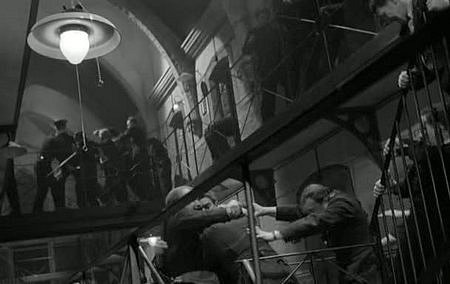
The Criminal opens with a shot of three men sitting around a table playing poker with tense concentration. As they make their final bet of 7,000 pounds and lay down their cards, the camera draws back for a longer shot—to reveal that the men are actually sitting in a prison cell and the 7,000 pounds is really seven cigarettes. Almost immediately the credit sequence begins, a two-minute long take of numerous prisoners and guards and the roving camera performing an elaborately choreographed dance around each other while the credits roll and on the soundtrack Cleo Laine sings the mournful, bluesy theme song: "All my sadness, all my joy / Came from loving a thieving boy." It's a remarkable opening which announces unequivocally that this is going to be a film that uses image and sound in ways which will keep us constantly surprised.

In the film Stanley Baker plays a career criminal named John Bannion who is due to be released on parole the next day. During his three years inside, he has been planning a racetrack robbery in meticulous detail. Upon his release he reconnects with an old criminal crony, Mike Carter (played by the American actor Sam Wanamaker, another refugee from the Hollywood witch hunts), who helps him handpick a team to assist in the heist. The evening of his release, Carter organizes a welcome home party for Bannion, where he meets the sexy and seductive Suzanne (Margit Saad), who throws herself at him, and soon he has fallen in love with her. The robbery succeeds, and Bannion takes the stolen money to a field in the countryside, where he buries it, planning to retrieve it to be laundered after it has cooled off.

When Bannion makes the mistake of taking 500 pounds from the loot to buy an engagement ring for Suzanne, this allows the police to trace the money back to him, and he quickly finds himself back in prison. As soon as he arrives, he begins to plan an escape so that he can make his way to the loot, the escape to be covered by a riot engineered by Bannion's prison friends to divert attention away from him. The riot and escape form a stunningly conceived sequence, sensationally staged by Losey, photographed by Robert Krasker (Carol Reed's Odd Man Out and The Third Man), and scored by jazz composer John Dankworth. It's a good example of what David Thomson identifies as the defining feature of Losey's early films, the melding of the contradictory qualities of "subtlety" and "hysteria"—subtle in its precisely controlled visual choreography, hysterical in its typically flamboyant Losey touches and its hyperkinetic sense of organized chaos.


The screenplay, credited to Alun Owen (A Hard Day's Night) but according to the British Film Institute actually a rewrite of a script by veteran Hammer Films writer Jimmy Sangster, gives the film a tidy four-act structure. The first and third parts—about half the film's running time—take place in prison. In many ways these sections are an update of the traditional Warner Brothers-style prison movies of the thirties. The power structure of the inmates with Johnny as "top man," the opposing alliances of prisoners enforced by violent intimidation, the autocratic head guard, the weak prison warden—all the elements associated with this type of movie are present, only depicted here with even greater than usual emphasis on prison corruption and brutality. As bleak as this prison world is, though, it's a world that is totally ordered and self-regulated. The rules that govern it are understood, each man has a defined place in its power hierarchy, and its concepts of justice and ethics—as peculiar as they may be—are clear. At the same time it's also a world whose sense of order allows for a certain amount of individuality and fluidity within its social structure.

One of the great ironies of The Criminal is that when Bannion leaves prison, he finds in the criminal world outside its walls an even more oppressive environment, and the film takes an unexpected turn from a prison/heist movie to a movie about a loner battling the power elite (a type of narrative strategy Losey would use with even more startling results in his next film, the juvenile delinquent thriller turned sci-fi chiller These Are the Damned). At this point the film noir ethos really comes into play. Maybe Losey did in fact have a Marxist world view, because what happens to Bannion outside prison could almost be considered analogous to the plight of the individual worker in the face of a monolithic power structure, here a criminal syndicate organized on corporate principles. As Mike Carter warns Bannion at one point when he attempts to rebel against the dictates of the higher-ups in the criminal world, "Your sort doesn't fit into an organization. So we can't have you running about messing things up, now can we, Johnny?"

An even greater irony is that while Bannion might believe he's in control of his destiny, in this deterministic film noir universe the concept of choice turns out to be largely illusory. It is only toward the end of the film that he realizes he has been played and betrayed by the criminal organization the whole way to get him to lead them to the money. Every decision, every action he has taken has actually been preordained. Subtle forces have been exerted on him to move him in a certain direction, and his every reaction to these forces has been predicted and plotted in advance. Bannion thinks he has been acting on his own initiative, but the entire time since his release from prison, about twenty minutes into the movie, he has been callously manipulated like a piece in a chess game.

If like Bannion you think there is any possibility of his overcoming the odds against him, forget it. "Don't be a silly boy, John," Carter tells him smugly. "You can't win." And of course he's right.

You might also like:
• These Are the Damned (1963)
• They Made Me a Fugitive (1947)

They Made Me a Fugitive (1947)

Monday, January 16, 2012

***½
Country: UK
Director: Alberto Cavalcanti


For about ten years after the end of World War II, until the mid-1950s, the influence of film noir in the American film industry was pervasive. Every year dozens of films were made in the genre, and even pictures not in the genre were influenced by the visual style and the attitude of film noir. Although many British crime films were made in this period, few that I've seen come as close to the look and spirit of postwar American film noir as Alberto Cavalcanti's They Made Me a Fugitive (released in the US in 1948 as I Became a Criminal).

In one of his earliest film roles, Trevor Howard plays Clem Morgan, a recently discharged Royal Air Force pilot having trouble adjusting to the routine of civilian life after the daily risk of being a wartime flier. So when he is recruited by a small-time London gang leader involved in the postwar black market, Clem eagerly accepts to put a bit of excitement and danger back in his life. The gang leader, Narcy, short for Narcissus (Griffith Jones), is a ruthless Cockney looking for the upper-class Clem to add a bit of cachet to the gang. Working out of an undertaker's office, the gang specializes in the usual postwar black market items like cigarettes and nylon stockings, smuggled into their headquarters in coffins.

When Clem discovers that Narcy is smuggling drugs as well and threatens to leave the gang, Narcy promises to stop this, but it's clear that he resents Clem's challenge to his power. This, combined with Narcy's interest in Clem's posh, slutty girl friend, seals Clem's fate. Framed by Narcy during a robbery in which a policeman is killed, Clem is convicted and sent to prison. But he manages to escape and make his way back to London in search of the one gang member who can prove his innocence. After a series of misadventures, he hooks up with Narcy's former girl friend, a showgirl named Sally Connor (Sally Gray) who, bitter about being dumped by Narcy, agrees to help Clem. While simultaneously avoiding both the police and the vicious Narcy, Clem and Sally gradually find themselves attracted to each other.

The reason French film critics called this type of picture film noir is the pervasive darkness of the world it depicts, a darkness that extends far beyond the predominance of nighttime scenes, the night clubs, the criminal activities, the treacherous urban settings, and the underworld milieu typical of the genre. They Made Me a Fugitive certainly has these—along with the Expressionist-inflected cinematography, courtesy of the Prague-born Otto Heller, and the striking editing of the great film noirs—and more. Like the best film noirs, it has a sense that the world is a place where corruption is endemic, a place where people are ruled by self-interest and where nobility, morality, and any kind of ethical behavior are rare commodities indeed. There are no heroes in this world, with its relentlessly bleak view of human nature. Even the people the fugitive Clem encounters on his way to London turn out to be selfish manipulators intent on using him for their own ends.

Instead we see arrogant psychopaths like Narcy, an ego-driven dandy who stops at nothing to get what he wants, whether it's money, material goods, unearned status, or the girl he fancies at the moment. Most of all, he wants power, the ability to control other people through their terror of him and use them as instruments of his will. Griffith Jones gives a chilling performance as the vain, tyrannical Narcy. Even in a film as brutal as this one, his sadism is startling. The scene where he punches and kicks Sally in her dressing room after he finds she has visited Clem in prison seems strong even by today's standards of violence. But in 1947 it must have been downright shocking, far more graphic than anything similar I've seen in an American film of the time.

Matching Jones's performance is Trevor Howard as Clem. In his long film career Howard didn't often play such an unrepentantly unsympathetic character, but when he did—in pictures like Outcast of the Islands (1951), Sons and Lovers (1960), as Capt. Bligh in the 1962 Mutiny on the Bounty—he was most effective. His Clem is as cynical an antihero as you'll find in postwar British cinema. He is not motivated by any abstract sense of justice. His world is too pitiless a place and too indifferent to the suffering of any one individual to expect any such thing, and he is too aware that he is in the eyes of society himself a villain. Instead he is driven by a strictly personal sense of having been wronged. It's a stark, amoral take on the kind of film Alfred Hitchcock made time and again, the story of the wrongly accused man on the run desperately trying to prove his innocence.

The thing that most closely allies this film to postwar American film noir, though, is its unrelenting sense of fatalism. This aura of doom is the thing that for me distinguishes film noir from the gangster and crime films from which it developed—that feeling that the main character is enmeshed in circumstances beyond his control from which there is little possibility of escape. In the conventional gangster picture, the main character's fate is the result of flaws in his own nature, an ego that becomes so bloated that it spins out of control and leads to self-destruction. In film noir, the main character is a victim controlled by external forces. Like Clem, he may be responsible for putting himself in the situation that leads to his downfall, but in the end he becomes controlled by the situation. Unlike the gangster, the film noir antihero's downfall is ultimately caused not by internal, but by external forces.

One of the most intriguing things about They Made Me a Fugitive is the way it teases us at the end with the possibility that Clem might be able to avoid his fate after all. This comes about after a Hitchcock-like set piece that forms the picture's finale. With the police looking on from below, Clem chases Narcy across the roof of the undertaker's parlor which is the gang's hideout, a building with a huge sign that reads RIP on its roof. (Did I mention what a bizarre sense of humor and an almost Dickensian feel for the macabre the film has—perhaps not surprising from the director of the 1947 Nicholas Nickleby and the best episodes of Dead of Night.) Will Narcy relent and exonerate Clem in the end? Not on your life. Narcy remains true to character, continuing to insist that Clem is responsible for the policeman's death. Will Clem take comfort from Sally's vow to wait for him? "I was afraid you'd say that," he tells her coldly as he is led away.

There are no bogus happy endings in They Made Me a Fugitive, no contrived reversals intended to restore the viewer's sense of security and comfort. The movie doesn't draw back from following through on the implications of its cynical view of the world, but is faithful to its downbeat film noir sensibility to the end.

Turner Classic Movies is airing They Made Me a Fugitive on March 8. Check local listings for times. It's also available from Kino Video as part of the set Film Noir: Five Classics from the Studio Vaults.

Ken Russell at the BBC, Part 4: Song of Summer (1968)

Monday, October 24, 2011

The final film in the six-film box set of Ken Russell's work at the BBC in the 1960s is on the English composer Frederick Delius (1862-1934). Of all the films in the set, this is the closest in its narrative organization to a conventional feature and the most subdued in tone. It is also the only film of the six based not on an original screenplay but on an existing source, the book Delius As I Knew Him by Eric Fenby, who collaborated with Russell on the screenplay, and it is to this that Russell attributes his stylistic restraint: "Song of Summer was less fragmentary and kaleidoscopic than some of my work. But the book was a straightforward story [with] a beginning, a middle, and an end, and there didn't seem to be any point in jazzing it up." Although the least tricked up film in the set, it is ultimately the most satisfying, a moving work that offers Russell's most profound insights yet into the creative mind of the artist.

The film covers the last five years of Delius's life and his association with a young Yorkshireman, Eric Fenby, a self-taught musician and composer who became Delius's assistant during this time. Hearing a work by Delius on the radio one evening, Fenby writes to Delius's wife Jelka offering his services. By this time, Delius is paralyzed and blind and has for several years been unable to compose. Jelka invites Fenby to join them in their house outside Paris, where they have lived essentially in isolation for more than thirty years. Fenby finds the atmosphere of the household "sinister" (his room is decorated with a copy of Edvard Munch's painting The Scream) and Delius cranky, opinionated, and demanding. At first the two don't get along. Unimpressed by Fenby's limited musical education and inability to follow the composer's attempts to dictate his musical ideas for transcription, Delius bullies the diffident young man mercilessly. Fenby manages to form a close relationship with Jelka, though, and she encourages him to stand up to Delius.

Fenby does assert himself, and eventually, through trial and error, the two are able to work out a method of musical dictation that makes it possible for Delius to begin composing again. The bulk of Delius's compositions were impressionistic tone poems based on natural scenes and elements—places, seasons, the time of day, for example—and although very different in temperament, the two men have one important thing in common that allows them to forge a working relationship: their ability to hear the music in nature and to use that as the source of their inspiration. When Fenby puts a broadcast of Beethoven's Fifth Symphony on the radio, Delius reacts dismissively: "Beethoven, Bruckner, Mahler and that lot. . . . A complete waste of time. . . . Listen to the music of nature. Forget the immortals. I did long ago."

The scenes of their first successful working sessions together, about half an hour into the film, are just stunning. Film biographies have often attempted to portray the almost subliminal communication of creative minds that can occur when songwriters work together, but Russell's depiction of this process in Song of Summer is far ahead of any other attempt of this kind that I'm aware of. The film critic Richard Schickel once called Song of Summer "the best dramatic television program I've ever seen" because of its insights into the creative process and the creative personality, and I have to say that, along with Jacques Rivette's La Belle Noiseuse, it's the best film of any kind on these subjects I've seen. As he slowly returns to life, Delius doesn't abandon his waspish personality altogether, but you can nevertheless sense an easing of his frustration and hostility. And you can see his attitude toward Fenby evolve into something resembling gratitude as the two collaborate to translate the melodies in Delius's mind into musical notation. For his part Fenby is very much the receptor in all this—he describes himself as Delius's "amanuensis"—but you can sense his active pleasure in enabling the great composer to regain his creative voice.

The film may concentrate on the last five years of Delius's life, but as he develops greater intimacy with Fenby, he opens up to him and begins reminiscing about the past, and this permits Russell to work in unobtrusive biographical details about Delius. Two episodes from Delius's past are particularly striking. One is of his experiences in Florida as a young man working as a factor on an orange plantation near Jacksonville. After Delius asks Jelka to play a recording of "Ol' Man River" on the gramophone, he tells his young assistant of the profound effect on him of the African American music of Florida, its spontaneous sense of harmony, rhythm, and counterpoint such a contrast to the academic music of Europe. It was in Florida, he tells Fenby, that "I first felt the urge to express myself in music."

The other experience, this time shown in flashback, is one that happened in Norway years earlier, when he could no longer walk but before he lost his sight. He wanted to go to the top of a nearby mountain to see the sunset and was taken there in a chair carried by Jelka, his friend the English composer Percy Grainger, and a Norwegian servant. This is a beautifully conceived sequence which shows the group ascending higher up the snow-covered mountain through clouds that grow ever denser. Then suddenly at the last moment they break through the clouds at the top of the mountain and see the sun setting in the distance. All this is accompanied by glorious music by Delius that exactly corresponds to the mood of the images, building in intensity until it suddenly seems to resolve itself tonally, soar free, and float away in an almost mystical sense of calm and release. Visually and dramatically, this small, technically simple sequence is the centerpiece of the film, a return to the melding of rapturous music with rapturous imagery that distinguished Russell's earlier biographical films on Edward Elgar and Claude Debussy.

In the earlier films in the set, Russell tended to use non-professional actors—often choosing them, like Fellini, for their faces—and to mold their characterizations himself through the writing, photography, and editing. But in Song of Summer, with its more conventional narrative approach, he concentrates more on getting his main actors to create sustained characterizations. And it pays off. Christopher Gable, who plays Eric Fenby, was a ballet dancer who had appeared in only one television program before this film. But he seems wholly comfortable with his character here, conveying all the boyish enthusiasm, hero worship, and insecurity of the young Fenby. Later, as he becomes a full-fledged collaborator with Delius, he makes plain Fenby's greater maturity and self-confidence. (He would go on to work with Russell five more times before his death in 1998.)

Maureen Pryor, an experienced film and television actress who plays Delius's wife Jelka, grounds her character in Jelka's selfless devotion to her husband and her motherly but companionable support of Fenby. Her finest moment comes when Delius delivers a tirade to Fenby against marriage. "It's only from your art you will find lasting happiness in your life," he tells Fenby, then advises him that if he must marry, marry a woman who is more devoted to his art than to him. The blind Delius cannot see the effect his thoughtless words have on Jelka, but we can, and the pain provoked by his insensitivity registers clearly on her face.

As good as those two actors are, though, it is really Max Adrian as Delius who carries the film. At this point in his life, Delius is paralyzed, confined to a wheel chair, and blind. His character unable to gesture or use his body, unable to see, his eyes often concealed behind dark glasses, and his facial expressions immobilized by his illness, Adrian must create a portrait of Delius largely through his voice. Despite these limitations, he gives Delius a tremendously vivid personality. Another of Russell's troubled geniuses, he has the additional burden of being an artist still in possession of his full creative ability, but physically unable to express it. His resentment of his dependence on Fenby gradually becomes tolerance then admiration as Fenby subsumes his own creativity to Delius's and becomes a channel for the great composer's inspiration. Delius may never entirely lose his irascibility and egotism, but Adrian lets us see some of the sharp edges to his personality begin to soften and suggests just a touch of increasing regard for someone other than himself.

Song of Summer is a remarkable finale to the six works in this box set. Beginning with Elgar, the closest to a traditional biographical documentary, Russell proceeds in these films through stages that become more and more idiosyncratic. "There are certain points in every film I do, where I deliberately want to shock people into awareness," he once said in an interview, and in these works you can see him honing this vision of cinema as shock treatment. Finally he arrives at Song of Summer, in which he synthesizes all he has done in the previous films and integrates it into a more subdued yet still emotionally intense experience. To follow Russell through these six films is to be taken through the successive phases of a truly original filmmaker's experimentation with how to tell the life stories of artists in innovative ways. It's a journey well worth taking.

Ken Russell at the BBC, Part 3: Dante's Inferno (1967)

Monday, October 17, 2011

If you didn't know you were watching the beginning of Ken Russell's 1967 biography of the English Pre-Raphaelite poet and painter Dante Gabriel Rosetti (1828-1882), you might think you were watching a black-and-white Hammer horror film from the 1960s. The film opens in sensational Hammer fashion, with the nighttime exhumation of a grave. While eerie, melodramatic music on the soundtrack builds in intensity, torches wave over a coffin being raised from an open grave, the scene shot from overhead. The lid slides away from the coffin and we see an arm sweep away cobwebs from the shriveled remains of a woman in a burial shroud. The arm reaches into the coffin and lifts out a small moldy book, the camera moves in for a closer shot of the face, its skin sunken and stretched tight over the skull, and suddenly the title of the film appears: Dante's Inferno.

Immediately the scene cuts to a shot of Oliver Reed, who plays Rosetti, leaping directly at the camera over a bonfire around which a group of people are cavorting as they toss in paintings in the style of Thomas Gainsborough and Joshua Reynolds and chant slogans like "Away with the wishy-washies!" A narrator explains in voice-over: "Arson, rapine, riot, civil insurrection is terrifying Europe. This is 1848. . . . In England rebels conspire to overthrow the Royal Academy of Art." Thus the film begins in Ken Russell's typically flamboyant style, with the juxtaposition of horror, social rebellion, and high jinks.

For the next hour and a half Russell gives us a crash course in the Pre-Raphaelite movement and the Pre-Raphaelite Brotherhood, with its fascination with knights and damsels and all things medieval. The cast of characters surrounding Rosetti sounds like a who's who of the movement: his sister the poet Christina Rosetti, the painters Millais, Holman Hunt, and Burne-Jones, the decorative artist and founder of the English Arts and Crafts Movement William Morris, the poet Algernon Swinburne, the critic John Ruskin. But always at the film's center are Dante Gabriel Rosetti and his lovers: his model Elizabeth Siddal, Jane Burden, another model who later married William Morris before beginning an affair with Rosetti, and Fanny Cornforth, yet another model with whom Rosetti lived off and on for several years at the end of his life. The film concentrates especially on Rosetti's relationship with Elizabeth Siddal (Judith Paris), a milliner's assistant who became his model, his muse, his mistress, and eventually his wife. Siddal posed for many of the best-known paintings of the Pre-Raphaelites, including Millais's iconic Ophelia. Their relationship was a stormy one, complicated by her mysterious chronic illness, her addiction to laudanum, and her adoption as a protégée by the domineering John Ruskin.

The tone of the film—at least for the first hour—is the mixture of satire and seriousness of Russell's earlier films on Henri Rousseau and Isadora Duncan. The PRB might be preaching a revolutionary message, but unlike their champion the priggish John Ruskin (when offered snuff, he declines, saying condescendingly, "Art is my stimulant"), they aim to have a good time doing it. When early in the film Russell accompanies their prankish behavior with Irving Berlin's "There's No Business Like Show Business" playing on a carnival organ on the soundtrack, we know that these are young men living their lives as theater. Later when Rosetti, Morris, Burne-Jones, and Swinburne spend the summer in Oxford painting murals of the Arthurian legends on the walls of the Oxford Union debating hall, they frolic like buffoons, becoming Russell's Pre-Raphaelite version of the Marx Brothers. Yet when they go out punting on the Isis with Jane Burden, who is posing for the murals as Guinevere, the visuals become almost idyllically beautiful.

After Siddal's death in 1862 from an overdose of laudanum, the tone of the film takes a sharp turn, becoming serious, hallucinatory, and morbid, and stays there for its last half hour. Siddal's death is portrayed in the film as suicide after she learned of Rosetti's affair with Jane Morris. (The coroner's verdict was accidental death.) It is Elizabeth Siddal's grave which is opened at the beginning of the film, and the book inside her coffin is a journal of Rosetti's containing the only copy of his early poems. Persuaded by an unscrupulous art dealer to exhume Elizabeth Siddal to retrieve those early poems so they could be published, Rosetti chose to place commerce over art, and he never really got over what he came to view as a betrayal of the idealistic principles of his youth. Already in a fragile mental state, his health ruined by alcohol and dependence on the drug chloral hydrate, Rosetti was haunted by what he had done. "He accuses and condemns himself . . . endlessly," his sister Christina says of his despair over the exhumation. Russell has said it was specifically that incident and its effect on Rosetti which inspired him to make Dante's Inferno and guided his approach to portraying Rosetti's life.

The film continues the style Russell developed in the earlier semi-documentary biographies in this box set, but with all the elements of that style more elaborate than ever. Voice-over narration, fully dramatized scenes, and a copious number of passages from Rosetti's poetry recited by Reed accompany stunningly staged, photographed, and edited images filled with detailed period decor, costumes, and Pre-Raphaelite art. Especially memorable are images of the Lake District, where Rosetti and Siddal pursue their romance, and a waterfall used as a recurring location at key points in the film. It appears to be the same waterfall where Millais posed John Ruskin for his portrait of Ruskin, an amazingly realistic, almost photographic work that illustrates the Pre-Raphaelite creed of "truth to nature." (The waterfall's exact location wasn't discovered until 2010, so the one used in the film must be a similar one, though it appears virtually identical.)

Early in the film Rosetti paints Siddal posed there. Later, after the exhumation, it appears in a hallucinatory dream/nightmare sequence while Rosetti is stoned on chloral. Still later it appears again in another hallucinatory sequence during his attempt to commit suicide with laudanum, with Siddal reaching out for Rosetti from her open coffin, which is resting on a boulder in the stream, and Rosetti plunging headlong off the boulder and into the stream at the end of the sequence. At the very end of the film, he returns to the Lake District setting of the early days of his romance with Siddal and yet again to that waterfall, which has become an image of the untamed drama of Rosetti's life.

Dante's Inferno is a wonderfully apposite follow-up to Russell's film on Isadora Duncan. Like Isadora, Dante Gabriel Rosetti was a great artist, but also a self-centered showoff who lived life on the grand emotional scale. His contradictory personality was, like Isadora's, composed of traits that were frequently at odds with one another, his serious creative urges shot through with pretension and a degree of dilettantism, his troubled personal and professional lives dominated almost as much by a showbiz mentality as by the artistic impulse. Both were youthful innovators who later ran out of new ideas, who grew stale and saw their creativity fossilize, and whose response to this and to their personal troubles was behavior that became increasingly self-destructive. Theirs was the tragedy of those artists who blaze bright in their youth and burn out in middle age.

Ken Russell at the BBC, Part 2: Always on Sunday (1965) and Isadora (1966)

Monday, October 10, 2011


After his New Wave-influenced The Debussy Film, in which he presented the composer Claude Debussy's life as an intricate Chinese box of time, character, point of view, and narrative mode, Ken Russell next turned to the life of the French painter Henri Rousseau (1844-1910). In his film on Rousseau, Always on Sunday, Russell returns to the more conventional approach of his 1962 biography of the composer Edward Elgar. He uses a combination of impersonal voice-over narration (by Oliver Reed), first-person narration by Rousseau (the voice and accent of the actor playing Rousseau, James Lloyd, sound exactly like those of the English actor Jim Broadbent), passages from contemporary critics' reviews of Rousseau's work, music, and dramatized scenes—some factual, some imagined—to tell Rousseau's story.

Rather than covering all of Rousseau's life, Russell begins with Rousseau's retirement, at the age of fifty-one, after twenty years as a French government civil servant, to devote his life to painting. The very first scene shows Rousseau packing his civil servant's uniform and the French flag (he was a customs inspector) in a trunk and pouring mothballs over them. On the soundtrack we hear a chauvinistic passage from the valedictory letter of Rousseau's supervisor expressing the hope that in his retirement he will produce art which will raise the opinion of France in the estimation of "foreigners." If the title of the film, with its word play on the title of the movie Never on Sunday, doesn't make us suspect that something not quite straightforward is up, Russell gives us a clear indication within the first minute that this is a film whose tone—both visual and verbal—will combine seriousness with satire. That is the innovation of Always on Sunday—its combination of a conventional stylistic approach and a wildly unconventional and constantly shifting tone in which scenes of restrained visual beauty alternate with scenes of outlandish comic exaggeration.

Rousseau retired the same year the avant-garde painters of Paris founded the Salon des Indépendants. This was an annual exhibition in which painters like Manet, Monet, Cézanne, and Seurat could display work that had been rejected for the annual exhibition of the conservative Academy of Painting and Sculpture. In fact, anyone could enter work in the new exhibition, and this is exactly what Rousseau did that first year and nearly every year for the rest of his life. But Rousseau, a self-taught painter and ordinary middle-class retiree, was not part of the Impressionists or any other artistic movement or group and was ignored by other artists and scorned for his primitive style even by critics and those members of the public sympathetic to the new style of painting. This gives rise to a jaw-dropping scene early in the film in which Russell gives full rein to his mordant sense of humor and his extreme sense of dramatic hyperbole.

At the first exhibition of the Salon, a group of onlookers gathers around Rousseau, who is standing beside one of his paintings, and ridicule him. At the front of the group are a rakish gentleman and a woman in tawdry dress. As she gorges on a huge box of chocolates she is holding, the two trade repartee in working-class British accents for the benefit of amused bystanders. The painting, of Rousseau's Army unit, is titled 51st Artillery: A Portrait of the Artist and His Brothers at Arms (it's pictured above), and the couple are making fun of the fact that all of the soldiers look pretty much alike. (They do.) "Which one's he then?" the man asks. "That's him," she says, pointing to one of the soldiers. "No, uh, that's him," he replies, pointing to a different soldier. The pair continue trading those two lines—"That's him!" "That's him!"—faster and more shrilly as the whole group breaks up with laughter and the abashed Rousseau looks on in humiliation. Finally the woman silences the man by shoving a chocolate in his mouth. The entire absurd routine wouldn't seem out of place in an episode of Monty Python's Flying Circus.

Things get even more peculiar when Rousseau is adopted as a protégé by the proto-surrealist dramatist and poet Alfred Jarry, who promotes Rousseau's original painting style as "unconscious" genius. "Why should strangeness provoke mockery?" he asks. Their scenes together are filmed in a frenetic physical style which recalls that of silent comedy, not the balletic comedy of Chaplin or the acrobatic comedy of Keaton, but the hyperactive knockabout farce of the Keystone Kops. Rousseau and Jarry, who is played by the five-foot tall actress Annette Robertson from The Debussy Film, become a weird comedy team of physical opposites in the style of Laurel and Hardy.

If the film later settles into a comparatively more sedate style, it never loses its satirical edge. Yet even though it pokes fun at just about everything in sight, it never makes fun of Rousseau, portraying him as a naïf (he actually considered himself a "realist" painter) and as a perennial outsider, too odd to be fully accepted by the straight world, too unfashionable to be embraced by the avant-garde art movement. Russell treats the neglect of Rousseau's talent during his lifetime—he was consistently dismissed by the public, critics, and other artists—seriously as well. Despite being championed by Jarry, the poet Guillaume Apollinaire, and very late in his life by Pablo Picasso, who discovered Rousseau after buying one of his paintings for a few dollars in a junk shop, Rousseau was only truly recognized as an innovative genius by the Cubists and Surrealists, who claimed him as a forerunner of their styles, years after his death.

Russell takes the satirical exaggeration of Always on Sunday even further in the fourth film in the set, his biography of Isadora Duncan (1877-1927), Isadora: The Biggest Dancer in the World, and this time extends it to the subject of the film herself. The film begins with a narrator reading from newspaper articles describing events in Isadora's life: being banned from Boston after a nude performance, the death of her two children when their car rolls into the Seine, the suicide of the mad Russian poet she married, Isadora's suicide attempt on the French Riviera, finally her bizarre death and her funeral. Accompanying this Citizen Kane-like opening, however, are images played strictly for farce, filmed in fast motion and edited like a manic two-reel silent comedy. The rest of Isadora continues in this vein, as lyrical passages lead to outrageously comic ones. But mostly the tone is comic, covering just about every variety of comedy—farce, satire, irony, parody, visual and verbal humor.

Aside from that opening newsreel-style sequence and a few passages where Isadora (Vivian Pickles) reads from her letters, the narration is by Sewell Stokes, a writer who was a friend of Isadora and is given credit along with Russell for the screenplay and sole credit for the dialogue. "I suppose Isadora had the most sensational life of any woman who has lived during this century," he begins, and what follows makes a strong case that he is not exaggerating. The film really has two stars. One of these is, of course, Isadora herself as portrayed by Pickles. A stage and television actress who was also a trained dancer, Pickles, with her flat-voweled, drawling imitation of an American accent, is a marvel as Isadora, whose motto was "To dance is to live."

A self-taught dancer born in California who modeled her movements on what she imagined to be those of dancers in the statues and frescoes of ancient Greece, Isadora didn't set out to shock, even if that was often her effect on others, but to express herself without the customary constraints of society and to spread her "message of beauty and freedom." She did this above all by using the fluidity of her body in motion to express through movement her inner life and blend her entire being with the moment. If Isadora as portrayed in this film is impossible to take completely seriously, Pickles makes it clear that Isadora took herself seriously. No matter how extravagant her private life or how theatrical and impetuous her behavior, Isadora was absolutely serious about her dancing, which Pickles makes seem earnest, graceful, and spontaneous.

The other star of Isadora is Ken Russell. Here Russell takes the application of the auteur principle to the film biography, begun in The Debussy Film, and goes all the way with it. One expects a film in this genre to be serious, especially when it is dealing with a life as frustrating, unorthodox, and at times tragic as Isadora Duncan's. (Think of Karel Reisz's Isadora with Vanessa Redgrave, which was made at the same time as this film.) Yet nearly everything about Russell's Isadora pulls the film in an opposite direction from its serious subject. Russell's seemingly capricious style is all over the map, veering from gorgeous high-contrast scenes that might have come from a Murnau silent, to scenes of decadence reminiscent of those in a Stroheim silent, to sequences inspired by Mack Sennett and by British New Wave films like Richard Lester's A Hard Day's Night and Tony Richardson's Tom Jones. The choice of music is sometimes serious, sometimes jokey—everything from Satie, Prokofiev, and Beethoven to John Philip Sousa, "Bury Me Not on the Lone Prairie," and "Bye Bye, Blackbird." Serious subjects like death, suicide, drug and alcohol abuse sit side by side with hysterically funny passages that will have you laughing out loud.

For all the gravity of its subject and the quirkiness of Russell's treatment of it, this is one seriously entertaining movie. It's an incredibly dense movie too, covering in one hour more than most films could manage in twice that time. Yet in the end, Russell's synthesis of opposing styles is not merely self-indulgent cleverness, but rather an intentional choice used to make some very important points. Of all the films in the set I've written about so far, Isadora has the most vivid and clearly defined main character. And for all Russell's stylistic shenanigans, this is also the film that makes the strongest statement so far on the nature of art and artists. If anything lingers after watching Isadora, it's the paradox of just how close individualism is to narcissism, genius to foolishness, and a life's tragedy to farce.
 

Blogger news

Blogroll

Most Reading