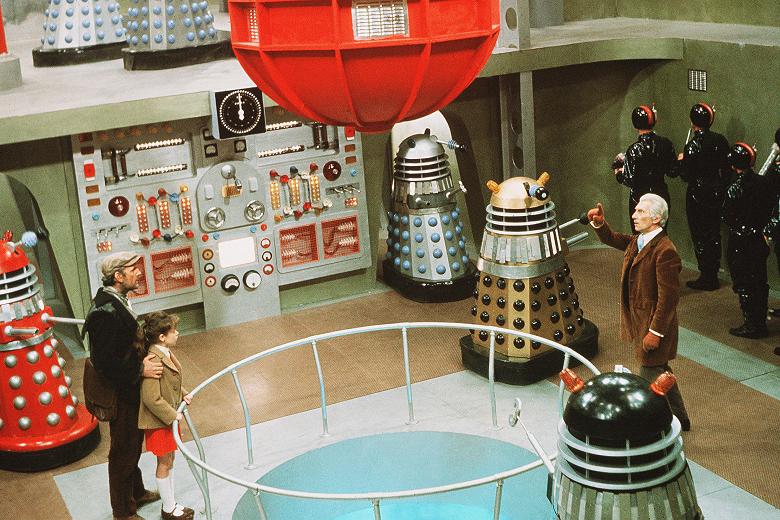
“I had played Winston Smith in ’1984′ on television, and the next thing I played ‘Doctor Who’. I was doing it in the cinema while Bill Hartnell was doing it on TV! That’s the way it goes. It was no surprise to me to learn that the first ‘Doctor Who’ film was in the top twenty box office hits of 1965, despite the panning the critics gave us. That’s why they made the sequel and why they spent twice as much money on it. Those films are among my favourites because they brought me popularity with younger children. They’d say their parents didn’t want to meet me in a dark alley but ‘Doctor Who’ changed that. After all, he is one of the most heroic and successful parts an actor can play. That’s one of the main reasons the series had such a long run on TV. I am very grateful for having been part of such a success story.”
The End of the Affair(1955). Directed by Edward Dmytryk. Cast: Deborah Kerr, Van Johnson, Peter Cushing and John Mills. It is based on the novel The End of the Affair by Graham Greene. It was filmed in London, around the Chester Terrace. Gregory Peck was offered the male lead.
After Maurice Bendrix, receives an honorable discharge from the military and goes back to his writing. Soon after, Maurice, is invited to a party at the home of Henry Miles and his wife Sarah. Henry suggests that Maurice interview Sarah for his new book.
A couple of days later, Maurice meets with Sarah and over a short period of time they fall deeply in love, meeting often at a cozy country inn. Maurice, becomes extremely jealous of her.
In London, Sarah meets Maurice at his apartment and the couple are attacked by German "buzz bombs". Maurice suggests they go below to the shelter, but Sarah worries about his landlady seeing them together. Maurice goes downstairs alone and is caught in the explosion and buried under a pile of rubble.
After regaining consciousness, Maurice goes back upstairs and to find Sarah kneeling by the bed praying, as she believed him dead. Sarah tends to Maurice's injuries and then quickly leaves.
Over the next several days, Maurice recovers from his injuries, but.. is unable to find Sarah. Maurice, believes Sarah used the bombing to break it off with him. Maurice, decides to leave London and does not return for a year.
Maurice, is walking home in the rain when he sees Henry, who invites Maurice to his home and after learning that Sarah was not there, Maurice agrees. Where, Henry shares his concern about Sarah's long absences and was considering hiring a detective. Maurice, volunteers to look into it for him, but.. Henry refuses.
The next day, Maurice visits the Savage detective agency and hires them to follow Sarah.
Later, Maurice meets up with Sarah in front of her house and asks her why she broke it off with him, but Sarah.. offers no reason.
The next day, Maurice meets the Savage agency representative, Albert Parkis, and is surprised to learn that his report was about Maurice's own meeting with Sarah.
A few days later, Parkis calls on Maurice to watch Sarah show up at Richard Smythe's, home whom she has visited several times.
Later, Parkis says that he has befriended the Miles's maid and shows him a love letter written by Sarah. Maurice contacts Henry and tells him what he has learned about Sarah's meetings with Smythe and the letter. But... Henry refuses to believes him.
That evening, Parkis gives Maurice Sarah's diary and tells him that Sarah has been ill. Maurice, begins reading the diary: During their affair, Sarah is concerned that, Maurice's jealousy will ruin their relationship. During the night of the "buzz bomb" attack, Sarah finds Maurice buried beneath the rubble and believes him dead. Sarah promises to God, to give up Maurice if he is allowed to live. When she realizes Maurice's is alive, Sarah must keep her promise and on her way home stops at the church and confesses to Father Crompton. Soon after, Sarah begins seeing Smythe, who says that there can not be a God. Because, he would not allow the war to continue. Having a hard time believing him, Sarah continues to see Father Crompton.
The day that Parkis and Maurice follow Sarah to Smythe's, where she plans to break it off with Smythe telling him that his hatred for God has only proved of his is existence.
Returning home, Sarah writes a love letter to Maurice, apologizing and promising to return to him, but then destroys the letter. Henry, arrives home and begs Sarah not to leave him and she unable to keep up the fight agrees.
After finishing the diary, Maurice goes to see Sarah, who refuses to see him. He shows up anyways, Sarah leaves the house running in a rainstorm. Maurice catches up to her and makes her promise to return to him. But.... will she be able to keep her promise to him?
This love triangle film has many plot twists and turns. Just when you think that the movie is over it goes into a flashback to show you what really happened. The acting by, Kerr, Johnson and Peter Cushing, will keep you in your seat until the unexpected ending.
Nora Swinburne (24 July 1902 – 1 May 2000) was a British actress, born Leonora Mary Johnson in Bath, Somerset, daughter of Henry Swinburne Johnson and his wife Leonora Tamar (née Brain). She married English character actor Francis Lister in 1924, actor Edward Ashley-Cooper in 1934, and actor Esmond Knight in 1946. Her stepdaughter is the actress Rosalind Knight.
She was educated at Rosholme College, Weston-super-Mare and studied for the stage at the Royal Academy of Dramatic Art. As a member of Clive Currie's Young Players in 1914, she appeared at the Grand, Croydon, Court and Little Theatres, during that year. While still a student at the Academy she appeared at the New Theatre on 11 April 1916 as The Wild Flowers in Paddly Pools; appeared at the Comedy Theatre, September 1916, as a dancer in the revue, This and That; and in October 1916 appeared in Samples at the Globe Theatre (now the Gielgud Theatre). She also appeared at the Globe in March 1917 as Gabrielle in Suzette.
Other early roles included Lulu in Yes, Uncle! at the Prince of Wales Theatre in December 1917, and Regina Waterhouse at the Strand Theatre in December 1918. At the Apollo Theatre in 1919 she played the title role in Tilly of Bloomsbury "for about six weeks" according to her personal notes in Who's Who in the Theatre, followed by the role of Roselle in The Betrothal at the Gaiety in January 1921, concluding the year with what she charmingly called "several cinema plays".
132. (07 Jul) Horror of Dracula (1958, Terence Fisher) 63
Fisher's Dracula feels well ahead of its time, brimming with eerie atmosphere almost immediately. However, this version seems oddly truncated. Because there's little build-up before the scares are doled out, the film lacks tension overall. It doesn't help that the vampires are so easily foiled; when Dracula's burnt to a crisp in the final reel, it feels by the numbers enough to make the ending anticlimactic. Still, Fisher's crafted an intelligent, expensive-looking horror movie that lives up to a large fraction of its potential.
Those of us who bemoan Peter Cushing never played Ebenezer Scrooge can take solace in “Cash on Demand” (1961), a first-rate suspense melodrama from the famed English film company.
Set on December 23, Cushing plays Fordyce, a most Scrooge-like bank executive and a notorious stickler for detail and order. He dresses down one of his long-time tellers Pearson (Richard Vernon) for a minor mistake and threatens him with termination. No holiday cheer at this bank in the English provinces, and certainly no time for office chit chat or small talk with the staff.
That morning an examiner for the bank’s insurance company shows up. The smartly dressed Hepburn (Andre Morell) is there to check on the bank’s security system and to make sure everything is on the up and up.
Once alone with Fordyce in his office, Hepburn springs into action. He’s not checking on security but plans to rob the bank with Fordyce’s help. An accomplice has Fordyce’s wife and child held hostage at their home and Hepburn threatens to have them killed if Fordyce doesn’t help rob the bank by a certain time frame.
“Cash on Demand” is based on a play, and it shows somewhat, but it doesn’t seem to matter when performances of this caliber are on display. Both Cushing and Morell are absolutely at the top of their game as we witness the suave and very confident Hepburn toying with the continually battered emotions of the uptight and distraught Fordyce.
The film is only 80 minutes long and there’s not a wasted scene or moment. It’s a terrific suspense movie with no big set pieces, just the mounting tension as the clock winds down.
This is one of Peter Cushing’s very best performances and it’s too bad he never got to play Scrooge. Seen here, one can easily imagine him taking the role on and doing a marvelous job with it.
The dependable Andre Morell is always a pleasure to watch (he’s one of the screen’s best Dr. Watsons) but this is also a standout performance. It’s ironic that these two Hammer mainstays gave among their best performances in a film that was very hard to see until it was released on DVD. One early Hammer book even listed “Cash on Demand” as missing. There were poor VHS dupes floating around in the bootleg market, which didn’t do the film justice.
Earlier this year, the fine folks at Sony Home Video released their latest volume of Hammer offerings in a new collection called “Icons of Suspense: Hammer Films”, six hard to see films including “Cash on Demand.” I have yet to watch the other films, but the set is worth it alone for “Cash on Demand.” I’m greatly looking forward to the other films in the set.
It’s too bad Hammer never made a version of “A Christmas Carol.” A friend of mine came up with having Peter Cushing as Scrooge, Christopher Lee as the three Christmas ghosts and Michael Ripper as Bob Cratchit.
I’ll expand on that: Peter Cushing as Scrooge; Christopher Lee as Jacob Marley; Michael Ripper as Bob Cratchit; Barbara Shelley as Mrs. Cratchit; Francis Matthews as Fred, Scrooge’s nephew; Veronica Carlson as Fred’s wife; Martita Hunt as the Ghost of Christmas Past; Andrew Kier as the Ghost of Christmas Present.
Andre Morell would have to be worked in somewhere, perhaps one of the chaps who asks Scrooge to make a charitable donation to the city’s orphanages.
Sigh. What a wonder it would have been. At least we have “Cash on Demand” to quench the demand of a Christmas movie done Hammer-style.
Hammer’s first mummy movie, titled simply “The Mummy” (1959), is a real treat, and one of the famed British studio’s best films.
I decided to re-visit this favorite after I got the new issue of Little Shoppe of Horrors, a magazine devoted to Hammer movies. The new issue looks at the making of all the Hammer mummy movies. I continue to be amazed, and delighted, that a magazine exists devoted to Hammer movies. Twenty years from now will there be a magazine devoted to Jerry Bruckheimer movies? I seriously doubt it and if there was, then I think it would be time for God to pull the plug on all of us. (The question if there will even be magazines in 20 years is a question for another day).
Hammer enjoyed worldwide success and broke box office records worldwide with their monster re-treads “The Curse of Frankenstein” (1957) and “Horror of Dracula” (1958). Both films starred Peter Cushing and Christopher Lee and were directed by Terence Fisher.
Universal, the great horror movie studio of the 1930s and 1940s, knew a good thing when they saw it and offered up their other past properties for remaking. The next property was “The Mummy” a semi-official remake of the 1932 Boris Karloff classic, and elements from the B movie Kharis series starring Lon Chaney Jr. as the slowest mummy in movie history. As Bill Cosby famously said about these movies, “If you can’t outrun the mummy, you deserve to die.”
For “The Mummy” Cushing and Lee were re-united, along with director Fisher, ace cinematographer Jack Asher and production designer Bernard Robinson, who always made the Hammer movies look more expensive than they were. Regular Hammer composer James Bernard did not return for “The Mummy”, instead replaced by Franz Reizenstein, and it’s one of the film’s happy accidents that Reizenstein’s score accompanies the film. Christopher Lee feels it’s the best score composed for a Hammer movie, and I agree.
Felix Aylmer and Peter Cushing play, respectively Stephen and John Banning, archaeologists looking for the tomb of the Princess Ananka. They discover the tomb, but John doesn’t enter, due to a bad leg. Stephen goes in and accidentally reads from the Scroll of Life, which brings to life the mummy Kharis (Christopher Lee). (A flashback to Ancient Egypt shows Kharis as a priest committing the blasphemous act of using the Scroll of Life to revive his beloved dead Princess Ananka. His punishment was having his tongue cut out, being buried alive in her tomb and serving as her protector for all eternity.)
Shipping the tomb’s contents back to England, the Bannings are followed by Mehment Bay (George Pastell, a terrific performance) who uses the revived mummy to stalk and kill the defilers of Ananka’s tomb. No lumbering Chaney Kharis here, but a fast moving, unstoppable instrument of death. In one of the film’s best scenes, Kharis breaks through the bars and screen of a sanitarium’s window to get at Stephen Banning, who pounds and screams furiously at the door trying to escape.
Eventually, Cushing’s John Banning is the last of the expedition’s members to still be alive, but he’s temporarily saved thanks to wife Isobel (Yvonne Furneaux) who eerily resembles Ananka. Is Isobel the reincarnation of Ananka?
This is a gorgeously shot film, one of Hammer’s most beautiful. The tomb scenes have an eerie green glow to them, and the swamp scenes look like there’s red glowing coals emanating from the marsh grounds. Not sure where the light is coming from but it doesn’t matter. In horror movies I’ll take atmosphere over logic any day of the week and “The Mummy” is drenched in atmosphere.
Lee gives a very good physical performance as Kharis. There’s terrific use of his body and eyes in his scenes when he’s staring at his reincarnated Princess. Cushing, of course, is marvelous, as he always is. Watching Cushing and Lee grapple together in a Hammer Gothic is like watching Fred and Ginger dance…all is happily right with the world.
For a horror film, one of the film’s best scenes is not one of terror but a long dialogue scene between Cushing and George Pastell. Both know what each other’s motives are when Cushing comes to call on the new Egyptian who moved down the road. They feel each other out and soon begin to spar about England’s legitimacy in looting Egypt of its archaeological treasures. Beautifully acted and filled with tension, it really shows off Terence Fisher’s strength as a director. (His other masterpiece, “The Devil Rides Out” (1967), has a similar scene).
But nothing can compare to Kharis’ first attack on the Banning mansion. Kharis smashes through the windows and is unstopped by Banning’s shotgun blasts and skewering by a harpoon. Reizenstein’s music is gloriously all out here, filled with pounding intensity and booming chords. Kharis disarms Banning and begins to strangle him, when Isobel enters the room and screams. Kharis looks at her and Reizenstein’s evocative main theme kicks in, redolent of all things Ancient Egypt. With this piece of music, we know Kharis is looking at the visage of his beloved Princess. The whole sequence is a wonderful textbook example of how effective good film music can be.
According to the Little Shoppe of Horrors, “The Mummy” played in the United States on a double feature with Universal’s odd vampire western “Curse of the Undead (1959). If I was a kid back then and knew that double feature was coming, I would have been unable to sleep for weeks. “Curse of the Undead” has a lot wrong with it, but not the poster. It’s one of my all time favorite posters. Isn’t this stunning?
Hammer followed with other mummy movies with middling success, but none to match the timeless appeal of their first one. It’s one of the best films from the studio and one of the great Gothic horror masterpieces of all time. A wonderful movie.
I watched “Dracula A.D. 1972” (1972, naturally) the other night and, while recognizing its faults, thoroughly enjoyed myself. When I first saw it 20-some years ago I didn’t care for it at all, and hated the “mod” aspects that Hammer brought to their Dracula films.
Now it’s almost like a period film, with the 1970s music, fashions and slang seeming almost as antiquated as the Victorian-era costumes and manners of Hammer’s earlier Dracula films.
“Dracula A.D. 1972” opens with a poorly staged and photographed prologue showing a runaway coach and fight scene between Dracula (Christopher Lee) and his nemesis Van Helsing (Peter Cushing). Dracula is impaled by a broken coach wheel and disintegrates into dust.
One hundred years later Dracula is revived by a disciple Johnny Alucard (dig that groovy spelling kids) during a black mass at an unconsecrated church. The resurrection scene here is very effective. Director Alan Gibson doesn’t skimp on the chills here. While not possessing large budgets, Hammer always made their films look good, and the abandoned church and fog-drenched graveyard adjacent to it is a marvelously atmospheric set.
At this point, the film picks up here to its credit and detriment.
Credit: Dracula starts biting members of the group that resurrected him. Scotland Yard calls in Professor Van Helsing (Cushing again) because he has helped them before on a case involving the occult, and Van Helsing’s granddaughter Jessica (Stephanie Beacham) knew the victims. Unknown to her grandfather, Jessica had been at the ceremony but fled in terror.
Detriment: Unfortunately Hammer wanted to keep the Gothic continuity of its previous films, so kept Dracula confined to the church and graveyard. Hammer was happy to bring him to 1972 but only so far. He may as well be stuck in the 1870s for all that he interacts here with modern London. This was a fatal mistake on the part of the film makers. Producer Michael Carreras takes the blame here.
Credit: Dracula’s first victim is Laura (Caroline Munro, in her first large role) and I was sorry to see her go so soon. Like many guys my age, Caroline Munro was a particular favorite growing up. She’s quite good here, and her reactions to Dracula approaching her in the church are very effective. No bimbo acting style her, her tears and cries for help seem very real. It’s too bad she didn’t stick around longer through the movie, it would have been better for it. (If Hammer knew how popular she would become, she probably would have.)
I’ve met Caroline Munro twice at conventions and a nicer celebrity I’ve never met. She’s a welcome presence in any film and I only wish she had more scenes in “Dracula A.D. 1972.”
Detriment: Christopher Lee didn’t care for the Dracula films that Hammer forced him to make and watching them, one completely understands where he’s coming from. Here he’s given hardly anything to do, sporting little dialogue, snarling his lines and being easily dispatched. By staying confined to one set, he’s hardly the Vampire King.
Credit: Peter Cushing is, as always, remarkable. He likely knows what a piece of junk he’s in, but you’d never know it from his performance here. Never condescending to the material, he gives it all he has. It’s a pleasure to hear him detail the vampire lore he possesses. Always a very physical actor, Cushing engages in fight and chase scenes with the energy of a man several decades younger.
The film’s biggest detriment is the opening society party scene, crashed by Johnny Alucard and his friends who dance to the music of Stoneground. This party scene is interminable, and goes on for what seems like days.
One year later, Warner Bros. would release “The Exorcist” and forever change the face of horror films. Entertaining romps like “Dracula A.D. 1972” to enjoy on a Saturday night out would soon be history.
There’s a lot wrong with “Dracula A.D. 1972” but a lot to like, especially the Cushing performance and the pulp-like narrative. I’ll probably watch it again sooner than more lauded classics. It’s that kind of movie.