Pages

Powered by Blogger.
Showing posts with label Marion Cotillard. Show all posts

296. The Dark Knight Rises

Monday, December 3, 2012

296. (02 Dec) The Dark Knight Rises (2012, Christopher Nolan) 39


The most tolerable of Christopher Nolan's Batman films, The Dark Knight Rises at least has an iota of levity. For the most part, it trudges along in the self-serious fashion of the first two films, but Anne Hathaway's Selina Kyle offers a faint glimpse of the franchise that might have been. She's a buoyant, even silly presence — cracking wise and kicking at things with outrageous heels when she could clearly tone it down. But therein lies the fun in a superhero movie, as Bane is every bit as unpleasant a presence as Heath Ledger's Joker was.

Setting up preposterous plot that never feels properly established or developed, Bane is relentlessly irritating. With the exception of the action sequences centering around him, he's another joyless mouthpiece for Nolan to make Batman as gloomy as possible. The ensemble is bloated, to be sure, but no one sucks the life out of the film as readily as Bane.

The opening scene on an airplane, the football field collapse, and Batman's flying machine make this a worthy Oscar contender for Best Visual Effects. The sound work is also impressive. It took sloppily written transitions and clichés too clunky to ignore (a ticking time bomb, a busload of orphans) to keep this out of the Best Picture race, and I'm so grateful for it.

283. Rust and Bone

Sunday, November 25, 2012

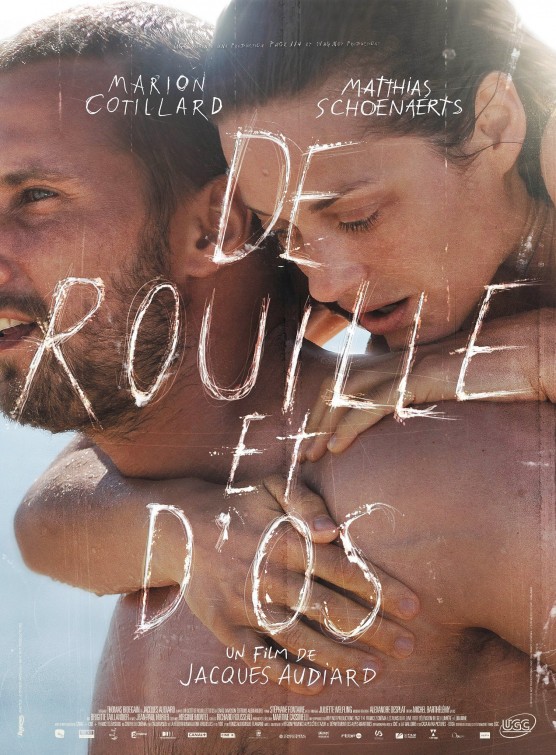
283. (24 Nov) Rust and Bone (2012, Jacques Audiard) 48


There should be some joy in Rust and Bone. For all its bleakness and self-seriousness, it's ultimately about finding companionship and comfort in dark times, yet there's not a moment of levity to be found.

Jacques Audiard never quite gives heart to this character drama. The film at least nicely contrasts Matthias Schoenaerts and Marion Cotillard's characters, as one carelessly destroys his body fighting while the other has to cautiously adapt to her body's limitations. The pair have a chemistry together that lends some credence to an otherwise unbelievable relationship.

Cotillard is a slight standout here, filling in the gaps for a character who's either explosive or entirely demure on the page. Her very faint smile when she's called first Schoenaerts' girlfriend adds a layer I doubt Audiard intended. However, she and Schoenaerts can only do so much with an implausible, limited screenplay full of throwaway scenes. Subplots involving Schoenaerts's surveillance job, his sister and son are all heavy-handed. The corny finale literally treads on thin ice.

The Final Conclusion - Best Actress 2007

Saturday, October 20, 2012

2007


So the much anticipated ranking is:

5. Ellen Page in Juno
 I don't really know what to make out of Ellen Page's extremely weak performance. Although the character is incredibly annoying and as fake as possible, I really think that it's more due to Diablo Cody's  incompetent screenplay and Jason Reitman's forced direction. Ellen Page's only fault is that she's just not talented enough to make this character realistic and human. So after all, for me this work is nothing more than a failed effort.

4. Cate Blanchett in Elizabeth: The Golden Age
Cate Blanchett's second Elizabeth is a real disappointment, but I'm much more forgiving about it than others. Cate is always such a force on screen that it makes up for the flaws of the character a little bit. Although there's no depth or real development in Elizabeth, Cate is able to prevent the movie from being a total disaster and she kept me from turning off the tv set. A flawed performance for sure, but not a real failure.
 

3. Laura Linney in The Savages
Laura Linney gives an extremely relatable, wonderful performance as a person who doesn't seem to be likeable at all at first sight and yet we get close to her and sympathise with her character. She never goes for cheap tricks to portray the neurotic personality of Wendy. She excellently mixes comedy with drama, creating the ideal dramedy performance while seeming effortless all the time (something that one of her fellow nominees didn't really succeed in). 
 

2. Julie Christie in Away from Her
 As Fiona Anderson, Julie Christie gives an amazing, heartbreaking performance that stays with you long after you finished watching the film. She portrays Fiona's pain and suffering with an incredible amount of grace and dignity and that's what makes this movie even more effective and heartwrenching. Although Julie's acting might be too subtle and seem too effortless for some, for me this is a true masterclass in acting, which is easily among the greatest achievements of this fantastic actress.

1. Marion Cotillard in La Vie en Rose
In what's one of my easiest decisions ever, Marion easily walks away with this year. She is nothing short of amazing in every possible way an actress can be. Her performance has the effect of an earthquake: it makes you go through Édith's journey along with her and get to understand why this woman was such a brilliant artist. It's very unusual, extraordinary and unbelievable work from a truly great actress who gives probably the most  brilliant portrayal of a real life person.

So I can proudly announce
that the winner is...
Marion Cotillard
in 
La vie en rose

Easy win.

Final thoughts: What an unexcting year! Everything went the way I expected and things went pretty predictably. Marion simply killed her competition, Julie was shining, Laura was fine and then there were the two other ladies, far behind. With hindsight, I can't see how Marion could have lost this, she's so damn good here. Congrats to Andre Lepaun, Louis and Nues20 on your predictions! :) You can pick a year, that I'm gonna do some time, hopefully. :)

Omissions: 
  • Anamaria Marinca in 4 Months, 3 Weeks & 2 Days

About the next year: I really needed to go back to my favorite decade and my most special actress for some refreshment. :) I think this is enough clue. :) 


What do you think? Any thoughts on your mind?

RUST AND BONE

Thursday, September 6, 2012

RUST AND BONE
Written by Jacques Audiard and Thomas Bidegain
Directed by Jacques Audiard
Starring Marion Cotillard and Matthias Schoenaerts

We can all carry pain, often better than we might expect. French director, Jacques Audiard’s RUST AND BONE is a frank and honest reminder of just how much of that pain we can actually bear. His follow up to the brilliant, A PROPHET, creates its own narrative path toward a level of understanding that can only likely be had by those who have come to the very edge of losing everything they hold dear. For those of us fortunate enough to not know this kind of pain, and for those of us who aren’t afraid to go there, Audiard makes it possible for us to get a glimpse of just how crippling that pain can be.

RUST AND BONE is a romance for those who walk around angry with the world, for those who have lost all faith in even the idea of love. Audiard splits our time almost evenly between Ali (Matthias Schoenaerts) and Stephanie (Marion Cotillard). He is directionless father, who has just taken responsibility for his young boy; and she is a killer whale trainer, who is in a bad relationship. They meet in a bar one night, when he breaks up a fight she gets hit in, and drives her home. Shortly afterwards, she gets into an accident at work with one of the whales during a show and loses both of her legs. They find each other again when she leaves the hospital and form a relationship that is clearly foreign, and frightening, to both of them. Both actors play their parts as entirely self-involved individuals masquerading as self-sufficient ones, so much so that they are practically oblivious to how damaged they’ve become at their own hand. Cotillard, in an inherently showy part, takes a decidedly more subtle approach than one would expect, which allows her to get uglier than I’ve ever seen her get before.


There is nothing sentimental about RUST AND BONE and it requires a certain ability on the part of the viewer to be able to handle its weight. Beneath that weight though is a tiny bit of hope that one would have thought to have been long dead. As Ali and Stephanie begin to spend more time together, and as a physical connection grows between them, they become aware, little by little, of the walls they have built around themselves over time. They were originally meant to protect but have evolved into a tool to keep them separate. The fight back is not an easy one in the least but, like the film itself, it is worth going through to come out the other side enlightened.


LITTLE WHITE LIES

Wednesday, August 22, 2012

LITTLE WHITE LIES
Written and Directed by Guillaume Canet
Starring Marion Cotillard, Francois Cluzet and Jean Dujardin

Ordinarily, when we think about the lies we tell, they are usually the ones we tell others. We don’t often stop to take a hard look at the lies we tell ourselves though. French actor/director, Guillaume Canet’s LITTLE WHITE LIES, his first film since his international hit, TELL NO ONE, is here to ensure we finally turn that mirror inward. Every summer, Max (Francois Cluzet) invites his friends, including Marion Cotillard, to his country home to vacation. When one of the gang gets into a serious accident right before the trip is to take place, the remaining members can’t seem to keep up their facades any longer. While this may not make for a very pleasant summer, it does make for an awful lot of solid drama.


Marion Cotillard in La vie en rose

Wednesday, August 15, 2012

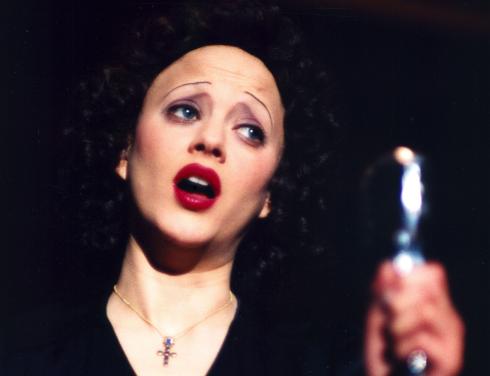
Biopic performances have always been right up the Academy's alley, especially in the last few years when we can't seem to have an Oscar year without such an Oscar winning performance. Still, when a relatively unknown French actress named Marion Cotillard took home an Academy Award for playing Édith Piaf, the legendary French singer over the legendary Julie Christie, viewers were nothing short of shocked. Marion Cotillard's Oscar win shows how the Academy can (and should always) work: Marion Cotillard won an Oscar simply on the merits of her work, which lots of Hollywood actors praised for its bravery. You might say that Marion campaigned for that Oscar, but after all, she got all the attention for her performance and in the end, it was always about her performance. Every once in a while, the Academy really gives the Oscar to what they consider the best performance of the year (I loved 2007 because all the important awards went to the right place, except for Original Screenplay).

Also, it really amazes me that people seem to dislike La vie en rose, which is, in my opinion, one of the three best films of 2007. It achieves everything that The Iron Lady was aiming to and does so effortlessly. Basically, it's about Édith Piaf remembering her life on her deathbed and that explains its odd structure. I feel that the movie should have taken home all the Oscar for the costumes and the win for the make-up was well-deserved. Actually, I would have nominated the film, the director and Emmanuelle Seigner who breaks your heart in her brief time on the scene as Titine, the prostitute who takes care of the five-year-old Edith.

Although Marion Cotillard was no stranger to American audiences after her parts in Big Fish and A Good Year, it was La vie en rose that brought her the recognition that lead to lots of other roles in the US (she's actually even become a sort-of-muse to Christopher Nolan). Some were hoping for an F. Murray Abraham type of post-Oscar career and instead she's become a prolific and popular actress in Hollywood with lots of new fans and the possiblity of another Oscar nomination for her critically acclaimed performance in Rust and Bone (fingers crossed).

Olivier Dahan told reporters that he chose Marion for the part of the French chanteuse because she's the actress who's not afraid of portraying tragedy on the big screen and tragedy is what best describes the life of Édith Piaf: blindness, alcoholism, morphine addiction, being an abandoned child, loss of the true love. It seems that whenever Édith was having a good time or feeling good about herself, there was something coming towards her that would take all the pleasure from her. Even Judy Garland's life story seems to be a cakewalk compared to Édith's. Although each of those above mentioned elements scream Oscar (especially in a biopic), I'm still saying that Marion's performance is a very unusual one to win the Oscar since it ignores so many rules and is so different from everything we've seen before. No wonder her work's become somewhat controversial: first of all, the subject of the movie is really European, it's passionate, the emotions are really overwhelming and I don't think many people got it. Also, some might refuse to read subtitles and think that great performance come only in English. I suppose Julie Christie might have been a more defendable pick for the Best Actress and we all know the Academy likes to play safe. I think it takes a very special performance to overcome all these boundaries and boy, is Marion special in every way!

Even if we ignore every merit of Marion's performance beside the technical part, it still remains a riveting and haunting performance, which rivals Meryl Streep's astonishing work as Margaret Thatcher. Marion transforms into this woman and embodies her so well that you refuse to believe that you're not looking at Édith Piaf. Even if this all sounds cheesy, you have to see to believe it. Marion Cotillard indeed completely disappear and instead we see a woman in different ages and conditions.  The beautiful, young and tall Marion Cotillard becomes a broken-down, dying woman who looks 70 at the age of 47. Marion heartbreakingly shows the effects of Édith's self-destructive lifestyle on her body: her voice becomes scratchier, her body deforms and so on. I don't think I've seen self-destruction portrayed in such a harrowing, brutal way. But the fact is, that Marion disappears even in the scenes without the tons of make-up. Yes, the terrific make-up helped Marion a lot, but she uses it as a tool instead of letting it do the work for her.

And yes, if we're here, let me just adress all the comments about her lip-syncing as it's probably the most annoying thing what I hear about her. First of all, whether an actress sings herself or not is the choice of the director. We all know from Nine (and other movies) that Marion is a terrific singer who could have sung all the chansons of Piaf perfectly, but the aim of the movie was to draw an intimate portrait of Édith Piaf and not  providing a showcase for Marion Cotillard and Piaf's voice was essential to that portrait. Marion's task was to make this voice her own by using her body and main task was to recreate the wonder of Édith Piaf who was much more compley than a great singing voice. During her performances (and in real life) she had a very special aura that made her such an enourmous, radiant presence, which is really indescribable. In a scene, Marion has to recreate this miracle on screen without Édith's voice and she (SURPRISE!) succeeds in every possible way because above all, she embodied the soul of Édith Piaf, which was indeed the key to her personality.

And here we come to the most important thing about her: the most brilliant thing about this performance is neither the technical part nor the emotions, it's really the way these two combine. First, Marion inhabited Édith's soul and spirit, which helped her recreate the phsyical aspects of the character and this is how she developed Édith's. And she did so with the movie standing in her way: since it ignored the chronological order of the events, Marion couldn't develop Édith gradually so she had to find some connections in the story and the events.

On this journey, we get to know many faces of Édith and actually, very few of them is likeable. However, Marion was somehow able to make us look up to Édith even when she's the bitchiest or the nastiest to everyone, because we are able to understand why and how her personality changed throughout the years. As a result, every part of her life is somehow different and the tragedies become heartbreaking for different reasons. As a young woman, the two most heartbreaking moments come right after each other: her menthor dies and her best friend is taken away from her as well. Her drunken meltdown over this (for me) is equal to the choice of Sophie.

My favorite moments in this film come when we get to see the romance between Édith and Marcel Cerdan (and you just cannot ignore the scene between Édith and Marlene Dietrich, which is indeed magical). Life is unusually balanced for Édith here and Marion excels also as a happy woman. For me, the real feat is that she was able to make the happiness of Édith just as haunting as her suffering and that's why the end of this story is one of the most painful scenes in movie history.

However, it's the end that most people will probably remember the most about this performance as it's quite simply cathartic. The moments of the interview on the beach, Édith crying on her deathbed or her final performance are nothing short of amazing. In about 15 minutes, Marion does what others couldn't do in 150 minutes. She shows the essence of Piaf's character without seeming preachy or cheesy. All the pieces of the puzzle fall into place and its effect is just cannot be described with words. Her "advice" for every person becomes so true and so effective, even in its simplicity. And Marion's delivery of that single word is just... :)

In the end, there isn't much to say about Marion Cotillard as Édith Piaf. Cotillard is nothing short of amazing in every possible way an actress can be. Her performance has the effect of an earthquake: it makes you go through Édith's journey along with her and get to understand why this woman was such a brilliant artist. It's very unusual, extraordinary and unbelievable work from a truly great actress who gives probably the most  brilliant portrayal of a real life person.
What do you think? 

The Next Year

Monday, July 30, 2012

2007


So the nominees were:

  • Cate Blanchett in Elizabeth: The Golden Age
  • Julie Christie in Away from Her
  • Marion Cotillard in La vie en rose
  • Laura Linney in The Savages
  • Ellen Page in Juno
A great-looking year, which I was lucky to follow at the time. Marion was a surprise winner over Julie Christie, let's see if I she'll be a winner here as well or I pick another fantastic lady. :) 

What do you think? Who's your pick? What's your prediction for my ranking? :)

005. Contagion

Tuesday, January 3, 2012

005. (02 Jan) Contagion (2011, Steven Soderbergh) 53


Clinical for the most part, Contagion occasionally lets itself turn mawkish for no good reason. Marion Cotillard's subplot where she's held captive until a vaccine is delivered the compound she's at is especially dumb. The film occasionally allows itself a naivete despite seeming otherwise hard-edged. Jude Law is the standout here. Gwyneth Paltrow would've been if she hadn't ingested that guano.

470. Midnight in Paris

Sunday, November 20, 2011

470. (20 Nov) Midnight in Paris (2011, Woody Allen) 54


There's clumsiness in both the film's key plot device and the way famous individuals who populated 1920's Paris are introduced. Though warmth and charm carry a handful of scenes, it's burdened by inobservant observances like no time period recognizing its own significance. Owen Wilson's character wants to take his chances with an entrancing young woman in the past rather than his clearly dreadful fiancee in the present; that sort of deck-stacking prevents the film from feeling romantic or insightful. There are also some smug moments like Wilson pitching a scenario to Luis Buñuel.

CONTAGION

Thursday, September 8, 2011

Written by Scott Z. Burns
Directed by Steven Soderbergh
Starring Matt Damon, Kate Winslet, Lawrence Fishburn, Jude Law, 
Marion Cotillard and Gwyneth Paltrow


Dr. Ian Sussman: Blogging is not writing. It's graffiti with punctuation.

I’m not sure I can in good conscious recommend CONTAGION to anyone at all. It’s not that it’s a bad film; it’s just that seeing it has potentially damaging consequences on your psyche. About ten minutes into watching it, you might become hyper aware of your surroundings. Coughing noises will become amplified while your armrest might suddenly feel stickier than it did when you first sat down. In fact, by the time you’ve gotten home from seeing it - after touching door handles, staircase railings and, god forbid, other people - you may never want to leave the house again.


Directed by Steven Soderbergh, CONTAGION stars many an Oscar winner, from Matt Damon and Gwyneth Paltrow to Marion Cotillard and Kate Winslet. For all it’s familiarity though, it presents like a faceless production to demonstrate just how feasible this scenario really is. There is no real character development - there is no time for that - just different people reacting to a common foe. The enemy here is a new disease named MEV-1. It is considered novel because humanity has never seen it before and Soderbergh paints what he believes to be a very real picture of how the planet would handle something like this. As you can imagine, we don’t do very well.


CONTAGION is not as infectious as it could be. With so many plots in the air, some are almost forgotten and Soderbergh is none too subtle about how lackadaisical we all are with everything we touch. Still, with this much talent on screen and Soderbergh’s brilliant eye, CONTAGION remains a tense thriller with plenty of casualties and horrifying moments. Perhaps the most dire thing about it though is the hard reality that even in our darkest hour, humanity still exudes selfishness and greed, leaving every man to fend for himself. Sure, it’s a theory but it’s a plausible one and really just another argument to stay indoors.

MIDNIGHT IN PARIS

Saturday, May 28, 2011

Written and Directed by Woody Allen
Starring Owen Wilson, Rachel McAdams, Marion Cotillard and Michael Sheen

Inez: The studios adore you; you’re in demand. Do you really want to give it all up just to struggle?

Every time I review a Woody Allen movie, it seems I address the same issues time and time again. This is likely because Allen always chooses to tackle the same themes – class, art and commerce, American values, inferiority and infidelity, to name but a few. Often times, he falls flat, which is entirely reasonable when one takes into account that he makes a movie every year, but once in a while, his recurring neurosis come together so perfectly, they reveal his true genius. MIDNIGHT IN PARIS, Allen’s 41st feature film, embodies this culmination brilliantly and is perhaps his most enchanting film in years. It is unmistakably “Woody Allen” but for some cinephiles out there, that is cause for celebration and not reason to run away.

Allen opens MIDNIGHT IN PARIS the way he always does, with plain white titles on a black background and a plucky jazz track playing. Suddenly, he interrupts himself and goes into a montage of Paris postcard shots, spanning a day that sees all the sights, a heavy rain fall and the kind of charm that only an evening in Paris can provide. It isn’t that the montage itself isn’t also quintessentially Allen-esque that is striking; it is the interruption that announces that Allen is alert and making choices instead of just letting everything play out naturally. It also allows the viewer, or any remotely sentimental one anyway, to get fully sucked into the clichéd idea of Paris as the most romantic city in the world. The images themselves are stunning yet subtle, thanks to cinematographer, Darius Khondji (who has worked with Allen once before on ANYTHING ELSE, but we probably shouldn’t talk about that), allowing Paris to be its grand self and showing us very clearly how much Allen is in love with the city.

Owen Wilson is Gil, the Allen figurehead in this story (and a very suitable one at that). He is a successful Hollywood screenwriter who considers all his success to be built on the production of meaningless material. He and his fiancée, Inez (Rachel McAdams, who does materialistic and shallow all too well) find themselves in Paris on her parents’ dime, just as he has decided to try his hand at writing a novel in hopes of achieving a more respectable level of artistry. Their priorities are clearly at odds; she prefers to go out and party while he prefers to soak in the city’s elegance. More importantly, she is of the moment and he cannot help but long for a simpler time, when life was rich and not empty like the constantly moving present. Then one night, Gil gets exactly what he has been longing for. He is mysteriously whisked away to the Paris of yesteryear when the clock strikes midnight. Here he meets artists he has always admired and finds romance he has only dreamed of. If only he wasn’t from another era.

It may sound a little “je ne sais quoi” but MIDNIGHT IN PARIS is truly a magical experience and meant to be absurdist and surreal. The cast is delightful, from Marion Cotillard as Gil’s other world love interest to Michael Sheen as the pedantic windbag archetype Allen loves to mock so much. Paris, past and present, also presents Allen with an opportunity to showcase exquisite production designs and lovely costume pieces. The literary references may go above some heads but aside from that, it is practically impossible not to get caught up in the glamour of it all. Despite all of this allure though, what most distinguishes this work from so much of Allen’s previous work, is Allen’s shift towards resolution. Infamous for being trapped by the past, Allen now moves towards letting go of his illusions of the past, allowing for a catharsis that his films rarely ever achieve.

Midnight in Paris trailer drops

Monday, March 28, 2011


Or as non-dorks call it, another Woody Allen film.  But this Woody Allen film is the one slated to open Cannes in a few month's time.  Sure, the last few Allen projects have been bumpier than not, what with Match Point and Vicky Cristina Barcelona being the standouts amongst some of his career-worst efforts like Whatever Works and You Will Meet A Tall Dark Stranger.  But here's a toast to not judging a book by its cover and hoping that Allen has found his groove in Paris that he seemingly lost in London last summer.  Anyone else excited for Michael Sheen in a full-on beard?  Prime Minister say what?

This film's BEAUTIFUL poster after the cut ...


Marion Cotillard: The Actress of the Century

Sunday, October 10, 2010

Marion Cotillard (b Sept 30, 1975, Paris; 5-6 ½" tall)
Marion is the daughter of French mime, playwright, and theater director Jean-Claude Cotillard, and the actress and drama teacher Niseema Theillaud. I think she is already one of the best five actresses of all time (up there with Davis, Hepburn, Jackson, Streep, Burstyn) and certainly the best actress of the new millenium.

Given that she

Public Enemies

Tuesday, July 7, 2009


With the exception of “The Last of the Mohicans” (1992), I’ve never had a desire to see any Michael Mann film more than once. That record continues with “Public Enemies”, one of the biggest disappointments of the year.

Probably the biggest irritation is Mann’s insistence of shooting on high definition video with hand held cameras. I found it very annoying and it really took me out of the movie. I was always aware I was watching a movie - and not even a movie, but a cheap-looking video.

The “Public Enemies” book by Bryan Burroughs was a stunning read, detailing the crime spree that racked Middle America in the early 1930s. For a short period of about 15 months or so, every day saw newspapers accounts and radio reports relating the exploits of John Dillinger, Bonnie and Clyde, Baby Face Nelson, Pretty Boy Floyd, Alvin Karpis and the Barker Gang to a Depression-weary audience. In those early days FBI agents were not allowed to carry guns and it was the easiest thing in the world to rob a bank in Indiana and hightail it to Illinois, where the chase would end at the state line. What was needed was a national police force that would not be put off by state boundary lines.

The book was impossible to put down, describing shoot outs in downtown Chicago and Kansas City that read like something out of the Wild West (only with Tommy guns).

Such sprawling material meant much had to be left out, so Mann focuses on John Dillinger (Johnny Depp, too low key), pursued by G-Man Melvin Purvis (Christian Bale at his dullest) on direct orders from J. Edgar Hoover (Billy Crudup).

I was disappointed at how lackadaisical Mann treats the material. For a film with such colorful characters it’s curiously uninvolving. The film meanders from one bank robbery to another, with time spent in between of Dillinger romancing coat check girl Billie Frechette (Marion Cotillard).

Mann also believes the audience already knows details of the Dillinger saga, so no need to repeat them. When Dillinger breaks out of the jail in Crown Point, Indiana, the audience assumes he was able to smuggle a gun into the jail. He didn’t of course, but used a gun carved out of wood. We’re never told this, and I’m sure there are people watching the movie that do know about the wooden gun story.

More Mann sloppiness occurs when the FBI tracks Dillinger’s gang to the Little Bohemia lodge in Wisconsin. The raid is a disaster, with much ammunition discharged, several civilians accidentally killed and Dillinger and most of his gang escaping.

We see the civilians killed but it doesn’t register for a while that they aren’t gangsters, but innocents. Surely it wouldn’t have hurt to have a quick establishing shot or two showing them as civilians. When they’re killed, we don’t feel anything due to Mann’s incoherent staging.

And I’m sure Mann and his acolytes feel that the hand held camera work makes us feel part of the action. For me, it had the opposite effect. Like I said earlier, the swaying camera and irritating close ups took me out of that sequence the entire time. I was always aware of watching a movie. It didn’t envelop me, but pushed me away.

That Little Bohemia shootout was the inspiration for a similar sequence in the James Cagney film “G-Men” (1935) with FBI agent Cagney on the trail of a vicious hood (Barton MacLane at his nastiest). This is a stunning set piece, with bullets flying all over, sets being destroyed by ricocheting gunfire and a genuine sense of excitement. What does it say about current movies that two action scenes – similar in situation – where the 1935 offering has it all over the 2009 one?

One of the film’s affecting sequences is the montage of close ups of Myrna Loy as Dillinger watches “Manhattan Melodrama” (1934) at the Biograph Theater, the night he is killed. It’s obvious Dillinger is thinking of Billie as he watches Myrna. There’s more emotion in that short scene than in the preceding two hours. It’s not enough to salvage this mess. Mann has made the dullest Dillinger film to date.
 

Blogger news

Blogroll

Most Reading