Pages

Powered by Blogger.
Showing posts with label War. Show all posts

Outlander (2008)

Wednesday, February 6, 2013


Genre: War/Drama/Action/Science-fiction

Starring: Jim Caviezel, Sophia Myles, Jack Huston, John Hurt

An alien ship crash lands onto Earth with an alien emerging who looks exactly like humans. Mankind is still in the iron age and Kainan (Caviezel), the alien, finds himself in Norwegian lands amongst Vikings. Kainan was carrying with him a deadly alien beast called the Moorwen which escapes from his ship when they land. Determined to get his prisoner back, Kainan goes on a hunt but is captured by Wulfric (Huston) a Viking prince and is escorted to King Hrothgar. Moorwen has already started destroying villages and eating humans and the Vikings are unaware of the power of the beast. Kainan confesses his true identity to the Vikings and offers help to capture the beast and bring peace once more to their lands. The movie is a very typical story of a hero who slays a beast and that of aliens on Earth. It offers nothing exceptional whatsoever and has probably one of the most cliched stories and climax that can be possible. If this very specific genre interests you, then only must one take the chances of watching this movie. Otherwise, this is a complete washout.

Thumbs up: Decent build-up of the action sequences
Thumbs down: Very cliched and predictable throughout

Rating: 5.3/10

The Hobbit: An Unexpected Journey (2012)

Friday, December 14, 2012


Genre: Adventure/Fantasy/Action/War

Starring: Ian McKellen, Martin Freeman, Richard Armitrage, Ken Scott, Graham McTavish, Aidan Turner, Dean O'Gorman, Mark Hadlow, Jed Brophy, Adam Brown, John Callen, Peter Hambleton, William Kircher, James Nesbitt, Stephen Hunter

The prequel to the iconic Lord of the Rings series of books and movies, this movie narrates the story of Bilbo Baggins (Freeman) and how he came across the ring that led to the story that followed. Bilbo is a peace loving Hobbit who finds himself undertaking an adventure he never thought he would. The dwarfs, led by Thorin (Armitage) are attempting to go back to their land which was besieged by a fearsome dragon that has taken hold of the Dwarf castle and all their gold. Gandalf (McKellen) has agreed to assist the dwarfs and suggests that Mr. Baggins should join them as the burglar. Although Bilbo has never so much as stolen a stone from the ground, he surprises himself by being a part of the 14-member contingent that is out to do the impossible. LOTR was epic in its own way and it is very normal for anyone to expect its prequel to be just as amazing. Sadly, however, the movie is far from its famous siblings. It is slow, very slow, doesn't have the drama or the intensity of LOTR and simply seems to miss that special factor that was required for this movie to be good. It seems the movie was made just to finish the entire franchisee and never really to entertain the audience. I don't know if it was the 3D glasses, the theater or the print of the movie but this has to be by far my worst ever 3D experience ever.

Thumbs up: Stunning graphics and visuals
Thumbs down: Slow, boring and stretched and it yet didn't finish the entire story.

Rating: 7.1/10

Bright Victory (1951)

Monday, October 15, 2012

***
Country: US
Director: Mark Robson

Several months ago I wrote about Marlon Brando's first film, The Men (1950), a picture about a paraplegic World War II veteran and the problems he faces adjusting to his disability. Just a year after that film was made, a very similar film on the same subject was made, Bright Victory, about a soldier who has been blinded in North Africa in 1943. Not having seen Bright Victory in many years, I watched it last week when it was shown on TCM as part of the channel's series on disability in film. Because the two films deal with such a similar subject and have many elements and even scenes in common, a direct comparison was inevitable. Even though I found both pictures to be good, I would have to say that in all respects The Men is the better film.

Arthur Kennedy stars as the war veteran, Larry Nevins, who is ambushed by German snipers. The two other men in his Jeep are killed, and Nevins receives serious wounds to his eyes. (One of the men in the Jeep is played by 25-year old Rock Hudson in one of the last bit parts he had at Universal before becoming a featured player and then one of the studio's biggest stars.) When Larry is first told by doctors that he is completely blind, his reaction is a bad one, and these scenes are some of the few highly emotional ones in a picture that is generally restrained about its subject. Sent to the veterans' hospital in Valley Forge, he goes through an intensive training course to help him cope with his disability. As in The Men, these scenes have a documentary feel. While at Valley Forge, Larry meets Judy Greene (Peggy Dow), a young woman who works as a volunteer at the hospital, and the two soon develop a close friendship.

After the training course Larry returns to his family in Florida, where he is engaged to a young woman, Chris Paterson (Julie Adams), whom he hasn't seen in more than two years. After films like The Best Years of Our Lives and The Men, the problems he faces in his return to civilian life have an air of familiarity. Larry has accepted his disability and is managing to cope with its challenges, but his parents and the people around him don't have such an easy time of it. His fiancée's wealthy family in particular are dismissive of his ability to rejoin the mainstream and don't hide their displeasure at the prospect of the marriage. Chris doesn't seem to share this attitude, but she is strongly under the influence of her parents, and it's not totally clear whether her feelings for Larry are more love or loyalty. At the same time, Larry yearns to do something more meaningful with his life than work for his in-laws in a job that is the result of patronage, and he is inspired by the success of a blind lawyer to consider taking up law studies. As the film proceeds, we see how Larry arrives at the decisions that will determine his future.

Chris (Julie Adams) and Larry (Arthur Kennedy)

Bright Victory has an exceptionally able cast—including James Edwards, Will Geer, Minor Watson, Richard Egan, and Jim Backus—but this is Arthur Kennedy's show all the way. A stage actor brought to the attention of Warner Bros. by James Cagney, who wanted him to play the younger brother in City for Conquest (1941), Kennedy went on to work over the next twenty years with some of the best film directors in the business. He became one of the most reliable supporting actors in Hollywood, continuing as he began with Cagney by playing second lead to stars like Bogart, Kirk Douglas, James Stewart, and Robert Mitchum, and earning four Oscar nominations for best supporting actor. Bright Victory, the second of four films Kennedy made with director Mark Robson, was one of the few times he was given a lead role, and it got him an Oscar nomination as best actor. (He lost to Humphrey Bogart in The African Queen but was named best actor by the New York Film Critics, in the view of some as an alternative to Marlon Brando's controversial performance in A Streetcar Named Desire.)

Kennedy is superb in the picture. If his performance lacks the impact of Brando's in The Men—and it does—it's not because of his acting, but because of deficiencies in the conception of the character. Brando's Bud Wilocek is isolated from the people around him by his despair, a tortured individual whose attempt to adjust to his disability is a soul-challenging struggle. Kennedy's Larry in Bright Victory might initially be devastated by the realization that he is totally blind, but in contrast to Bud in The Men, he is a resilient, confident person who quickly confronts and masters the challenges of his changed circumstances. Like Bud he has to cope with hurtful reactions to his condition by those around him, but any internal struggle he might experience is soon resolved. This removes from the situation the constant inner torment that made Brando so compelling in The Men.

Instead, the writers (the film is based on a novel by Baynard Kendrick) inject a couple of tangential subjects to intensify the element of conflict. One is racial prejudice. Early in the film, Larry, a native Floridian, unknowingly sits next to an African American soldier on the train to the hospital at Valley Forge. When he realizes the race of the man he has been chatting to in a friendly way, Larry shuns him. Later this trite situation of the blind person not recognizing race is repeated when Larry unwittingly becomes friends with a blind African American soldier in the hospital, Joe Morgan (James Edwards), then shuns him too when he discovers his race. At the end of the movie there is a pat reconciliation scene in which Larry suddenly abandons his lifelong bigotry and again becomes friends with Joe. This subplot is so compressed that it just doesn't ring true. It's an inadequate way of addressing an issue that might have seemed less of an afterthought had it been more explicitly connected to the film's theme of tolerance, with the change in Larry's attitude explained in a more psychologically convincing way. Instead it seems a contrivance intended to distinguish Bright Victory from similar films and, worse, a distraction from the film's main theme.

Another subplot that diverts attention from the main subject of the film is the well-worn love triangle. Judy, the young hospital volunteer Larry meets at Valley Forge, plainly has romantic feelings for Larry. Yet although he flirts with her, he seems oblivious to her emotions. Even after he does finally recognize the true nature of her feelings, he still chooses to return to his fiancée and his former way of life in Florida. But when he goes back briefly to Valley Forge, they meet up again, and in fact it is Judy who introduces him to the blind lawyer who causes him to rethink his plans for the future, including his engagement to Chris. The whole love-triangle subplot makes Bright Victory seem a more conventional picture than The Men. And like Larry's racial bigotry, it's a measure of a lack of confidence in the power of the subject of disability to carry the film by itself.

Bright Victory lacks not only the thematic focus of The Men, but also the more truthful tentativeness of that film's conclusion. The Men ends hopefully but uncertainly. Things might work out for Brando's Bud. But we get the idea that if they do, it won't be easily, it won't be without problems further along, and it won't be with any permanent sense of security. With its more optimistic outlook, Bright Victory leaves us feeling much more comfortable than does The Men. Despite Larry's problems, in comparison to Bud his future seems predictable and upbeat. There never seems much doubt that Larry will overcome his problems, and that's why in the end his victory over adversity seems entirely too easy.


Persepolis (2007)

Tuesday, August 21, 2012


Genre: War/Historical Event/Drama/Romance/Animation/Action/Biography

Starring (voice): Chiara Mastroianni, Catherine Deneuve, Danielle Darrieux, Simon Abkarian

The story of a young girl who witnesses the rise and fall of Iran and its evolution from a free monarchy to an intolerant democracy. Like any other country of its time, Iran too was ruled by a ruler, the Shah of Iran. The Shah's ruthlessness against his enemies and those who opposed him did not go down well with his citizens and was eventually overthrown in the Iranian Revolution. Marjane Satrapi (Mastroianni) was brought up in a contemporary Muslim family, where freedom and western lifestyle was easily accepted and widely protested against the Shah and wanted Iran to be free. When Islamic Fundamentalists win the first general elections with a landslide victory, the peoples hopes of any freedom are squashed. Woman are forced to cover themselves from head to toe, all forms of music and entertainment are banned and life becomes hard to get by. Marjane's parents do not want her to be brought up in this Iran and send her off to Europe to experience a good life with freedom and education. If it is a lesson in history that you seek, the movie accurately recounts the Iranian Revolution and depicts modern fundamentalist Iran very accurately. The childish but yet modern animation is clever and easy to watch and makes the movie much lighter than what it would have been in regular print. An autobiographical movie is made only when the persons life story has something unique to narrate. Apart from being a part of a revolution at a young age, most of Marjane's life is like any other teenage girl and does not reflect a uniqueness that it should have. A slow and slightly tedious movie but a must watch for history lovers.

Thumbs up: Good animation
Thumbs down: Slow, nothing unique about the autobiography

Rating: 6.4/10

The Chronicles of Narnia: Prince Caspian (2008)

Wednesday, July 4, 2012


Genre: Fantasy/Action/War/Adventure

Starring: William Moseley, Anna Popplewell, Skander Keynes, Georgie Henley, Ben Barnes, Sergio Castellitto, Pierfrancesco Favino, Damian Alcazar, Liam Neeson (voice), Peter Dinklage

1,300 years in Narnia has passed when the Pevensie siblings were living in the real world for only 1 year. Contrary to their expectations, Narnia has changed a lot from what they last knew it to be. The Telmarines are a non-magical, human race that have put the Narnians on the verge of extinction with most of them assuming that they are already extinct. A Telmarine Lord, Lord Miraz (Castellitto) is the brother of the King of Telmar whom he killed along with all his sons, save Prince Caspian (Barnes). Now that Lord Miraz has a newborn heir, he intends to get rid of Caspian and hence pronounce himself the King of Telmar. Caspian escapes Telmar and in an act of desperation, summons the Queens and Kings of Old, the Pevensie siblings. Aslan (Neeson) has not returned and the Telmarines intend to attack the Narnians and Prince Caspian and wipe them out once and for all. The movie is a large improvement from the previous movie on multiple fronts. There is far more action, adventure and anticipation than before and the useless and immature dialogues have been thrown for something more mature and needful. It's a wholesome, entertaining fantasy- war movie that young and old can enjoy and relate to alike.

Thumbs up: Fabulous special effects
Thumbs down: Being an all-rounder there isn't much one can complain about

Rating: 6.6/10

Elizabeth: The Golden Age (2007)

Tuesday, July 3, 2012


Genre: Drama/Romance/History/Biography/War/Action

Starring: Cate Blanchett, Geoffrey Rush, Jordi Molla, Samantha Morton, Abbie Cornish, Clive Owen

Queen Elizabeth I of England (Blanchett) was known in history for a string of reasons. She was a virgin queen who never married or conceived a child, the reason for which is not clear. She also stood up against the King Phillip II of Spain (Molla) who despised Elizabeth's Protestant belief as against his Catholic one. He consumed all of Europe in holy war to ensure that the Protestant belief was squashed and only England stood in the middle of his path. He built the famous Spanish Armada, a massive fleet of ships to charge against England which unfortunately crumbled under Elizabeth's shrewd and tactical war strategies. Elizabeth was also known to have expanded England's borders to the new world through the explorer, Sir Walter Raleigh (Owen) who founded the land of Virginia and named it after his virgin Queen. The movie is a sequel to the 1998 movie and focuses on the latter part of Elizabeth's life as compared to the earlier movie that looked at the accession of Elizabeth to the throne of England. The movie provides immense historical knowledge about Elizabeth but sadly focuses too much on her love life and focuses little on the matters of politics and state. The focus on drama and romance is not actually a bad choice but it makes the movie a tad boring. 

Thumbs up: Cate Blanchett's performance
Thumbs down: Boring bits, too much focus on Elizabeth's personal life

Rating: 6.3/10

Complete Reality: The War Documentaries of William Wyler

Friday, June 29, 2012

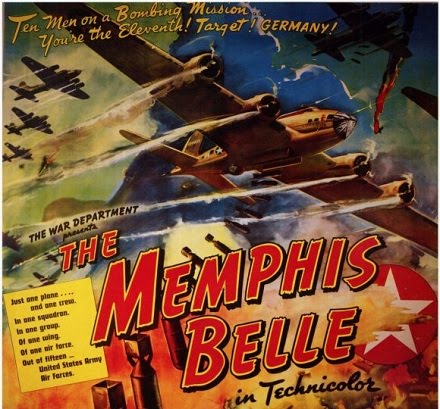
The Memphis Belle (1944)


Only days after the December 7, 1941 attack on Pearl Harbor, William Wyler, who had begun shooting Mrs. Miniver less than a month earlier, applied to the Army Signal Corps as a volunteer. In the event, Wyler was eventually turned down by the Signal Corps, and other projects he tried to develop to help the war effort, including a film for Frank Capra's series Why We Fight, didn't come to fruition. But in June 1942 he was introduced to Major General Carl A. Spaatz, who was organizing Army Air Forces operations in Great Britain, which he invited Wyler to document. After summarily being made a Major in the AAF, Wyler rounded up equipment and a four-man technical crew in Hollywood and left for Britain, arriving in August just as the first American B-17 Flying Fortress bombers began flying combat missions over the Continent.

Between early 1943 and the time aerial filming was completed at the end of May, Wyler and his film crew flew in several B-17 bombing raids, two of them in a B-17 nicknamed the Memphis Belle. The discomfort, not to mention the danger, endured by Wyler and his film unit on these missions was extreme. The noise from the engines was deafening and communication inside the plane impossible without an intercom. Unlike modern aircraft, the B-17 was not pressurized or heated, yet needed to fly at high altitudes, so crews had to wear bulky pressure suits to protect them from below-freezing temperatures and to carry around heavy oxygen tanks. The pressure suits and oxygen tanks, combined with the cramped interiors of the planes and the lack of oxygen at high altitudes, made for miserable working conditions for members of the film unit. "Taking three steps was like walking a mile," Wyler later said (Stevens 211).

The actual filming involved even more difficulties. The handheld cameras, which held only enough film to shoot about three minutes of footage, had to be reloaded frequently and at minus sixty degrees Fahrenheit inside the B-17 often froze. Moving from one side of the plane to the other to shoot completely changed the light exposure. The speed at which enemy fighters came at the bomber meant they were often past before they could even be filmed. Above all, the tremendous personal courage of Wyler and his crew cannot be overstated. Over 80% of the planes in the group they were flying with were lost, and the unit's sound engineer was killed when the plane he was flying in was shot down returning from France. Wyler in particular showed a remarkable willingness to take risks, although he evidently didn't see himself as especially brave. "You didn't even think of the danger," he said in an interview at the American Film Institute. "There wasn't time; you only thought of getting it on film" (Stevens 212).

From the beginning Wyler aimed for absolute authenticity. "Of course it was the real thing," he explained. "It was all done under the conditions of complete reality" (Stevens 211-12). Rather than a newsreel-style documentary, General Spaatz wanted Wyler to emphasize the human element of the soldiers flying these dangerous missions. With this is mind, Wyler decided to structure the film around the idea of a crew flying their twenty-fifth mission, after which their tour of duty would be over, and began to look around for a plane whose crew were nearing the end of their tour. There were several possibilities, but when he got a good look at the pinup-like figure painted on the nose of the Memphis Belle, his unerring instinct for telling visual detail told him he had found his plane and crew.

In June 1943 Wyler returned to California to fashion a picture from the 19,000 feet of film he had, silent and shot in 16mm after the equipment he had assembled in Hollywood was lost in transit to Britain and never recovered. He brought the crew of the Memphis Belle to Hollywood to record voice-over dialogue for the film, which had now been blown up to 35mm. His original intention of a two-reel picture, though, quickly became more ambitious. To the dialogue of the plane's crew, Wyler added sound effects, music, and voice-over narration, tightened the initial seven reels to four (about 40 minutes), and pressed for commercial distribution of the film, tentatively titled Twenty-Five Missions.

After a special screening at the White House which left FDR deeply moved, the President agreed: "This has to be shown right away, everywhere," he told Wyler (Herman 265). Retitled The Memphis Belle, the film opened in April 1944 in New York, where it received an unprecedented front-page rave review by Bosley Crowther, in which he called it "thorough and vivid" and praised its "real and exciting detail." The Memphis Belle was later shown in more than 16,000 theaters in the U.S. In 2001 it was added to the National Film Registry.

The Memphis Belle covers one day in the lives of a B-17 bomber crew as they fly the last mission of their tour of duty before shipping home. It documents step by step a high-altitude daylight bombing raid on the submarine base at Wilhelmshaven in northern Germany, beginning with the ground crew prepping the plane at an air base in Britain on the morning of the mission. Early in the film we are introduced individually to the ten members of the plane's crew, who are presented as ordinary men not much different from people the viewer is likely to know. While keeping our attention firmly on these men and their activities, Wyler manages to subtly include a great deal of factual detail about the nature of aerial warfare—"the new battle front: the air front."

Even though Wyler frames the film as the story of the air raid told from inside the Memphis Belle, he places its role in the raid clearly in the context of the complex operation of which it is only one element, one plane of the one thousand taking part. The explanation of the operational procedures involved in the mission is detailed, lucid, and concise. Wyler deftly balances information and narrative, using the skill at succinctly making his point through potent images that was evident in the studio films he made in Hollywood. The Memphis Belle is always dramatic and compelling and suffused with a real sense of urgency, while at the same time being patriotically stirring in the best possible way, avoiding the jingoistic excess of much of the wartime output of Hollywood. Anyone watching it for the first time is almost certain to be moved by its simple message, presented without sentiment, that when placed in trying circumstances, ordinary people are capable of extraordinary behavior.

Thunderbolt (1947)


Wyler's military career as a documentary filmmaker very nearly ended in March 1944, the month before The Memphis Belle was released, when he punched a hotel bellman in Washington, D.C., after the bellman made an anti-Semitic remark in his presence. (Wyler later reproduced this incident in The Best Years of Our Lives when Dana Andrews is fired from his job in a drug store after he socks a customer for making offensive comments.) Wyler was threatened with court-martial for misconduct but offered a way out if he would accept an official letter of reprimand. At first determined to fight the charge, he reluctantly agreed to the letter of reprimand so that he could continue with his next project for the War Department, a documentary about fighter squadrons involved in the Mediterranean campaign, which became the film released in 1947 as Thunderbolt.

In early June 1944 Wyler arrived in Italy accompanied by John Sturges, a film editor and future director whom Wyler chose as his assistant director, and scriptwriter Lester Koenig, who had written the narration for The Memphis Belle. The subject of the new picture was the P-47 Thunderbolt, a single-engine fighter-bomber whose mission was air support of ground troops. This time there was no film crew. Not only was there no room in the plane for a cameraman, but the planes were already equipped with cameras connected to the machine gun triggers. To these Wyler added more cameras mounted in various parts of the plane, which the pilot could turn on and off. Wyler and his film crew spent their time getting additional footage to combine with the film shot by the cameras on the P-47s—footage at the air base of the air crews between missions, ground footage of the combat the P-47s were involved in, and also aerial footage of the P-47s in flight taken from B-25 Mitchell bombers.

By the end of September, Wyler felt he had shot enough film and traveled to London to begin putting the movie together. After sending Sturges and Koenig back to Hollywood to do more work on the film, he stayed behind, returning to the Continent to follow the Allied invasion. In February 1945 he returned to Rome to shoot more footage from a B-25, what he called "atmosphere shots" of the Italian landscape. During one of these sessions, Wyler suddenly lost his hearing. As he described it, "My hearing just went" (Herman 275). He had suffered nerve damage which left him permanently deaf in both ears, a devastating experience that resulted in a period of deep depression. When Wyler finally accepted his condition and began working again after the war, he was able to compensate for his hearing loss by wearing headphones connected directly to the sound recording equipment.

Thunderbolt focuses on a squadron of P-47s stationed at the Alto air base on Corsica. The film deals with a two-month long operation in central Italy, Operation Stranglehold, the purpose of which was to strike behind enemy lines to cut off supply routes. The footage of the low-level raids conducted by the P-47s gives a much more vivid sense of the damage done—we can clearly see buildings, bridges, trains and trucks being strafed and bombed—than the rather remote and indistinct damage of the high-altitude bombing mission described in The Memphis Belle. Later in the film, after Allied forces have liberated Rome and moved north into the area involved in Operation Stranglehold, we see from the ground just how extensive was the destruction.

Not only does the depiction of warfare seem more graphic and specific in Thunderbolt than in The Memphis Belle, but the film has an altogether less idealized attitude toward the airmen in it. Thunderbolt shows much more of the lives of the pilots between missions, emphasizing the alternation of the routine activities of daily life with comparatively brief periods of intense danger. "In danger a couple of hours a day. The rest of the time, you're out of it," the staccato, Hemingway-style narration tells us as we're shown footage of the airmen going about their daily lives. The film also has a more grim attitude toward the danger these airmen faced. At one point we see the wreckage of a P-47 that crashed a few hundred feet short of the runway at Alto, then a gruesome shot of men pulling the body of the pilot from the smoldering wreckage. "For some the war is expensive," the narrator says. "You wish the people back home could at least see it." And this is the biggest difference between Thunderbolt and The Memphis Belle: here we're shown much more explicitly the war's human cost.

By the time Thunderbolt was finished in 1945, its time had passed: the Second World War had been over for six weeks. The Memphis Belle had been considered so vital to the war effort that it was distributed free to exhibitors by the government, but the new film aroused no interest at the War Department. Nor were commercial distributors interested, feeling that the public had had enough of war documentaries. Thunderbolt was finally released by the Poverty Row studio Monogram Pictures in July 1947. After all the work Wyler had put into it, risking his life repeatedly and even sacrificing his hearing, the film caused little enthusiasm, even with a prologue by James Stewart added to it, and quickly became a historical relic. As Stewart says in his introduction, only three years after the events described in the film happened, they seemed to war-weary Americans as distant as "ancient history."

Making Thunderbolt and The Memphis Belle changed William Wyler irrevocably. As his biographer Jan Herman wrote, "Wyler came back from the war a changed man. Like millions of returning veterans, he had been radically altered not just physically but emotionally" (278). The things Wyler experienced and witnessed while making those two war documentaries created lasting impressions that were to play a huge part in inspiring him to make his first Hollywood film after the end of the war, one of his greatest and the one that would bring him the second of his three Oscars for directing: The Best Years of Our Lives.

Sources

Herman, Jan. A Talent for Trouble. New York: Putnam, 1995.

Madsen, Axel. William Wyler: The Authorized Biography. New York: Crowell, 1973.

Stevens, George, Jr., ed. Conversations with the Great Moviemakers of Hollywood's Golden Age. New York: Knopf, 2006.

You might also like:
This post is part of the William Wyler Blogathon. For more information and a schedule of posts, visit the William Wyler Blogathon page at The Movie Projector. The Memphis Belle and Thunderbolt are included in the DVD WWII: In Color (Topics Entertainment, 2008).

Act of Valour

Tuesday, June 26, 2012


The unique selling point about Act of Valour remains the fact that it is based on real events and features real active duty Navy SEALs. It is also probably this point that makes the entire film about a team of Navy SEALs trying to stop a terrorist from entering America with undetectable human vest-bombs authentic and exciting.

What really struck me from the get go was the ingenious use of camera angles during the film. Be is the first person shooter action or what I call the carpet cam (the camera revolves as an undercover CIA agent is wrapped around in a carpet), there are just about enough varieties to keep the audience happy. Moreover, the film doesn't overdo anything when it comes to camera work, be is slow motion, shaky camera, or any of the other angles.

I do have to mention that at times the dialogue delivery by the "actors" seems a bit wooden, especially during the non-fighting scenes, but considering that they are not actors but soldiers, it is a small point that can be overlooked. The film has a lot more to offer than to fret over this.


Being a film about Navy SEALs the action scenes are of uttermost importance and they stand their ground. Intense and in-your-face Act of Valour is a look at the lives of people who rely on each other for support and is in complete contrast of the one-man-army Hollywood action films we are used to watching.     

Another aspect of the film that I personally appreciated was that the military/army/navy terms being used by the cast were in one way or another explained within the dialogue delivery. It might seem a bit childish and maybe the reason why the dialogue seems wooden at times, but in the end it is once again for the benefit for the audience.

Visually the film is simply brilliant. It might be a bit harsh to say since this is after all about war and death, but the fashion in which directors Mike McCoy and Scott Waugh shoot the scenes is simply a pleasure to eyes. Add to that the availability of the latest gadgetry and equipment and we have a film that can give any big budget Hollywood film a run for its money (I'm not sure what the budget of this film was, but it is stunning enough to justify whatever money was spent on it).    


While the film even comes across as a alternate version of G.I.Joe at times and at others a recruitment video, it doesn't hide away from the starkness of war and the dangers, tragedy, grief, and horrors that it brings about. It is about heroes, but heroes too have to make sacrifices in life, for their family, for their friends, for their country, and the film clearly showcases that aspect about these soldiers who fight to protect the country from both inside and outside threats.

Featuring some top-notch action and visually stunning imagery, Act of Valour is recommended viewing for anyone who prefers thrilling action films and for those who would like to know what it is to be in the heat of action for real.

Rating 4/5

You can find the DVD information below, but I would like to mention that the Deleted Scenes section has some rather interesting scenes; ones that I wish could have made it to the film, but nevertheless are available with the DVD along with other special features.

DVD/BluRay Information : Act of Valour
Certificate        15
Release Date       16 July 2012

Special Features   Trailer, Commentary with director, Deleated scenes, Interview with active-duty Navy SEALs, Making of, Real Bullets, "For You" Music video by Kieth Urban, Real SEALs Real Tactics, Making of the Music Video, Director's intro.  


DVD Review: Red Tails

Friday, May 25, 2012

Red Tails ** ½ Directed by: Anthony Hemingway.
Written by: John Ridley and Aaron McGruder based on the book by John B. Holway.
Starring: Terrence Howard (Colonel A.J. Bullard), Nate Parker (Marty 'Easy' Julian), Tristan Wilds (Ray 'Junior' Gannon), Elijah Kelley (Samuel 'Joker' George), Leslie Odom Jr. (Declan 'Winky' Hall), Kevin Phillips (Leon 'Neon' Edwards), Method Man (Sticks), Lee Tergesen (Colonel Jack Tomilson), Daniela Ruah (Sofia), Cuba Gooding Jr. (Major Emanuelle Stance), David Oyelowo (Joe 'Lightning' Little), Ne-Yo (Andrew 'Smoky' Salem), Marcus T. Paulk (David 'Deke' Watkins), Michael B. Jordan (Maurice Wilson), Andre Royo (Antwan 'Coffee' Coleman), Bryan Cranston (Colonel William Mortamus), Gerald McRaney (Lieutenant General Luntz).

The Tuskegee Airmen have deserved a big budget tribute that Red Tails aspires to be since the end of WWII. They were an all-black air unit of pilots who were heroes – took on all the jobs that no one else wanted, and performed them better than anyone else. They faced racism both at home and abroad – even the military brass didn’t believe in them, and set them up for failure. George Lucas has apparently been developing this movie for more than 20 years, and was turned down by every studio he went to, who didn’t want to spend all the money on an all-black cast in a war movie. Finally, the movie makes it way to the big screen – in what Lucas calls the middle movie of a planned trilogy. And when the movie is in the air, it is an exciting, brilliantly choreographed aerial action movie, helmed by Anthony Hemingway. The problem is when the movie is one the ground.
Red Tails opens with the airmen already over in Italy. They are put on the least glamorous jobs – hundreds of miles from the frontline, basically running patrols and taking out single targets and essentially doing boring work. They have old, beat up planes, and get no respect. The military brass does not want to give them any high profile jobs – it makes it much easier to insult their lack of aerial takedowns when they never come close to any enemy aircraft. Eventually though, they will get their chance – and make it undeniable how skilled they are.

You could use a checklist in running down the assembled pilots that make up this unit. The leader with some personal demons (in this case, alcoholism), the hot shot who doesn’t follow orders, but is too good to take out of the air, the young kid trying to prove himself, the joker (whose nickname is conveniently Joker) and so on. Their commanding officers include the biggest stars – Cuba Gooding Jr., who gives them their orders while chomping on a pipe, and Terrence Howard, who fights the military brass to give the airmen better jobs. There is even a romance between one of the pilots an Italian girl that as clichéd as it is, is also undeniably sweet.

The highlight of the movie is the aerial fight sequences. George Lucas have director Anthony Hemingway the keys to the CGI kingdom for these sequences, and the result is some of the best, aerial fight sequences I have ever seen in a movie. They are fast paced and exciting, but they never fall into the trap of going over the top, or being so rapidly edited that you do not know what is going on. When he was on The Daily Show, Lucas mentioned that this is the closest you’ll ever get to Episode VII, and he meant in the aerial fight sequences that rival those in the Star Wars movies.
But the scenes are the ground are too clichéd to be effective – the characters are too cookie cutter for you to truly care about them, or connect with them on a persona level. Even the racism they face seems benign in comparison to how it probably really was – and seems to be solved far more easily. I have a feeling that the first and third movies in this apparent trilogy are meant to delve into those issues a little deeper – and that Lucas decided to make the action packed middle segment first because it was the easier sell. But that means the movie lacks context. For all the problems in Spike Lee’s Miracle at St. Anna, which was also a black military unit in Italy in WWII, it had something that is lacking in Red Tails – anger and passion. For Red Tails to be a good movie, it needed more of both.

Passchendaele (2008)

Thursday, May 24, 2012


Genre: War/Drama/Romance/History/Action

Starring: Paul Gross, Caroline Dhavernas, Joe Dinicol

We all have heard and watched movies of American, French, British, German and Japanese involvement in the World Wars. This movie shows Canada's involvement in World War I, a war in which she was not directly involved but sent her sons since she came under the British Empire. The movie sets a love story of two separate individuals against the backdrop of the war and all the suffering and emotions that come with it. Sgt. Michael Dunne (Gross) has been asked to returned home since he was diagnosed with neurasthenia and deemed unfit to serve on the battlefield. It was here that he meets nurse Sarah Mann (Dhavernas) and instantly feels attracted to her. He was assigned the task to recruit young men to join the army and one such recruit was Sarah's brother, David (Dinicol). David suffers from asthma and hence cannot serve on the front due to which he cannot get his girlfriends' fathers acceptance who openly ridicules him for not supporting the war. The movie shows two men, of different ages, both having their own worries with love and war and both suffering from disorders that disallows them to fight for their country. It mixes war and love nicely and brings out the true heartbreak that one must face when war divides love and family. However, the time spent on the romance is slow and stretched which loses audience attention. The movie quickly recovers to offer a decent climax but it is still not the best. The war scenes have gore and bloodshed that may not be watchable for all. A well made movie that only needed a more hurtful and emotional climax.

Thumbs up: Good concept
Thumbs down: Slow and dragged at times, climax could be better.

Rating: 6.1/10

The Men (1950)

Monday, April 23, 2012

***
Country: US
Director: Fred Zinnemann


Marlon Brando's performance as Stanley Kowalski in the 1951 film version of A Streetcar Named Desire made him a movie star. So closely identified is Brando with that character that many people believe it was his first screen appearance. But it wasn't. A Streetcar Named Desire was actually the second film he made. A year before making Streetcar, Brando starred in a modest film produced by Stanley Kramer and directed by Fred Zinnemann about the problems of a paraplegic ex-soldier, The Men.

Brando plays Bud Wilocek, a young man who was shot in the back by a sniper in the closing days of the Second World War and is now paralyzed from the waist down. He has been languishing in Veterans Hospitals for four years without making any significant physical or psychological adjustment to his disability. When we first see Bud he is having a nightmare, and it soon becomes clear that he is a depressed and bitter man. Dismayed at Bud's lack of progress, the physician in charge of his treatment, Dr. Brock (Everett Sloane), decides to move him from a private room to a ward in the hope that this will force him to socialize with other patients and bring him out of his lethargy and self-pity. The three other patients in his section of the ward find it difficult to relate to Bud's sullen attitude. One of them, though, a Latino named Angel Lopez, treats him with more patience than the others and manages to reach him. Eventually, following the upbeat Lopez's example of dedication to physical rehabilitation, Bud begins to emerge from his self-imposed isolation and at last to make both physical and psychological progress.

Matters become complicated when Bud's girl friend from before his injury, Ellen (Teresa Wright), seeks him out to try to resume their relationship. For four years he has refused to see her, viewing the future of any relationship as hopeless. But she persists and slowly succeeds in thawing him emotionally, to the point where he agrees to marry her. An hour into the movie, the Bud we now see is a quite different person from the man we met at the beginning. Ellen seems to have motivated him to make a real effort to adjust to his condition and adopt a more hopeful attitude toward the future. After being married in the chapel at the hospital, they go to their new house, the first time Bud has lived away from a hospital since his injury. But things do not go well that first day. Ellen suddenly gets cold feet, and when Bud senses her trepidation he reacts with anger and moves back to the hospital. With disappointment on both sides, it's questionable whether the young couple will ever get back together.

The Men is an early example of a kind of American film that really began with William Wyler's The Best Years of Our Lives—the postwar film that sought to place a personal story in the context of a social problem and to present that problem realistically and informatively. Before directing feature films, Zinnemann worked for years as a director of documentary shorts, and in The Men that background is evident right from the beginning, as Dr. Brock speaks to a group of women—mothers, wives, and fiancées—about the nature of paraplegia and its implications for personal relationships. "The word walk must be forgotten," he tells them bluntly. "It no longer exists." It's the kind of explanatory narrative passage Zinnemann had used in the first minutes of The Search (1948) to describe the process of dealing with displaced children after WW II and would use again in the opening of The Nun's Story (1959) to document the way novitiates train to become nuns.

Today we are familiar with films about the kinds of social and medical problems dealt with in The Men, but in its day it must have been seen as an example of a new kind of movie, one that treated such subjects with unaccustomed candor and seriousness. One thing that makes The Men so effective at this is the amount of realistic detail in the picture. Much of it was filmed on location at the Birmingham VA Hospital in Van Nuys, California, and several dozen actual patients of the paraplegic ward at the hospital appear in the film. Fred Zinnemann and the writer, Carl Foreman, did a great deal of research in preparation for the picture, and that attention to realism shows.

Marlon Brando did equally meticulous preparation for his role as Bud. For a month before filming began, Brando lived as a patient at Birmingham VA Hospital. For the first three weeks he was at the hospital, the other patients didn't know he was an actor. He lived as a paraplegic, experiencing and absorbing as much as he could. He even learned to use a wheelchair expertly, as you can tell when you see him rocketing down the hallway of the hospital and deftly maneuvering around obstacles or playing wheelchair basketball with real paraplegics. To say that Brando was researching his role seems too mild a way to describe the lengths he went to for authenticity.

Marlon Brando on the set of The Men

Brando is probably the film actor admired by fellow film actors above all others. Time and again I've heard actors say how affected they were by him and how he inspired them in their craft. They often say how real he seems on screen. Yet Brando has never struck me as a realistic actor. Despite the Method's fundamental tenet of actors reaching deep inside to find a connection between themselves and the character they're playing, I've generally found Brando the actor to be highly mannered. Sometimes this can be hugely effective, as with his flamboyant, sinister/comical Stanley Kowalski. One exception to the high level of artifice found in so many Brando performances is his Terry Malloy in On the Waterfront, which seems on the whole a very honest job of acting. His Bud in The Men is another performance I would call honest.

I suspect that Brando must have burned out on screen acting within a few years. Perhaps this is why his Bud in The Men seems so fresh. There's a very unaffected quality to Bud not found in most of the characters he played later. In those later performances, Brando sometimes strains so hard to locate the uniqueness of the character that he comes perilously close to caricature. In Bud, though, he creates a character who cannot be reduced to a set of mannerisms, a complex young man—and Brando does seem very young, at times almost boyish—who embodies the opposing qualities of anger and sensitivity. Brando makes us believe that these are not contradictory traits, but that they coexist innately in Bud. It's an impressively natural performance, one without the sense of contrivance of his later work. Brando's presence alone makes The Men worth watching, not just for its historical interest as his first appearance on screen, but also for the quality and openness of his acting.

Unfortunately, the rest of the cast is not always as consistent as Brando. In The Men we can witness a whole range of acting styles. As fellow patients, Richard Erdman and Jack Webb (yes, Sgt. Joe Friday himself) give controlled performances, as does Teresa Wright, who conveys with great subtlety the initial determination and later irresolution of Ellen. As Dr. Brock, though, Everett Sloane is prone to overacting and speechifying. Interestingly, in a scene late in the film between him and Brando, when Bud is venting his full anger to Dr. Brock, Sloane holds back to let Brando dominate the scene and in his restraint does his best acting in the film.

The non-professional actors in the film also show varying degrees of ability. Arthur Jurado, the real-life paraplegic who plays Angel (apparently he died not long after making the film) is quite affecting and natural. Some of the other non-professionals portraying patients, however, seem amateurishly overemphatic. This is especially obvious in a scene where a group of these men meet to determine how to deal with an instance of Bud's serious misbehavior. Besides the inconsistency of the acting, my chief complaint about the film is the heavy-handed music score by Dimitri Tiomkin. The low-key style of the film is not well served by Tiomkin's overbearing and seemingly incessant music.

If the idea of a movie about war injury no longer seems as novel as it must have in 1950, the subject itself is one that has just as much relevance today as it did then. In the film Bud received his injury in the closing days of the Second World War. But just a month before The Men was released, the Korean War began. Since then we have had Vietnam, the Gulf War of the early 90s, the Serbian conflict of the late 90s, and now Iraq/Afghanistan. If today the plight of soldiers suffering war injuries—both physical and psychological—has become a subject films tackle routinely, we can thank movies like The Men for making this so.

You might also like:
This post is part of the LAMB Acting School 101 on Marlon Brando. Click here for more posts on Brando.

A Midnight Clear

Monday, April 16, 2012


A movie about war, yet one that looks at peace; inner peace from the turmoil soldiers face during warring times.

Starring Gary Sinise, Kevin Dillion, Peter Berge, and a young Ethan Hawke, A Midnight Clear is about a group of American soldiers assigned to a mission towards the end of World War II in the snowcapped French-German border mountains. It's here that they come across seven German army soldiers who initiate talks with their American counterparts and work on a scheme to surrender without any bloodshed.


It doesn't take long to realize that the movie is not a typical war movie. There is hardly any "fighting". A Midnight Clear is a study of human nature in times of adversity. It's a look at friendship and trust and brotherhood amongst the men on the front line. It's also a stark look at the politics of war.

While the slow buildup of initial tension in the story does lead to momentary jubilation, eventually like war in the end there is sadness, destruction, loss, and a general feeling of melancholia.

The film succeeds brilliantly in taking the audience on a roller coaster ride of emotions. There are light moments of self discovery as we witness the time when our young American soldiers loose their virginity, together. Or the time they have a snowball fight with the Germans. But, unexpectedly the truth of war catches up on them and the harsh realities of being away from family in severe conditions eventually takes it toll.


A Midnight Clear is a beautifully shot film. Keith Gordon directs wonderfully giving the snowy terrain a character of its own, bringing together the beauty of nature alongside the beast of war. The entire cast supports each other rather well with Ethan Hawke giving one of his finest performances.

A Midnight Clear is a must see film. It's not about war, nor does it preach about peace; what is does is encourage us to look inside ourselves and think about the important things in life like family, friendship, courage, forgiveness, love, ...

Rating 4/5

A Midnight Clear: 20th Anniversary Edition is available to buy on DVD and BluRay from April 16,2012 courtesy of Second Sight Films.

Letters from Iwo Jima (2006)

Monday, March 5, 2012


Genre: War/Drama/Action/History/Biography

Starring: Ken Watanabe, Kazunari Ninomiya, Tsuyoshi Ihara, Ryo Kase, Shido Nakamura

Whilst Flags of Our Fathers portrayed the American story of the Battle of Iwo Jima, Letters from Iwo Jima narrates the Japanese story of the same war. Both movies were made by the exact same crew and shot one after the other. While Flags of Our Fathers focuses on the famous photograph and the life of three American soldiers after the war, this movie narrates only the Japanese perception of the events that took place during the war. The movie revolves around the fictional character of Pvt. First Class Saigo (Ninomiya) a newly married baker who was conscripted to join the army. The character of Saigo is the only survivor and is depicted as experiencing all the highs and lows of the war. The insightful general of the Japanese Army on Iwo Jima, General Kuribayashi (Watanabe) faced a tough decision when he learnt that his platoon would not be receiving any backup from the mainland and yet they are to defend the island with every last soldier to prevent the Americans from making it a base. The movie revolves around the cold hardships of war, suicides and bloodshed. The movie is a critics delight with fine performances and picture perfect scenes, however, its not a movie the average audience might appreciate due to its slow and heavy nature. The movie shows the raw approach to war and is widely different from its elder sibling. Another excellent movie from the stable of Clint Eastwood.

Thumbs up: Beautiful performances, great execution
Thumbs down: Slow and heavy

Rating: 7.2/10

Movie Review: Act of Valor

Saturday, March 3, 2012

Act of Valor **
Directed by: Mike McCoy & Scott Waugh.
Written by: Kurt Johnstad.
Starring: Jason Cottle (Abu Shabal), Alex Veadov (Christo), Ailsa Marshall (LT Rorke's Wife), Gonzalo Menendez (Commander Pedros), Emilio Rivera (Sanchez), Roselyn Sanchez (Lisa Morales), Nestor Serrano (Walter Ross).

I have nothing but respect for the real Navy SEALs that essentially play themselves in Act of Valor. They do a nearly impossible job and put their lives on the line for what they believe in. And I know the whole idea behind Act of Valor was to use “real Navy SEAL” tactics, instead of pumped up Hollywood clichés of what those tactics really are. And yet, there are so many problems with Act of Valor that I do not know where to begin. No, I did not expect that the Navy SEALs would be very good actors, but still, you would think that directors Mike McCoy and Scott Waugh would be able to get them to sound a little more natural in their roles, since they playing themselves. And you would think that a movie that wants to show “real” tactics instead of Hollywood clichés, would have been able to come up with a less clichéd story. This is a movie with no complexity whatsoever.

The SEAL team is first seen relaxing on R&R discussing family, patriotism and heroism, before they are thrust into action. First, they need to rescue a captured CIA agent from a heavily guarded compound of South American drug traffickers. That leads them to information about an Eastern European drug lord, Christo, and his Muslim childhood friend, who wants to strap bombs to people and detonate them all over America. These two main villains are such cookie cutter bad guys that it is impossible to take them seriously – they are one step away from twirling their mustaches. The SEALs themselves blend together because there is no effort or attempt made to differentiate between them by showing things like personality.

So the SEALs rush headlong into one action sequence after another, mowing down dozens of bad guys, in action sequences that, are at times, impressive and harrowing. And yet, the movies visual style seems inspired more by video games than anything else – there are many, many shots that replicate the look of a first person shooter video game. And because the SEALs are so interchangeable, and the henchmen they gun done are even more nameless and faceless, Act of Valor plays even more like a video game than any movie I can recall. And as anyone who plays video games will tell you, there is nothing more boring than watching someone else plays a video game.

There are moments that work – that first raid on the compound to get the captured CIA agent for example is particularly good – especially in the quieter moments of killing that precede the all-out bloodbath it will become (shooting someone on a dock while another SEAL has swam up behind him to catch his body so it won’t back a sound is particularly fascinating). The massive gunfight that follows is also well handled. But too much of what follows feels interchangeable. The action sequences work, at least to a certain extent, but whenever the movie slows down, and anyone says anything, the whole things grinds to a halt.

I understand that the filmmakers wanted to honor the heroes who fight for their country, and are willing to die for it. But I also think that the best way to do that would be to present a realistic portrait of what their lives are actually like. Act of Valor turns their lives into a globetrotting adventure film – and worse yet, merely a game. I doubt they view it that way.

Flags of Our Fathers (2006)

Monday, February 6, 2012


Genre: War/Action/Drama/History/Biography

Starring: Ryan Phillippe, Jesse Bradford, Adam Beach, John Benjamin Hickey, John Slattery, Barry Pepper, Paul Walker, Neal McDonough, Thomas McCarthy

Can a single photograph change the course of world events? Not likely, but for US Marines Ira Hayes (Beach), Rene Gagnon (Bradford) and John Bradley (Phillepe) it certainly did. Set in WWII, USA is launching an attack on Japan and needs to capture the island of Iwo Jima. Most of the movie narrates the occurrences on the island and gradual advancement of the troops. The marines planted the US flag atop a mountain on the island and a photograph taken at the correct time reached the mainland and the press in no time. Three marines who survived from those that planted the flag were recalled back to USA to market war bonds in the effort to fund the countries war efforts. The US treasury was empty and dollar had lost any value it ever had. The country cannot borrow anymore and hence is trying to sell bonds to the citizens and hopes that the photograph along with the presence of the three marine officers would aid the sale. The movie comes from Clint Eastwood and anyone familiar with his recent movies would quickly identify the style to be very similar to its other movies. The movie is a directors delight and has a lot of appeal and insight. It smartly weaves multiple plot lines together without making a mess and keeping audience attention intact. One of the better war movies of this age and a superb watch.

Thumbs up: Phenomenal direction and acting
Thumbs down: The story lacks variation and seems to show the same thing over and over again

Rating: 7.6/10

War Horse (2011)

Thursday, January 19, 2012


A quick perusal of my top 100 films can tell you any number of things about me. For starters, that I have an unabashed love for all things Kurosawa. Then again, spending five minutes talking with me about movies could easily tell you that one. However, if you were to dig a little deeper. To seek out the connections and overlaps between many of the relating films, one constant should become entirely evident. I love me some good ol' fashion epics.

Throw a group of characters together, stretch their journey through life and war over two and half plus hours and low and behold, I'll be waiting at the end hands ready in applause position. So imagine my excitement when I found out that Spielberg was set to deliver such an experience. Let alone one covering one of the most oft ignored and yet still powerful wars in history, World War I.

From the sweeping landscapes of old English farm land to the mud enriched, rat infested, world of trench warfare, War Horse takes us on the kind of journey one might imagine would be found in the likes of a Disney film grown up. Joey, our titular horse, whose journey through a war with which he had nothing to do is sentimental to the highest degree, and yet at the same time strikes subtle and yet resonating chords on the true nature of war.

War Horse boasts what I might argue is some of Spielberg's finest directing moments in over half a decade. Not least of which is found in Spielberg's craft at creating a violent war film without much of the violence. In a way that would make Pulp Fiction era Tarantino proud, Spielberg creates graphic violence through carefully place camera movements. The substitution of imagery for actual bloodshed is a particularly nice decision - as evident in the riderless horses in one early battle sequence. This decision presents something I've been asking Hollywood to deliver for years - intensity without blatancy.

Of course for a generation like myself which has been born and raised on that graphical conclusion to events, these might leave some wanting. But I would like to hope that deep down one can admire the craft in coordinating and filming such scenes.

Still, where War Horse succeeds in visual poetry, it falters in a revolving cast of characters. Like many epics, War Horse deals with a wide array of characters coming and going, and as such the time for whole and complete character building is often left to the cutting room floor. Take for example Captain Nicholls and Major Stewart, played by the equally brilliant Tom Hiddleston and Benedict Cumberbatch respectively, who give off so much charisma in their short screen time that they still leave you longing for their return. Not to mention the sadly underused Eddie Marsan in the generally thankless role of Sgt. Fry towards the film's climax.

So in substitute for the revolving characters we are effectively given human bookends to Joey's journey. In this we find ourselves with Albert (Jeremy Irvine). The young, poor farm hand son of a perpetually drunken father (Peter Mullan) and fiery mother (Emily Watson). Albert provides much of the necessary scenes which help Joey build the skill set he needs to survive so many of the sequences he deals with in war. At the same time, Albert is also given a journey of his own to survive. Including a thrilling battle sequence - by far the film's most violent - as he seeks out his long embattled friend, Joey.

The rest of the cast is a wide assortment of "hey, it's um that guy" talent who deliver time and time again. But no matter what is thrown at us, there is never a doubt that this film is entirely Joey's film. For he is the heart of the matter. He is the life blood through which each character is given a reason for being. The film thrives and falls on the strength of his shoulders. Luckily for us all, he is made of stuff stronger than steel.

OVERALL SCORE: 8.00 / 10

Film Credits:
Directed By Steven Spielberg
Screenplay By Lee Hall and Richard Curtis
Novel By Michael Morpurgo

DVD Review: City of Life and Death

Thursday, January 5, 2012

City of Life and Death *** ½
Directed by: Chuan Lu.
Written by: Chuan Lu.
Starring: Ye Liu (Lu Jianxiong), Yuanyuan Gao (Miss Jiang), Hideo Nakaizumi (Kadokawa), Wei Fan (Mr. Tang), Yiyan Jiang (Xiao Jiang), Ryu Kohata (Ida), Bin Liu (Xiaodouzi), John Paisley(John Rabe), Beverly Peckous (Minnie Vautrin), Lan Qin (Mrs. Tang).

When you’re a Chinese filmmaker making a film about the Japanese Nanking massacre of 1937, and you manage to piss off both the Japanese and the Chinese, you’ve most likely made a good film. And Chuan Lu’s City of Life and Death is a good film – a very good one. One that is difficult to watch, but impossible to turn away from. The unspeakably horrible actions on the screen are contrasted against the beautiful black and white photography. There is no uplift here – no sentimentality, no real hope. It recounts the events, and shows you images you will never forget.

The movie offers little back story – because none is really needed. It basically opens with the Japanese breaching the walls of Nanking, and then cuts back and forth between the desperate Chinese trying to escape the city, and the Japanese soldiers trying to pen them in. This part of the movie is hectic and chaotic, but remarkably, Lu Chuan manages to make it both epic and intimate. Epic because of all the chaos, all the bloodshed, all the murder on a huge scale going on. Intimate, because he often pauses on the participants faces. A few emerge as memorable – especially Lu (Ye Liu), a Chinese soldier we follow from the beginning of the massacre until he, along with thousands of others, is trapped and massacred.

But this is one the first part of the film. The majority takes place in the refugee camp after the initial massacre, where a few kind hearted souls try their best to take care of and protect the surviving residents of Nanking. But the Japanese continually raid the camps – murdering some, and raping many of the women. Finally, the Japanese offer the refugees a deal – if they give them 100 women, who they assure them will be returned alive in 3 weeks – then they will leave the rest of them alone. The mass rapes that follow are as difficult to watch as all the bloodshed that continues throughout the film.

I mentioned off the top that both Japanese and Chinese people were upset with this film, but for different reasons. The Japanese do not like any mention of the Nanking Massacre at all – it does make them look bad, and this film, that dramatizes it with horrifying detail, is worse than normal. Many Chinese people will were offended because they felt Lu Chuan whitewashed German Nazi John Rabe – who stayed and tried to help the refugees, before being ordered home by his superiors, because they did not want him jeopardizing their relationship with an alley. Even worse, according to them, was the presentation of Kadokawa (Hideo Nakaizumi), a sympathetic Japanese soldier.

But I think Kadokawa is key to the entire film. Yes, he is horrified by what he witnesses his countrymen doing, and he does not take part in the worst of it. When it is his “turn” with one of the 100 women, he’s even nice to her. But when his time is up, he just sits and watches another soldier rape this poor woman once again. That pretty much describes Kadokawa – horrified and disgusted, but never moved to action. Kadokawa is key to the film because he humanizes the Japanese – which makes what they do all the more difficult to watch. Every time there is a massacre, some people call it inhuman and the perpetrators monsters, but that let’s them off the hook too easy. The cruelty on display in this film is human cruelty.

City of Life and Death is a difficult film to watch. Many won’t want to watch it at all. Unlike a film like Schindler’s List, it offers no hope. No film can truly, accurately capture a massacre on this scale – but City of Life and Death comes as close as any film is likely to.
 

Blogger news

Blogroll

Most Reading