Pages

Powered by Blogger.
Showing posts with label Verities. Show all posts

Television and Cinema Verities #57

Monday, February 11, 2013


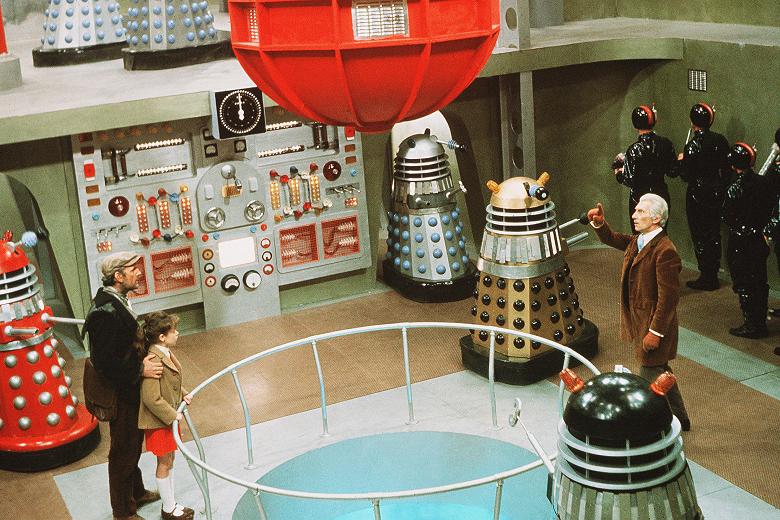
“I had played Winston Smith in ’1984′ on television, and the next thing I played ‘Doctor Who’. I was doing it in the cinema while Bill Hartnell was doing it on TV! That’s the way it goes. It was no surprise to me to learn that the first ‘Doctor Who’ film was in the top twenty box office hits of 1965, despite the panning the critics gave us. That’s why they made the sequel and why they spent twice as much money on it. Those films are among my favourites because they brought me popularity with younger children. They’d say their parents didn’t want to meet me in a dark alley but ‘Doctor Who’ changed that. After all, he is one of the most heroic and successful parts an actor can play. That’s one of the main reasons the series had such a long run on TV. I am very grateful for having been part of such a success story.”

The late, great Peter Cushing, on his heroic turn as Doctor Who in Doctor Who and the Daleks (1965).

Television and Cinema Verities #56

Monday, February 4, 2013


"Well, people have this impression that I don’t want anything to do with the Hammer period, that I don’t even want to admit that I ever played Dracula. Totally wrong. In 1956, the success of the Hammer films kick-started my career. That immediately gave me a name and a face to go with it. I will always be grateful to Hammer for that. But it’s all so long ago it barely seems relevant any more. That’s what I said."

- Christopher Lee discusses playing Count Dracula in the Hammer Films of the late 1950s and 1960s at Total Film, in 2005.

Television and Cinema Verities #55

Monday, January 28, 2013


"It sounds so gooey, but it was a stupendous privilege, an amazing gift, like something out of a fairy tale. Everywhere I went I was actually loved and adored by children. And now those children have all got children of their own, and they still come and see me. I was at a sci-fi do at Earl's Court the other day, There were several thousand people there, And scores of them showed me pictures of themselves, these middle-aged men losing their hair, sitting on my knee in 1976 or something. It's all very sweet, that."

Television and Cinema Verities #54

Monday, January 21, 2013


"...if I was given a chance to identify with any character on television, I would choose Spock. I admire him, I like him and I respect him. I would rather be identified with Spock than any other character on television."

- Leonard Nimoy discusses his admiration for the famous half-Vulcan, Mr. Spock at MTV Geek.

Television and Cinema Verities #53

Monday, January 14, 2013


"V was never about spaceships and aliens -- but about Power. About its abuse, and some people who suck up to it, others who lay low hoping it won't bother them, and still others who say no this is wrong and we have to fight back. -- It's a timeless story with deep roots that go back through the American Revolution..."

- V creator Kenneth Johnson discusses his creation at The Sci Fi World in 2008.

Television and Cinema Verities #52

Monday, January 7, 2013


"Everything is everything else.  The whole universe is living thought."

- Commander Koenig, Space: 1999: "Black Sun"

Television and Cinema Verities #51

Monday, December 31, 2012


“Reality is incredibly larger, infinitely more exciting, than the flesh and blood vehicle we travel in here. If you read science fiction, the more you read it the more you realize that you and the universe are part of the same thing. Science knows still practically nothing about the real nature of matter, energy, dimension, or time; and even less about those remarkable things called life and thought. But whatever the meaning and purpose of this universe, you are a legitimate part of it. And since you are part of the all that is, part of its purpose, there is more to you than just this brief speck of existence. You  are just a visitor here in this time and this place, a traveler through it.” 

- Gene Roddenberry, creator of Star Trek

Television and Cinema Verities #50

Monday, December 24, 2012


"I think the destiny of all men is not to sit in the rubble of their own making but to reach out for an ultimate perfection which is to be had. At the moment, it is a dream. But as of the moment we clasp hands with our neighbor, we build the first span to bridge the gap between the young and the old. At this hour, it’s a wish. But we have it within our power to make it a reality. If you want to prove that God is not dead, first prove that man is alive."

- Rod Serling, December 3, 1968.

Television and Cinema Verities #49

Monday, December 10, 2012


"I’m 34. I grew up with Thundercats and She-Ra: Princess Of Power. That was sort of my take on fantasy: the women after-school cartoon world. And that was the action figure I was playing with. I grew up having this fantasy of being a superhero, being Princess Power."

- Milla Jovovich discusses her approach to action and fantasy roles. (Interview by Nisha Gopalan, in 2010 at The AV Club)


Television and Cinema Verities #48

Monday, December 3, 2012


"I think the inclination to expand upon evil and the nature of evil and to really embrace that as something real in this world grew stronger and stronger, so I think it became something that writers over time carried forward but without necessarily the producers of the show being the ones orchestrating that malign feeling.  It was like all of us were sewing this quilt, a bunch of different weavers working on it, and some of those threads got passed from different pairs of hands over the years."

- Frank Spotnitz describes Millennium's approach to evil in Back to Frank Black (page 279).

Television and Cinema Verities #47

Monday, November 26, 2012


"I'm a Roger Corman baby. Just keep rolling, baby. You've got to get something on there. Maybe it's right. Maybe it's wrong. Maybe you can fix it later. Maybe you can't. You can't imagine the things that come up when you're making a movie where you've got to adjust on the spot."

- Jack Nicholson discusses his beginnings in Roger Corman's low-budget cinema, at MTV News in 2007.

Television and Cinema Verities #46

Monday, November 19, 2012


"I don't have an ego."

- William Shatner, on working with his Star Trek co-stars.

Television and Cinema Verites #45

Monday, November 12, 2012


"...each one had, at the helm, such an original visionary. Ridley transformed the idea of space from this sterile, cerebral place to a place where people actually got up and had breakfast and swore and griped and carried on like regular people. Then Jim [Cameron] took it to a whole other scale of story and emotional resonance. Each director has put his own emotional stamp on it and I think they're all legit. It was kind of dizzying to go from one to another, even though there were some years between..."

- Sigourney Weaver discusses the four Alien films, and their directors in a 2010 interview with Shock Till You Drop's Silas Lesnick.

Television and Cinema Verities #44

Monday, November 5, 2012


"I think all of us were stunned by it, because it's like being at war, and then somebody shows you war movies made during the battle.  Each shot comes up and you think of the context and the struggle related to it.  The whole thing is a little hard to take in.  The film has a strange pace too.  I've sat with eager midnight shows watching the thing, and you get to the twenty-four minute mark and the kids behind you are saying 'this sucks, nothing's happening, when's there going to be some blood?'  then, as soon as Betsy gets stabbed in the ankle with the pencil, you're off to the races and they're going, 'Arrgh, this is good...'"

- The Evil Dead (1983) cinematographer Tim Philo discusses his reaction to the Sam Raimi film in my 2004 book The Unseen Force: The Films of Sam Raimi.

Television and Cinema Verities #43

Monday, October 29, 2012


Yes, I was offered “Halloween III” as a matter of fact, shortly after “Halloween II” came out, but I found the new story weird and I felt that by doing “Halloween II,” I’d paid my debt to John Carpenter and Debra Hill. It was time to move on. It wasn’t time to do another Halloween movie back then. Twenty years later, that was the time. “Halloween III” had no connection to Laurie or Michael so I didn’t feel like I was obligated to do it.

- Jamie Lee Curtis discusses Laurie Strode and the Halloween franchise with Film Threat, in 2002.

Television and Cinema Verities #42

Monday, October 22, 2012


"I put a lot of effort into making Cujo scary.  That started when I was preparing Alligator.  I had Jaws in mind when I was doing that.  Before I started that I film, I wanted to have a few scenes that would make people jump, so I thought about the films I'd seen in my lifetime that scared me.  And I focused on a few that had particularly frightening scenes that made me jump.  The scene in Jaws I selected is where Richard Dreyfuss is swimming underwater at night, discovers a hole in the bottom of a boat, and a head falls into view.  Another scene I focused on was in Wait Until Dark...I studied those scenes to find out what they had in common, to extract a set of principles I could utilize to make a scary scene, and I applied them..."

- Director Lewis Teague talks horror movie craft, in my book, Horror Films of the 1980s (2007), page 310.

Television and Cinema Verities #41

Monday, October 15, 2012


"When I did my episode, I just loved the script, loved the idea that this strange man (Spock) was finally going to be schtupped and I was going to be the one to do it, and that I was going to be the one to teach him how to not be a vegetarian. So I loved the idea. Then, when they showed me the costume, I thought I was going to die. But I sensed that it was a very special thing when I was doing it. I don’t know why. I don’t know if it was because of the script or the costume or the makeup, but there was a special-ness to it. I mean, who had any idea that it’d become what it has? I don’t think Leonard (Nimoy) or Bill (Shatner) had any idea, either."

- Mariette Hartley discusses playing Zarabeth in the classic Star Trek episode, "All Our Yesterdays," in an interview at Star Trek.com in 2011.

Television and Cinema Verities #40

Monday, October 8, 2012


"I thought there was something very likable in her transparency. She didn’t hide her huge ambition and her fearlessness. I loved that about her. And, for me, it was a fantasy character. I could be this totally amoral being, without any harm coming to me – it was fantastic."

- Jane Badler discusses Diana, leader of the Visitors in V (1984).  From a 2010 interview at Sci-Fi Now.

Television and Cinema Verities #39

Monday, October 1, 2012


“It didn’t occur to me on any kind of conscious level, but what this guy [a psychologist] was saying was that Night of the Comet was like a reflection of where teenagers are in their personality development.  At that point, they’re still extremely egocentric.  They believe the world orbits around them, and that their concerns are the only ones that matter.  They have little concern for anybody or anything around them.  He said that Night of the Comet is a visual representation of that stage. There are these two girls and nothing else matters.  I wasn’t doing that on a conscious level, but it makes a lot of sense.  I had no illusions when I did it that this was anything more than a drive-in movie.”

- Writer-director Thom Eberhardt discusses with me the psychological underpinnings of Night of the Comet (1984). From Horror Films of the 1980s, page 402.

Television and Cinema Verities #38

Monday, September 24, 2012


“One of the things Twilight Zone did most effectively….was made you think you were watching one thing and only in the last three minutes did you realize you were watching another thing.”

- Damon Lindelof discusses The Twilight Zone, with interviewer Shawna Malcom. (TV Guide, July 24, 2006, page 24.)
 

Blogger news

Blogroll

Most Reading