Pages

Powered by Blogger.
Showing posts with label King Kong. Show all posts

Thanksgiving Blogging: Mighty Joe Young (1944)

Thursday, November 22, 2012


In several significant ways, Mighty Joe Young (1949) might be described as the “most evolved” of the Merian C. Cooper/Ernest Schoedsack giant ape films of the 1930s and 1940s.

In part this is so because the third (and last) film in the cycle understands that audience sympathies rest with the exploited main character, a kindly gorilla named Joe, and not with the humans who exploit him for financial gain.

And in part this is so because this film depicts the female lead character, Jill Young (Terry Moore) as more than a screaming ninny.  The feisty Jill can see beyond Joe’s intimidating physicality -- in part because she raised him -- and recognize that he is an intelligent creature worthy of dignity and respect.  Jill is no mere damsel in distress, but rather a very human woman trying to do the right thing, and honor the important relationships in her life, both with Joe, and with promoter Max O’Hara (Robert Armstrong again), the man who brought her “fame and fortune” in Hollywood.

These elements, along with an exciting chase and nail-biting finale, make Mighty Joe Young a solid addition to the King Kong canon, even if the film doesn’t actually concern Kong or his progeny.

Mighty Joe Youngbegins with little Jill Young (Moore) living on her father’s farm in Africa.  She trades a baby gorilla for several trinkets, including a flashlight, and decides to raise the ape she names “Joe.”  Her father objects to this course of action, worrying that the gorilla will one day grow into a fierce animal and menace. 

But Jill prevails, and a friendship is born.


Twelve years later, Max O’Hara (Armstrong) plots to make his next Hollywood night club, “The Golden Safari,” a runaway success.  He strikes on the idea of going on a dangerous safari in Africa with cowboy, Gregg (Ben Johnson) in tow.  Once there, they collect man-eating lions and other animals, and then unexpectedly encounter a fully-grown gorilla, Joe.  Max urges Jill to sign a contract making the ape and his master the newest (permanent) attractions at the Golden Safari.

Back in Hollywood, Joe grows increasingly depressed by the nightly festivities in the club, and his near-continual entrapment in a too-small cage.  Jill sees the gorilla suffering, and attempts to get out of her contract with Max.  He sweet-talks her back into compliance, and the Mighty Joe Young show continues for a whopping seventeen weeks.

Then, one night, a trio of obnoxious drunks release Joe from his cage, feed him champagne, and watch as the gorilla trashes the club from top to bottom.  Deemed a public safety menace by a judge, Joe is ordered executed.  Realizing what he has done to Jill and Joe, Max O’Hara teams up with Gregg and Jill to free the ape from captivity, and return him to his home in Africa.

On the way to freedom, however, Gregg, Jill, and Joe spy a disaster in the making.  An orphanage is burning down fast, and three children are trapped upstairs with no hope of escape. 

One last time, it’s Joe to the rescue…

Although there are no prehistoric monsters on hand in Mighty Joe Young, the film nonetheless perfects (or evolves) the King Kong formula.  Max O’Hara -- the familiar showman character -- undergoes his transformation from exploiter to defender in one movie, not two (as was the case with Carl Denham), and the movie also makes the point that there is something worse than imprisonment…the loss of dignity. 

Here, Joe undergoes a horrible humiliation when a nightclub routine requires Jill to dress up as an organ grinder, and Joe as her monkey.  Then, the unruly crowd is encouraged to throw giant coins at Joe while he catches them in his cap.   One drunk gets out of hand and tosses a glass champagne bottle at the ape.  This is a miserable moment for Joe, one which reduces the noble beast to the level of carnival freak.


Joe goes wild soon after this humiliation and destroys Max’s night club, but he finds redemption by saving the imperiled children at the burning orphanage.  Again, this kind of redemption was something denied Kong in the original film (though awarded to his son, in The Son of Kong).

Though it is impossible to argue that Mighty Joe Young is more spectacular or exciting than King Kong was, one can certainly detect how a very similar story (with similar characters) is more completely and emotionally told here.   Some may consider that comment a heretical remark in terms of cinema history, but at least three of the four leads in Mighty Joe Young -- Max, Jill, and Joe himself -- are treated with greater humanity than their counterparts were in King Kong. 

While there’s nothing as awe-inspiring as a battle with a T-Rex in this film, Mighty Joe Young nonetheless satisfies on a purely human level.  No one in King Kong really listened to their conscience, at least until it was far too late.  Here, the characters all make difficult personal decisions to repair the breach, and honor their friendship with Joe.

I had not seen Mighty Joe Young in several years before this recent viewing, and was delighted to find the film so engaging, and so action-packed. My wife watched this one with me, and was on the edge of her seat during the finale at the orphanage.  She told me that if Joe died, I should just turn the movie off right then, because she couldn’t handle it.


That in-the-moment exclamation/protest reveals how successfully Mighty Joe Young works on an emotional level. It’s not the Beauty and the Beast epic or prehistoric safari that King Kong is, but it’s a damned exciting and engaging adventure film with some fine special effects (from Willis O'Brien and Ray Harryhausen).

The very next night after I watched Mighty Joe Young with Kathryn, I watched it again with my six-year old son, Joel, and now it’s his new favorite movie.  

Thanksgiving Blogging: The Son of Kong (1933)


The conventional wisdom regarding this sequel is that The Son of Kong (1933) is a not-very-good, not- very-memorable follow-up to the enormously successful and enormously beloved original King Kong (1933). 

It’s easy to see why critics, scholars, and some fans feel this way about the film.  The sequel is but a brief seventy minutes long, two of the original stars -- Bruce Cabot and Fay Wray -- are missing-in-action, and the film was produced on an extraordinarily low-budget.  

Furthermore, King Kong is a spectacular, a non-stop rollercoaster ride of action and spectacle, and The Son of Kong…is not.

And yet despite these deficits The Son of Kong is an intriguing little movie, primarily because it focuses almost obsessively on Carl Denham (Robert Armstrong), the man who brought Kong back to modernity because he wanted to give that jaded world a sense of “wonder.”

Denham has been repaid for that act, however, as The Son of Kong opens, with law-suits, public condemnation, and grand jury indictment.  His original desire to “escape” modernity, has, in fact, brought the bureaucracy of modernity crashing down upon him.

We also learn early in The Son of Kong that Denham feels guilty regarding Kong’s death, and wishes -- for his own sake andKong’s -- that he had never visited Skull Island in the first place. 

This is all very interesting, very human material, and there is likely more focus on characterization and character development in The Son of Kong than in all of King Kong.  Robert Armstrong is terrific and charismatic again as Carl Denham, but he shows many more shades of the man here than he was able to reveal in the original Kong.

With its lead character dwelling in self-hatred and guilt, and facing a future of legal entanglements, The Son of Kong depicts a more dissolute, sleazier world than did its predecessor.  In short order, Denham and Captain Englehart (Frank Reichert) slink out of New York Harbor on the Venture not in search of great adventure this time, but in search of a job -- any job -- in the East Indies.


In far-flung Dakang, they settle in at a tiny port and meet another fallen Western entertainer, Peterson, and his lovely daughter, La Belle Helene (Helen Mack).  Both are going nowhere, and have no future save for the next (sparsely populated) show.

Denham and Englehart also meet the troublesome Captain Nils Helstrom (John Marston), the very man who first sold Denham the map to Kong’s island. Helstrom -- a murderer -- is looking for a way to escape Dakang too and soon he, Denham, Englehart, and Helene head to Kong’s island in search of a legendary treasure.

On Skull Island, Denham and Helene encounter a young giant ape, Kong Junior.  He’s more playful than his father, but no less fierce when it comes to fighting dinosaurs.  After Denham and Helene save Kong Jr. from a quicksand trap, he defends them from a giant bear, a four-legged dinosaur carnivore, and other grave threats. 


After the giant ape helps Denham retrieve the legendary treasure from a secret temple, an earthquake sinks the island, and Kong Jr. gives his life to save Denham.

While it’s true that the pleasures of The Son of Kong are relatively mild in comparison to King Kong, some are certainly worth noting.  I love the first act in particular, set in a corner of the world where people go to disappear.  There are some great deep-focus shots in the local bar, which sell beautifully the nature of the people living in that environment.  


I also admire the fact that the sequel attempts to make a human judgment about what happened to Kong in New York City…a subject the original film did not broach. 

Here, Denham admits that he owes Kong’s family “something,”and when he takes care of Kong Jr.’s injuries, he notes that the act is “sort of an apology.”   

These moments reveal Denham’s humanity and decency, and also acknowledge the audience’s (quite correct) feelings that King Kong was badly exploited in the first film.  This movie rehabilitates Carl Denham, one might assert, and that’s a worthy enterprise for a sequel.

The stop-motion effects of The Son of Kong are certainly as impressive as those of its predecessor, and the film suffers mainly in the final act when, out-of-the-blue, an earthquake arrives to, literally end the movie.  The earthquake comes from out-of-the-blue, and stops the movie’s development cold, skipping essentially from the beginning of the third act (arrival on the island and discovery of the treasure…) right to the denouement, Kong Jr’s sad death, and the ape’s heroic sacrifice to rescue Denham. 

Those valedictory images of heroic Kong Jr. holding Denham aloft above the swirling ocean waves as Skull Island sinks below the roiling surface are arguably as powerful as any image in King Kong, but in some sense they have not adequately been prepared for or built-up to.  The moment of Kong Jr’s death is powerful, but could have been infinitely more so if the film actually spent more than twenty or so minutes in the company of the mighty ape.


The Son of Kong’sfinal “happy ending,” that Denham and Helene will marry and share the proceeds from the island’s treasure, also fails to ring true.  Even a huge payday isn’t going to take away a grand jury indictment for Denham.  Plus, Carl has once again looted Skull Island for a resource or treasure by which he hopes to profit…an act which in some sense hampers his character’s development and maturity.  He's still, even after everything that's happened, a profiteer.

But taken in total The Son of Kong is a charming little monster movie, a good dessert after King Kong’s main course.  The sequel boasts some real humanity, and represents a turning point in the Cooper/Schoedsack saga because it is the first big ape film to suggest sympathy for the central animal, and to recognize that the exploitation of natural resources like Kong results only in destruction for everyone.

Also, I must admit that on a personal note, I get a kick out of one idea in The Son of Kong that is often not even considered in terms of sequels.  In essence, this humble movie acknowledges that King Kong was the main event, and that this is a smaller, perhaps less important story in the same universe.  That kind of modesty is, at the very least, refreshing.  It also seems realistic, to some degree.  Sequels traditionally get bigger and bolder, and more outrageous.

But how do you create a sequel bigger than a giant ape climbing the Empire State Building? 

I submit that The Son of Kong’s human, if small potatoes approach, works just fine.

Thanksgiving Blogging: King Kong (1933)


King Kong (1933) commences with a title card that recites an old Arabian proverb:  “And lo, the beast looked upon the face of beauty.  And it stood its hand from killing.  And from that day it was as one dead.”

This on-screen legend frames the famous monster movie as a beauty-and-the-beast story, though King Kong has been interpreted quite frequently over the decades as a coded social critique as well. 

No less prominent a figure than director Quentin Tarantino has interpreted the Merian C. Cooper (1893 – 1973)/Ernest Schoedsack (1893 -1979) film as an “allegory about the transatlantic slave trade and America’s fear of the black male.”

I recently re-watched the original King Kong in preparation for this review, and can’t deny that the sub-textual material is present.  Nor can I deny that the film is mindlessly racist and sexist by today’s standards, at  least at certain junctures.

But I was struck by another intriguing aspect of this famous monster movie as well. 

In short, this 1933 fantasy film seems very world-weary,and disappointed with the predictability, safety and even bureaucracy of modernity.  Accordingly, the film positions itself as an escape from modernity.

The modern world, represented by the gleaming skyscrapers and skyline of New York Harbor in the film’s inaugural shot, is a place that -- especially during a financial Great Depression -- can’t seem to provide much of anything to people in terms of answers, or even sustenance. 

Instead, people like filmmaker Carl Denham (Robert Armstrong) actively seek the “thrill of a lifetime” outside of modernity, in places such as Africa or the West Indies.  This desire for freedom and excitement is contextualized as the thrill of something new, or conversely, the thrill of something very old, and very natural…but never-before-seen and recorded by modern eyes or cameras.

Denham sees it as his mission to show “something new” to a depression-weary people.  The first such “new” thing he finds, for example, is the untested screen presence of Ann Darrow (Fay Wray).  Denham’s bosses want a female to appear in his latest motion picture to ramp up the box office grosses, and Denham must kowtow to their wishes.  But the “reckless” Denham goes out and finds a female star on his own, in his own way. He discovers the young woman, Ann, attempting to steal an apple from a fruit stand, on the verge of starvation. 

He essentially offers her an escape from modernity too. 

Denham then goes in search of that elusive “something new” on Skull Island, far beyond the well-populated waters of New York Harbor….beyond the horizon itself.  An old legend in the South Seas tells of an “island held in the grip of fear…” 

Kong’s island stands in unexplored, mysterious waters, beyond a gateway made of natural reefs. And Kong himself -- the ultimate unknown or something new -- exists behind yet another barrier, a large perimeter wall built by an ancient society of natives. 

To find Kong -- to find something new and natural, then -- one must pierce all the various “gates” of modernity, and head straight back into the less-calculated, less buttoned-down past…even to prehistoric times. 

The sea voyage of the Venture (a name meaning “risky or daring journey”) is accordingly one that escorts audiences and the film’s dramatis personae through a series of doorways leading from staid modernity to unfettered antiquity, and “freedom.”

This freedom is first expressed in terms of the rigidity of New York’s bureaucracy, where Denham learns that an insurance company plans to halt his voyage because of the dangerous explosives he is transporting.  Denham orders an early departure to assure there are no such further impediments to his…entrepreneurship.  

Once en route, Ann and Jack Driscoll (Bruce Cabot) let down their guards and fall in love.  This is a big deal for Jack, who finds that women are a “bother,” but comes to change his mind.  Something about the open air of the sea makes them connect, and come to love one another.

In modernity...

...the search for new faces and new things begins...

Beyond the reefs...

...and behind the wall...

...lives Kong.

King Kong’s final act -- with Kong returned to New York City as Denham’s captive -- reverses the film’s conceits regarding freedom. 

Once found by Denham, “freedom” (represented by Kong himself) becomes a commodity not to discover and enjoy, but to exploit, and share (at a price) with those dwelling in modernity.  People will pay good money to vicariously experience the danger of Kong Island, the expedition, and Kong himself.   The giant ape is billed as “The Eighth Wonder of the World,” something human eyes have never seen before.

To put a fine point on it, Kong -- the thing beyond modernity, the thing with the capacity to thrill a jaded modern audience -- is brought back and caged, but Denham quickly learns that no chains and no bars can hold him for long.  Instead, Kong runs free and, by nearly reaching the clouds atop the Empire State Building, eludes modernity again.  Modernity and nature, or freedom, cannot exist side-by-side, the film suggests.


If one considers the biography of the film’s producer/co-director, Merian Cooper, one can see how these ideas of escaping adventure-crushing modernity and pinpointing thrills in incorruptible nature fit in well with his career and biography.  An air force pilot during World War I and a founding member of Pan Am Airways, Cooper directed several early films such as Chang (1927) which were, essentially, travelogues set in far-flung, wild locales.  That film, for instance, famously featured an elephant stampede. 

For long stretches, King Kong plays like a travelogue or documentary, with hearty men of adventurous spirit witnessing beasts never-before-seen. In short, the film is a safari into the wildest jungle ever, with the most spectacular beasts in cinema history.  “Safari” is a Swahili word meaning “long journey,” and a safari usually involves explorers or other adventurous-types going where no man has gone before for the express purpose of seeing new wild life.   

Yet, what remains so interesting about this juxtaposition of a fantasy setting with the safari motif is that Cooper has utilized a tool of modernity -- film -- to bring this story back to his audience.  In fact, it’s not only modernity on display in King Kong’s creation, but pioneering technical innovation as well.  The Willis O’Brien stop-motion effects and optical composites look staggeringly good even to this day, particularly in black-and-white, a schema which hides seams beautifully. 

Thus, one can gaze upon King Kong as the work of a man who looked at the world, couldn’t see any new kingdoms to conquer, and so utilized technology to create something from whole-cloth that his audience had never before witnessed: a prehistoric world populated by the “dinosaur family” of Skull Island. He uses special effects to bring to life creatures people have read about, but never seen “alive.”

This travelogue or safari approach to the filmprecludes, to some degree, much in terms of humanity or characterization.  After Ann is taken by Kong to the interior of Skull Island, the film descends into a series of (still) harrowing fight sequences and battles, but always with a new animal on display, front-and-center in the frame. 

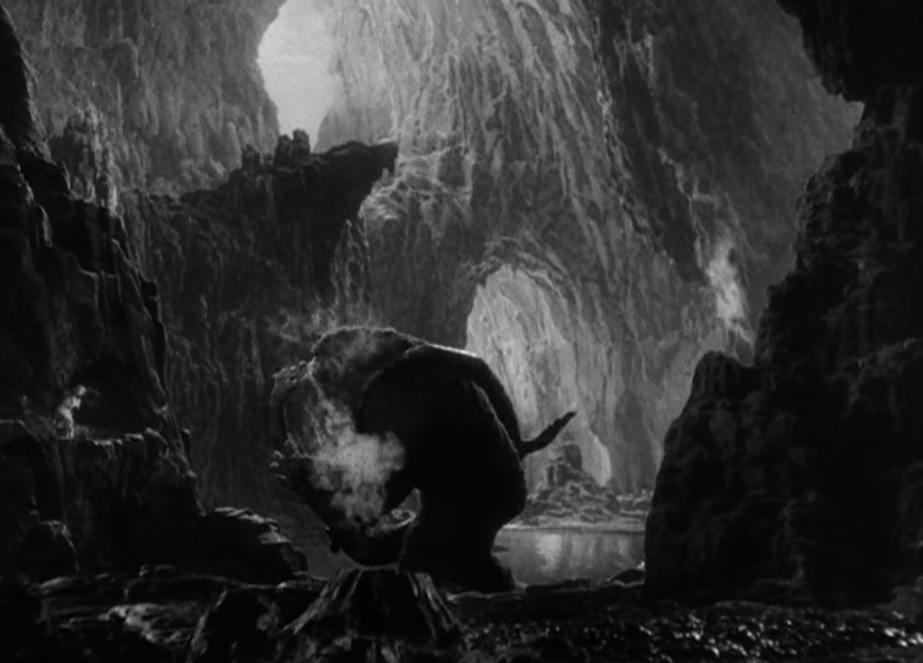
In short order the audience “discovers” Kong, a stegosaurus, an apatosaurus, a T-Rex, a giant snake, and a pterodactyl.  The film’s soundtrack, largely, is a sustained scream from Fay Wray, from about the forty-five minute point on.  People don’t talk or relate as people, they just delve deeper and deeper into the prehistoric jungle, and attempt to survive each new animal featured on the safari.

The Skull Island Safari #1

The Skull Island Safari #2

The Skull Island Safari #3

The Skull Island Safari #4

I also noted on this viewing that more than ever, King Kong boasts a strong reflexive quality.  Carl Denham takes a camera and a girl, Ann, into the jungle to make an adventure movie, a new kind of safari in a different kind of habitat.

But the movie that the audience is watching -- King Kong -- is also a safari…with a pretty girl fronting it.  When Denham complains about having to kowtow to studio bosses, one feels that the comment originates from Cooper himself. Denham is clearly his surrogate figure.

While we watch a safari film, Denham is also making a safari film.

A girl is needed front both films.  Hence the presence of lovely Fay Wray.
Fans of later generations of King Kongin 1976 and 2005 – will be surprised upon returning to this 1933 classic that there is almost no reciprocal relationship between Kong and his bride, Ann.  He may love her, but here it’s an unrequited love.  She never moves beyond terror for the “beast,” whatever he may feel for her.  By Son of Kong (1933) and Mighty Joe Young (1949), a sympathy or love for “the beast” is added as a crucial element of the equation, but it is definitively not present in this film. 

Certainly, one can look at King Kong today and consider it a beauty and the beast story, though beauty has but distaste and fear for her groom. 

And certainly, one can see how Kong himself is a stand-in figure for a proud African slave, dragged from his country in chains to provide the entertainment for an elitist society that is both fearful and envious of him.  But the quality that makes King Kong so great is its sense or spirit of adventure. 

The film steadfastly takes us through the gates of a real world lacking magic, happiness, and perhaps even romance, and reminds us that there are places and things on this Earth yet unseen by man.  And those things, fierce or beautiful, still have the capacity to surprise us, and perhaps change us for the better if we don’t abuse or exploit them.

I suspect one reason that King Kong has survived for roughly eighty years at this juncture, and translated ably from one generation to another, is that many of us still want to believe in our own capacity to be surprised and delighted by nature.  The film is a non-stop safari of vicarious thrills and terrors, a spectacle in the truest sense of the word (meaning that it shows the audience things never before captured on film). 

Even today, King Kong exists to show bored and world-weary audiences that there is more in Heaven and Earth than is dreamed of in "safe" modernity.  

And even today, the film’s spirit of adventure -- if not divine -- is at least as “royal” as its title indicates.

Movie Trailer: King Kong (1933)

Memory Bank: Thanksgiving, WWOR, and Monsters

Wednesday, November 21, 2012


When I was growing up in the New Jersey burbs during the seventies and early eighties there was a great Thanksgiving Day tradition that I’d like to share with you today, on the eve of the holiday. 

Every year, WOR Channel 9 would broadcast King Kong (1933), Son of Kong (1933) and Mighty Joe Young (1949) on Turkey Day.

Then, on Friday, the same station would host a Godzilla marathon consisting of such films as King Kong vs. Godzilla (1962), Godzilla vs. The Smog Monster (1971) and many others.  Some years, if memory serves, War of the Gargantuas (1968) also played.

I remember showering and dressing early on those Thanksgiving Days, so I could be lodged near the TV when the Kong movies started.  Meanwhile, my Mom and Dad would be busy in the kitchen preparing a great meal of turkey, stuffing, baked carrots with cinnamon, and home-made biscuits.  The house would fill with the delectable aromas of the feast, and even downstairs --while glued to WOR-TV -- I could feel my appetite for dinner building.

Our guests, usually my grandparents and aunts and uncles, would arrive sometime in the early afternoon, around 1:00 pm and I would socialize with them, and then sneak back to the family room for more King Kong.  Sometimes my uncle Larry, a horror fan after a fashion, would join me.

Then the meal and dessert -- a chocolate cream pie and a pumpkin pie -- would be served, and we’d all enjoy each other’s company over the delicious food.  After an appropriate interval of visiting and socializing, I’d high-tail it once more back down the stairs to watch more of the movies.

I’m certain my description of Thanksgiving makes it sound weird and anti-social, but you must remember that in the seventies, there were no VCRs (let alone DVRs or movie streaming), which meant that if you wanted to see a movie like King Kong, you had to seize your moment, or else wait for another year.

I believe it took me the better part of four Thanksgivings to see all of King Kong, and then not even in chronological order.  I actually saw the entirety of Son of Kong first, perhaps because it was often scheduled between our early afternoon dinner and dessert course.

This tradition of King Kong Thanksgiving and Godzilla Black Friday continued over a long period at my house -- the better part of a decade -- so much so that I still irrevocably associate the Holiday season with WOR Channel 9 and its monster movie broadcasts.  

I still remember, a bit guiltily, forcing my parents to watch the 1970s Godzilla movies on Fridays, while we ate Thanksgiving leftovers in the family room.  My folks liked the King Kong movies, but when it came to Japanese monster movies, they weren’t exactly big fans.

To celebrate this tradition I’ll be posting reviews of King Kong, Son of Kongand Mighty Joe Young here tomorrow, on Thanksgiving, and a review of Godzillas (1954) on Black Friday.

That line-up ought to start the 2012 Holidays just right.  Make sure to bring the pumpkin pie...and Happy Turkey Day!


Top Ranked Films by Year: the 30s

Monday, June 20, 2011

Based on our compendium of all film polls
[2011 Update Edition]
© William L. Sinclair

This continues our series of top-ranked films by year, based on the Top Ranked 1000 Films on the Net, 2011 Edition that we compiled.

Total Ranked Films in the 30's: 59

- [ 1930 ] -
1. Blue Angel, The (1930) von Sternberg, Josef #196
2. L'Âge d'or (1930) Buñuel, Luis #261
3. All Quiet on the Western

Top Ranked Horror Films on the Net

Tuesday, August 18, 2009

Top ranked horror films from our internet survey, listed from over 1280 film, 43 horror films were mentioned, with 35 making the top 1000. This is probably my least favorite genre, as its like cooking hamburgers, there's only so many ways to kill people, and the best of these go beyond that. Unfortunately directors and filmgoers do NOT, preferring the simple slasher films over anything creative.
 

Blogger news

Blogroll

Most Reading