Showing posts with label 1990s. Show all posts
Showing posts with label 1990s. Show all posts

Best Screenplays: 1990s
Friday, January 18, 2013
Best Adapted Screenplay:
1990: Goodfellas (Nicholas Pileggi and Martin Scorsese)

Oscar winner: Dances with Wolves (Michael Blake)
Was this nominated?: Yes
1991: The Silence of the Lambs (Ted Tally)


Oscar winner: The Silence of the Lambs (Ted Tally)
1992: Glengarry Glen Ross (David Mamet)

Oscar winner: Howards End (Ruth Prawer Jhabvala)
Was this nominated?: No
1993: Schindler's List (Steven Zaillian)

Oscar winner: Schindler's List (Steven Zaillian)
1994: Quiz Show (Paul Attanasio)

Oscar winner: Forrest Gump (Eric Roth)
Was this nominated?: Yes
1995: Casino (Nicholas Pileggi and Martin Scorsese)

Oscar winner: Sense and Sensibility (Emma Thompson)
Was this nominated?: No
1996: Trainspotting (John Hodge)

Oscar winner: Sling Blade (Billy Bob Thornton)
Was this nominated?: Yes
1997: L.A. Confidential (Brian Helgeland and Curtis Hanson)

Oscar winner: L.A. Confidential (Brian Helgeland and Curtis Hanson)
1998: The Thin Red Line (Terrence Malick)

Oscar winner: Gods and Monsters (Bill Condon)
Was this nominated?: Yes
1999: Eyes Wide Shut (Stanley Kubrick and Frederic Raphael)

Oscar winner: The Cider House Rules (John Irving)
Was this nominated?: No
Best Original Screenplay:
1990: Miller's Crossing (Joel Coen and Ethan Coen)

Oscar winner: Ghost (Bruce Joel Rubin)
Was this nominated?: No
1991: The Double Life of Veronique (Krzysztof Piesiewicz and Krzysztof Kieslowski)

Oscar winner: Thelma & Louise (Callie Khouri)
Was this nominated?: No
1992: Reservoir Dogs (Quentin Tarantino)

Oscar winner: The Crying Game (Neil Jordan)
Was this nominated?: No
1993: Three Colors: Blue (Krzysztof Piesiewicz and Krzysztof Kieslowski)

Oscar winner: The Piano (Jane Campion)
Was this nominated?: No
1994: Pulp Fiction (Quentin Tarantino and Roger Avary)

Oscar winner: Pulp Fiction (Quentin Tarantino and Roger Avary)
1995: Before Sunrise (Kim Krizan and Richard Linklater)

Oscar winner: The Usual Suspects (Christopher McQuarrie)
Was this nominated?: No
1996: Secrets & Lies (Mike Leigh)

Oscar winner: Fargo (Joel Coen and Ethan Coen)
Was this nominated?: Yes
1997: Good Will Hunting (Ben Affleck and Matt Damon)

Oscar winner: Good Will Hunting (Ben Affleck and Matt Damon)
1998: Following (Christopher Nolan)

Oscar winner: Shakespeare in Love (Marc Norman and Tom Stoppard)
Was this nominated?: No
1999: Magnolia (Paul Thomas Anderson)

Oscar winner: American Beauty (Alan Ball)
Was this nominated?: Yes
Cult-TV Blogging: Brimstone: "Mourning After" (February 12, 1999)
Thursday, December 20, 2012

The final episode of Brimstone (1998 – 1999), titled “Mourning After,” rivals “It’s a Helluva Life” as the best installment of the short-lived horror program. The repetitious “investigation of the week” formula is dropped, and instead this story focuses squarely on Detective Stone (Peter Horton) and his predicament.
In particular, Stone desperately wants to reach out to his wife (or, technically, widow…) Rosalyn (Stacy Haiduk), who still believes he is long dead. But Stone isn't certain how to approach her, or even if it is right to burden Rosalyn with the truth of his situation as the Devil’s bounty hunter, essentially.
“Mourning After” takes place on Valentine’s Day as a lonely Stone reminisces about his life with Rosalyn. In particular, he remembers the day they moved into a second story apartment together.

In the present, Stone follow Rosalyn home and discovers that she has a new man in her life, a handsome real estate attorney named Barry (Mark Valley). But the more Stone probes, the more he grows concerned about this character. As he soon learns, Barry is actually a vengeful Ashe (Teri Polo) in disguise. She is looking to become Rosalyn, actually, so that Stone and she can share real love together.
A charming and heartfelt hour, “Mourning After” finds Stone battling his conscience. Is it right to burden Rosalyn with his presence, and the facts of his (admittedly strange…) life? Or, as his beloved wife, does she simply deserve to know the truth? If she had him back, would she care about the circumstances?

Stone’s jealousy also pops up when he meets Barry, and there are some great moments here for Horton to play barely concealed rage as Barry keeps discussing how beautiful Rosalyn is, and how he just likes to just spend the weekends at home with her. Of course, this is coded talk for sex, and Stone just quietly burns.
As the last episode of the series -- though not intended as such – “Mourning After” sees the return of the monstrous but incredibly sexy Ashe (Teri Polo), who is still on the loose when the credits roll. The episode also brings Rosalyn a realization that her husband is alive.


After saving Rosalyn from Ashe, Stone leaves his wife a Valentine’s Day snow-globe that boasts significance in their shared history. But while Rosalyn now has information that her dead husband is actually alive, the series seems to leave Stone with the idea that, perhaps, he has seen Rosalyn for the last time.
His final, emotional moments in the series -- looking back at Rosalyn while hiding on the side of a speeding garbage truck -- seem to indicate that Stone has made his peace and decided to put the past to rest, if only so Rosalyn can truly live, and truly move on.


It would have been wonderful to see the next chapter of this tragic love story, but of course, Fox canceled Brimstone (1998 – 1999) and brought the story to a premature end. Originally, "It's a Helluva Life" and "Mourning After" aired consecutively, meaning that the series ended on a true high note, and an incredibly emotional one too.
Watching Brimstone for the first time since 1999 (when I wrote about it in my book Terror Television), I have been struck by how well the series holds up in 2012. The visuals are beautiful, and Horton and Glover are really terrific in the series. Glover has the flashier role, of course, but Horton just quietly holds the whole enterprise together, presenting audiences the portrait of a flawed but very human man.
I just can't help but think that if Fox had shown a little more faith, Brimstone would have caught on, and run for at least three years or so. It deserves to be more than a cult-tv obscurity. It's really that good.
I hope an official DVD is forthcoming.
Cult-TV Blogging: Brimstone: "Faces" (January 29, 1999)
Tuesday, December 18, 2012
“Faces” findsBrimstone (1998 – 1999) back on more formulaic ground. Here, another Hell Convict is on the loose in Los Angeles, wreaking havoc, and it’s up to Det. Stone (Peter Horton) to send him back to the Devil.
But, as we have come to see with Brimstone, even a more formulaic installment boasts a twist or two, and manages to make the “criminal of the week” story one about Stone himself, and his life and decisions.
In “Faces,” the Devil (John Glover) mysteriously directs Stone to 153 Green Street, a suburban street address where a man named Karl has just been murdered by a Hell escapee who suffers from multiple personalities.
Stone befriends one of those personalities -- a helpless teenage boy named Brian -- and questions him about the others, including the violent Vic, and the protective Tammy. Stone soon uncovers the fact that Brian was the subject of a 1957 book called Beaten Down, and that he went to Hell for murder. But he’s back now to finish off his abusive step dad.


The problem, however, is that if Stone sends Vic back to Hell, the innocent Brian goes to Hell with him. And Stone has begun thinking of Brian as the son he never had…
“Faces” opens at a batting cage in Los Angeles as Stone watches a loving father (Jerry Hardin) and a child bond together over baseball. This sight gets Stone in a contemplative mood, especially since Rosalyn (Stacy Haiduk) and Zeke were trying to have children at the time of his death in 1983. Stone begins to take advice from Hardin’s character, and wonders what his life might have been like if his own father hadn’t been such a “brutal bastard.”
Stone as a prospective father -- and Stone as the wounded son -- are the characters that dominate “Faces,” and make for an engaging, emotionally-affecting hour. As has been the case for a while now, the actual investigation of the crimes is far less interesting than the focus on Stone and the issues he tackles. This episode is filled with wisdom about fathers and sons and despite the formulaic investigation, manages to be a strong hour. That is especially true when Stone must send Brian back to Hell for eternity.
Since Brian is an innocent, this predicament raises a question of justice. Though Vic is a guilty bastard, why should Brian – essentially an independent personality-- be punished for his sins? This is one more notch in Brimstone’s obsession with moral shadings within the confines of a good/evil, black/white universe.
There are a number of powerful observations and jokes in this episode. At one point, the Devil points out that he is a father…and points to members of Congress (then bent on impeaching President Clinton…) as his “sons.”
Another moment suggests that some men become parents to “fill the empty space” where a “father’s love should have been.” In another moment, the Devil suggests to Stone that men want sons so as to satisfy “the insatiable narcissism” of the male of the human species. These are all caustic and powerful notes in a story about fatherhood.
Watching “Faces” today one can detect how the writers on Brimstone were virtually longing to escape the criminal of the week formula and venture into more character-based shows. The final episode of the series, “Mourning After” reveals just how well that approach could work. It’s a shame that the series didn’t last beyond a dozen or so programs.
Next time, we finish off Brimstone with “Mourning After.”
Best Music: 1990s
Friday, November 23, 2012
Best Original Score:
1990: Edward Scissorhands (Danny Elfman)
Oscar winner: Dances with Wolves (John Barry)
Was this nominated?: No
1991: The Double Life of Veronique (Zbigniew Preisner)
Oscar winner: Beauty and the Beast (Alan Menken)
Was this nominated?: No
1992: The Last of the Mohicans (Randy Edelman and Trevor Jones)
Oscar winner: Aladdin (Alan Menken)
Was this nominated?: No
1993: Three Colors: Blue (Zbigniew Preisner)
Oscar winner: Schindler's List (John Williams)
Was this nominated?: No
1994: The Shawshank Redemption (Thomas Newman)
Oscar winner: The Lion King (Hans Zimmer)
Was this nominated?: Yes
1995: Braveheart (James Horner)
Oscar winner: The Postman (Il Postino) (Luis Enrique Bacalov)*
Was this nominated?: Yes
1996: Fargo (Carter Burwell)
Oscar winner: The English Patient (Gabriel Yared)*
Was this nominated?: No
1997: Gattaca (Michael Nyman)
Oscar winner: Titanic (James Horner)*
Was this nominated?: No
1998: The Thin Red Line (Hans Zimmer)
Oscar winner: Life is Beautiful (Nicola Piovani)*
Oscar winner: Life is Beautiful (Nicola Piovani)*
Was this nominated?: Yes
1999: October Sky (Mark Isham)
Oscar winner: The Red Violin (John Gorigliano)
Was this nominated?: No
*These Oscar winners are from the Best Original Dramatic Score category.
Best Original Song:
1990: "Somewhere in My Memory" - Home Alone
Oscar winner: "Sooner or Later (I Always Get My Man)" - Dick Tracy
Was this nominated?: Yes
1991: "Beauty and the Beast" - Beauty and the Beast
Oscar winner: "Beauty and the Beast" - Beauty and the Beast
1992: "A Whole New World" - Aladdin
Oscar winner: "A Whole New World" - Aladdin
1993: "Streets of Philadelphia" - Philadelphia
Oscar winner: "Streets of Philadelphia" - Philadelphia
1994: "Can You Feel the Love Tonight" - The Lion King
Oscar winner: "Can You Feel the Love Tonight" - The Lion King
1995: "I Will Remember You" - The Brothers McMullen
Oscar winner: "Colors of the Wind" - Pocahontas
Was this nominated?: No
1996: "Walls" - She's the One
Oscar winner: "You Must Love Me" - Evita
Was this nominated?: No
1997: "My Heart Will Go On" - Titanic
Oscar winner: "My Heart Will Go On" - Titanic
1998: "I Don't Wanna Miss a Thing" - Armageddon
Oscar winner: "When You Believe" - The Prince of Egypt
Was this nominated?: Yes
1999: "Save Me" - Magnolia
Oscar winner: "You'll Be in My Heart" - Tarzan
Was this nominated?: Yes
Cult-TV Blogging: Brimstone: "Ashes" (December 18, 1998)
Tuesday, November 20, 2012

If “Slayer” and “Encore” didn’t already prove how the turn-of-the-century horror TV series Brimstone (1998 – 1999) could scale the heights of TV series greatness, then certainly this week’s episode, “Ashes” does.
In this story, Detective Ezekiel Stone (Peter Horton) teams up with Detective Ash (Teri Polo) to investigate a series of arsons in Los Angeles. Houses of faith from various religions are being burned down by an unknown culprit, and worse, someone inside those burned buildings seems to be conducting ceremonial human sacrifices. One night, Stone even dreams of being the victim in one such sacrifice.
At one crime scene, Stone discovers a 4,000 year old Canaanite knife, and realizes that he is facing, perhaps, the most powerful of the 113 Hell escapees. Meanwhile, Ash and Stone grow ever closer while working together, and this episode features an unexpectedly hot sex scene between them in a car. Unfortunately, it ends badly when Ash sees all the strange tattoos on Stone’s chest. She brings things to a stop when she realizes she doesn’t really know who Stone is.


The episode’s final revelation, I must admit, threw me for an absolute loop when I first saw this episode in the 1990s. It turns out that the escaped convict of the week – the arsonist who is angry with God (or Yahweh) is not a guest character, but Ash herself. In fact, as Stone learns, she is actually Ashur Badaktu, the “ringleader” of the break-out down below Worse, she escaped from Hell in the first place (with 112 others…) by tricking and seducing the Devil (John Glover) himself.
It’s a great and absolutely unexpected twist to transform the put-upon, curious and very human Detective Ash -- whom we have seen in virtually every episode so far -- into the series’ villain. This episode also answers some critical questions about her judgment, and why she has been willing to let Stone take the lead on so many cases in her jurisdiction. It turns out, they really are two-of-a-kind.


The chemistry between Stone and Ash (and Horton and Polo) is terrific in this episode, and the latter half of the episode (after the typically dull police procedural aspects…) really sizzles. The final punctuation, of course, is the Devil’s realization of what has occurred. “You fool, you’ve fallen in love with her,” he says to Stone with dismay. Stone counters that he isn’t the only one, and the look on the Devil’s face is priceless. Ash is so powerful a personality that she has pulled the wool over both of their eyes.
The episode’s climax, in which Ash transforms from a blond, 20th century police officer into a dark-haired Caananite warrior is also a real shocker. When Ash escapes, her survival makes “Ashes” the first episode of Brimstone in which Stone doesn’t send a convict back to Hell.


In many ways, “Ashes” feels like it introduces one of the final and most important elements to Brimstone: the individual explicitly working against Stone and the Devil’s agenda. Had the series lasted, I’m certain she would have been an even more important player…
Next week on Brimstone: “Lovers.”
Cult-TV Blogging: Brimstone: "Repentance" (November 13, 1998)
Tuesday, October 23, 2012

The story involves Detective Stone’s (Peter Horton) investigation of a gruesome murder. Specifically, a homeless man, Harry (David Proval) witnesses a man cutting out the eyes of another man.
Stone looks into the horrific act, and finds a clue -- a brass pin -- tying the crime to a Dutch S.S. Nazi uniform, and a Hell escapee known in life as “the Angel of Mercy.”
Stone looks into the horrific act, and finds a clue -- a brass pin -- tying the crime to a Dutch S.S. Nazi uniform, and a Hell escapee known in life as “the Angel of Mercy.”
However, Stone soon learns that this Angel of Mercy (Norbert Weisser) has returned from Hell to make restitution for his crimes, and that the real culprit here is another man, an addict who was once also homeless…

The story finds Stone tracking a Hell escapee who isn’t actually the perpetrator or criminal of the week. That wrinkle is a welcome one, and reminds us that all evil in the world does not originate from the realm below.
By contrast, I was deeply disappointed by the first season of Grimm (2011 - ) because week-in and week-out, every single crimeinvestigated by the lead character was caused by a fairy tale creature. This fact did two (bad) things simultaneously. First, it painted the fairy tale creatures as lawbreakers and violent offenders, all. Secondly, it suggested that man was not culpable for any criminal activity in this world. Rather, he was just victimized by monsters that happened to be disguised as men. It’s a terrible dynamic, and feels very two-dimensional.

On a thematic level, “Repentance” lives up to its title. It concerns a man who wants nothing more in life than to make-up, in some way, for the crimes he committed. He is out to redeem himself, but as the episode points out, he must also be forgiven in the eyes of others.
 To his credit, Stone makes that leap in this episode. Our culture claims to be a forgiving one, yet on a daily basis we see how this isn’t always so.
 Once more, I enjoy how Brimstone threads this particular needle. The show clearly exists in a universe of blacks and whites, and of good and evil, but Stone is constantly asked to make decisions that require him to think in shades of gray, and nuance.
He determines that the Angel of Mercy is innocent -- that he has paid for his crimes -- but he still must send him back to Hell, regardless.
Finally, this episode also adds another piece of delightful Brimstone mythology: Stone’s love for the now-defunct 1980s “Reggie” candy bar (after Reggie Jackson). By episode’s end, he’s got a box of them to enjoy, thanks to a collector…
Next week: “Executioner”
In the meantime, here’s a Reggie Bar commercial:
Cult-TV Blogging: Brimstone: "Slayer" (December 11, 1998)
Tuesday, October 16, 2012
 The 1998-1999 Fox horror series Brimstone conjures up another strong installment with “Slayer,” an action-packed tale which pits hang-dog, world-weary Detective Stone (Peter Horton) against a merciless Carthaginian warrior from the Punic Wars, Hasdrubel Skaras (Richard Brooks).
 This unusual nemesis can actually “blend into in the landscape,” and he revels in “the slaughter of innocent bystanders.”
The episode commences with a bang when Hastrubel Skaras unexpectedly challenges Stone at a city diner. The “slayer” punctures one of Stone’s eyes (the windows to the soul, remember...), and nearly sends our protagonist straight back to Hell.
Naturally, the Devil (John Glover) isn’t too happy about this one-sided confrontation, and suggests to Stone that perhaps he ought to be employing Hanstrubel Skaras to recover the escaped convicts, not the detective.
Naturally, the Devil (John Glover) isn’t too happy about this one-sided confrontation, and suggests to Stone that perhaps he ought to be employing Hanstrubel Skaras to recover the escaped convicts, not the detective.
 Using a deadly Hittite blade, the ancient slayer sets out to murder the widows of several police officers in Los Angeles, a violent ploy to make Stone stop hunting him, and even join up as an ally. The threat is clear: by killing police widows, Hastrubel reminds Stone that his wife, Rosalyn (Stacy Haiduk) is also a police widow, and therefore also one of his targets.
 Out-matched, Stone finds himself in something of a tactical conundrum. If he warns Rosalyn of the threat, he may be leading the (nearly) invisible Skaras right to her.
Given these strategic problems, "Slayer" is the first episode of Brimstone in which we feel Stone is truly up against an enemy he really may not be capable of defeating, and that fact makes for a compelling hour.
Brooks is great here, too, just as he is in Firefly’s “Objects in Space.” Brooks brilliantly portrays a loquacious, physically-intimidating villain, one who projects a cunning intelligence. “Slayer’s” opening scene in the diner is something of a masterpiece as Skaras talks and talks and talks, almost hypnotically. Watching this scene, I realized that Brooks could sell me anything. His delivery is mesmerizing, and I love the way he relishes each threat, each insinuation.
Brooks is great here, too, just as he is in Firefly’s “Objects in Space.” Brooks brilliantly portrays a loquacious, physically-intimidating villain, one who projects a cunning intelligence. “Slayer’s” opening scene in the diner is something of a masterpiece as Skaras talks and talks and talks, almost hypnotically. Watching this scene, I realized that Brooks could sell me anything. His delivery is mesmerizing, and I love the way he relishes each threat, each insinuation.
The good vs. evil conflict is resolved imaginatively in “Slayer” when Stone determines his enemy’s only weakness. Hastrubel may be able to blend in with the landscape, but when he moves about, he still creates movement; he still displaces air. Accordingly, for the final battle Stone sets up candles throughout a Catholic cathedral and then traces Hastrubel’s movement by their flickering.

Much like Arnie’s Terminator, the Slayer here goes after the mother of one target, and then kills that matriarch so as to learn the target’s location. And, when saving one widow, Stone -- wearing a Kyle Reese-like trench coat --remarks: “Come with me if you want to live,” echoing Reese’s first words to Sarah Connor (Linda Hamilton).
Despite such similarities (or perhaps tributes…), “Slayer” makes for a very tense confrontation between a warrior of the past, and a warrior of our age, and in the process allows the audience to ponder how much things have changed in a millennium.
A thousand years ago, harming the innocent was apparently no big deal. Life was cheap. In fact, it was a joke to men like Skaras. But today, soldiers and police go out of their way to avoid hurting non-combatants, at some risk to themselves. A thousand years ago, such mercy was considered a sign of weakness. On Brimstone, however, it is a sign of Stone’s character and strength.
Also, a thousand years ago, this monstrous soldier, Skaras, could rely on his dark magic to deceive his opponents. But today, Stone has science on his side, so maybe it's a fair fight. It’s a great and involving dynamic, regardless. “Slayer” is such a fun episode because we get to measure Stone against Skaras, and consider who remains the greatest of all warriors. Not incidentally, we get to ponder the fact that both warriors ended up in the same place: Hell.
Also, a thousand years ago, this monstrous soldier, Skaras, could rely on his dark magic to deceive his opponents. But today, Stone has science on his side, so maybe it's a fair fight. It’s a great and involving dynamic, regardless. “Slayer” is such a fun episode because we get to measure Stone against Skaras, and consider who remains the greatest of all warriors. Not incidentally, we get to ponder the fact that both warriors ended up in the same place: Hell.
Next week: “Repentance.”
Cult-TV Blogging: Brimstone: "Encore" (November 6, 1998)
Tuesday, October 9, 2012

In specific terms, that means the Hell-escapee of the week isn’t merely a diabolical fugitive to be apprehended and sent back to Hell, but a deliberate reflection of Detective Ezekiel Stone’s (Peter Horton) personality and situation.
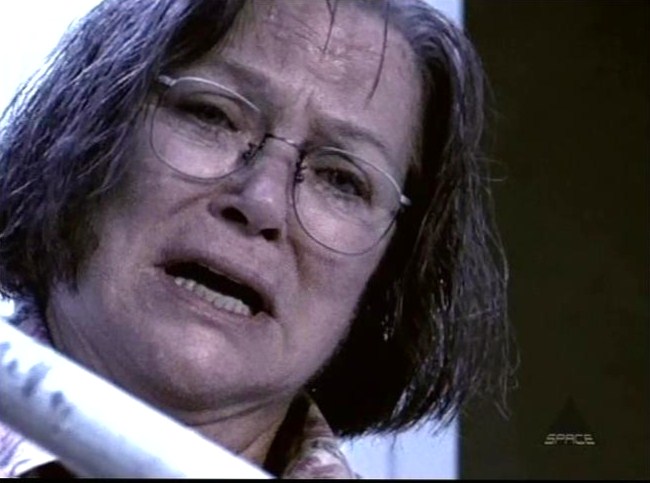
In this case, the villain of the week is Gilbert Jax (William McNamara), the man who raped Stone’s wife, Rosalyn (Stacy Haiduk) in 1983 and by doing so destroyed the Stone marriage. Stone murdered Jax, and that’s the reason Stone was consigned to Hell. Now, Jax is back on Earth, and living with his mother, Evelyn McNabb (Louise Fletcher). She believes her son has been in Heaven with the angels and is getting a second chance at life on Earth.
 While Stone hunts Jax down, he relives the day of Rosalyn’s rape (via flashback), and compares his own feelings of powerlessness and rage to those of another rape victim’s husband. That man gets “angrier and angrier” every day, and Stone counsels him to calm down, lest he take the same path that Stone took; the path that led the detective to Hell.
In the end, Stone dispatches Jax with some difficulty (arranged by the Devil [John Glover]) and there’s a terrific final scene that helps to explain succinctly why Brimstoneis such a great series. Jax disappears, and his mother, Evelyn, sits down heavily, realizing that her son is gone…for good this time. Then, she asks if Stone is an angel and if Gilbert has been “sent back to Heaven” where she feels he “belongs.”
 Instead of arguing with Evelyn about the merits of her (terrible...) boy, Stone is quiet…and lets her keep her delusion. He doesn’t tell her the truth that Gilbert is back in Hell, and Damnation is where he actually belongs.
 This small moment reveals that even in a situation where Stone has been grievously wronged and feels absolute rage, he realizes he can still be decent to someone else who is hurting. There is nothing to gain by shattering Evelyn’s image of her wayward child. So instead of laying more hurt at her feet, Stone holds his words, and it’s a powerful and moral act. It’s a great moment for the episode, and for the series.
 “Encore” also looks long and hard at Stone’s behavior in other ways: his murder of Gilbert back in 1983, for example. The Devil accuses him of “denial, pride, and self-righteousness,” and those are feelings all of us might have in a similar situation. Stone lost everything because of what Jax did, but also because of how he, personally, responded to what Jax did.
Stone knows too well that to indulge those feelings of denial, pride and self-righteousness with action (and murderous action to boot) is to indulge his dark side, especially since he abuses his position as a police officer.
Again and again, Brimstone charts this fascinating trajectory. Stone is a man stuck in a universe of absolutes: Heaven/Hell, God/Devil, Good/Bad. Yet everything he experiences on his journey is a reminder that life isn’t that simple or black-and-white.
 He keeps finding shades of gray in the human experience, and trying to countenance what they mean. The show thus asks questions about the differences between vengeance and justice, and suggests that even “monsters” like Jax are loved by their mothers, and that such love can be respected.

It’s a very, very challenging dynamic, and it’s absolutely part of what made Brimstone must-see TV. I loved that on Friday nights in 1998-1998 -- between Brimstone and Millennium, -- viewers got a double dose of the horror genre at its best, a genre that can ask and answer the big questions of humanity in a meaningful way without seeming preachy.
Subscribe to:
Posts (Atom)


