Pages

Powered by Blogger.
Showing posts with label Tom Hanks. Show all posts

Alternate Best Supporting Actor 2012: Results

Saturday, February 9, 2013

5. Tom Hanks in Cloud Atlas- Hanks plays six different characters and gives four lacking characterizations showing his lack of range as an actor. The two characters in his range though are fairly well handled actually, unfortunately he really misses with the others.
4. James Spader in Lincoln- Spader is a delight in his role as political operative. Creating a unique character and naturally adding a great deal of humor to his film.
3. Samuel L. Jackson in Django Unchained- Jackson gives a terrific performance giving one of brilliant absurdity but as well a fascinating depiction of pealing behind his character's facades.
2. Sam Rockwell in Seven Psychopaths-Rockwell does his thing to the extreme here, and if you want a Rockwellian performance get Sam Rockwell. Rockwell is great being extremely funny while managing to still bring weight at the same time.
1. Javier Bardem in Skyfall- Good Prediction Micheal Patison and RatedRStar. This is is incredible year for supporting actors. Its a shame the academy chose to award three veterans giving descent but not particularly special performances and two leading performances. My choice overall this year goes to Javier Bardem as the greatest Bond Villain of all time. He is fun, entertaining, menacing, as well as even moving in a strange way. A true achievement that is just a performance enjoyable to watch but as well fulfilling character piece.
Overall Rank:
  1. Javier Bardem in Skyfall
  2. Christopher Walken in Seven Psychopaths
  3. Sam Rockwell in Seven Psychopaths
  4. Samuel L. Jackson in Django Unchained
  5. Eddie Redmayne in Les Miserables 
  6. Woody Harrelson in Seven Psychopaths 
  7. Ben Whishaw in Cloud Atlas
  8. Leonardo DiCaprio in Django Unchained 
  9. James Spader in Lincoln 
  10. Tom Waits in Seven Psychopaths
  11. Ewan McGregor in The Impossible
  12. Bruce Willis in Looper
  13. Scoot McNairy in Killing Them Softly 
  14. Jason Clarke in Zero Dark Thirty
  15. Jim Broadbent in Cloud Atlas
  16. David Straithairn in Lincoln
  17. Edward Norton in Moonrise Kingdom
  18. Michael Fassbender in Prometheus 
  19. Ray Liotta in Killing Them Softly
  20. Ezra Miller in The Perks of Being a Wallflower 
  21. David Costabile in Lincoln
  22. Tom Hardy in The Dark Knight Rises
  23. Irrfan Khan in Life of Pi
  24. Bruce Willis in Moonrise Kingdom 
  25. Michael Shannon in Premium Rush 
  26. Aaron Tveit in Les Miserables 
  27. Andy Serkis in The Hobbit
  28. Bryan Cranston in Argo
  29. Russell Crowe in Les Miserables 
  30. James D'Arcy in Cloud Atlas 
  31. Dwight Henry in Beast of the Southern Wild
  32. Richard Jenkins in Killing Them Softly 
  33. Werner Herzog in Jack Reacher 
  34. Jim Sturgess in Cloud Atlas
  35. Jeff Daniels in Looper
  36. Josh Brolin in Men in Black 3
  37. Jared Harris in Lincoln 
  38. Matthew McConaughey in Bernie
  39. Ha Jung-Woo in Nameless Gangster
  40. Ben Whishaw in Skyfall 
  41. Jackie Earle Hayley in Lincoln 
  42. Tom Wilkinson in The Best Exotic Marigold Hotel
  43. Ian McKellen in The Hobbit 
  44. Albert Finney in Skyfall 
  45. Richard Armitage in The Hobbit 
  46. Robert De Niro in Silver Linings Playbook
  47. Hal Holbrook in Lincoln 
  48. Alan Arkin in Argo
  49. Scoot McNairy in Argo
  50. Bruce Dern in Django Unchained
  51. John Goodman in Argo
  52. Michael Wincott in Hitchcock
  53. Thomas Haden Church in Killer Joe
  54. Dallas Robert in The Grey
  55. Dermot Mulrooney in The Grey
  56. Chris Tucker in Silver Linings Playbook
  57. Tommy Lee Jones in Lincoln
  58. Guy Pearce in Lawless
  59. Ralph Fiennes in Skyfall
  60. Tom Hiddleston in The Avengers
  61. Tim Blake Nelson in Lincoln
  62. Harry Dean Stanton in Seven Psychopaths
  63. John Hawkes in Lincoln
  64. Mark Strong in Zero Dark Thirty 
  65. Michael Stuhlbarg in Seven Psychopaths
  66. Frank Grillo in The Grey
  67. Kyle Chandler in Zero Dark Thirty 
  68. Walton Goggins in Lincoln
  69. Don Johnson in Django Unchained
  70. Bill Nighy in The Best Exotic Marigold Hotel
  71. Michael Pitt in Seven Psychopaths
  72. Gary Oldman in The Dark Knight Rises
  73. Nate Parker in Arbitrage
  74. Walton Goggins in Django Unchained
  75. Bob Balaban in Moonrise Kingdom
  76. Michael Caine in The Dark Knight Rises
  77. Ben Mendelsohn in Killing Them Softly
  78. Sacha Baron Cohen in Les Miserables
  79. Michael Stuhlbarg in Lincoln 
  80. Jason Clarke in Lawless
  81. Joel Edgerton in Zero Dark Thirty
  82. Clark Gregg in The Avengers 
  83. Gulliver McGrath in Lincoln
  84. James Gandolfini in Killing Them Softly
  85. Joseph Gordon-Levitt in The Dark Knight Rises
  86. Bill Murray in Moonrise Kingdom
  87. Colm Wilkinson in Les Miserables 
  88. Bruce McGill in Lincoln
  89. Joseph Gordon-Levitt in Lincoln
  90. Keith David in Cloud Atlas
  91. Tom Conti in The Dark Knight Rises
  92. Woody Harrelson in The Hunger Games
  93. Jesse Plemons in The Master
  94. Don Cheadle in Flight
  95. James D'Arcy in Hitchcock
  96. Gary Oldman in Lawless
  97. Bruce Greenwood in Flight
  98. Lee Pace in Lincoln
  99. Jeremy Renner in The Avengers
  100. Donald Sutherland in The Hunger Games
  101. Daniel Huttlestone in Les Miserables
  102. John Ortiz in Silver Linings Playbook
  103. Rory Kinnear in Skyfall 
  104. Stanley Tucci in The Hunger Games
  105. Brian Geraghty in Flight
  106. Lenny Kravitz in The Hunger Games
  107. Morgan Freeman in The Dark Knight Rises
  108. James Badge Dale in Flight
  109. William H. Macy in The Sessions
  110. Hugo Weaving in Cloud Atlas
  111. Anupam Kher in Silver Linings Playbook
  112. Rafe Spall in Life Of Pi
  113. Pierce Gagnon in Looper
  114. Michael Stuhlbarg in Men in Black 3
  115. Josh Hutcherson in The Hunger Games
  116. Tom Hanks in Cloud Atlas 
  117. Matthew Modine in The Dark Knight Rises
  118. Hugh Grant in Cloud Atlas
  119. Logan Marshall-Green in Prometheus
  120. Liam Hemsworth in The Hunger Games
  121. Guy Pearce in Prometheus
  122. Dash Mihok in Silver Linings Playbook
  123. Rafe Spall in Prometheus
  124. Paul Dano in Looper
  125. David Oyelowo in Lincoln
  126. Ben Mendelsohn in The Dark Knight Rises
  127. Wes Bentley in The Hunger Games
  128. John Goodman in Flight
  129. Jemaine Clement in Men in Black 3
  130. The Cast of The Expendables 2
  131. Aasif Mandiv in Premium Rush
  132. Wole Parks in Premium Rush
 Next Year: 2012 Lead

    Alternate Best Supporting Actor 2012: Tom Hanks, Jim Broadbent, Ben Whishaw and Hugo Weaving in Cloud Atlas

    Tuesday, February 5, 2013

    Tom Hanks did not receive an Oscar nomination for portraying Dr. Henry Goose, Hotel Manger, Isaac Sachs, Dermot Hoggins, Timothy Cavendish look-a-like actor, and Zachary in Cloud Atlas.

    Cloud Atlas is another film this year like Les Miserables, or The Master where you tap into its wavelength, or you do not, and if you do not you are in for a long watch. For me personally Cloud Atlas really works and I was thoroughly entertained and intrigued by it.

    Cloud Atlas is not a perfect film, and there are questionable choices in it. One being the few actors cast who are decidedly not chameleon. Tom Hanks is one of them and looking at this performance can easily be done by thinking what would Gary Oldman do. Hanks plays six roles and it is really best to look at each of the roles separately and see Hanks's attempts in each role. The first chronologically is that of Dr. Henry Goose who pretends to help an American Lawyer Adam Ewing (Jim Sturgess) recover from a parasitic worm, where in fact Goose is slowly poisoning the man and intends to kill him to rob him of his gold. This is a unique role for Hanks doing an accent as well as playing a villain.

    It would seem this sort of role is not for Hanks as he is not very menacing nor as enjoyable as the greedy Goose probably could have been in say the hands of Gary Oldman. Hanks seems a little silly in the role actually, and the makeup never seems to fit him. It does not help that Hanks never seems all that comfortable with the accent either leaving him rather uninteresting to say the least. Honestly there was a great deal of potential for Goose to really be a great turn, but Hanks just really does not have the command of the role that is really required for an excellent villianous turn.

    Well we can skip the Hotel Manager as he is basically just Goose again just with less screen time. Next he comes as Isaac Sachs a Nuclear scientist who attempts to help journalist Luisa Rey (Halle Berry). Hanks is far more comfortable in this role brings out his best qualities as just an average role. He is good at showing the decency of his character, and naturally brings about the connection Sacs feels with Rey. It is a very short role though, and he really is only in one scene as Sacs leaving the good qualities of this performance fairly easy to forget.

    Next is a double display of lacking as he plays Dermot Hoggins as the actor playing Timothy Cavendish. Hoggins is quick scene of a deranged gangster who kills a critic for dissing his book. Again a sort like Gary Oldman could have knocked this scene out of the park and turned the rage of Hoggins into a hilarious overstatement. Hanks though lacks the punch in his performance and just seems silly in the get up as well as with his heavy accent. The same is true as the actor reenacting Jim Broadbent's story. Another actors could had a lot of fun in the brief scenes, but Hanks plays it oddly straight and does not make much of an impact. 

    The last segment as Zachary in a post apocalyptic land as a tribesman Zachary plagued by guilt due to not acting when his brother and nephew were killed by roaming cannibals. Now even this segment has problems with the future speak used which almost none of the actors are comfortable with. All filmmakers who decide to do something like this should always remember there are things called Shakespearean actors for a reason, even if you make up a derivative of English actors still need to be comfortable with it, but when the actors speak here they always seem somewhat rehearsed.

    Hanks though does have good moments in his silent reactions in these scenes as Zachary, and he has powerful moments showing the painful struggle he is facing due to his loss as well as his feelings of guilt. For the most part this is a fairly effective piece of work by Tom Hanks in these scenes even if he never makes the words entirely natural. He has quite a bit power in his scenes particularly when Zachary see his entire village destroyed, and brings the weight to these scenes as he should. So the final tally goes like this Goose -2, Manager-2, Sachs-2.5, Hoggins-1.5, Cavendish-1.5, Zachary-3.5 leaving him as a:
    Jim Broadbent  did not receive an Oscar nomination for portraying Captain Molyneux, Vyvyan Ayrs, Timothy Cavendish, Korean Musician, Prescient 2 in Cloud Atlas.

    Jim Broadbent is certainly an actor more capable of various characterization than the fairly limited Hanks, but he honestly only plays three roles the first three. The last two are null as you'd be hard pressed to notice him in those roles. So really I only need to examine his performances in the other three. The first two which are Captain Molyneux and Vyvyan Ayrs are can really be spoken together as they are similar with Ayrs basically being a more complex version of Molyneux. As both Broadbent plays arrogant men who are filled with their own sense of skill and power. 

    Broadbent does well in both roles and gets the cruel pompousness of these characters out. As Molyneux he is particularly good and Broadbent shows the brutal nature of the composer who makes Molyneux as the societal injustice he should be. Importantly though Broadbent does show a quieter nature to the man in a few scenes that helps establish the idea that this man does have some brilliance behind his less positive features. He makes this role completely suiting its needs which is to put the lead of this story, ambitious young composer Robert Frobisher, through hell and set the man on the course of dread and despair.

    Now the most important role of Jim Broadbent in the film is that of Timothy Cavendish the only story in the film that is a straight out comedy. It details a book publisher who must go into hiding when one of his writers demands payment that he does not have. He is in fact the lead of this story he is still supporting though of the film, as everyone is supporting the film here and not one actor leads the film. Broadbent fills a very important role in the story of Timothy Cavendish as he must bring a lighter touch to the film that alleviates some of the heavier elements of the film expressed in all of the other stories.

    Broadbent makes the story of Timothy Cavendish enjoyable one through his various reactions as Cavendish faces various bouts of bad luck. Broadbent is an effective comedic actor in that he is able to express the emotions honestly in each scene well making them amusing at the same time. Broadbent makes the ride of Cavendish an enjoyable one as he goes from running from the gangster to trying to escape from a jail like retirement home. Broadbent has a lot of fun in the role a he makes every comedic scene as entertaining as they should be. Broadbent is charming and likable as Cavendish, and makes The Ghastly Tale of Timothy Cavendish an easy story to watch play out.

    Broadbent adds well to the film in a way that Tom Hanks does not. Although he is certianly recognizable as Jim Broadbent in all of his important roles he differentiate them properly, and they work well in the nature of the film rather than seem distracting as it did for Hanks. Broadbent is particularly effective in giving entirely opposing performances as a fiendish composer, and a likable publisher. Frankly Broadbent's performance only helps in showing exactly what is wrong with Hanks's characterizations.
    Ben Whishaw did not receive an Oscar nomination for portraying Robert Frobisher in Cloud Atlas.

    Ben Whishaw actually plays five roles but they do not really matter in that they are very short and unnoticeable. To his credit though he is not distracting in the moments, and fulfills these roles as he should. They just do not amount to much which is fine though because he plays the meatier role of Robert Frobisher who is the main character of his story. His story being that of a young bi-sexual musician who goes to work with a forgotten but talented composer Vyvyan Ayrs (Jim Broadbent). Whishaw leads which is probably the weightiest story of the film, and the one that depends probably the most on the lead performance.

    Whishaw at the beginning of Frobisher's story shows him to be a young man with a great deal of energy who is enthusiastic at the prospect of composing a masterwork with Ayrs's help. Whishaw is quite good in emphasizes the ambitious qualities within Forbisher and makes his urge to create something remarkable something worthwhile. Frobisher's story easily could have been excessively uninteresting, or seem the story of just a selfish man. Whishaw though succeeds incredibly well by being very genuine with the feelings that Forbisher's feels that compels him to such a task.

    There are several narrations competing throughout the film each which make varying impacts. Whishaw's honestly adds the most to the film and there is something particularly compelling about his delivery. He infuses a tremendous amount of life to each and poignancy. every moment that Frobisher's the one we here on screen. There are a great deal of lines in the film about the interconnected nature of everyone and everything. Perhaps they don't leave these sort of lines for Tom Hanks for a reason as they really require a great deal of conviction to make them seem more than pretentious babble, Whishaw manages to bring this conviction.

    Whishaw adds a power to all of his scene through his turn as Frobisher. He is very effective later on as it seems less and less likely that he will achieve his dreams he falls into despair only holding on to finish his masterpiece. It is a moving performance by Whishaw because he never does overwhelm with the depression of the character. Instead there is something particularly special about his portrayal of this man's suicide because of the final moments of happiness before regulating himself to his fate. They are short subtle reactions by Whishaw but they beautifully show the complexity of the man as well as what Frobisher really has lost by committing suicide. Ben Whishaw gives a very strong performance here and despite only having one role of note actually is one of the most memorable portrayals in the film. The nature of the film that weaves in and out of each story and Whishaw always holds the proper amount of attention, and brings to life the story Robert Frobisher in a powerful fashion.
    Hugo Weaving did not receive an Oscar nomination for portraying Haskell Moore, Tadeusz Kesselring, Bill Smoke, Nurse Noakes, Boardman Mephi, and Old Georgie in Cloud Atlas.

    Hugo Weaving is best known for playing villains so they took this as reason to cast him as villianous character in five of his six characters. His only character who is not a villain can be quickly forgotten as he is only seen briefly and makes almost no impact on the film. Weaving basically takes a similar approach for three of the five villains so I might as well just look at the two most prevalent. Bill Smoke a hit man who is the purest of his villains here and the other three similar ones are only slight deviations from him. His other villain that is the most dissimilar is that of Nurse Noakes as Weaving in that role plays a female character. 

    As Bill Smoke shows signs of his role as Agent Smith in The Matrix, which is a good thing. Weaving is quite good at the evil maniacal stare, as well as the imposing delivery that brings to life the fierce some nature of his character well. Weaving knows how to deliver with a character like this as well as the other similar ones. He oozes menace with an ease and oddly enough a certain grace. He makes looking evil seem easy, and even though Bill Smoke is not given much time he makes him the proper threat from his very first scene. Weaving is perfectly cast in these roles because he knows exactly how to play them and brings out the evil of these characters quickly without effort even seeming required.

    It is a real shame though that Weaving's strengths shown with the other villains is rather wasted in the role of Nurse Noakes. Noakes is basically the Nurse Ratched of the retirement home that imprisons Timothy Cavendish. Weaving is not very good here basically doing the stereotypical voice that any man does to imitate a woman when they are not trying at all to believable. Noakes is indeed in the comedic section of the film so really he would not exactly have to be the most believable woman of all time, but Weaving performance is rather embarrassing instead. Frankly someone, like maybe Gary Oldman for example, could have brought out more menace in these scenes well being funny at the same time. Weaving is neither menacing or funny as Noakes.

    The last villianous performance by Weaving here is as Old Georgie, the representation of the devil, who haunts Tom Hanks's Zachary. Weaving here seems to be doing his best Tom Waits impression. To be perfectly honest this works out just fine, and Weaving is fine at being this existential evil. Old Georgie is pretty limited but Weaving is just as he should be. Hugo Weaving for the most part works as the go to evil doer for the film. Nurse Noakes weighs down his performance which unfortunate as that part could have easily been the highlight if he had delivered a better performance. This rest of his roles though Weaving fulfills them quite well particularly Bill Smoke.

    Alternate Best Supporting Actor 2012

    And The Nominees Were Not:

    Leonardo DiCaprio in Django Unchained

    Samuel L. Jackson in Django Unchained

    Sam Rockwell in Seven Psychopaths

    Christopher Walken in Seven Psychopaths

    Woody Harrelson in Seven Psychopaths

    Tom Waits in Seven Psychopaths

    Javier Bardem in Skyfall

    Tom Hanks in Cloud Atlas

    Jim Broadbent in Cloud Atlas

    Ben Whishaw in Cloud Atlas

    Hugo Weaving in Cloud Atlas

    James Spader in Lincoln

    David Strathairn in Lincoln

    Due to the ensemble nature of the year I have decided to review multiple performances in each film insane as that might be. To allow you to not go insane in attempting a prediction I will reduce the contest to only five.

    Nominees For Prediction Contest:

    Samuel L. Jackson in Django Unchained

    Sam Rockwell in Seven Psychopaths

    Javier Bardem in Skyfall

    Tom Hanks in Cloud Atlas

    James Spader in Lincoln 

    024. The Bonfire of the Vanities

    Wednesday, January 23, 2013

    024. (22 Jan) The Bonfire of the Vanities (1990, Brian De Palma) 13


    A notorious critical and commercial failure for all the right reasons, The Bonfire of the Vanities is all style, no substance. De Palma is so lost in his intricate tracking shots, he loses focus on a screenplay that's oblivious, offensive and irritating. He should be ashamed of himself, but then so should the ensemble. Kim Cattrall, Melanie Griffith and Tom Hanks are the worst in that order, but only Morgan Freeman comes off well. The courtroom scenes are some of the worst I've ever seen, defying reality in ways that should offend anyone with a shred of common sense.

    310. Cloud Atlas

    Wednesday, December 19, 2012

    310. (14 Dec) Cloud Atlas (2012, Tom Tykwer, Andy Wachowski & Lana Wachowski) 33


    Ambitious, to be sure, but fundamentally obvious in its themes and hackish in execution. From painfully inconsistent make-up effects to the flat, run-of-the-mill visual effects, even the supposedly stunning look of Cloud Atlas is a letdown. (Jim Sturgess in Asianface is the most obvious mistake, but little of the make-up genuinely works.) There are still human moments that are quite moving in this sprawling, choppy drama. Ben Whishaw's quite good as a tortured gay pianist, but his screentime is limited compared to Tom Hanks, who seems to be attempting to win a different Razzie for each new character he tries on. Hanks' futuristic scenes with Halle Berry (with faux-English involving nonsensical phrases like "true true") are the worst. Were this an appropriate length, it might have made a good Mystery Science Theater 3000.

    CLOUD ATLAS

    Monday, October 22, 2012

    CLOUD ATLAS
    Written and Directed by Andy Wachowski, Lana Wachowski and Tom Tykwer
    Starring Tom Hanks, Halle Berry, Jim Broadbent, Hugh Grant, Hugo Weaving, Jim Sturgess, Ben Wishaw, Xun Zhou and Susan Sarandon.

    Vyvyan Ayrs: What is a critic other than one who reads quickly, arrogantly but never wisely?

    I must be missing the deeper meaning in CLOUD ATLAS, a film so massive in scope that it required three of the most visually innovative directors working today to tackle it properly. I watched six separate stories span centuries and unfold in spectacular fashion before my eyes, and understood pretty early on into its gargantuan 164 minute running time, that all of these stories, although seemingly completely unrelated, were in fact all connected. I’m sure there has to be so much more symbolically going on underneath all the heavy handed imagery and crushing weight of all the prosthetics used in this film, but if there was, it never surfaced to the movie I was watching. CLOUD ATLAS is surprisingly engaging, and at times extremely satisfying, but it insists you invest in it with every fiber of your being at all times, so it can also be exhausting to get through. And by the time I reached the end of this epic journey, I did not find the revelations to be all that worth the effort.

    Where to begin when talking about a story that is meant to demonstrate that all stories are connected throughout time? Honestly, I don’t know and thinking about it is making my head hurt. This is my job though so I must attempt this, no matter how convoluted the directorial team, made up of the Wachowski siblings and Tom Tykwer, try to make it for me. A man (Jim Sturgess) takes a stand against slavery and is unknowingly poisoned while on a ship at sea, circa 1850. Another man (Ben Wishaw) writes a sextet that no one will ever hear in 1931. A woman (Halle Berry) tries to take down a nuclear company up to no good in the 70’s. An older gentlemen (Jim Broadbent, the film’s shining star) is tricked into a nursing home prematurely in present day. A genetically engineered woman, known as a fabricant (Xun Zhou), serves food and wonders if there is anything more to life in a dystopian near future (in what I found to be the most compelling of the stories). And finally an old man (Tom Hanks) tells a campfire story in the far away future about when he was young and what it was like to live just after humanity fell. All of this is tied together by the suggestion that each of these stories contains a character that once lived in another time, in another one of these stories.


    From what I hear, the book which CLOUD ATLAS was based upon, written by David Mitchell, is even more dense. From what I hear, it also does a better job at showing how cyclical all of our history and connectedness truly is. Having not read it, I cannot confirm this, but a novel does provide a better foundation with which to base this elaborate and ambitious undertaking. The visual adaptation here is more a spectacle than an emotional or meaningful exchange. Even the interconnectedness of it all has to be spelled out to us by having all the actors play several different parts (with varied results). While the three directors are all on the same page visually, seamlessly jumping back and forth between the Wachowski’s future and Tykwer’s past and present, they are all amiss when it comes to tying together the actual feelings that humanize us all throughout time. When they are in the moment, they often get it right, but CLOUD ATLAS, isn’t about just one moment; it is about them all and this is just too big a picture to behold all at once.


    Forrest Gump

    Monday, March 5, 2012

    Forrest Gump, 1994
    Directed by Robert Zemeckis
    Nominated for 13 Oscars, Won 6
    Up Against: Four Weddings and A Funeral, The Shawshank Redemption, Pulp Fiction, Quiz Show

    Embarassingly, I haven't seen this movie before. Actually, I don't know if it's embarassing to admit. The only things I really knew about this movie was "life's like a box of chocolate..." and "run forrest! run!" Other than that, I didn't know a whole lot about it. Though I knew people quoted it a lot. But overall, no idea really going into this.

    Forrest Gump is the story of, well, Forrest Gump. Forrest is peculiar. He is sitting at a bus stop and starts telling his story to a woman (the 'audience' changes various times). He was a peculiar kid. He has leg braces, giving him a funny walk, and has an extremely low IQ. He meets a girl named Jenny on the first day of school. She's nice to him while all the other kids are mean. We are told they become lifelong friends. The story continues; Forrest telling us about shedding his leg braces, falling in love with running, playing football in college, serving in the Vietnam War, having his own shrimp boat, and finding Jenny again.

    I'm just going to put it out there that I thought this movie was pretty weird. It was quirky, and odd and just really weird. Some things were so unrealistic, and hard to believe. That being said, I didn't enjoy this movie as much as I thought I would. Sure, it was a nice movie, but it was pretty odd, and I kept wondering how this won Best Picture. Again, not terrible, just okay. However, Tom Hanks was utterly amazing. He really owned the part of Forrest, and truly brought him to life. He completely shines and is overtaken by the role. He really knows his character, and is able to embody him in all ways. The accent was great, the manner of speech, the body language.. The best thing about this movie was Tom Hanks.

    This is a movie about life, and following Forrest through it. Through this movie, I was continually thinking of The Curious Case of Benjamin Button. I really loved that film, and thought it was so heartbreaking, and so interesting. And I could see so much of CCBB in this (or vise-versa I suppose). Interestingly enough, both movies had the same screenplay writer, Eric Roth. Roth really understood his source material for this film though. It was funny, and really followed through on Forrest, really embodying him the same way, the entire film even though the film was a little too long. Much could've been shaved off.

    For some of this film, I was sure whether it was supposed to be taken seriously, or to be joked off. It went back and forth between these two things, being very extreme on the 2 side to boot, that it was a little hard to take in, since it seemed so choppy. One moment Forrest is rescuing his fellow soldiers from an attack and bombing in Vietnam, the next he is eating ice cream in the hospital while recovering from being shots "in the buttocks" and wearing an enormous bandage/cast. The next we're learning about his friend, who lost his legs, and is mad Forrest didn't let him die out in the attack, and then Forrest is becoming a ping-pong champ and hitting at "amazing" speeds. It was very back and forth, and made it hard to take the serious stuff seriously, and the funny stuff in a jokey way. Not that other movies aren't like that, but there is a fine line, and having the serious stuff and funny stuff on two very different ends of the spectrum, it was hard to swallow.

    Overall, the film was a little all over the place. There were recurring jokes of showing Forrest with celebrity icons before they were famous and inspiring them (John Lennon, Elvis), and him being put into old footage of football teams meeting the president, when the first black students arrived at Forrest's university (University of Alabama). We see contrast between Jenny's wild life of sex, strip clubs, drugs, and hippie lifestyle, with Forrest living a simple life, being in the Vietnam war, living on a shrimp boat, and their on again, off again relationship. It's a story about life, and love, and how you never really know what you're going to get in life, but that it's your life, and it's worth living to the fullest. While it was a cheesy at some points, purely lame at others, and just full-out unrealistic at others, Forrest Gump is an alright movie, but is extremely mediocre when you think about it winning Best Picture- particularly over films like Shawshank Redemption, Pulp Fiction and Quiz Show.

    6/10

    Extremely Loud and Incredibly Close

    Sunday, February 5, 2012

    Extremely Loud and Incredibly Close, 2011
    Directed by Stephen Daldry
    Nominations Include Best Picture and Best Supporting Actor.

    Synopsis: Oskar Schell is special child. Being an amateur inventor, pacifist, tambourine-player, etc, he and his father have a special connection, playing a game called "reconnaissance expedition", which Oskar must find clues and solve mysteries his father sets him on which makes him talk to people, and do more things he's scared of, all while learning. But then tragedy strikes and his father is killed in 9/11. Oskar is shattered, and feels alone, scared, and angry. A year after his death he finds a key in his father's closet, labelled black, inside a vase he breaks by accident. Immediately he assumes it's another clue, something he needs to figure out, and he sets out to find the lock for this key, and to try to find out what his father left him.

    I watched the trailer for this film several months ago, when the initial buzz started forming around this film. I remember watching it and thinking "seriously? Best Picture potential?" and I shrugged it off, knowing it was stlil 2 or 3 months until it's release. Then  it got nominated for Best Picture (after poor reviews) and again I thought, really? But knowing it was one of 2 films I still needed to see of the nominees, I'd have to go see it. I opened my mind to give it a blank slate, and expected nothing of it. I gave it a chance.

    And, well, it wasn't horrible, but it wasn't that great either. Hm, where to start this review.

    Oskar was an extremely unsympathetic character, which probably would've been a lot better read in the book. You can get away with a lot more things in books than you can on film. And I think this film was a good example. Oskar would frequently ask nosy questions he really had no business asking strangers, he had many quirks about him (like shaking a tambourine to calm himself), counting his lies, listing the things he was afraid of, giving random facts and just having a general inner-monologue that was slightly unnecessary in a film. All would've worked well in the book, but didn't work quite as well on film. Additionally, a lot of the time Oskar would say things about himself, but would act almost hypocritically later. For instance, he has a fear of bridges, but darts right across when the Renter (a mute neighbor of his who offers to help him on his quest) offers to share his story. He's also scared of public transit, but is okay once the Renter, once again, coaxes him on, and they exchange Oxymorons (his father and him used to have "Oxy-moron wars"). This was no fault of Thomas Horn's (the actor of Oskar), or even Jonathan San Froer's (the authors). It was that of the screenwriter, who didn't seem to follow through on things written. Additionally, there seems to be much more to Oskar than is shown in the film. We get a list read to us that he's an Inventor, a Francophile, a Pacifist, and we never get to see any of that. We only get it read to us on a list.

    Thomas Horn, who played Oskar, was quite good, but you can tell he has not had too much experience. This is Thomas Horn's very first film, and I must say he did quite well for this being his first. However, many of the voice-overs were very monotone, and he, in fact, spoke monotone a lot of the time, except for when he was angry and yelling (the latter, he did very, very well). He was convincing as the quirky, unique Oskar, even if a little stiff or awkward at times.

    One part I was excited for about this film though, was Alexandre Desplat would be scoring it. Desplat, being my favourite film composer, I was delighted, and as always, he didn't disappoint. His music was simple, and so melancholy, but it had a great effect. Mr. Desplat was indeed snubbed this year, missing out on several different opportunities, having scored Harry Potter & The Deathly Hallows Part II, Carnage, The Ides of March, and a Better Life.

    While the summaries of this story boast about it being about Oskar's quest to find the lock that the key his father had, it isn't really. While it certainly was a part of it, it wasn't too as well as it could've been. Many a times we see little clips of the different people he visited (usually all looking purposefully at the camera, no Oskar involved), or very small clips with no conversation where we see Oskar interacting. We get the idea he's met so many people, since we see him scrap-booking pictures of everyone he's met, but we don't really get to see any of that, besides one or two characters. Instead, what we mostly see if the many tantrums of Oskar, the many times he leaves his apartment in the night, in his pajamas, out doing something or other, or flashbacks to "the worst day". In a way, I felt like, well, not a lot happened. The movie didn't go very far forward, and I felt like we had very little character development. Most of the time Oskar was rude to the Renter, or his mother, or the doorman, or he was in his room either crying, or looking at his maps. It could've been a meaningful story,  had the option of the people he'd met, heard their stories, and realizing we all have stories, and we've all lost someone. It could've been very impactful. Instead that route isn't taken and it's a shame. There was potential.

    Overall, the word that floated through my mind while watching this movie was "pretentious". I had never really understood what people meant when they said a film tried too hard. I do now. It tried to hard to be "deep", it tried too hard to have a quirky little boy, and it tried too hard to show Oskar's grief and his thoughts. Several times in the film we get this image of a man falling through the air (presumably out of one of the twin towers), and it just seems so forced. Force for an emotional reaction. Of course, there is one (as I could tell from the sniffling from those around me in the audience), but the times that were the saddest were the conversation, were the "i love you"s that were almost unheard, and those moments that seemed more natural. Those were the moments where the film was at it's best, and really had something going for it. But in the end, I feel like we hardly moved forward. It was countless moments of Oskar being sad, when we could've gotten more in-depth to some of the people Oskar and the Renter met. While it was a sad film with a good message, it look a long time to get there, and with too many 2d characters.

    Will it win Best Picture? It hasn't a hope. I still wonder why it was nominated, especially given that it had to get at least 5% of the overall number #1 choice votes. While it was an okay film, it was definitely the bottom of the 9 nominated, though I have seen a lot, a lot worse films this year. And Max von Sydow hasn't a hope either. Christopher Plummer already has it all wrapped up. Not that I thought Von Sydow's performance was particularly noticeable, much less award-worthy, but nevertheless.

    Not a terrible movie, but not a great one either. Again, when asked if I liked this film, I simply shrugged, because there wasn't a whole lot to say about it. It was just okay.

    6.5/10

    008. Extremely Loud & Incredibly Close

    Saturday, January 7, 2012

    008. (05 Jan) /Extremely Loud & Incredibly Close/ (2011, Stephen Daldry)* 82


    On a second viewing, I can truly appreciate what powerful filmmaking this is. The emotional weight Daldry lends to both simple scenes, like Thomas Horn's scenes opposite Jeffrey Wright and Viola Davis, and the powerhouse ones like Horn's with Bullock. It's a rarity when fine acting, focused direction, and technical achievement combine like this. Chris Menges' cinematography and Alexandre Desplat's score are especially wonderful.

    The film itself is repeatedly an outright devastating experience. I can scarcely recall being more moved by situational sadness or finely drawn connections between characters. Daldry continues to be the most accomplished of emotion-driven directors working today.

    EXTREMELY LOUD AND INCREDIBLY CLOSE

    Thursday, December 29, 2011


    EXTREMELY LOUD AND INCREDIBLY CLOSE
    Written by Eric Roth
    Directed by Stephen Daldry
    Starring Thomas Horn, Sandra Bullock, Max von Sydow and Tom Hanks

    Making movies about the September 11 tragedies is unquestionably tricky. You don’t want to gloss over the facts and you definitely don’t want to exploit the pain but you also have to ensure that your movie is not so bleak and depressing that no one ends up seeing it. EXTREMELY LOUD AND INCREDIBLY CLOSE, the latest film by Oscar nominee, Stephen Daldry (THE READER), does a pretty decent job of oscillating between the morose and the uplifting, without ever succumbing too much to either side, but it also never truly finds its voice as a result.

    The story itself, adapted from the well regarded novel of the same name by Jonathan Safran Foer, is a poignant one. Young, precocious, Thomas Schell (played by Teen Jeopardy winner, Thomas Horn, in his first film), loses his father (Tom Hanks) in the September 11 attacks. Naturally, this causes his already rampant anxiety to expand greatly. He no longer takes trains, fears tall buildings and carries a tambourine around with him at all times to help ease his mounting tension. All of this makes his quest to find the lock for a key he found amongst his father’s belongings particularly difficult. Before his father passed away, he would orchestrate mysterious puzzles for his son to solve and Thomas sees this key as a way to keep his father alive just a little bit longer. Not surprisingly, he pushes away his mother (a touching Sandra Bullock) in the process and subsequently befriends a stranger (Max von Sydow, in an incredibly telling turn considering the character is mute) in an effort to replace his absent father figure. Across the board, the acting is quite understated and very respectful to the horror that inspired this story. The way the events unfold though is at times too whimsical to be fully believed.


    What I found most moving about EXTREMELY LOUD AND INCREDIBLY CLOSE was how perfectly it captured that newfound sense of danger, apprehension and confusion that didn’t exist in Western society before the World Trade Center towers collapsed. At nine years old, Thomas cannot make sense of what happened on that day. Heck, most adults couldn’t make sense of it. And so, without being able to understand how his father was taken from him when planes flew into buildings, he now fears most everything instead. The beauty in the final journey Thomas finds himself on, is that it not only brings him closer to his father, but it also brings him closer to healing without his even realizing it. Maybe Daldry will have the same effect on you.

    486. Extremely Loud & Incredibly Close

    Thursday, December 8, 2011

    486. (07 Dec) Extremely Loud & Incredibly Close (2011, Stephen Daldry)* 82

    LARRY CROWNE

    Friday, July 1, 2011

    Written by Tom Hanks and Nia Vardalos
    Directed by Tom Hanks
    Starring Tom Hanks, Julia Roberts and George Takei

    Dr. Matsutani: They call them smart phones but only dummies use them in my class.

    It’s nothing personal against Tom Hanks – I like the guy – but he would not be my first choice to write, direct and star in a feature about the difficulties one faces when one loses a thankless job in the middle of one’s life. Larry Crowne is uneducated, which employer, U-Mart, uses as an excuse to let the long time worker go. Larry decides to go back to college so this never happens again and there he gets a makeover, joins a scooter gang and falls in something that I think is supposed to resemble love with his teacher, Mercedes (Julia Roberts). By keeping the tone light and avoiding what should be the harsh reality of the situation, Hanks, the former everyman, only shows how far removed from the rest of us he now is.

    To be fair, even though this is clearly a Hanks passion project, he should not bear the full brunt of the blame for how insipid LARRY CROWNE is. Some of that responsibility falls distinctly on the shoulders of his co-writer, and good friend, Nia Vardalos. You may remember Vardalos as the author and star of the biggest independent film of all time, MY BIG FAT GREEK WEDDING. She played up stereotypes and clichés as much as possible back then and her lack of connection with what is real has not improved since. To call the “revelations” made in LARRY CROWNE simple would be itself an oversimplification. For instance, did you know that social networking is apparently responsible for ruining the attention spans of young people? Or more importantly, were you aware that student apathy in class has spread and apparently has now affected the teaching community as well? My personal favorite lesson learned in LARRY CROWNE is how the stuff we own eventually owns us. Clearly, I’m a much better person for having seen this.

    This is a film about education but yet I learned absolutely nothing. This is a film about starting over and yet nothing about LARRY CROWNE felt remotely new. Perhaps when you’re as famous as Hanks, and backed by the equally famous Roberts no less, nobody dares tell you that what you’re making isn’t working. The tone is not serious, even though at times it certainly should be, but it is never actually funny either. It exists in some sort of film purgatory and forces us to suffer there with it. Maybe Hanks himself should consider going back to school; he clearly could stand to learn a thing or two about making movies and something I like to call real life.

    Yearly Perspective – 2002 – Supporting Actor Edition

    Monday, April 25, 2011


    In case you missed my explanation of Yearly Perspectives or my 2002 Best Director analysis, please check them out.  

    Pound for pound, throughout the history of the Oscars—and film in general—supporting men are always the strongest.  At least for me.  In a male-dominated film industry, men are typically allowed to be more “out there” and can inhabit less typecast roles.  Grieving wives and hookers fill a good portion of historic supporting female performances, but supporting males and their types are all over the board.  It’s just the strongest race and usually the most interesting array of nominees.

    Except for 2002.  There’s no question the eventual, shockingly-inspired winner Chris Cooper was a great choice and totally deserved the win.  I’d rank his no-holds-barred performance among some of the best work done in the 00s.  But his competition in 2002 was relatively weak.  The platoon of Christopher Walken in Catch Me If You Can, Ed Harris in The Hours, John C. Reilly in Chicago, and Paul Newman in Road to Perdition we nipping at the champ’s heels.  His closest competition was likely SAG and BAFTA champ Christopher Walken for his wacky and tender turn in Steven Spielberg’s Catch Me If You Can.  A likely cause for his SAG win was that the young awards organization hadn’t yet rewarded the acting vet, unlike the Academy did in 1978.  That’s not to say his performance wasn’t very good.  In fact it was fine; just fine.  One of those performances that aren’t championship caliber, but are good enough to make the top five.  A filler nominee.  He was subtle in his Walken sort of way, but wasn’t even the best supporting turn in the film if you ask me.

    It’s hard to believe Ed Harris’s last nomination was nine years ago.  For an actor who so quickly raked up four nominations (only took him eight years), the latter portion of the 00s have not been friendly to this actor’s actor.  A mass of buzz met distribution woes last year in Peter Weir’s The Way Back, and a series of baity flops have kept Harris dry this decade.  But his last nominated performance as a haunted AIDS-ridden poet in Stephen Daldry’s lyrical The Hours was probably his best.  Though his screen time in The Hours is quite small, his impact in unspeakable.  As Virginia Woolf’s tragic poet, Harris brought a sense of frailty to the role that I don’t think most actors would have found.

    With Chicago’s John C. Reilly, you have somewhat of the surprise nominee in the category on Oscar morning (what with Alfred Molina’s libido-ridden painter in Frida, and the duel attack of Dennis Quaid and Dennis Haysbert from Far From Heaven snatching a strong majority of the precursor nominations).  Reilly made quiet acting seem powerful, and made effective use of his single song and subtle role.  As Amos, he was charged with a difficult task, one that, should he falter, the film would ultimately fail.  He was the moral compass, we must not only want to root for him, but feel compelled to in a sea of tricksters, lies, and erroneous lawyers.  One of those performances where an actor does their job, and in doing so, turns in a good performance.  (On a related side note, I constantly go back and forth between Richard Gere’s category placement in the same film, and momentarily, I’m considering him Lead).  It's a shame that he's yet to return to this level of performance after sinking into the slapstick depths of Will Ferrell comedies.

    Then there’s Paul Newman—in his last live action role—as a mob boss with a heart of gold in Sam Mendes’s Road to Perdition.  I won’t whine too much about his nomination, as I’m more indifferent to it than anything.  If you ask me, Jude Law was handedly better in the same film, but then again it would have been hard as a voter to deny a screen legend a nomination for doing such quality work at his age and in his sixth decade of acting.  It’s a stalwart performance in a gem of a film (added bonus from Perdition: pre-James Bond Daniel Craig).  He’s strong, reserved, and commands the screen whenever graces them with his blue eyes.  Looking back, it’s really hard to understand how more voters weren’t swayed by the Legend status, but I for one am glad they weren’t.  His final scene is beyond beautiful, specifically in how he demonstrates leagues of emotion with merely an accepting glance.


    Then we’ve the oh-so deserving victor: Chris Cooper.  A character actor’s character actor.  Unfortunately, Spike Jonze’s Adaptation was a hit and miss during the 2002 awards season, taking both supporting Golden Globes, then a SAG loss by Cage and Cooper (and a Streep snub there to boot), and finally a trio of BAFTA losses coupled with an inspired screenplay win.  So the fact that this film eked out a performance win is a relief.  And I’m very glad it was Cooper.  As spoken numerous times within Adaptation, “[John] Laroche is such a great character,” and in reality it’s nothing short of the truth.  Toothless and philosophical aren’t exactly conductors for critical praise or an Oscar, but Cooper manages it with ease.  He plays an eccentric, which as a character type shows up time and time again in the Best Supporting Actor race, and they can either be histrionic misfires or divine homeruns.  Paired against the near-perfect performances of previous Oscar-champs Meryl Streep and Nicolas Cage, he steals the show.  I simply can’t say enough about his performance.  How can you deny a character the convincingly says in complete earnest, “I’m probably the smartest person I know”?  If you haven’t seen it—or Adaptation—I highly suggest checking adding it to the top of your queue.

    But to me, only three of these men deserved a nomination, and surprisingly neither of the two legends made my cut.  So, we keep Reilly, Harris, and Cooper.  But what of the other two?  As I said earlier, I was indifferent to both Walken and Newman—I don’t hate their performance, but rather, I just don’t merit either as awards quality.  However, there is a performance in Catch Me If You Can that I would find worthy of such praise, and it’s Tom Hanks.  Aptly handling a brilliant screenplay by Jeff Nathanson, Hanks is the glue which holds the film together.  He never attempts to make the role cliché or sappy, but rather he plays the role straight as a human being rather than a man on a mission.  Too easy the cat of the cat-and-mouse role is left devoid of personality or soul, but Hanks delivers a man with both infused.  His frankness with Leonardo DiCaprio’s Frank Abagnale Jr. is his strength; treating the cunning con man as a kid instead of a mastermind, and thereby always having the upper hand in their latter conversations.  Also too, he makes it a fun performance, capturing the buffoonish nature of so smoothly being had by a teenager.  The final scene in the airport is his strongest: imbuing the feeling of being both enthralled by and sorry for a kid who’s lost in the world.  Sure his accent is a little questionable at times, but thankfully that doesn’t impede his performance.

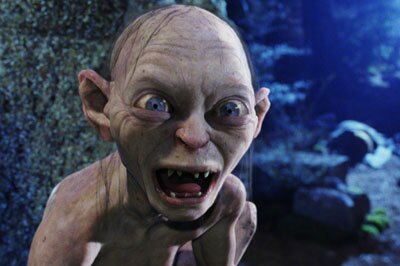
    My final nominee is someone who likely would have gotten a nomination had him getting a nomination been legal under Academy by-laws.  Don’t quote me on this, but I’m fairly certain voice-performances, even those done in motion-capture, are not eligible for a nomination at the Academy Awards.  So, even though what Andy Serkis did as Gollum in the second installment of Peter Jackson’s Lord of the Rings: The Two Towers is nothing short of master class acting, he wasn’t even allowed on voting ballots.  He would repeat this perfect puppetry three years later in Jackson’s King Kong as the title ape, and with equal character study on scale with that of Sean Penn in Milk or Phillip Seymour Hoffman in Capote.  As Gollum, Serkis crawled, gouged, and hopped his way to a character that is unquestionably the most famous of the franchise, and with good reason.  Every scratch in his voice, every movement and eye glance is 100% Serkis’s.  No amount of CGI can airbrush desperation and devotion like the human actor can.  Simply for discovering such a perfect character within Tolkein’s work is enough for a nomination, and pulling it off is nearly worth a win.

    So there you have it.  My Yearly Perspective on the 2002 Best Supporting Actor race with comments on the real nominees and my personal selections.  Expect Best Actress later this week.

    BEST SUPPORTING ACTOR
    ***Chris Cooper, Adaptation.***
    Andy Serkis, Lord of the Rings: The Two Towers
    Ed Harris, The Hours
    John C. Reily, Chicago
    Tom Hanks, Catch Me If You Can


    .


    Blogger news

    Blogroll

    Most Reading