Pages

Powered by Blogger.
Showing posts with label The X-Files. Show all posts

The X-Files 20th Anniversary Blogging: "Beyond the Sea" (January 7, 1994)

Thursday, February 14, 2013


In “Beyond the Sea,” which originally aired on Fox TV on January 7, 1994, Scully’s father (Don Davis) unexpectedly passes way during the holidays following a sudden, massive coronary.  Scully (Gillian Anderson) experiences a premonitory vision of her late father immediately before her mother (Sheila Larken) notifies her by phone of his death.

At work the next day, Scully and Mulder (David Duchovy) attempt to locate and rescue two kidnapped teenagers in Raleigh, North Carolina by meeting with a notorious death row inmate, Luther Lee Boggs (Brad Dourif). 

Boggs claims psychic powers and knowledge due to a recent brush with state-sanctioned execution.  He wants to bargain for a pardon, if he helps to save the missing kids.  Scully gives Boggs’ claims of psychic knowledge special credence in part because she feels vulnerable after her father’s death, but also because Boggs seems to possess first-hand knowledge of her father, including his nickname for her (Starbuck) and his long-standing affection for the song “Beyond the Sea.”

When one of Boggs’ channeling sessions proves unexpectedly fruitful, Scully wants to pursue the lead, even as a skeptical Mulder is warned by Boggs that his life is in danger “under the white cross.”  Sure enough, Mulder is badly injured by the kidnapper while attempting to recover one of the missing teens.  His absence leaves a vulnerable Scully to negotiate with Boggs for information regarding the missing youngsters…and her father’s final disposition.  On the latter front, Boggs promises to deliver a “message” for Dana.


The X-Files almost universally vets its tales of the paranormal and extraordinary through two distinct lenses. One lens is rationality or science, as seen and understood by Scully.  The other lens is romanticism and belief, as embodied by Mulder. 

This duality might also be specifically parsed in terms specifically regarding belief.  In “Beyond the Sea,” Scully notes that she is “afraid to believe,” while Mulder is famous -- across the series and films -- for the refrain “I want to believe.”  He even says so directly, early in this episode: “Don’t get me wrong, I want to believe.”

Yet “Beyond the Sea” is a crucial episode in the early X-Files canon in part because, for a time, it flips the traditional roles/viewpoints of these characters in the drama.  Scully wants to believe at first…but then backs away from that particular precipice.  Mulder refuses to believe at first, but by episode’s end is actively upbraiding for Scully for her failure to do so.  Still, this episode offers the novel pleasure of Scully arguing for the paranormal, and Mulder arguing against it.

The crux of the issue in this story is Boggs himself, the flawed, even despicable person who offers otherworldly or paranormal knowledge.

Luther Lee Boggs is a brutal murderer, a man who would say and do absolutely anything to avoid dying on death row.  He’s terribly afraid to die, and already knows he is “going to Hell.”  These motives make Boggs an unreliable -- and desperate -- source of information. 

Yet, contrarily, Boggs seems to legitimately understand several things about the future, and about Mulder and Scully’s live.  Perhaps some of this knowledge could be known, as Scully insists, through research.

But it would be abundantly difficult for Boggs to access information regarding Scully’s pet name (Starbuck), or the title of the song played at her father’s funeral.  Those are facts that wouldn’t be reported in a local newspaper, for instance, and certainly not an out-of-state paper.  And Boggs is in North Carolina, remember, while Scully and Mulder are in Virginia.  If Boggs had requested a Virginia newspaper, his jailers would have reported that information to the F.B.I. agents.

So the question becomes this:  Would you want to hear your loved one’s final, loving words from the lips of a serial killer and monster? 

From a person you consider vile? 


This problem recurs throughout X-Files history.  Father Joe in The X-Files: I Want to Believe (2008) serves as a book-end reflection, essentially, of Boggs.  He is another fallen man (a pedophile), but another one boasting legitimate psychic powers.  Yet neither Father Joe nor Boggs are believed by society at large because of their crimes, and because of an understandable and legitimate abhorrence of those crimes. 

Thus the implication is that human beings sometimes can’t hear “the truth” if the mouthpiece of that truth is someone whom we deem fallible or fallen in some crucial way.  The irony of this approach, and one also suggested by The X-Files, however, is that we are all fallible in some way.  Therefore, in failing to accept “psychic transmissions” from Boggs or Father Joe, we are also cutting off the possibility of accepting such information from any human vessels.

Thus, the “truth,” whether we want it or are afraid of it, is unknowable.

If God indeed moves in mysterious ways, is it impossible to believe that message of hope and renewal could come from Luther Lee Boggs

That’s the question that roils underneath this narrative.  Why would God let a Boggs or a Father Joe be that vehicle, knowing how reluctant we would be to accept the information?

The episode, if examined closely, seems to suggest that a brief reunion between Scully and her dead father is indeed possible….through Boggs, if only Scully can set aside her judgment of the man. 

In elegant and artistic terms, the veil separating our world from the next is contextualized in this story from James Wong and Glen Morgan in the terminology of the Bobby Darin hit, Beyond the Sea(1946).  In that song, the singer is separated from a loved one by the water, by the ocean.  That loved one is there on the other side, “watching” for the singer.  But the singer can’t reach that loved one; he can only wait.   Failing the ability to fly “like a bird on high” to the afterlife, the singer must satisfy himself with belief “beyond a doubt” that his heart will lead him to the same place, “beyond the shore.”

For all of his contemptible, anti-social behavior, Boggs offers the possibility of breaching the sea now, of connecting Scully and her father again in this world.  Finally, Scully refuses the offer because of her fear. Because, perhaps, she is afraid of learning what her father knows about the boundaries of death, and the afterlife.  It might better, in a sense, to hope for an eventual reunion “beyond the sea” than to meet again, under these circumstances, with the unreliable intermediary, Boggs, in control of the dialogue.

I would suggest again that this is actually a missed opportunity, however.  Late in the story, Boggs tells Scully the truth (as he understands it, from psychic information) about the kidnapper’s lair.  He even gives her the key to save her own life, warning her not to approach “the blue devil.”  She sees the illustration of a blue devil at a critical juncture and stops chasing her quarry.  Meanwhile, the kidnapper falls through the planks of a bridge…to his death.

At this point, however, Boggs knows he will be denied a pardon, so there is no earthly reason for him to help Scully. So why did he do it? Why did he save her life?

Well, I  mentioned earthly reason.  There’s always a reason of the soul or spirit:  personal redemption.  I alluded to this factor in my review of I Want to Believe, but our culture professes a deeply-held, Christian belief in redemption.  Yet often those who seek redemption are denied that second chance,  that forgiveness.


If redemption is not for a man like Father Joe, or a man like Luther Lee Boggs, then who is it for, precisely? The righteous have no need of it.

I submit that much of the final (emotional) imagery of “Beyond the Sea” -- which depicts Boggs going to his execution -- concerns this matter of redemption.  We see Boggs surrounded by his victims (including his family) as he takes his final steps on this mortal coil.  He goes to his death, as he should, for his grievous misdeeds.  But his family is present with him, a reminder both of what he did wrong, and of the comfort of human companionship.  Thus Boggs is not alone when he dies, as he feared.  Instead, he is with those who have crossed, “beyond the sea.”  His act of redemption allows him to see that beyond death, another plane of life exists, and perhaps because he has sought forgiveness and redemption, it will not be the Hell he fears so greatly, the Hell his original actions brought about.

“Beyond the Sea” has frequently been compared to Silence of the Lambs (1991), and that is for two reasons, primarily.  The first is that both Silence of the Lambs and “Beyond the Sea” involve a female F.B.I. agent who attempts to contextualize her father’s death, and more than that, her father’s very meaning in her life.  Secondly, of course, both stories feature lengthy interview sessions with an imprisoned, loquacious serial killer.

But where Silence of the Lambs is very much about a woman without a father, and having to choose between two surrogate fathers (either Jack Crawford or Hannibal Lecter), “Beyond the Sea” is a story about Scully’s inability to grow beyond her father.  She wonders again and again if he is proud of her, if he approves of her life and career choices.  She can’t move beyond the lens her father imposed upon her in childhood.

In perhaps the ultimate of ironies, her father’s final message to Scully is forever unheard because Dana chooses, ultimately, to double-down on fear and disbelief, the same viewpoint that made her father skeptical of her career choice in the first place.  The catch-all phrase “he’s my father” doesn’t reveal pride, love, support, or anything beyond a biological bond.  But by episode’s end, Scully is parroting that empty term, as if it is Scripture.  That’s all that needed to be said.  She doesn’t want or need a further message, especially from Boggs.  

Scully's predicament -- her entrapment -- is visualized explicitly in the episode in a composition pictured near the top of the post, with the good doctor standing behind bars, Boggs behind her, in the background.  She can't move forward, but she won't let herself deal with Boggs.

In terms of the Mulder/Scully relationship, “Beyond the Sea” is indeed an intriguing, if brief flipping of roles.  Ultimately, each individual can’t escape their established viewpoint.  This notion could be made clearer, however, in the epilogue.  It is abundantly plain why Scully shifts back to her position of rationality: fear.  But Mulder flip-flops from telling Scully not to believe Boggs to asking her why she refuses to believe Boggs in light of all the evidence..  It would have been helpful to an include a scene in which Mulder admitted that he was wrong initially, and that he now believes Boggs was indeed a conduit to connect souls on Earth and souls in the afterlife.


“Beyond the Sea” also ups the ante in terms of the physical relationship between the two F.B.I. agents.  Mulder places his hand on Scully’s cheek and caresses it gently after expressing his sadness over her father’s death. 

The moment is unexpectedly powerful because, as we’ve seen before, the sex roles are largely reversed in terms of typical TV stereotypes. Usually, it is the man who silently soldiers on in the face of grief, tending nobly to his duties and responsibilities.  Here it is Scully who assumes that role, repressing her grief, and stoically returning to work. 

And Mulder, for his part, tends not to matters of duty and job (and emotional denial…) as we stereotypically expect of our male heroes.  Rather, he openly addresses issues of grief, and with physical re-assurance to boot.  In a very real sense, Scully is often the “head” in the X-Files duo, while Mulder is often the expressive, emotional “heart.”

Next week: “Genderbender.”

The X-Files 20th Anniversary Blogging: "Eve" (December 10, 1993)

Thursday, February 7, 2013


“Eve” is our X-Files episode of the week as we continue to celebrate the 20thanniversary of the classic Chris Carter TV series.  This eleventh episode of the fledgling series was penned by Kenneth Biller and Chris Brancato, and directed by Fred Gerber.


“Eve” commences as Scully (Gillian Anderson) and Mulder (David Duchovny) fly to Greenwich, Connecticut to investigate the death of a suburban man who was drained of blood.  Mulder suspects alien abduction is behind the murder, citing examples of cattle-mutilations with a similar modus operandi.  At first, the only witness, young Teena Simmons (Sabrina Krievans), seems to obliquely corroborate this theory.

When an identical murder occurs in Marin County, California, however, and the only witness is a dead ringer for Teena, little Cindy Reardon (Erica Krievans).  Scully and Mulder realize that they are looking not at an alien abduction case, but a case involving illicit experiments in in-vitro fertilization. 

While Scully investigates the activities of a doctor named Sally Kendrick (Harriet Sansom Harris) at the Luther Stapes fertility clinic, Mulder learns more on the subject from his covert government informant, Deep Throat (Jerry Hardin). 

Deep Throat reveals a top-secret genetic experiment of the 1950s called “The Litchfield Project” that was designed to compete with a similar eugenics program in the Soviet Union.  The goal was to breed a new race of super-soldiers.  The American version of the project created a number of “Adams” and “Eves,” all identical, all incredibly-intelligent…and all homicidal.

After visiting with the incarcerated Eve 6 (Sansom Harris) at the Whiting Institute for the Criminally Insane, Scully and Mulder realize that Eve 7 and Eve 8 may still be free, and even attempting to kill Cindy and Teena, the grandchildren of the program, essentially.

Unfortunately, their suspicions prove absolutely wrong, and Teena and Cindy prove to be far more cunning adversaries than either F.B.I. agent could have possibly predicted.


At the heart of “Eve” is a well-worn horror trope involving evil children.  In the 1950s, the movie The Bad Seed famously raised a crucial issue regarding diabolical children: nature or nature? 

Could a child be evil by dint of the genetic material passed on from his or her parents? Or did that evil arise out of the manner in which he or she was raised?

The X-Filestakes that notion a step further – and straight into the post-modern 1990s -- by noting that an evil child might actually be designed so by over-reaching scientists run amuck. Although the twins possess superior intellect and cunning, these girls were not gifted with a superior sense of morality, and that fact makes them monsters.

Didn’t the scientists ever stop to think about morality? How about mere emotional stability?

The 1990s was indeed a perfect time to re-visit the notion of evil children, and accordingly a few horror movies of the era did so, including The Good Son (1993).  The reason this issue was so timely a concern involves the development, in 1990, of the Human Genome Project, an initiative designed to map fully our DNA. 

In terms of the horror genre and its development, this scientific project was every bit as important, creatively, as was the Manhattan Project to an earlier era.  In both cases, creative artists explored the notion that “tampering in God’s domain” could effectively destroy mankind.  By harnessing the atom in the 1940s, and by mapping the human genome in the 1990s, mankind was opening “Pandora’s Box.”  The “real” monster in “Eve” is thus wanton genetic experiment, vetted without a controlling, moral authority.


The Krievan twins portray Teena and Cindy here, and do a remarkable job.  They play their roles, at first, as though everything happening to the girls is observed from some great emotional distance.  They are disassociated from the horrific and monstrous things happening around them. 

Late in the episode, we understand that this distance arises from a lack of empathy.  The deaths of their foster-fathers means nothing to the girls, emotionally-speaking, and their almost blank facades embodies not shock, but mere boredom. 

In the finale, when the audience learns their true nature, the twins finally reveal a new aspect: childish glee in their anti-social activities. To the very end, Teena and Cindy try to manipulate others with their childish appearances.  “We didn’t do anything wrong,” they insist, “we’re just little girls…”

The distance between Teena and Cindy’s youthful appearance and their evil acts is one factor that makes this episode so chilling, and therefore so successful.  There’s something deeply disturbing about children who are disconnected from their emotions, and also, deceitful and manipulative. 

Again and again in the episode, Scully and Mulder make mistakes because they can’t quite reckon with the idea that these little girls could possibly be monsters.  They can’t make the leap that appearance isn’t reality.

Interestingly, “Eve” doesn’t end without an important, if brief glance towards the “nurture” end of the eternal debate about children.  Cindy’s mother, after learning of her daughter’s evil behavior, completely abandons her.  She cuts her off.  She rips up her photograph of Cindy and burns it in a fire.  This is not the act of a loving mother, even one whose child has acted badly.


Call this the Frankenstein Principle.  We make life in our own image, but when we don’t like that image, we dismiss that life as “monstrous.”  Suddenly, it’s not a part of the family anymore.  It can never be spoken of aloud…just burn all the photographs in the fireplace

This act or purging a family member, depicted in the finale of “Eve,” suggests that Cindy and Teena aren’t the only ones who lack empathy, and perhaps that “missing” factor is indeed a matter of nurture. 

If these girls had been raised in loving homes, would they have resorted to murder, even factoring in the genetic predisposition towards instability? 


In terms of the character development, “Eve” is a necessary piece of The X-Files puzzle for a few reasons.  I often read other critical evaluations of the series, and some reviewers have complained (loudly) that the series is not actually concerned with the science vs. belief battle, but rather with a strange kind of faith in which Mulder is always right, a priori,no matter what.  These critics see Mulder as unrealistic.  They term him infallible, always able to guess what is happening and deduce correctly the solution to a mystery. 

As a reviewer, I don’t see this as a legitimate complaint about the series, and could point to “Eve” as Exhibit A refuting it. 

Here, the episode begins with Mulder hell-bent on proving a case of alien abduction.  He discusses missing time (a call-back to the pilot episode), cattle-mutilations and the like.  He obsesses over the idea of a “red cloud” in the sky on the day of the crime.  Young Teena – sensing Mulder’s desire to reach a pre-ordained conclusion -- plays into his vanity and supports Mulder’s reading of the investigation.  She is doing this merely to trick him and throw him off the scent.

As the investigation unravels, Mulder realizes he is barking up the wrong tree, and drops his theory, as any smart investigator concerned with the facts rightly would.  The conclusion to draw here is that he saw a commonality between a contemporary case and some old case in his X-Files, but that the lead didn’t pan out. 

So, already -- just ten episodes in -- the series is proving that Mulder canbe wrong, and in his zealousness to be right, even make mistakes.  This quality makes him a fallible and interesting protagonist, not the kind of “infallible” master detective I’ve seen him described as in other reviews. His viewpoint is not constantly validated.

There’s also a very nice, very effective moment in “Eve” that plays upon audience expectations and desires regarding the Scully/Mulder relationship.  Scully and Mulder have “rescued’ the two girls, and are unaware of their true, homicidal natures.  They decide to take care of the girls, and drive them to their next destination.  On the long road trip, the girls need to use the bathroom, and Mulder, slightly annoyed, pulls over at a rest-stop restaurant. 

With a slight smile, Scully takes the two girls to the bathroom with her, while Mulder gets their order of four sodas.  While he uses the rest-room, one of the girls poisons two of the sodas, the ones meant for the F.B.I. agents.

There’s a great dramatic conflict in this scene between what Scully and Mulder (and a waitress) believe is happening, and what is actually happening.

Scully and Mulder are knowingly playing Mom and Dad, and seem to recognize it…and even enjoy the roleplaying a little.  That waitress thinks Mulder is the twins’ dad, and says so. 

As viewers tantalized by the Mulder/Scully relationship, we too are pulled into this world of sudden parentage, though we know better.  Despite our knowledge, we are suddenly contextualizing these folks in terms of a “family,” something that has explicitly always been denied the original Adams and Eves. 

Then, of course, the illusion is shattered, and Mulder realizes at the last moment that the girls have poisoned the sodas.  It’s a wonderful moment when he realizes the truth, and realizes, fully, how successfully the girls can play on the illusion that they are made of sugar and spice and everything nice…plus, apparently, a healthy dollop of foxglove.

A tense, intriguing, and fun episode, “Eve” is another bonafide victory for the first season team.  In terms of The X-Files canon, it points towards the series’ obsession with genetic experimentation and research.  “Eve” is sort of the tip of that iceberg on that front, and the theme will return in a big way in later seasons, though in a more intimate fashion that affects Scully and Mulder directly. 

“Eve” thus represents a promise of things to come -- and another indicator of past government malfeasance -- rather than a direct connection to the overarching Mytharc.

Next Week: “Beyond the Sea.”

The X-Files 20th Anniversary Blogging: "Ice" (November 5, 1993)

Thursday, January 31, 2013


The X-Filesepisode “Ice,” which first aired on November 5, 1993, is a sterling tribute to one of the science fiction genre’s greatest short stories: Who Goes There? (1938) by John W. Campbell.  

That novella is set in Antarctica and involves a group of scientists who discover an alien ship and pilot that have been trapped frozen in the ice for twenty million years.  When thawed out, the extra-terrestrial pilot is revealed as a dangerous shape-shifter, one who can “hide” in human and other biological forms. 

In the end, the alien invader is barely stopped (with just a half-hour to spare…) before it can escape isolation and reach (and contaminate...) the rest of Earth’s population.


“Who Goes There?”has been re-imagined several times throughout film and television history.  The Thing from Another World (1951) starring James Arness was one such effort, though it eliminated the shape-shifting nature of the alien menace and replaced it with a humanoid plant, a so-called “carrot.” 

John Carpenter’s The Thing(1982) proved a more faithful adaptation of the original story, and is perhaps the most well-known version today.  It recently inspired the 2011 prequel. 

On television, Doctor Who (1963 – 1989) featured a 1976 serial called “The Seeds of Doom” which involved the discovery of an alien plant pod in Antarctica's ice from 20,000 years ago.  That seed was the heart of a planet-devouring vegetable monster called a “Krynoid.” 

And on Star Trek: Deep Space Nine (1993 – 1999), a race of shape-shifters or "Changelings" called the Founders proved detectable -- like the Thing -- only by blood test in episodes such as the third season finale, “The Adversary.”  The blood test was featured in the original novella and proved the most popular (and perhaps most effective…) sequence in the Carpenter film.

The Thing (1951)

The Thing (1982)

Doctor Who: The Seeds of Doom (1976)
“Ice,” written by James Wong and Glen Morgan and directed by David Nutter, remains a notable variation on the Campbell theme, one bolstered by some unique, even trademark X-Filestwists.  In fact, this episode might be Exhibit A in terms of my theory about the series as a whole; that it deliberately re-purposes commonly told tales in the genre and then imbues them with new meaning and relevance for the 1990s.

From Campbell’s source material all the way to "Ice" we see a similar location (an ice-bound installation), a similar threat (an alien) and even the presence of a dog as an infection vector.  But “Ice,” uniquely, develops in an original fashion because in The Thing, for example, there aren't many close relationships on the line.

Instead, the story has been interpreted frequently as a comment on man’s alienation from his fellow man.   

Nobody trusted anybody in The Thing because nobody really liked or even knew anybody else.  Hidden inside a man's skin, the Thing was indistinguishable from man.  What does that say about man?

It's alive!
The X-Files deliberately explodes that artistic conceit by landing two sets of dedicated partners or allies into the paranoia blender and then diagramming the manner in which close-relationships contend with the possibility of individual infection.  The responses are either burgeoning independence (Scully) or total abandonment of personal will in favor of the stronger personality’s will and desire (Da Silva). 

In a way, The X-Files amplifies the horror of The Thing.  It’s one thing to face a shape-shifter in a battle to the death when there is no one you really care for to worry about on the battlefield.  But in “Ice,” Mulder and Scully have one another to fight for, and must face the very real possibility that one of them could die or be permanently infected.  They are more "connected" individuals than many we meet in various versions of the Campbell story.

Are you who you are?

I am who I am.

In “Ice,” Mulder (David Duchovny) and Scully (Gillian Anderson) join a team of scientists including Dr. Hodge (Xander Berkeley), Dr. Da Silva (Felicity Huffman), and Dr. Murphy (Steve Hytner) to investigate the deaths of a government research team at a base in Alaska.  

The team had been digging deep down into an icy shelf believed to be a prehistoric meteor impact.  Without warning, however, the members of the expedition began murdering one another, reciting the mantra “we are not who we are.”

After a helicopter pilot named Bear (Jeff Kober) flies the team to Alaska, Mulder and Scully discover that the previous team had found core samples containing strange alien worms frozen in the ice…from 250,000 years earlier. 

At least some of these worms have thawed out in the base, and discovered that human beings make for perfect hosts. 

While living on the excretions of the hypothalamus, these parasites also cause extreme paranoia and aggression in their prey….

Who do you trust?

An almost unbearably claustrophobic and tense hour, “Ice” is a deliberate nod to Who Goes There? and The Thing, but also a tale, ultimately, about territoriality. 

The episode’s climax reveals that two worms cannot exist in the same host…or they will kill each other.  Similarly, the episode-long tension between Mulder and Hodge -- each looking to assert leadership -- nearly imperils everyone.   Both men believe they are right in their belief-system and engage in a kind of paranoid “pissing” contest, trying to swing the allegiances of the other team-members to their viewpoint. 

There’s even an amusing scene here where the men must strip down naked to check each other for signs of parasitic infection.  Mulder jokingly reminds everyone that they arein the Arctic, a not so-subtle joke about penis size.

But joke or no joke, the matter of which man possesses the “biggest dick” -- to state it inelegantly -- is  a sub-text in this particular tale.  Once you make the thematic connection, it’s intriguing to see how the “territoriality” theme mirrors the infection theme.  A terrified Bear asserts control of the situation early on, since he is the only person capable of flying the plane, and he stakes out a command position early.  Simultaneously, he is the first infected by the alien organism.   Power and infection are definitively linked.

Then, after Bear dies, the battle of wills moves over to Hodge and Mulder.  Soon, nobody is certain which of them, if either, is infected. In the end, we learn that neither man was infected, only that each was driven (by adrenaline? by testosterone? by ego? by all three?) to attempt to take charge of the situation. 

Why were they so aggressive, if neither was actually infected?  Is it simply the human condition?

Why can't these two get along?

Why can't Mulder and Hodge?

Just remember, we're in the Arctic...
The underlying social commentary, then, seems to concern man's capacity for self-destruction, particularly if he doesn't get his way.  This quality impacts even the usually sensible (and sensitive) Mulder.  What complicates this issue of territoriality, and what is explored rather fully in “Ice” is the notion of allies, friends and subordinates in such a dynamic.

Dr. Da Silva is Hodge’s ally, but treated like a subordinate, and Scully is Mulder’s ally and equal.  Neither woman is truly impartial or on the side-lines,  but Hodge bullies Da Silva to see things his way, and acts in a borderline abusive fashion in his treatment of her; thus keeping her in line.

Scully -- recognizing the weight of evidence against Mulder at one point -- backs Hodge over her partner.  She never gives up on Mulder, and finds way to protect him, but she is able to weigh the facts…and the facts seem to go against Mulder's perspective.

Unlike Da Silva, however, Scully is not cowed into making a decision by either Mulder or Hodge.  Instead, she studies the available facts and makes a logical decision, to Mulder’s dismay, since her choice doesn’t favor him in the short term.  Scully thus becomes the de facto leader because she is able to bridge the gap between parties.

Scully’s behavior in “Ice” is another key development in the fledgling series.  Last week, in my review of “Squeeze,” I noted that Scully had to choose between Mulder and his quest, or Colton and his ambitions of avarice.  She chose Mulder. 

This week, Scully must face the difficult possibility that Mulder, because of infection, has become a murderer and a psychopath.  One thing I love about The X-Files is that this possibility doesn’t impact Scully’s affection, feelings, or loyalty for Mulder.  She wants to protect him and wants to heal him, but to do that, she must first make certain he doesn't represent a danger to everyone.  She uses science and wisdom to do so, again showcasing her finest human qualities.

Given all this dramatic material, it’s probably fair to state that what “Ice” truly involves is relationship dynamics in a difficult situation, where no clear chain of command can be respected or even determined.  

Going further, "Ice" involves the way that men sometimes behave in a crisis. Who do you choose to follow?  Why does someone, like Mulder, choose to lead?  

The elegant quality of this thematic dynamic is, as noted above, that it mirrors so beautifully the nature of the aliens of the week.  There can’t be two big worms (another phallic symbol…) vying for the same “command” post, or else hostility, anger, and violence will result.

Location plays a crucial role in “Ice’s” success as drama and as horror.  The episode feels like a pressure-cooker because after the first act, it never leaves the claustrophobic outpost interiors.  All versions of “Who Goes There?” are set in icy environments, and that sets up an imposing, endless sense of isolation.  Not only is there terror inside the various “Thing” outposts, but terror outside as well.  

The frozen environment will kill you too, just not as quickly as an alien invader.  

In other words, a person can’t just run outside and catch a bus to escape.  The Arctic or Antarctic installation in all these production is thus a trap within a trap.  Escape is simply not possible.  The "monster" must be reckoned with, no delay, no negotiating.

As a title (and phsyical substance...) “Ice” is also a contrast or counter-point to the hot, passionate, aggressive behavior we witness among the dramatis personae here.  It may be well below zero outside the outpost, but inside temperatures and tempers continue to rise.

In terms of X-Files series continuity, “Ice” raises the concept of Panspermia: life from elsewhere in the cosmos taking root here.  That’s a concept which would come to play a crucial role in the series’ sixth season.

Furthermore, “Ice” seems to set the narrative template for later tales such as “Darkness Falls” and the second season entry, “Firewalker.”  The former is set in an isolated forest; the latter in a live volcano.  But both stories, like “Ice,” involve ancient life-forms awakened in the present, with the promise of deleterious impact on the human race.

In the final analysis, "Ice" succeeds because, like "Squeeze," it develops the relationship between Mulder and Scully in a clever way  The episode also intelligently re-configures a horror standard, and even offers a healthy dose of social critique.  For the seventh episode of a first season, such depth is simply astounding.

Next week: “Eve.”

X-Files Promo: "Ice"

X-Files 20th Anniversary Blogging: "Squeeze" (September 24, 1993)

Thursday, January 24, 2013


“Squeeze” is The X-Files (1993 – 2002) first “monster-of-the-week” installment. As such, it represents a template for future entries such as “2Shy,” “Teliko,” “Hungry,” and “Alone.” 

Most of these monster-of-the-week-styled outings deal with a murderous genetic mutation of one type or another, but one who -- out of some biological deficiency -- kills human beings in order to survive.  This mutant pinpoints in the human physiology, then, the key to controlling its own existence and satisfying that aforementioned deficiency. 

Watching the “genetic mutants” of The X-Files, it’s easy to imagine that we are gazing at the blind alleys or dead ends of human evolution.  With just a little variation, we could become them, and that factor lends a certain degree of empathy to some of these tales, and to some of these monsters.

But not to Eugene Victor Tooms, importantly, who remains an opaque and monstrous presence, and one that the episode contextualizes in grand, even historic terms.


Written by James Wong and Glen Morgan, “Squeeze” apparently suffered some pretty serious behind-the-scenes tumult when it was shot, meaning that though director Harry Longstreet is credited on-screen, director Michael Katleman also conducted re-shoots of some critical sequences. 

Despite the apparently-troubled production history, this early episode works splendidly, and is abundantly creepy and disturbing.  In fact, “Squeeze” is likely one of the best remembered first season entries.  “Squeeze’s” success as a drama and as horror piece might be measured by the fact that a sequel was produced and broadcast later in the first season (titled “Tooms,”) and that the episode essentially became the benchmark by which later monster-of-the-week episodes would be judged.

Doug Hutchison’s unsettling, focused (and largely internal) performance as the anti-social, monstrous Tooms brings genuine menace to the hour, and the final sequence set in Scully’s bathroom features some subtle but effective visual effects which ably depict the serial killer’s unique, mutant capacities.

But ultimately “Squeeze” is an important tale for The X-Files not merely because of its early placement and impact in terms of later storytelling, but because of several unique thematic conceits. 

The first of these involves a kind of thesis about the nature of evil, and how a certain brand of “evil” sees the world.  This thesis is forwarded mainly through the eyewitness testimony of a retired police detective, Briggs.

The second conceit involves the way that everyday bureaucracy and record-keeping rituals can actually cloud the truth, rather than excavate it.  We see this idea most clearly in the details of Mulder’s investigation into Tooms’ long history.  Over and over again, a man named Tooms seems to live at the same address at Exeter Street but never, before Mulder, have these records been exhumed, weighed, and connected.

The third conceit is perhaps the most crucial in terms of Mulder (David Duchovny) and Scully (Gillian Anderson), and their rapidly blossoming relationship.  On this front, one might view “Squeeze” as the story of “Scully’s Choice,” wherein she must choose between the Bureau (and old friends), and a crusade at Mulder’s side. 

One selection could bring her promotion, success, and notoriety, while the other promises only epistemological honesty.  She chooses the latter, and I think that says a lot about Scully as a partner and as a human being.


In “Squeeze,” Scully’s old friend and fellow agent Tom Colton (Donal Logue) asks her to consult on a difficult murder case in Baltimore.  An unknown assailant has managed to break into a locked office and kill a businessman…removing his liver in the process.  Scully agrees to consult on the investigation, but “spooky” Mulder’s involvement worries Colton, who is bucking for a fast promotion.

Mulder begins to suspect that the murderer is a most unusual killer: the sullen, Eugene Victor Tooms (Doug Hutchison)…a man who has resided in Baltimore, apparently, since before 1930, but who doesn’t look a day over thirty. 

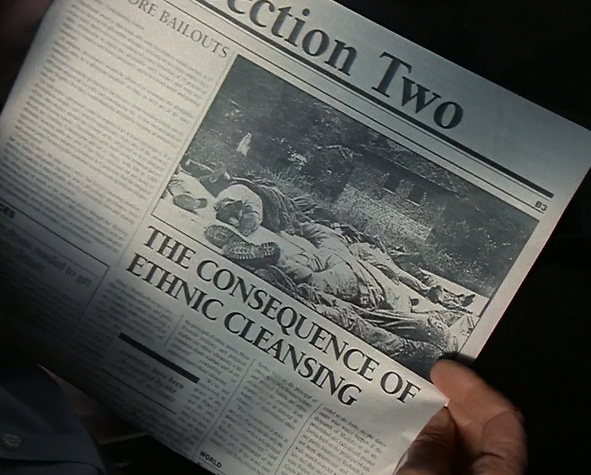
Mulder consults with Detective Frank Briggs (Henry Beckman), a detective who worked on an identical case decades earlier and also considered Tooms the primary suspect.  Briggs likens Tooms’ brand of “evil” to that of the Holocaust, or the Bosnian ethnic cleansing.

Although it is almost impossible for Scully to accept Mulder’s theory of a nearly immortal mutant killer who kills five victims and consumes their livers every thirty years to stay alive (and young), she casts her lot with her partner, rather than with Colton, who is more interested in racking up successful collars than solving the case and honoring the victims. 

Finally, Tooms -- whose strange physicality allows him to “stretches” into impossible positions -- decides to make Scully his latest victim…

A very human brand of evil...
Across two decades, “Squeeze” has drawn heavy criticism from those who cast the episode’s comparison of the Tooms’ murders to the Holocaust and the Bosnian conflict as either pretentious or somehow inappropriate in what is essentially a mainstream entertainment. 

However, the comparison succeeds in The X-Files for a few significant reasons.

First, the comparison is explicitly made as one of Det. Briggs’ personal observations.  If, as a character in the play, he makes that connection himself, based on his particular experience, who are we to judge whether he is right or wrong?  The comparison is a representation of his viewpoint, based on his experience.

In their official capacity, Scully and Mulder never explicitly compare the Tooms killings to real life atrocities, though they do note that the killer’s environs create a kind of aura of death and decay
Instead, the comparison is simply the opinion of a retired -- and very shaken -- old man…one who has lost faith in the human capacity for goodness, at least until the coda, which serves explicitly as his catharsis.

Secondly, if one chooses to compare Tooms, the Holocaust, and the horror of ethnic cleansing, there is clearly a data point in common.  All the murderers -- all the perpetrators in such events -- share a common point of view: they don’t see their victims as fully human.

Instead, the victims are deemed not entitled to human dignities and freedoms because they are somehow inferior, and thus can be used/misused/abused as the “monster” in question sees fit. 

It’s always much easier to hurt someone if you decide they aren’t fully human or equal.  In our history this viewpoint has accounted for genocide, ethnic cleansing, slavery, prejudice, and other horrors.  So I submit that this is the specific horror at the core of the Holocaust, Bosnia, and, yes, Baltimore. 

What’s so intriguing about the comparison of Tooms’ bloody handiwork to these real-life atrocities is that the two historical events are very closely linked with the worst human behavior imaginable.  The idea here is that Tooms may be physically different from us but he shares in common with us this human capacity for evil.  Tooms is not the “monster outside” then.  Instead, he is the monster with a very human nature.

One of the qualities of “Squeeze” that I very much admire is its critical look at record-keeping and bureaucracy.  When I managed a metropolitan hospital’s laboratory billing department way back in the mid-1990s, I spearheaded an initiative in accurate record-keeping that insisted “registration is as important as results.” 

The goal was to significantly improve record-keeping so that John Kenneth Muir wouldn’t get confused with a patient named Kenneth Muir, and that a six year old wouldn’t be mistaken for a 90-year old with the same name.   The point I was attempting to make back then, in 1995, was very similar to what we see in “Squeeze.”

Tooms has left a considerable paper trail across the decades, but  the elements of this trail don’t connect, and therefore can’t clarify anyone’s thinking about the investigation, save for Mulder’s.  The investigation of Tooms is held hostage to the fact that paper-work is filled out, dutifully recorded on micro-film, but then never looked at again by human eyes. 

Only Mulder can connect the dots (while humorously going blind at micro-film machine…), filling in the invisible connections between official documents.  The global point seems to be that humans want to record and categorize everything, but that once the initial categorization is done, there is no looking back, no more thinking to be done.  We see the same issue in Mulder’s manipulation of Toom’s fingerprints.  The fingerprints are already on file…if only someone had the wherewithal to look…and speculate.

Is the maintenance and furtherance of databases, micro-films, and paper documents just busy-work to keep the gears of bureaucracy spinning and grinding endlessly?   Does important, life-saving information disappear into archives, never again to be looked at, measured, or considered?

The information age is one of value only if data-points connect, and someone looks at the information with an engaged intellect.  We see in “Squeeze” that this is one of Mulder’s gifts.  The show is called the X-Files, accent onfiles, after all.

Last week I wrote about the epistolary quality of The X-Files; how the story is told in terms of Scully and Mulder's case reports on their PCs.  Continuing this epistolary quality, "Squeeze" is able to convey its story both through newspaper headlines (see above photo) and county census records and the like (see photo below).

Is anyone checking the records?
In terms of the characters themselves, “Squeeze” puts Scully in the position of having to choose where she ultimately wishes to cast her lot. 

Should she cast it with Colton, who is slick, successful, snarky, and wholly unimaginative? 

Or should Scully cast her lot with Mulder, who is unconcerned about his reputation, but unfailingly honest from an intellectual standpoint? 

Scully has a choice to make.

This guy.

Or this one.
If you gaze at the images above, you can see the outlines of Scully’s choice in starkly visual terms.  Colton is a man of lunch dates, meetings, and buttoned-down suits and ties.  He’s a man of surfaces and superficial qualities.

By contrast, Mulder is the kind of guy who takes off that suit jacket, rolls up his sleeves, and does the hard work himself because he knows that in the vetting of hard work, answers come to the surface.  Mulder may possess ideas and theories that some people consider ludicrous or insane, but he pursues his answers through rigorous investigation.  He doesn’t close off any possibility (usually) and thus is intellectually honest and open-minded.  Colton by contrast, does no investigating whatsoever.  Instead, he just brings in Scully to write the behavioral profile he isn’t imaginative or skilled enough to craft himself.

In “Squeeze,” Scully realizes she would rather work with a guy who cares about digging for the truth, even if the truth is unpalatable, rather than a fellow who just wants check a career box and move up the F.B.I ladder.

It was important that Scully make this decision early on.  The decision does two things, primarily.  First, Scully’s decision isolates her.  Like Spooky Mulder, she soon must live with the jokes about little green men and the like.  She must also contend with the disrespect of her peers.

But her decision to commit to Mulder and his quest also locks Scully into an on-going intellectual or cerebral debate.  Scully will now be present alongside Mulder to make certain that every crazy theory, every strange hypothesis, boasts a solid basis in fact, and empirical science.

All of this character development starts to cohere in “Squeeze”...and it’s only The X-Files third episode.

The hunter sees his prey.

In terms of horror visuals, “Squeeze” is unimpeachable.  We see the impossible made convincingly manifest in Tooms physicality.  We see his jaundiced, predator eyes gazing out from the darkness, and we get a great point-of-view from his (twisted) perspective.  The world appears black-and-white, and his victims move in slow motion, unaware of his sinister presence. 

The black-and-white photography reminds us that Tooms doesn’t see us as fully human, but as prey.  And the slow-motion photography indicates that this hunter is one step ahead of his quarry, a fact we can attribute to his unique physical abilities.  We move slowly, unaware we are hunted.  But he moves with lightning-fast rapidity, and that’s very, very scary.

next week, The X-Files offers a brilliant genre pastiche in “Ice.”
 

Blogger news

Blogroll

Most Reading