Pages

Powered by Blogger.
Showing posts with label Circle of Fear. Show all posts

Ghost Story/Circle of Fear (1972 - 1973) Final Episode Tally

Sunday, October 28, 2012


Episode Title
Good
Fair
Bad

The New House
X


The Dead We Leave Behind
X


The Concrete Captain


X
At the Cradle Foot
X


Bad Connection

X

The Summer House


X
Alter Ego
X


Half-a-Death


X
House of Evil
X


Cry of the Cat

X

Elegy for a Vampire


X
Touch of Madness

X

Creature of the Canyon

X

Time of Terror
X


Death’s Head


X
Dark Vengeance
X


Earth, Air, Fire and Water
X


Doorway to Death

X

Legion of Demons
X


The Graveyard Shift
X


Spare Parts

X

The Ghost of Potter’s Field

X

The Phantom of Herald Square
X


Here’s my final tally quality for Ghost Story/Circle of Fear.  Although the  horror anthology series started out as relatively weak, it finished relatively strong.  Overall, eleven episodes out of twenty-three I would rate as good or great, which is a strong tally for a series.

The best episodes -- and ones I highly recommend -- are:

“The Dead We Leave Behind” (w/Jason Robards)
“Alter Ego” (w/Helen Hayes)
“House of Evil” (w/Jodie Foster)
“Time of Terror” w/Patricia Neal)
“Earth, Air, Fire and Water”
“The Graveyard Shift” (w/John Astin)
“Legion of Demons” (w/Shirley Knight)
“The Phantom of Herald Square” (w/David Soul)

I must confess, I am pleasantly surprised how well so many of these episodes hold up after forty years.  Also, the series improved radically once Sebastian Cabot’s Winston Essex and Mansfield House were jettisoned from the format and the program became Circle of Fear.

If you can only watch three episodes, my top episodes would include "Alter Ego," "House of Evil," and "Earth, Air, Fire and Water."

Cult-TV Blogging: Circle of Fear: "The Phantom of Herald's Square" (March 30, 1973)


The final episode of the 1972-1973 horror anthology Ghost Story/Circle of Fearis called “The Phantom of Herald Square,” and it’s the series’ first out-and-out romance, or love story.  And as is appropriate given the genre, it’s atragic love story.

Here, a young artist in California, Holly Brown (The X-Files’ Sheila Larken) meets a handsome man in the park, James Barlow (David Soul).  He professes his love for her almost immediately, and Holly is resistant to his advances at first.  Over time, however, she falls in love with him.  As they grow close, however, strange incidents are also reported in the park.  A young woman dies there.  And Holly herself is accosted twice by a strange old man (Victory Jory).  He warns her not to see James again.

As it turns out, James knows the causes of these mysterious incidents very well.  As he explains to Holly, he once made a deal with the Devil to live forever so he could continue to “see the world.”  

Now, the Devil and his firm, called Gerontology, watch over James from a nearby skyscraper.  Every night, as part of the deal he signed, James must transform into his true form -- as an old man -- and also get lovely young women, like Holly, to give up their youth and very lives so he can continue eternally.

Realizing that she is indeed in love with James, Holly visits Mr. Matthews (Murray Matheson) at Gerontology and offers her soul for the same deal that James signed.  When David learns of this act, he angrily goes to Gerontology and says he is ready to cash in.  The Devil can take his soul now if only the contract with Holly is torn up.  The Devil agrees, and James and Holly are left to share a final, tender goodbye at Herald Square.

Buttressed by a seventies era folk-ballad, and stylish montages of Holly and James walking together by the glimmering (manmade) lake at Herald Square, this episode of Circle of Fear is undeniably cheesy. 

And yet, the love story is resonant.  Both James and Holly are people who don’t expect to find love, but do find it.  And then, they both make sacrifices for that love that are powerful.    The valedictory scene, with James sacrificing immortality so that Holly will never go through its torments, is enormously affecting.   

It’s not an easy choice.  James asks what will happen to him below (meaning in Hell), and Matthews paints a terrible picture.  James will serve the Devil and be tormented…for eternity. Even in the face of such unending suffering, James sticks to his guns.  He puts his love, Holly, above his desire to live.

Outside of the touching love story, “Phantom of Herald Square” is memorable since it poses the idea that the Devil works in a modern business office (as was the case in “Legion of Demons”) and that -- worse than that -- he cloaks himself behind science, under the business name “Gerontology.”

This story by Edward DeBlasio and Seeleg Lester has elements of Oscar Wilde’s The Picture of Dorian Gray (1890), and is well-acted by Soul and Larkin.  Their performances skip over some of the tale’s harder-to-believe aspects, and make for a surprisingly strong and emotional hour.  It’s a good note to leave the series on…

Next week, I move to a new cult-tv blogging selection. I’ll be watching and reviewing all episodes of the Canadian science fiction series: The Starlost (1973).  It’s been called the worst sci-fi TV series ever made, by some, and for the next several Sundays, we’ll see if that’s really the case.

Cult-TV Blogging: Circle of Fear: "The Ghost of Potter's Field" (March 23, 1973)

Sunday, October 21, 2012


In some ways, this week’s episode of the 1973 anthology Circle of Fear, “The Ghost of Potter’s Field,” plays like a remake of the extraordinary Ghost Story episode “Alter Ego,” by Dorothy Fontana.  

In that installment, as you may recall, a young boy was faced with a devilish doppelganger, one who wanted to steal his very life from him.  As the boy grew weaker, his malevolent opposite grew stronger and stronger…

“The Ghost of Potter’s Field” re-establishes the doppelganger concept, and the dynamic wherein only one individual can hold onto his life, with the counterpart facing oblivion.  Here, an investigative journalist named Bob Herrick, played by Tab Hunter, goes to visit a grave yard in Potter’s Field.  He believes the little-known cemetery might make a good story, because buried there are several men and women whose identity was not known at the time of death.   

On his first visit, Herrick is surprised to see what looks like an exact double watching him from afar.  Before long, this sinister counterpart insinuates himself into the journalist’s life, attempting to kill his friends and ruin his professional reputation.

The journalist and his girlfriend, Nisa King (Louise Sorel), realize that to destroy the doppelganger, they must learn his identity in real life.  They soon learn the doppelganger was once a gangster, and a man murdered by another gangster.  When they finally confront the spirit at Potter’s Field, they urge it to go after that murderer, not the journalist.  It seems to do so.

The concept of a writer battling an evil alter-ego is one that later found life in the 1990s, in Stephen King’s novel The Dark Half.  Here, the story is competently told, but all the horror elements do feel lifted from “Alter Ego.”  That story -- one of Ghost Story’s undisputed best -- succeeded so admirably because it featured a battle between the devil doppelganger and a kindly old teacher (Helen Hayes).  

That episode really put the audience in her court, as the evil child kept tormenting her.  “The Ghost of Potter’s Field” doesn’t find any story hook or character nearly as interesting. Tab Hunter isn’t especially expressive, but Louise Sorel shines as his more-knowledgeable and helpful girlfriend.

Next week, we reach the last Ghost Story/Circle of Fear episode, a masterpiece called “The Phantom of Herald Square.”

Cult-TV Blogging: Circle of Fear: "Spare Parts" (February 23, 1973)

Sunday, October 14, 2012


In “Spare Parts” by Jimmy Sangster and Seeleg Lester, two men and one woman receive vital transplants after the accidental death of Dr. Pritchard (Don Knight), a world leader in the field of transplant surgery. 

After the operations are complete, however, Pritchard’s malevolent ghost inhabits each of the recipients in an attempt to force a confession of murder out of his widow, Ellen (Susan Oliver).

I must confess here that I’ve never been a big fan of horror stories in which the organs of the dead manage to take over the minds of the living.  

We have seen this familiar story on Rod Serling’s Night Gallery (“The Hand of Borgus Weems”), Quinn Martin’s Tales of the Unexpected (“A Hand for Sonny Blue), and in John Carpenter’s Body Bags (1993) among others.  At the movies, the idea has dominated such films as Oliver Stone’s The Hand (1981) and Body Parts (1991). 

My problem with the story is that transplanted body parts are just…tissue.  They have no souls, and bear no life of their own.  They are mere flesh (without consciousness), and this is settled science.   I have a difficult time suspending disbelief when I see the souls of serial killers living on in their transplanted eyes/hands/hearts, etc.  It just seems silly and willfully ignorant, at least to me.  And I worry that it does real life harm.  Organ donor-ship is a great thing, and I'm afraid ignorant beliefs about it prevent some people from donating.

Anyway, “Spare Parts” involves a ghost whose transplanted larynx, hands, and eyes magically take-over three normal individuals.  These normal individuals then become mindless minions of the ghost, carrying out his evil bidding.  It is never explained how the ghost acquired this power of possession.  Even worse, the ghost is depicted (in flashbacks) as a really terrible, abusive man, so you wonder why he was given this tremendous ability to strike back from the after-life.

In terms of the story’s particulars, Ellen (Oliver), the ghost’s wife, indeed murdered her husband, but the episode makes it pretty clear that he had it coming.  It’s not like he was a good man betrayed by a scheming black widow or something.  

Rather, he was an awful man who promised Ellen a life of entrapment, misery and pain.  He wouldn’t give her a divorce, and she was left with precious few options except to remain in an unhappy marriage with a monster.  I’m not condoning murder, I’m just saying that it’s not like Ellen murdered a good man to go off and have an affair with another man.  She was trapped, and she made an escape for herself on immoral (but clearly desperate) terms.

Why are we to hate Ellen and root for the evil Pritchard to make her confess?  “Spare Parts” never really sells that idea, and so the story is not entirely successful because we sympathize with Ellen more than we do with Pritchard.  

Also, if everyone can see and hear the ghost of Pritchard anyway, why go to all the trouble of possessing the transplantees?  Why not just finger the murderer as a ghost?

Although I enjoyed watching the great Susan Oliver in this story, “Spare Parts” lives up its title in that it feels like a bunch of standard horror elements -- evil transplants, revenge from the beyond the grave, and ghosts -- in search of a coherent narrative.  

Accordingly, this is the weakest Circle of Fear episode in a while, perhaps since “Death’s Head.”

Next week: “The Ghost of Potter’s Field”

Cult-TV Blogging: Circle of Fear: "Graveyard Shift" (February 16, 1973)

Sunday, October 7, 2012


The legendary show-man and producer of Circle of Fear (1973), William Castle (1914-1977) appears in an extended cameo in “Graveyard Shift,” this week’s episode of the disco-decade horror anthology.

As you may remember if you are a horror fan, Mr. Castle was the legendary fellow responsible for theatrical gimmicks as “Emergo” and “Percepto” as well as well-regarded exploitation flicks such as Thirteen Ghosts (1960) and Strait Jacket (1964).  Castle also produced Rosemary’s Baby in 1968.

In “Graveyard Shift” Castle appears as the owner of a horror studio that has fallen on hard times.  In fact, the studio is due to be demolished soon, and Castle’s character, Fillmore, appears there late one night to take a last look around the place.  He doesn’t realize it, but the monsters that were once the bread-and-butter of the studio are still alive after a fashion, and still haunting the studio grounds. 

These monstrous characters are the Wolfman, the Apeman, The Claw, and most terrifying of all, Dr. Death.  

Dr. Death was never particularly popular with audiences, Fillmore tells us because he was just too frightening

As unlucky security guard Fred Colby (John Astin) learns during his last nights working at Fillmore Studios, these ghoulish creations -- including Dr. Death -- hope to live again in the body of his unborn child.  

The monsters attempt to make Colby’s wife, Linda (Patty Duke Astin) choose which one of them should have the honor of possessing her child, but she resists. 

Meanwhile, Colby -- who once starred in Fillmore’s horror films -- must confront his fears and nightmares, and face the cinematic ghouls come to life.  Though his wife begs him not to fight the monsters, he knows that his son’s very soul is on the line…

Although saddled with the same lethargic pace as most episodes of Ghost Story/Circle of Fear, “Graveyard Shift” is a pretty strong episode in the canon because of the chilling and ominous mood it fosters.  The villains want the same thing that so many of the series villains’ desire -- to possess the living – and yet their precise nature makes them special this time around.  

Specifically, the movie monsters featured in the episode recall an earlier, simpler era in Hollywood history, and “Graveyard Shift” boasts some affection for them and the times from which they hailed.  

Castle has that great cameo half-way through in which he waxes nostalgic for the good old days of horror, and it’s a special moment in the episode. Under the surface, there seems to be an awareness here that the genre was moving away from the “old” boogeyman (like vampires, ghosts and werewolves) and into the more realistic terrain of the 1970s, where slashers, serial killers, and even attacking animals would soon have their day.  It was a shift from artificiality and theatricality, to naturalism.

In a very real way, “Graveyard Shift” also forecasts the 1990s horror trend of post-modern commentary on horror productions, with imagined literary/cinematic monsters coming to life in the flesh.  

This is the same approach later adopted by great films such as In The Mouth of Madness or Wes Craven’s New Nightmare.  Here, the trick to destroying the “real” monsters is to burn the actual films featuring them, so that their creepy souls can’t come to life again. 

The episode generates a nice, creepy atmosphere, in part from the nighttime setting, and in part from the sense of authenticity involving the primary setting.  It really seems like Colby is patrolling the grounds of an old, abandoned studio, and "Graveyard Shift" possesses the anticipatory feeling of a dark past ready to burst upon the present

“Graveyard Shift” also succeeds nicely because of lead actor John Astin, who gives a committed and appealing performance as Colby.  

We know and love Astin from his cult-tv roles on The Addams Family, Batmanand other series, and those associations work in the episode's favor.  We like Colby.  There’s something gentle and sweet and retiring about him, and he’s finally roused to action only when he knows his family is on the line.

I must confess, I suspected the episode was going to feature a final jolt involving the Colby baby, but given the sensitive nature of Astin’s performance here, I’m grateful for the happy ending.

Next Week: “Spare Parts.”

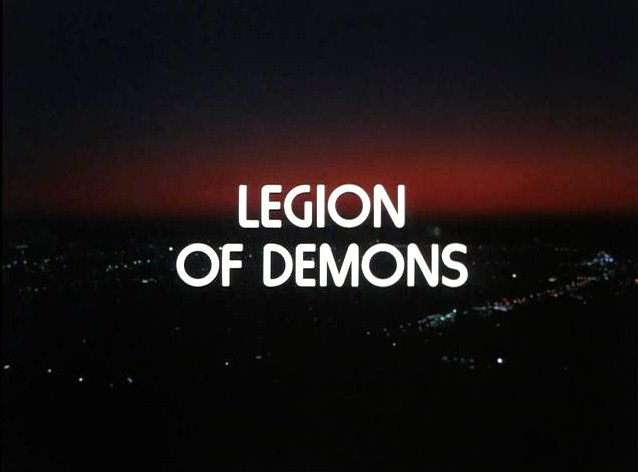
Cult-TV Blogging: Circle of Fear: "Legion of Demons" (February 2, 1973)

Sunday, September 30, 2012


Devil worshippers and witches were big players in the horror productions of the 1970s, thanks in part to films such as Rosemary’s Baby (1968), Asylum of Satan (1971), Brotherhood of Satan (1971), Race with the Devil (1975), The Devil’s Rain (1975) and The Omen (1976).  

This week’s episode of the horror anthology Circle of Fear (1973), capitalizes on this trend with the deeply creepy, occult-centric pisode titled “Legion of Demons.”

Written by Anthony Lawrence, “Legion of Demons” concerns a naïve young woman from the country, Beth (Shirley Knight), who -- at the urging of her friend, Janet (Kathryn Hays) -- leaves her small town home and goes to work in the big city, in L.A.  There, Beth joins Janet on the job in a skyscraper office building, working as a secretary. 

But one day, after a meeting with the office manager, Mary (Neva Patterson) and other employees, Janet disappears without a trace.

Shirley begins to experience terrifying dreams involving Janet, and feels increasingly uncomfortable as Mary and the other employees on the thirteenth floor urge her to replace Beth there. 

Soon, Shirley discovers the dark truth.  Mary and the others are part of a Satan-worshipping coven, and Janet has not been killed…she’s actually the head witch!

It isn’t much of a stretch to see that “Legion of Demons” is actually a (fun) commentary on its central business setting: an impersonal, late 20th century, “high-tech” office building.  Here, an employee is urged to “conform” to office politics, and the promise of promotion and other perks is tied to her acceptance of the office culture. 

Furthermore, success and fortune -- the accumulation of money -- is tied directly to the corporate world, a place where folks must leave their souls behind if they wish to excel.  “Legion of Demons’” subtext is all the more amazing for the fact that it precedes President Carter’s “crisis of confidence” speech by six years and President Reagan’s “yuppie” milieu by more than a decade.

Although this episode -- like virtually every recent installment of Circle of Fear -- relies on old standards such as weird nightmares and screaming damsels, this episode is nonetheless visualized in strong fashion.  


At one point, for instance, the episode cutes to an extreme high-angle shot of Beth seated in a chair, surrounded by the coven. The positioning of the witches reveals a five point or pentagram structure, a nice reflection of the group’s true nature.   

The revelation of Janet as the coven’s evil leader -- via creepy distortion lens imagery -- also ably suggests a world gone mad.

Much of the suspense in “Legion of Demons” emerges from the depiction of another new office employee, played by Jon Cypher.  All along, the episode plays this affable employee as a possible co-conspirator with the coven.  Every moment he’s one screen, we expect him to reveal his true, insidious colors.  But the episode has other plans for the character, thus smartly confounding expectations.

The most basic test for an episode of a horror show or a horror film even is an affirmative answer to the question: “is it scary?”  Although it clearly apes Rosemary’s Baby, and probably features one or two too many chases up and down an office corridor on the thirteenth floor, I still found “Legion of Demons” sufficiently frightening.  I was watching it alone (while my wife was asleep next to me in bed), at about 11:00 pm, and the episode gave me a good case of the shivers.

Given this fact, as well as the entrenched commentary on office politics, “Legion of Demons” proves itself another unexpectedly strong entry in this 1973 anthology.  I would need to check all the stats to be certain, but it certainly feels at this point like Circle of Fear boasts a better batting average than the Ghost Story component of the show.

Next week: “Spare Parts.”

Cult-TV Blogging: Circle of Fear: "Doorway to Death" (January 23, 1973)

Sunday, September 23, 2012


After two legitimately great episodes in “Dark Vengeance” and “Earth, Air, Fire and Water,” Circle of Fear (1973) falls back to Earth with a middling and lethargically-paced episode titled “Doorway to Death.”

Here, a widower, Jim (Barry Nelson) and his family move into a run-down apartment building in San Francisco. The eldest daughter, Peggy (Susan Dey) manages the two younger siblings, Robert (Leif Garrett) and Jane (Dawn Lyn) all day while the Dad is away at work most of the time.   

While exploring the building, the children discover a vacant upstairs apartment, and a doorway that leads into a wintry landscape.  There, they meet a strange man who likes to chop wood…as well as other things.

Almost immediately, the children befriend this enigmatic figure, even as Dey dismisses him as nothing more than an imaginary friend.  Before long, however, the specter confesses his loneliness to the children and grows romantically interested in Dey.  He’d like Peggy to be his new wife. 

And just to make sure she never tries to leave him (as his first wife did, unsuccessfully…), he plans to build a brick-wall around Peggy in an apartment closet…

There have been many worse episodes of Ghost Story/Circle of Fear, but “Doorway to Death is another one of those interminable episodes in which the biggest stumbling block is pacing.  In an effort to pad out the fifty-minute running time, this episode repeats crucial scenes and gives us the same visual and thematic information over and over. 

In horror, less explanation is usually superior to more explanation, since ambivalence stokes terror. Too much explanation can lead to boredom.  That’s largely what occurs here.  The more we see the “evil” ghost staring out the window, or chopping wood, or interacting with the children, the less he seems legitimately terrifying or menacing.  He never once seems insane enough to be an axe-murderer.  He shows nothing of his dark side, really, to the kids. 

Despite the repetitive nature of the story and the slow pacing, there are images in “Doorway to Death” that linger and resonate.  Dey’s character, Peggy, awakens from a troubled slumber and finds -- to her horror -- a set of wet footprints leading right up to the side of her bed.  Since there’s no sign of a visitor, and no rain or snow outside, this moment is legitimately unnerving.  She has evidence of an interloper close-by, but no rational explanation for that presence.  It's creepy.

“Doorway to Death” resolves with a tremendous amount of exposition jammed into a few moments.  That dialogue informs the audience of the crucial details.  The ghost killed his wife, then went to jail and was executed.  

Now, he’s lonely and haunting the apartment, waiting to take a new bride.  This back-story is told in tremendous detail, but then Nelson’s character just brushes it off cavalierly, without offering his own interpretation of the things that occurred.  How, I wonder, can he justify his willful blindness?  I mean, who else does he think bricked-up his daughter in the closet?  It’s one thing not to believe in the supernatural.  It’s another not to believe your own eyes.

“Doorway to Death” is long-winded and not particularly scary.  The ghost here –-- a man with an axe who lives in a snowy cabin, clearly forecasts The Shining’s Jack Torrance -- is seen too frequently on screen here to be legitimately scary.  Unlike those odd, malevolent jars in “Earth, Air, Fire and Water” and the sinister rocking horse in “Dark Vengeance,” this ghost  doesn’t see, like an adequate repository for our fears. 

Again, “Doorway to Death” is not terrible,and not great….just mediocre. 

Next week, another move back towards greatness for Circle of Fear with the chilling “Legion of Demons.”
 

Blogger news

Blogroll

Most Reading