Pages

Powered by Blogger.
Showing posts with label Chicago. Show all posts

In Honor of the LSAT

Tuesday, June 7, 2011

Yesterday, I took what is hopefully the first step in becoming a law student.  The formidable LSAT wasn't as bad as I thought it would be, but still pretty rough.  But, in honor of my taking the LSAT, I thought I'd compile a few of my favorite lawyer performances.  Mostly from movies, but a few from TV.  Enjoy and comment.

10. Gregory Peck in To Kill a Mockingbird
This would be higher, I think, but it's such an obvious choice.  Peck is remarkable as the stoic father in the adaptation of Harper Lee's novel.  But, as much as I loved his performance in the courtroom scene, his scenes at home with Scout are the highlight of the movie.  So his performance is less lawyer, and more awesome father.

09. Susan Sarandon in The Client
I love lawyer performances that are totally against the law.  That is to say, I'm not quite sure anything Sarandon's character does in The Client is legal nor am I sure she'd have survived the situation without being disbarred.  But in the end, it's not a portrayal of legalities, but rather of love.  And she knocks it out of the park.

08. Maximillian Schell in Judgement at Nuremberg
Schell won an Oscar for his passionate and utterly brilliant performance in Stanley Kramer, as a lawyer who brings up some sticky moral arguments regarding the Nazis and how they were condemned.  The performance is so powerful you begin to question your own opinions.

07. Reese Witherspoon in Legally Blonde
How fabulous was Reese in this?  Sure she's not really a lawyer at all in the movie, but the point is is that she does lawyerly things, like solve the case at the end of the movie, thereby proving to everyone she's smart enough!  I jump every time she connects the perm to the shower to the murder!  

06. Jim Carrey in Liar Liar
This is still a very surprising performance from Carrey.  Even with his more famous dramatic turns, this was the turning point for him I think.  Yes he did his typical funny thing, but in the middle of that he's dealing with being a total tool and in the process loosing his child.  It's a really sad reality, and the movie forces him to go from scumbag lawyer to good father.

05. Joe Pesci in My Cousin Vinny
Can anyone tell me anything that's not amazing about this performance?  Pesci is a great actor, but this was really the first time I saw him do comedy.  Sure he did it in Home Alone, but this was a different breed entirely.  His perfect ability to seemingly make up things on the spot is hilarious, and his chemistry with the entire cast specifically Marissa Tomei and Lane Smith is something other actors must covet.  "Two yoots."  Love it.

04. Al Pacino in ...And Justice for All.
What's not to love about Al Pacino?  I've always thought this was the best performance of his career.  His balance of comedy and drama masterful, and his legal mentality is nothing short of spitfire.  His performance demands him to both care about his clients, juggle them with his life, and find a light at the end of the tunnel.  Great performance.  Also gave us the end-all courtroom drama quote, "YOU'RE OUT OF ORDER! THIS WHOLE COURT IS OUT OF ORDER!"

03. James Spader in "Boston Legal" and "The Practice"
Has there ever been a better closing argument delivered than James Spader...in every episode of "Boston Legal"? I don't think so.  Spader's delishious ability to relish the best words and covey the desperation in defense of his client was most likely the causation of his 3 well-deserved Emmy awards for this character.  Whenever "Boston Legal" tackled major public issues, I dare any audience member watching not to change their stance into whatever Spader was arguing for.  He was brilliant.

02. Richard Gere in Chicago
The definition of a shark.  He's sheer perfection.

01. John Houseman in The Paper Chase
As the law teacher from hell, Houseman won an Oscar for his cold portrayal in the terrifyingly accurate law school movie The Paper Chase.  He's a jerk, he's frigid, and you know he cares about you in the smallest of smallest ways.  I hope I don't have anyone like him.

REVIEW: Pirates of the Caribbean: On Stranger Tides (B-)

Monday, May 23, 2011

(dir. Rob Marshall, 2011)

Full disclosure: this franchise is something which, despite poor quality and confusing narratives, I cannot hate.  No matter whether or not a Pirates film is good, I manage it thoroughly enjoy it.  It's the hold the franchise has over me.  Color me a biased film critic, matey.  (Also, Pirates of the Caribbean: The Curse of the Black Pearl in all it's by-the-book and Disneyfied glory, is my favorite film of all time.  Right around The Silence of the Lambs, Pulp Fiction, White Christmas, and Eternal Sunshine of the Spotless Mind).

But this film, the fourth in an admittedly bloated series, was attempting to recapture the start-up magic of the original.  It was without the second and third films' penchant for elaborate, complicated plots and subplots.  But it never fully recaptured the feeling of the original.  What was so grand about the first three was their undeniable epic scope; you felt like you were watching something that was a true adventure flick.  But On Stranger Tides doesn't have that feeling.  It's deflated.

This time around, Captain Jack Sparrow (Johnny Depp prancing around in the role that made him a star) is left yet again without a ship trying to locate the infamous Fountain of Youth.  Along his way he meets villain turned ally turned privateer Hector Barbossa (a perfectly hammy Geoffrey Rush), an erstwhile paramour (Penelope Cruz), and the mysterious Blackbeard (Ian McShane doing what he can to save the role from disaster).  Oh, and there's a replacement for Orlando Bloom's Will Turner in their somewhere and a mermaid.  But best not to bother ourselves with talking about them in depth, the filmmakers certainly didn't.


McShane, as I said, is doing what he can to save the part.  Blackbeard is easily the worst villain of the franchise, and simply because he's written so poorly.  A bad guy going out to seek the Fountain of Youth so he doesn't die?  Is that it?  Is that suppose to make him a bad guy?  He doesn't try to kill Jack, Barbossa, or anyone we like.  His majestically powers of battleship embottlement, zombification, and rope manipulation are never explained nor do we ever get a good glimpse of what make Blackbeard so vile.  At least with Davy Jones and Barbossa we understood their means to an end, even if their means were vicious.  The Pirates series never had a villain you could really hate; Barbossa just wanted to taste an apple and Jones was just a sad, heartbroken man.  But with Blackbeard, you're just told he's a bad man and you're left at that.

Reporting to duty, I was told I have to save this film?
I know the legion of stalwart Pirates fans voiced their criticism over the third installment (and even the second one), and how Disney didn't either hear or chose not to address those concerns is perplexing.  Perhaps their notion of going back to the original was eliminating overly excessive battle sequences and frothy plots, but I'd be hard to find anyone who doesn't cite the maelstrom scene from At World's End as that film's highlight.  Or the Kraken attacks from Dead Man's Chest, or that delicious final sword fight between Jack and Barbossa in The Curse of the Black Pearl.  In this film, there is not defining scene, no moment of pure excitement.  The climax seems merely little less than an afterthought and in many ways a foregone conclusion.

The true highlight of the film wasn't a battle, or a scene full of visual effects wonderment, but rather the brief scenes between Jack and Barbossa.  Johnny Depp and Rush have always such a marvelous chemistry, and I always felt their lack of togetherness in the second film stopped it from being great (granted, Barbossa was dead in that film...mostly).  It doesn't hurt that the writers gave Barbossa the only intriguing motive to do anything in the whole film, what with trying to enact revenge on the man who cost him his leg (and when Rush tells his tale vengeance, it's a scene of splendid acting).  When they're together, how they play off one another is just a type of magic you can't create with CGI.  If the fifth film wants to do better with everyone (audiences and critics), I think re-pairing that dynamic duo would be a wise decision.

A poor man's Will and Elizabeth
But this fourth installment just doesn't have the charm of the first three.  There no fun banter between straight man Will Turner and crazy man Sparrow.  No Pintel and Ragetti.  No Governor Swan or Norrington.  No fun villain that you secretly root for.  It feels too small, and there's not one standout performance.  Bother Depp and Rush are great, but a far cry from their work on the earlier films and not for lack of trying or prowess, but rather because the parts and the direction gave them little to work with.  It seems director Rob Marshall's career has been in a bit of a nosedive since he nearly won an Oscar in 2002,  as he's followed the best Picture-winning Chicago with Memoirs of a Geisha, Nine, and now this.  From the man that gave us "Cell Block Tango," I was expecting more grandeur, and instead I got a stifled, under-realized film.  The series needs Gore Verbinksi back and pronto.

But still, just being able to see Rush and Depp on screen again in these parts was a large portion of my enjoyment.  And I cannot argue with the genuine joy I get from seeing Capt. Jack.  That enough is enough to see the film.  I just wish there were more reasons.  GRADE: B-


.

Yearly Perspective – 2002 – Supporting Actor Edition

Monday, April 25, 2011


In case you missed my explanation of Yearly Perspectives or my 2002 Best Director analysis, please check them out.  

Pound for pound, throughout the history of the Oscars—and film in general—supporting men are always the strongest.  At least for me.  In a male-dominated film industry, men are typically allowed to be more “out there” and can inhabit less typecast roles.  Grieving wives and hookers fill a good portion of historic supporting female performances, but supporting males and their types are all over the board.  It’s just the strongest race and usually the most interesting array of nominees.

Except for 2002.  There’s no question the eventual, shockingly-inspired winner Chris Cooper was a great choice and totally deserved the win.  I’d rank his no-holds-barred performance among some of the best work done in the 00s.  But his competition in 2002 was relatively weak.  The platoon of Christopher Walken in Catch Me If You Can, Ed Harris in The Hours, John C. Reilly in Chicago, and Paul Newman in Road to Perdition we nipping at the champ’s heels.  His closest competition was likely SAG and BAFTA champ Christopher Walken for his wacky and tender turn in Steven Spielberg’s Catch Me If You Can.  A likely cause for his SAG win was that the young awards organization hadn’t yet rewarded the acting vet, unlike the Academy did in 1978.  That’s not to say his performance wasn’t very good.  In fact it was fine; just fine.  One of those performances that aren’t championship caliber, but are good enough to make the top five.  A filler nominee.  He was subtle in his Walken sort of way, but wasn’t even the best supporting turn in the film if you ask me.

It’s hard to believe Ed Harris’s last nomination was nine years ago.  For an actor who so quickly raked up four nominations (only took him eight years), the latter portion of the 00s have not been friendly to this actor’s actor.  A mass of buzz met distribution woes last year in Peter Weir’s The Way Back, and a series of baity flops have kept Harris dry this decade.  But his last nominated performance as a haunted AIDS-ridden poet in Stephen Daldry’s lyrical The Hours was probably his best.  Though his screen time in The Hours is quite small, his impact in unspeakable.  As Virginia Woolf’s tragic poet, Harris brought a sense of frailty to the role that I don’t think most actors would have found.

With Chicago’s John C. Reilly, you have somewhat of the surprise nominee in the category on Oscar morning (what with Alfred Molina’s libido-ridden painter in Frida, and the duel attack of Dennis Quaid and Dennis Haysbert from Far From Heaven snatching a strong majority of the precursor nominations).  Reilly made quiet acting seem powerful, and made effective use of his single song and subtle role.  As Amos, he was charged with a difficult task, one that, should he falter, the film would ultimately fail.  He was the moral compass, we must not only want to root for him, but feel compelled to in a sea of tricksters, lies, and erroneous lawyers.  One of those performances where an actor does their job, and in doing so, turns in a good performance.  (On a related side note, I constantly go back and forth between Richard Gere’s category placement in the same film, and momentarily, I’m considering him Lead).  It's a shame that he's yet to return to this level of performance after sinking into the slapstick depths of Will Ferrell comedies.

Then there’s Paul Newman—in his last live action role—as a mob boss with a heart of gold in Sam Mendes’s Road to Perdition.  I won’t whine too much about his nomination, as I’m more indifferent to it than anything.  If you ask me, Jude Law was handedly better in the same film, but then again it would have been hard as a voter to deny a screen legend a nomination for doing such quality work at his age and in his sixth decade of acting.  It’s a stalwart performance in a gem of a film (added bonus from Perdition: pre-James Bond Daniel Craig).  He’s strong, reserved, and commands the screen whenever graces them with his blue eyes.  Looking back, it’s really hard to understand how more voters weren’t swayed by the Legend status, but I for one am glad they weren’t.  His final scene is beyond beautiful, specifically in how he demonstrates leagues of emotion with merely an accepting glance.


Then we’ve the oh-so deserving victor: Chris Cooper.  A character actor’s character actor.  Unfortunately, Spike Jonze’s Adaptation was a hit and miss during the 2002 awards season, taking both supporting Golden Globes, then a SAG loss by Cage and Cooper (and a Streep snub there to boot), and finally a trio of BAFTA losses coupled with an inspired screenplay win.  So the fact that this film eked out a performance win is a relief.  And I’m very glad it was Cooper.  As spoken numerous times within Adaptation, “[John] Laroche is such a great character,” and in reality it’s nothing short of the truth.  Toothless and philosophical aren’t exactly conductors for critical praise or an Oscar, but Cooper manages it with ease.  He plays an eccentric, which as a character type shows up time and time again in the Best Supporting Actor race, and they can either be histrionic misfires or divine homeruns.  Paired against the near-perfect performances of previous Oscar-champs Meryl Streep and Nicolas Cage, he steals the show.  I simply can’t say enough about his performance.  How can you deny a character the convincingly says in complete earnest, “I’m probably the smartest person I know”?  If you haven’t seen it—or Adaptation—I highly suggest checking adding it to the top of your queue.

But to me, only three of these men deserved a nomination, and surprisingly neither of the two legends made my cut.  So, we keep Reilly, Harris, and Cooper.  But what of the other two?  As I said earlier, I was indifferent to both Walken and Newman—I don’t hate their performance, but rather, I just don’t merit either as awards quality.  However, there is a performance in Catch Me If You Can that I would find worthy of such praise, and it’s Tom Hanks.  Aptly handling a brilliant screenplay by Jeff Nathanson, Hanks is the glue which holds the film together.  He never attempts to make the role cliché or sappy, but rather he plays the role straight as a human being rather than a man on a mission.  Too easy the cat of the cat-and-mouse role is left devoid of personality or soul, but Hanks delivers a man with both infused.  His frankness with Leonardo DiCaprio’s Frank Abagnale Jr. is his strength; treating the cunning con man as a kid instead of a mastermind, and thereby always having the upper hand in their latter conversations.  Also too, he makes it a fun performance, capturing the buffoonish nature of so smoothly being had by a teenager.  The final scene in the airport is his strongest: imbuing the feeling of being both enthralled by and sorry for a kid who’s lost in the world.  Sure his accent is a little questionable at times, but thankfully that doesn’t impede his performance.

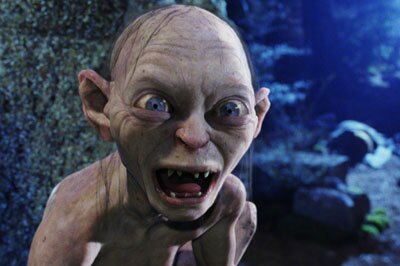
My final nominee is someone who likely would have gotten a nomination had him getting a nomination been legal under Academy by-laws.  Don’t quote me on this, but I’m fairly certain voice-performances, even those done in motion-capture, are not eligible for a nomination at the Academy Awards.  So, even though what Andy Serkis did as Gollum in the second installment of Peter Jackson’s Lord of the Rings: The Two Towers is nothing short of master class acting, he wasn’t even allowed on voting ballots.  He would repeat this perfect puppetry three years later in Jackson’s King Kong as the title ape, and with equal character study on scale with that of Sean Penn in Milk or Phillip Seymour Hoffman in Capote.  As Gollum, Serkis crawled, gouged, and hopped his way to a character that is unquestionably the most famous of the franchise, and with good reason.  Every scratch in his voice, every movement and eye glance is 100% Serkis’s.  No amount of CGI can airbrush desperation and devotion like the human actor can.  Simply for discovering such a perfect character within Tolkein’s work is enough for a nomination, and pulling it off is nearly worth a win.

So there you have it.  My Yearly Perspective on the 2002 Best Supporting Actor race with comments on the real nominees and my personal selections.  Expect Best Actress later this week.

BEST SUPPORTING ACTOR
***Chris Cooper, Adaptation.***
Andy Serkis, Lord of the Rings: The Two Towers
Ed Harris, The Hours
John C. Reily, Chicago
Tom Hanks, Catch Me If You Can


.


Blogger news

Blogroll

Most Reading